Data mesh vs data fabric solves two different enterprise coordination problems. Use this comparison to decide when to choose one pattern, when to combine them deliberately, and when a simpler architecture is sufficient.
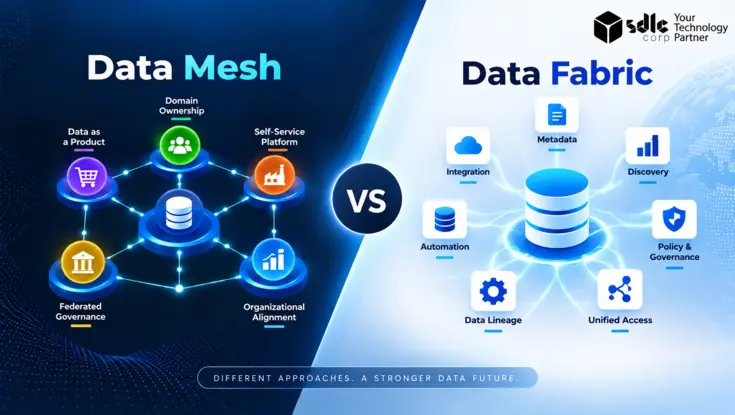
Keep the comparison anchored in operating implications. Data mesh is an organizational design built around domain ownership, data as a product, a self service platform, and federated computational governance.
Data fabric is a capability pattern that uses metadata, automation, integration, and policy tooling to make distributed data easier to find, connect, govern, and use.
- Use the page for selection criteria, not for a full AI readiness blueprint.
- Compare operating model consequences as much as technical capabilities.
- Treat hybrid use as common when the estate has mixed constraints.
- Treat feature stores, model pipelines, and broad governance topics as adjacent concerns unless they materially affect the choice.
Data Mesh And Data Fabric Solve Different Enterprise Problems
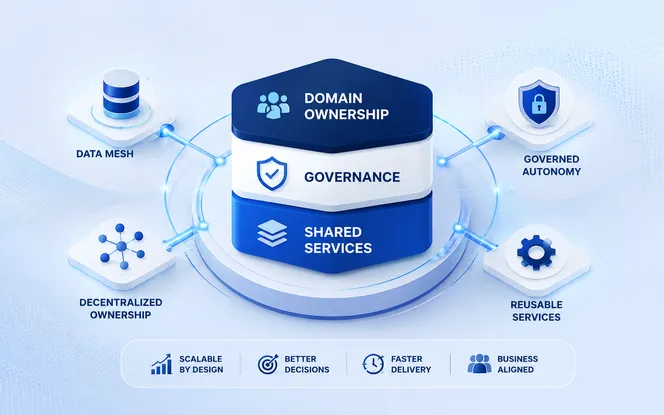
The simplest distinction is this: data mesh changes who owns and serves data, while data fabric changes how distributed data is connected, governed, and made usable. Mesh is primarily an operating model. Fabric is primarily a capability pattern.
That difference matters because the wrong choice often comes from treating them as substitutes in every scenario. They are sometimes complementary and sometimes one is clearly more urgent than the other.
- Use mesh when ownership, accountability, and domain alignment are the main bottlenecks.
- Use fabric when discovery, integration, metadata, and policy consistency are the main bottlenecks.
- Use both when domain ownership and cross estate usability must improve together.
- Avoid presenting either one as a universal prerequisite for AI.
What Data Mesh Means In Practice
In practice, data mesh means domains own the data products they publish, supported by a self service platform and federated governance rules. It is not only a naming exercise or a new catalog landing page.
The operating cost is real. Domains need product ownership, service expectations, and sustained accountability. Without those, a mesh programme can create more fragmentation while claiming to fix it.
- Core principles: domain ownership, data as a product, self service platform, federated computational governance.
- Mesh changes team accountability as much as platform design.
- It works best when domains are mature enough to own published data products.
- It fails when central teams rename datasets without transferring real ownership.
The data mesh concept was introduced by Zhamak Dehghani in her 2019 original data mesh article on MartinFowler.com.
She later formalized the approach around domain ownership, data as a product, a self-serve data platform, and federated computational governance in Data Mesh Principles and Logical Architecture.
What Data Fabric Means In Practice
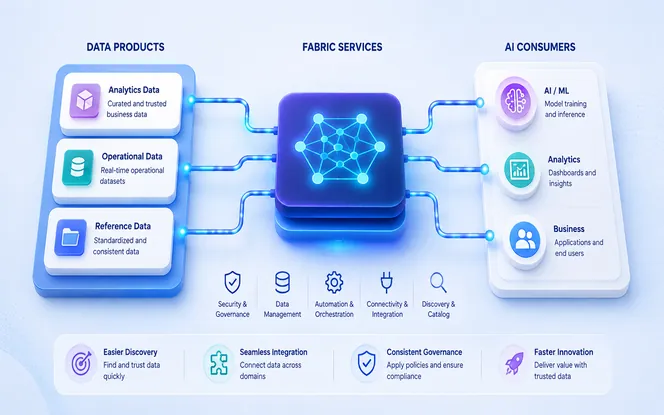
In practice, data fabric means using metadata, automation, integration patterns, policy tooling, and discovery services to make distributed data easier to connect and control. It is best understood as a set of enabling capabilities, not one universal architecture standard.
Gartner describes data fabric as an emerging data management and data integration design concept focused on flexible, reusable, augmented, and increasingly automated integration across distributed data. For the enterprise definition and capability framing, see Gartner's data fabric overview.
A fabric can improve usability in estates that remain distributed for valid reasons. It can also support mesh adoption by reducing the burden of discovery, lineage, policy, and integration across domains.
- Fabric emphasizes metadata, automation, connectivity, and policy consistency.
- It can improve distributed estates without forcing an immediate ownership redesign.
- It is a capability pattern, not a guarantee of good governance by itself.
- It still requires clear ownership and decision rules to work well.
Data Mesh Vs Data Fabric: Core Differences
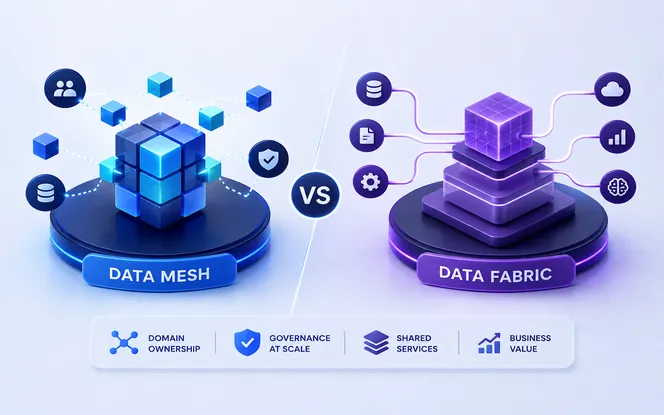
The data mesh vs data fabric comparison comes down to ownership, platform responsibility, governance execution, and adoption burden. Mesh demands stronger domain product behavior, while fabric demands stronger shared metadata and integration capability.
Use the decision matrix below to see these trade offs directly. Storage pattern selection and full platform layering require separate architecture decisions because they depend on workload, latency, governance, and migration constraints beyond the mesh versus fabric operating model.
| Criteria | Recommended | Why (one line) |
|---|---|---|
| Ownership (who owns data products) | Mesh | Pushes accountability into domains when ownership is the bottleneck. |
| Governance effort (policy vs execution) | Hybrid | Central policy with domain execution balances standardization and local control. |
| Platform skills (engineering capacity for shared services) | Fabric (if strong platform) / Mesh (if not) | As a planning heuristic, a strong shared platform usually means a dedicated cross-functional core of roughly 6–12 people covering platform engineering, integration, metadata or catalog ownership, security or governance automation, reliability, and product or architecture leadership. |
| Metadata needs (catalog, lineage, semantic layer) | Fabric | High metadata and integration needs favor fabric's shared capabilities. |
| Adoption burden (organizational change) | Mesh | Mesh requires domains to change behavior and adopt product roles. |
| AI readiness indicators (model feature curation, reproducibility) | Hybrid | Combines reliable domain products with shared metadata for repeatable models. |
Choose the ownership and automation model first, then place it within the enterprise data architecture that defines storage, integration, security, and shared control planes.
Strong shared platform team: plan for roughly 6–12 dedicated people for an initial enterprise fabric or hybrid capability.
A typical mix is 2–4 data or platform engineers, 1–2 integration engineers, 1 metadata/catalog or lineage owner, 1 security or governance automation specialist, 1 reliability/DevOps engineer, plus a product or architecture lead.
Smaller organizations can combine roles; larger estates may need multiple squads.
First mesh pilot: start with 1–3 domains and usually 2–4 high-value data products rather than attempting an enterprise-wide rollout. This is enough to test ownership, contracts, onboarding, governance, and platform support without creating too much coordination overhead.
Adoption horizon: a bounded pilot can show useful evidence in about 2–3 months, while moving from baseline through standardization and the first scaled wave commonly takes about 4–8 months. These are planning ranges, not fixed delivery guarantees.
- Ownership: mesh pushes more accountability into domains.
- Platform: fabric leans harder on shared metadata and integration services.
- Governance: both need policy, but they distribute execution differently.
- Adoption: mesh is heavier organizationally; fabric is heavier in enabling capabilities.
Which Approach Better Supports Enterprise AI?
Neither approach is automatically better for enterprise AI. Mesh can help when AI teams need trusted domain owned products with clear accountability. Fabric can help when AI teams struggle to find, connect, and govern data across many systems quickly.
The right question is where your current bottleneck sits. If teams cannot get accountable domain data, mesh may matter more. If teams cannot discover, join, and govern distributed data consistently, fabric may matter more.
- Choose mesh when domain accountability is the main AI blocker.
- Choose fabric when connected usability and metadata are the main AI blocker.
- Use hybrid patterns when both ownership and cross estate usability need improvement.
- Do not make feature stores or one specific AI toolchain the deciding factor.
How Data Mesh Helps AI Teams
Data mesh can strengthen enterprise AI when model quality depends on business context that only domain teams understand well. A customer domain, for example, can own definitions for customer status, consent, segmentation, and lifecycle events.
That ownership makes it easier for AI teams to know which data product is authoritative and who is responsible when definitions change.
This is especially useful for models that depend on stable semantics over time. Domain-owned data products can publish clear contracts, quality expectations, access rules, and change notices.
Those practices reduce the risk that an AI pipeline silently consumes a field whose meaning changed upstream. Mesh therefore supports AI by improving accountability around the data, not by replacing model platforms, feature stores, or MLOps.
How Data Fabric Helps AI Teams
Data fabric addresses a different AI problem. Many enterprise AI teams spend too much time locating data, negotiating access, tracing lineage, and building one-off integrations. Shared metadata, catalog, lineage, policy, and integration services can reduce that repeated work.
This can shorten the path from identifying a useful dataset to using it in a governed training or inference workflow.
Fabric capabilities also help when relevant data spans many systems and domains. A model may need customer, product, service, finance, and operational signals at the same time.
Shared discovery and policy services make those sources easier to understand and combine without requiring every consumer to learn each source system independently.
Choose Based On The AI Failure Mode
For AI leaders, the most useful selection test is to identify why current models or analytics initiatives are slow, unreliable, or difficult to scale.
If teams repeatedly question data meaning, ownership, or freshness, stronger domain product ownership may provide the bigger gain. If teams know which data they need but cannot discover, access, join, or trace it efficiently, fabric capabilities may remove more friction.
- Use mesh to improve accountability for business meaning, quality, and service expectations.
- Use fabric to improve discovery, lineage, governed access, and cross-system connectivity.
- Use both when AI needs trusted domain semantics and repeatable cross-domain data access.
- Measure improvement through data lead time, quality incidents, lineage coverage, and model delivery speed.
Enterprise AI readiness also depends on security, privacy, model governance, compute, deployment practices, and business adoption. Mesh and fabric can improve the data foundation, but neither one removes the need for those surrounding capabilities.
When A Hybrid Model Is More Practical
Hybrid is often the practical answer. Domains may own their data products while a fabric style set of metadata, policy, and integration capabilities makes those products discoverable and governable across the estate.
That model works when the organization can separate responsibilities cleanly: domain teams own product semantics and service expectations, while platform teams provide the shared capability layer that reduces friction.
- Use hybrid when ownership and connectivity problems exist together.
- Keep platform and domain responsibilities explicit.
- Avoid duplicating governance logic separately in every domain.
- Use shared metadata and policy services to make federated ownership workable.
Separate Ownership From Shared Enablement
A workable hybrid model draws a clear line between what domains own and what the platform provides once for everyone. Domains can own business definitions, quality thresholds, product roadmaps, and service commitments.
A shared platform can provide cataloging, lineage capture, identity integration, access policy enforcement, observability, and reusable integration patterns.
This separation prevents two common extremes. The first is over-centralization, where every data request becomes a ticket for one central team. The second is uncontrolled decentralization, where each domain selects different standards and creates incompatible products.
Hybrid design keeps domain autonomy where business knowledge matters while standardizing capabilities that benefit from consistency.
Use Hybrid Selectively
Not every domain needs the same level of ownership on day one. High-value or high-change domains can adopt stronger mesh practices first. Other areas can continue using centrally managed datasets while consuming the same fabric services.
This reduces transformation risk and gives the organization time to learn which responsibilities domains can sustain.
- Define a minimum data product contract that every participating domain must meet.
- Centralize reusable policy, metadata, and integration capabilities where duplication adds no value.
- Let domains control semantics and release priorities when local knowledge is essential.
- Review the responsibility split as domain maturity and platform capability improve.
Prerequisites Before Adopting Either Model
The real prerequisites are organizational and operational, not only technical. Mesh needs domain owners willing to publish and support data products. Fabric needs metadata discipline, integration standards, shared platform capability, and policy automation that teams will actually maintain.
Do not wait until every supporting component is perfect. Instead, identify the minimum capabilities needed to start safely, then strengthen them as adoption expands. The table below separates the most important prerequisites for each model.
| Requirement Area | Mesh Requirements | Fabric Requirements |
|---|---|---|
| Ownership & Accountability | Named domain owners who are accountable for data meaning, quality, availability, change decisions, and consumer support. | Clear ownership of shared metadata, integration, access, lineage, and policy services so central capabilities do not become unmanaged infrastructure. |
| Team Capability | Domain teams with enough product and data engineering capacity to publish, operate, monitor, and improve data products over time. | A capable shared platform team covering integration, metadata, governance automation, security, reliability, and platform product ownership. |
| Platform Foundation | A usable self-service platform for publishing, testing, discovering, securing, and observing domain data products without excessive central handoffs. | Reliable catalog, metadata capture, lineage, integration services, identity and access integration, and policy-aware automation across distributed systems. |
| Governance Model | Federated rules that define common standards while allowing domains to execute ownership, contracts, quality controls, and approved changes locally. | Shared governance standards that can be consistently expressed through metadata, access policies, classification, lineage, and automated controls. |
| Data & Metadata Discipline | Stable domain boundaries, documented semantics, measurable quality expectations, discoverable products, and versioned interfaces or contracts where needed. | Consistent metadata capture, naming standards, repeatable ingestion patterns, semantic context, and enough lineage to connect distributed assets reliably. |
| Funding & Operating Commitment | Long-term funding for domain product ownership so published data products remain supported after the initial implementation. | Sustained funding for shared services, connectors, metadata quality, governance automation, and platform operations rather than a one-time tooling project. |
| Best Starting Conditions | Domains with clear business boundaries, active consumers, recurring ownership problems, and teams ready to take direct responsibility for data services. | Distributed estates where discovery, integration, lineage, access consistency, or metadata quality creates repeated friction across many teams. |
What both models need: clear governance rules, executive sponsorship, realistic funding, measurable adoption expectations, security controls, and a defined process for resolving data quality or ownership issues.
Use the DAMA-DMBOK® framework as a governance reference for defining decision rights, accountability, data quality, metadata, security, and stewardship practices across mesh, fabric, or hybrid implementations.
Assess Readiness Before Choosing A Label
Before selecting mesh, fabric, or a hybrid model, assess the operating conditions that will support it. Architecture labels do not fix unclear accountability, weak data quality, or inconsistent funding.
A small readiness assessment can expose whether the organization needs an ownership change, a platform capability investment, or both.
For mesh, look for domains with stable boundaries, named owners, engineering capacity, and consumers who can define useful service expectations.
For fabric, look for a foundation of metadata capture, identity and access integration, repeatable ingestion patterns, and teams willing to maintain shared standards. If these basics are missing, start with the smallest capability that removes the current bottleneck.
Minimum Controls To Put In Place
- Define ownership for critical datasets and escalation paths for quality issues.
- Establish naming, schema, access, and change-management standards before scaling.
- Track lineage and data quality for the assets that support important decisions or models.
- Set funding and support expectations so products and shared services remain maintained after launch.
A practical readiness review should also identify legacy constraints. Mainframes, SaaS applications, regional data boundaries, and regulatory controls may limit how quickly ownership or integration patterns can change.
Those constraints do not rule out mesh or fabric, but they should shape the adoption sequence.
A Phased Adoption Path
A phased adoption path should start with the bottleneck, not the slogan. Pick one or two domains or high value workflows, prove the ownership or capability pattern, and expand only when the model is actually reducing friction.
That keeps the comparison grounded in operating results instead of abstract architecture language.
- Start with the clearest current bottleneck and a bounded scope.
- Prove the operating model and the supporting platform capability together.
- Measure adoption, service reliability, and consumer value before scaling.
- Change course if the model increases fragmentation, latency, or governance burden.
Phase 1: Prove The Bottleneck And Baseline
Start by documenting the current problem in measurable terms. Examples include time to discover a trusted dataset, time to approve access, number of manual handoffs, recurring data quality incidents, or the lead time required to onboard a new domain.
A baseline makes it possible to judge whether the new operating model is creating a real improvement.
Typical Phase 1 duration: about 2–4 weeks for stakeholder mapping, current-state metrics, domain selection, risk identification, and a pilot charter.
Phase 2: Pilot With A Bounded Domain Or Workflow
Select a domain or workflow that has visible business value and manageable dependencies. For a mesh-led pilot, start with 1–3 domains and usually 2–4 high-value data products.
Define an owner, product contract, quality expectations, and consumer feedback loop for each product. For a fabric-led pilot, prioritize metadata capture, lineage, access automation, and reusable integration paths.
Keep the scope small enough to expose problems without creating a large transformation programme.
Typical Phase 2 duration: allow about 8–12 weeks for a bounded pilot when core source access and platform foundations already exist. Add time when identity, data quality, or legacy integration work must be built first.
Phase 3: Standardize What Worked
After the pilot, convert successful practices into reusable templates. This may include data product definitions, ownership roles, onboarding checklists, policy patterns, metadata requirements, observability rules, and platform components. Do not scale practices that only worked because of exceptional manual effort.
Typical Phase 3 duration: about 4–8 weeks to convert lessons into repeatable standards, automate the highest-friction steps, and prepare onboarding material for the next domains.
Phase 4: Expand With Governance And Metrics
Scale to additional domains only when responsibilities are clear and the shared platform can support increased demand. Review metrics regularly.
Useful measures include discovery-to-access time, percentage of critical assets with lineage, data incident rates, domain onboarding time, consumer satisfaction, and the number of reusable integrations replacing one-off pipelines.
Typical Phase 4 duration: plan roughly 3–6 months for the first scaled wave across several additional domains. After that, adoption normally continues in waves rather than ending as a one-time project.
The phased approach also creates an exit point. If a mesh pilot increases coordination cost without improving ownership, simplify it. If fabric investment adds tooling without improving discovery or integration speed, reduce the scope.
The goal is better data delivery, not architectural purity.
A Practical Coexistence Example
A common coexistence pattern is to use fabric capabilities to improve discovery, lineage, policy automation, and integration across the estate while introducing mesh style ownership only for a small set of high value domains.
For example, customer and product teams may own their data products, service expectations, and backlog, while the wider platform still uses shared metadata capture, access policy automation, and integration tooling.
That avoids forcing every domain to behave like a full product organization on day one.
The practical test is whether the operating model is reducing handoffs and ambiguity. If domains still wait on a central team for every definition or release, the organization does not yet have mesh style ownership.
If every team invents its own contracts and controls with no shared standards, the organization does not have enough fabric or platform discipline. Coexistence works when ownership and automation reinforce each other instead of competing.
- Use fabric capabilities to standardize metadata, access, and integration.
- Introduce mesh ownership where a domain can actually run a service.
- Keep shared policy and platform standards visible across both models.
- Measure whether handoffs, lead time, and data trust are improving.
Example: Customer And Product Data For AI
Consider an enterprise building churn and recommendation models. Customer and product domains contain the business definitions that determine whether those models are useful.
Under a mesh-style ownership model, each domain can publish governed data products with documented semantics, quality checks, freshness expectations, and named owners. AI teams then consume those products instead of negotiating definitions separately for every model.
At the same time, a fabric capability layer can provide the shared services that both domains use. The catalog can expose available products and owners. Lineage can show how source changes affect training data. Policy automation can enforce access rules.
Integration services can connect operational, analytical, and historical stores without requiring every domain to build the same connectors.
The coexistence model becomes valuable when responsibilities remain visible. Customer teams should not expect the central platform to define what an active customer means. Platform teams should not expect every domain to build separate lineage, identity, and access systems.
Each side owns the work that matches its expertise.
What Success Looks Like
Success is not measured by the number of domains labeled as data products or the number of tools installed.
It is measured by whether consumers can find trusted data faster, whether ownership questions are resolved quickly, and whether changes propagate with less risk.
For AI use cases, teams should also see fewer training-data defects, better reproducibility, and shorter lead time from data request to model experiment.
- Domain teams remain accountable for meaning, quality, and service expectations.
- Platform teams reduce repeated engineering through shared metadata, policy, and integration services.
- AI teams consume governed products through consistent discovery and access paths.
- Governance teams can trace ownership, lineage, access decisions, and important changes across the estate.
Frequently Asked Questions
Yes. Starting with fabric to reduce integration cost can deliver rapid wins. However, without later clarifying domain ownership and product responsibilities, the organization risks recurring data quality and accountability problems.
Plan for a transition to federated ownership once fabric reduces immediate integration friction.
No. Data mesh is an organizational and delivery pattern that can be applied across cloud, on prem and hybrid estates. The key requirement is domain teams capable of product engineering and SLAs, not a specific runtime.
Cloud adoption can simplify some platform tasks but is not a prerequisite.
A feature store can be a reusable ML capability in either pattern when the use case needs shared structured features, online/offline consistency, or governed feature reuse.
In mesh it can be a domain product; in fabric it can be a shared service that materializes and indexes features. Use the store to enforce consistency and reduce duplicate feature engineering across teams.
Define a change process that requires domain notification, impact assessment and versioned contracts. The platform can provide adapters to ease migration, but domains must own semantic changes. Include model owners in the approval workflow to align retraining and deployment plans.
Early indicators include time from dataset discovery to consumption, number of datasets with complete metadata and lineage, data quality defect rates for model inputs, and domain onboarding time. Track these alongside business metrics that the models support to validate impact.