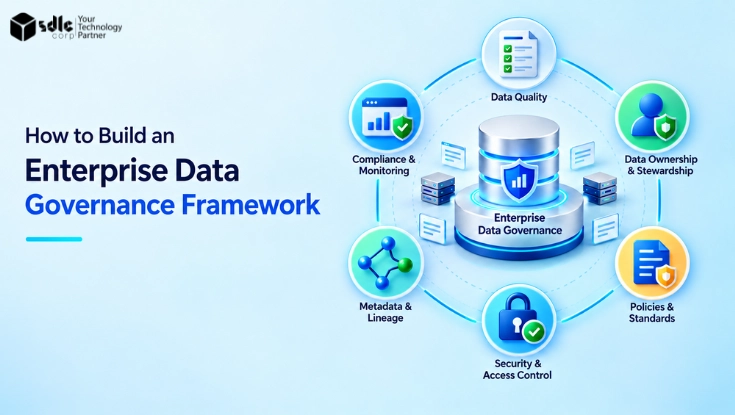
An enterprise data governance framework defines who owns important data, which rules apply to its use, how quality issues are resolved, and how access decisions are made.
So the goal is to make trusted data easier to use, rather than relying on ad hoc approvals or undocumented ownership.
Build the framework around five operating elements: accountable data domains, named owners and stewards, policy and access rules, issue-management workflows, and measurable control outcomes.
Metadata, lineage, and catalogs provide evidence and workflow support, but they are enabling capabilities rather than the governance framework itself.
Principles of Practical Data Governance
Governance boundary: Data governance sets accountable ownership, policy hierarchy, stewardship mandates, decision rights, exceptions, and evidence expectations. Catalog workflows, lineage reconstruction, and quality-monitoring implementation are specialist capabilities that this framework directs rather than duplicates.
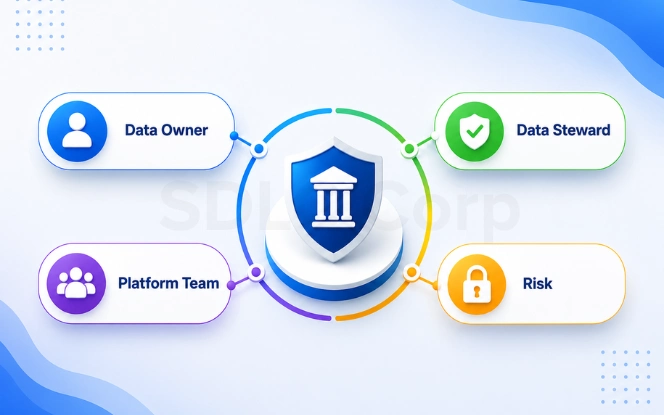
- Business ownership.
Business owners define meanings, priorities and acceptable risk for their domains so governance reflects operational needs.
Decision threshold/example: Codify sensitivity levels and map them to an approver matrix (for example: Low, domain owner; Sensitive, domain owner + compliance; Critical, domain owner + security).
- Risk-based control.
Prioritise human review where impact or regulation is highest and rely on automation for routine verification and auditability.
Decision threshold/example: Require manual review when predefined impact criteria apply (for example: Critical classification, regulatory tag, or wide external distribution); allow automated checks and logged approvals for lower-risk cases.
Proportionality and delivery
- Proportionality.
Apply controls that scale with data risk to avoid unnecessary overhead while protecting critical assets.
Decision threshold/example: Require full QA and multi-party approval only for high-sensitivity classifications; keep a concise exceptions register for temporary deviations, reviewed monthly by the governance council.
- Embedding in delivery.
Integrate governance checks into pipelines and product lifecycles so approvals are part of delivery rather than a separate bottleneck.
Decision threshold/example: Enforce pipeline gates with agreed SLAs for triage and resolution; route unresolved or automated-decision failures into the exceptions register for council review.
In short, principles must translate to explicit decision thresholds, not vague ideals.
The Governance Operating Model
Keep decision authority close to the data domain
A clear operating model defines who decides, who implements, who monitors and who resolves exceptions. In addition, include security, privacy, legal and consumer representatives to resolve cross-cutting concerns.
Produce one operating-model diagram to show decision flows: policy creation by the council, domain acceptance of standards, steward-led operationalization, and platform enforcement points. The roles, responsibilities and decision authority are set out in the table below.
Above all, keep the model small and enforceable. So avoid large committees that meet infrequently. Instead, use a small council for standards and escalation, delegating day-to-day decisions to domain owners and stewards.
Define escalation rules with clear timelines so disputes do not block delivery for weeks.
Roles and decision authority
Roles, responsibilities, time commitment, and decision authority:
| Role | Decision authority | Key responsibilities | Time commitment |
|---|---|---|---|
| Enterprise governance council | Approve | Set standards, approve exceptions, handle escalations | Monthly + ad hoc for escalations |
| Domain owner | Approve / Consult | Accept risk, prioritize definitions and quality work | Weekly |
| Data steward | Consult / Inform | Operationalize definitions, maintain metadata and issue logs | Daily |
| Platform team | Implement / Inform | Implement catalog, lineage, access controls, monitoring | Project-based + weekly ops |
| Security / Privacy | Consult / Approve (sensitive cases) | Review sensitive use cases, approve protective controls | As-needed review |
Escalations route back to the council within defined timelines.
Publish one roles table and an operating-model diagram so teams know where to route decisions.
To check these role definitions against an established industry reference, compare them with the DAMA-DMBOK data management body of knowledge.
Data Domains, Ownership and Stewardship
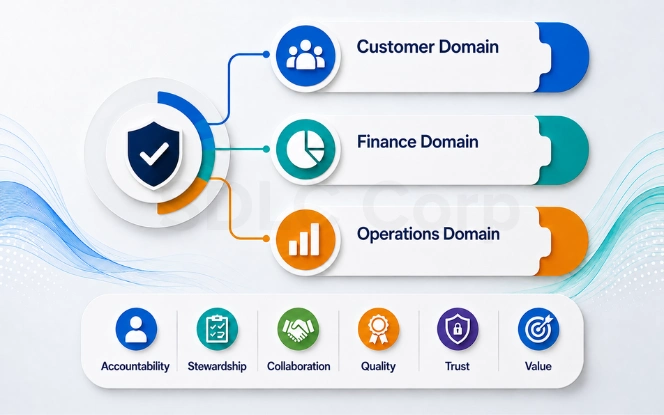
Organize data into business domains such as Customer, Product, Finance and Operations. Each domain should therefore have one accountable owner who signs off on definitions, acceptable uses and risk acceptance.
Domains make governance scalable by localizing decisions close to subject-matter experts and operational workflows where data is created and consumed.
Assign stewards beneath each owner to handle daily responsibilities: maintaining business glossary entries, monitoring quality indicators, triaging ingestion errors, and coordinating corrections with engineering teams.
Define steward workloads and handover rules so stewardship is a recognized, measurable job rather than an unpaid expectation placed on busy staff.
Handling cross-domain entities
For cross-domain entities (for example a customer that spans CRM and billing), define a primary owner and secondary custodians. Document reconciliation patterns, canonical identifier strategies, and conflict-resolution steps so consumers know which definition to trust.
Include failure modes and recovery plans when ownership is unclear or a product team changes.
Worked example of domain ownership
A worked example of how four common domains are usually split. Job titles vary, but every row needs a named person:
| Domain | Owner | Steward | Scope |
|---|---|---|---|
| Customer | Head of sales operations | CRM data steward | Accounts, contacts, consent flags and segmentation attributes |
| Product | Product operations lead | Product data steward | SKU master, product hierarchy, attributes and lifecycle status |
| Finance | Financial controller | Finance data steward | Chart of accounts, revenue, cost centres and reporting definitions |
| Operations | Supply chain manager | Operations data steward | Orders, fulfilment events, inventory positions and service records |
- Map domains to product or organizational boundaries, not to technical stacks.
- Declare one accountable domain owner with signed acceptance of risks.
- Assign dedicated stewards with clear responsibilities and time allocation.
- Define cross-domain ownership and canonicalization rules for shared entities.
- Document handover and succession plans to avoid orphaned assets.
In short, domain ownership localizes accountability and reduces reliance on central approvals.
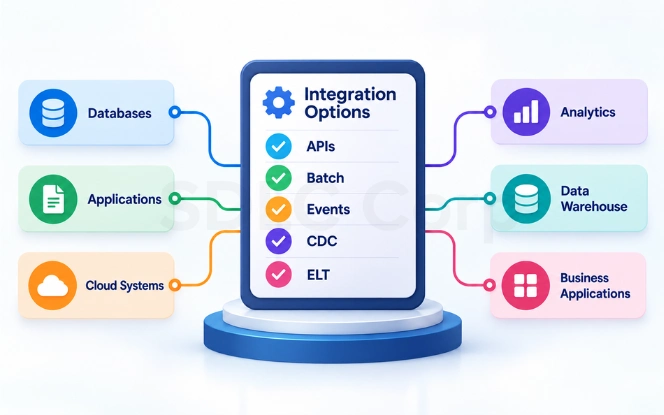
Shared entities that span CRM, billing and fulfilment also depend on reliable system-to-system connections, so reconciliation rules are usually implemented together with custom API development and integration services.
Use Metadata and Lineage as Governance Evidence
Governance needs clear evidence for every critical data asset. So record what it means, who owns it, where it came from, and how people use it.
Add an approved business definition, sensitivity classification, and enough lineage for impact analysis or an investigation. Then make this evidence easy to find in the catalog. Also use the catalog to route ownership and access requests.
Keep detailed catalog, glossary, and lineage design in the specialist guides.
Lineage that has to stand up to an audit or an AI review is covered separately in data lineage for AI governance and compliance.
Where catalog entries must be exchanged between tools, align the metadata fields with the W3C Data Catalog Vocabulary (DCAT).
Quality Governance and Issue Resolution
Quality rules define which fields and records matter, acceptable thresholds, and issue priority. First, group rules by impact. Fix blocking issues before production use. Then triage urgent issues quickly. Meanwhile, track low-priority defects for ongoing improvement.
Link each group to a business outcome, such as billing accuracy, regulatory reporting, or reliable model inputs.
The rule catalog, thresholds and remediation ownership behind these groups are set out in AI data quality controls.
Run a visible issue-resolution lifecycle
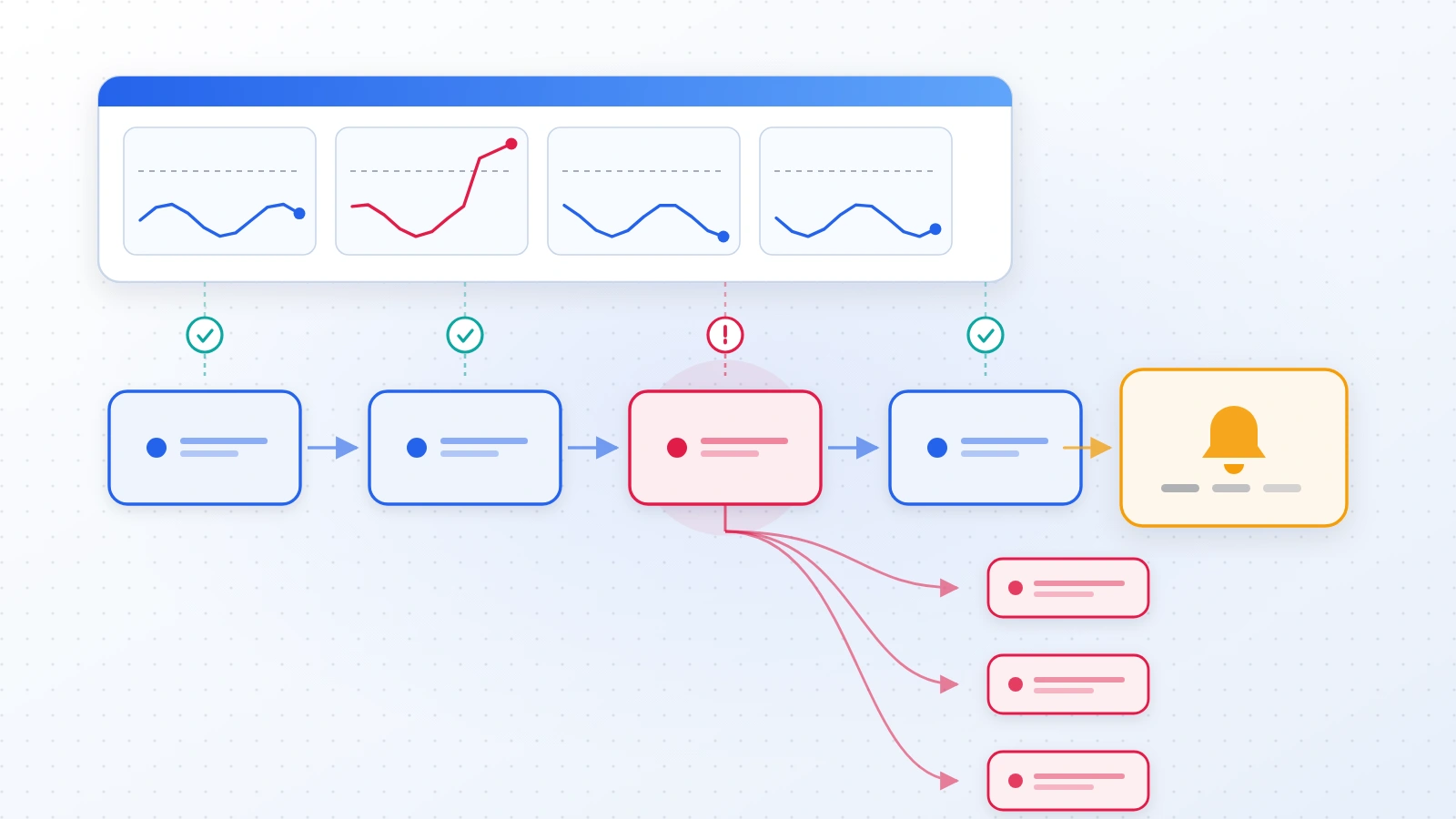
Operationalize issue resolution with a visible lifecycle: detection, triage, assignment, remediation, verification and prevention. Instrument pipelines and reports to surface alerts automatically, route incidents to the appropriate steward or engineering owner, and track time-to-resolution.
Also maintain a governance lifecycle diagram so teams can see their role in each stage.
Fix root causes, not symptoms
Focus on root cause rather than repeated fixes. Capture contributing factors (data source change, upstream schema drift, transformation bug, operational incident) and invest in preventive controls where recurrence risk and business impact justify the effort.
Use quality metrics in sprint planning so technical debt receives sustained attention.
Priority tiers and response times
Publish the tiers, the action and the response time together so nobody has to guess how urgent an issue is:
| Priority tier | Typical trigger | Action | Timing (SLA) |
|---|---|---|---|
| P1 - Critical | Billing, regulatory reporting or a production model is blocked | Pause downstream use, page the steward, owner and platform on-call, notify consumers | Acknowledge in 1 hour, fix or workaround in 8 business hours |
| P2 - High | A governed report or key attribute is wrong but not blocking | Steward triages and proposes the fix, owner signs off before release | Acknowledge in 4 business hours, resolve in 2 business days |
| P3 - Medium | Accuracy or completeness gaps consumers can work around | Log against the rule, queue into the next sprint with a named owner | Acknowledge in 1 business day, resolve in 10 business days |
| P4 - Low | Definition, glossary or cosmetic metadata fixes | Add to the stewardship backlog for the monthly governance forum | Acknowledge in 5 business days, resolve next review cycle |
Treat these figures as starting values. Confirm them per domain, then hold the same tiers across every source system.
Quality governance essentials
- Classify quality rules by business impact and required response time.
- Use automated checks in pipelines and surface alerts to stewards and owners.
- Route incidents through a tracked lifecycle with triage and SLA targets.
- Log root causes and prioritize preventive fixes over repeated downstream patches.
- Include quality metrics in team planning to address systemic issues.
In other words, measure and enforce quality by impact class, not by arbitrary completeness targets.
Impact classes are easier to agree when the reporting layer is already defined, which is why quality thresholds are often set alongside business intelligence services and solutions.
Access, Privacy and Approved Use
Make approved access easy while blocking improper use. First, map access to a role and purpose. For sensitive data, combine RBAC with purpose-based approval. Also use separate development, staging, and production environments.
Mask data for lower-sensitivity work so people do not need full access while exploring.
In addition, controls include classification, masking, approval workflows, and audit logging. For AI systems, add retrieval controls and token-level monitoring so model training and inference pipelines consume only approved data scopes.
Document allowed use cases and unacceptable uses with examples so consumers and reviewers have a shared interpretation.
Then run approvals through the catalog and enforce them in the data platform. Meanwhile, monitor access for unusual patterns.
Escalate unusual requests to the domain owner, security, and the governance council when needed. Keep privacy and security reviewers involved in high-risk approvals.
- Map dataset sensitivity to required approval workflows and masking rules.
- Use environment separation and masked views to enable safe exploration.
- Enforce access via catalog-integrated approvals and platform policy engines.
- Log access and monitor patterns to detect anomalous or inappropriate usage.
- Define allowed and disallowed uses with concrete examples for reviewers.
Make appropriate access easy and inappropriate access visible and auditable.
For personal data, map classification and purpose rules to the obligations published by the European Commission on data protection under the GDPR.
Data Governance for Analytics and AI
Analytics and AI share the same governance primitives: ownership, metadata and access. AI adds further needs: representative training data, documented feature provenance, model input/output monitoring, and human oversight for high-risk outputs.
Governance should require provenance for features used in models and link those features back to catalog entries and data owners.
Separate responsibilities: data governance covers data quality, lineage, access and definitions; AI governance covers model evaluation, prompt governance, testing, human-in-the-loop controls and post-deployment monitoring.
Controls that change for AI
Coordinate the two by sharing ownership records, access policies and escalation routes so a data incident triggers model review where necessary.
Operational controls include feature registries linked to the catalog, model data contracts, and production monitoring that correlates model drift with upstream data changes.
For high-risk AI use cases, require pre-deployment checklists signed by domain owners and model reviewers documenting data suitability and acceptable failure modes.
- Require feature provenance and link features to cataloged datasets and owners.
- Keep data governance and AI governance roles distinct but integrated.
- Use model checklists to ensure data suitability and documented failure modes.
- Correlate model drift alerts with upstream data quality and lineage events.
- Maintain human-in-the-loop controls for high-risk or automated decision systems.
Treat data governance and AI governance as distinct programs that share ownership and escalation paths.
The same data contracts and monitoring hooks apply whether models are built in-house or with an enterprise AI development company.
For an external governance baseline on managing AI-related risk and control evidence, use the NIST AI Risk Management Framework.
Implementing the Framework
Start with one or two high-value domains, not an enterprise-wide rewrite. Choose domains with clear owners, measurable pain points, and a credible return from better data trust. Then set a 60- to 90-day plan.
Include catalog onboarding, five to ten priority quality rules, steward assignments, and a basic access workflow.
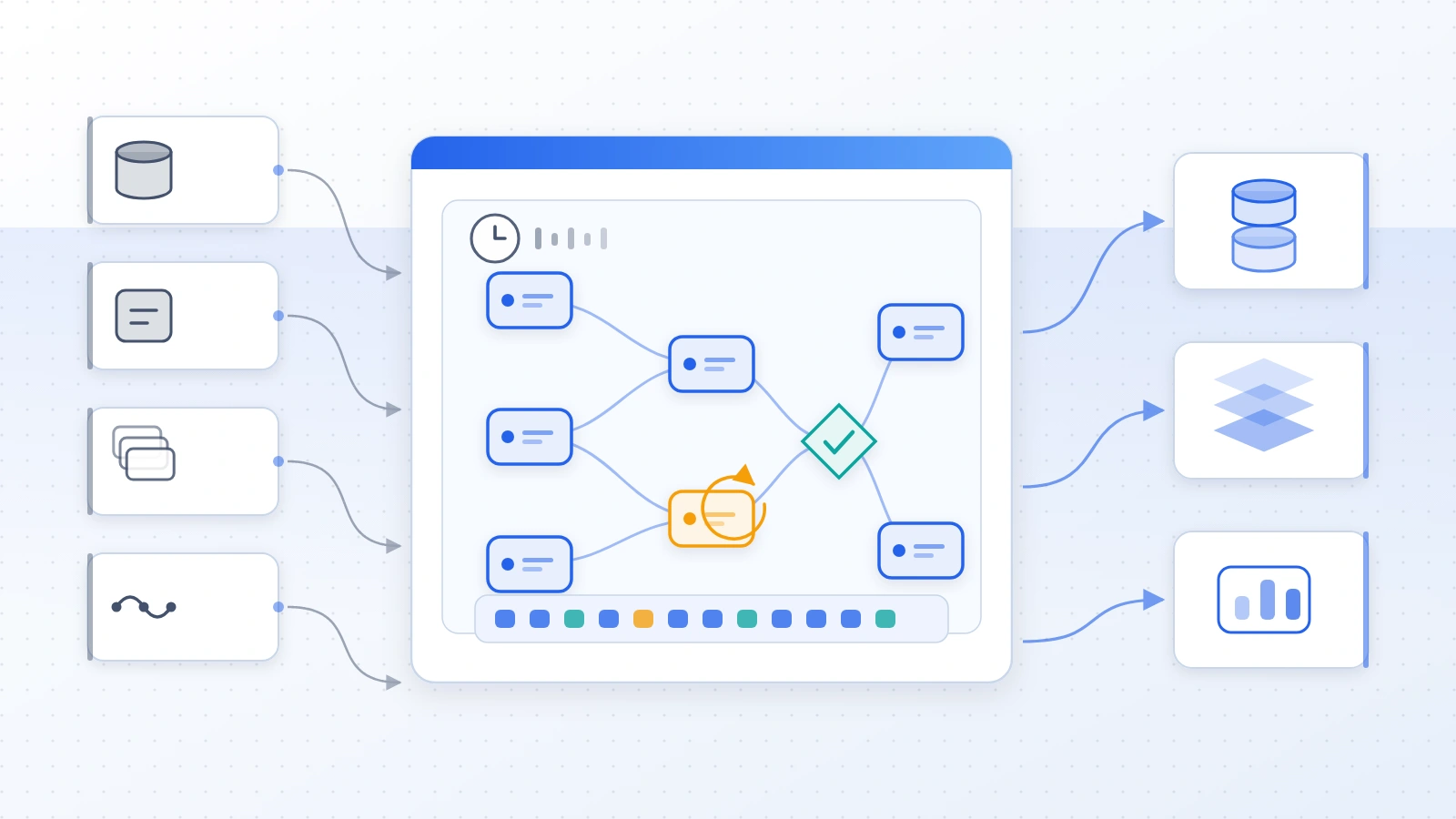
Connect the platform to collect metadata, apply access policies, and show lineage and alerts. The layers this depends on are set out in modern enterprise data architecture.
Also give teams templates for definitions, change notices, and issue tickets. They should not need to create governance material from scratch.
Finally, publish a short runbook for approvals, escalations, and pilot exceptions.
Measure the pilot before scaling
Measure adoption and value using concrete metrics: ownership coverage, metadata completeness, number and severity of quality incidents, mean time to resolve, and consumer satisfaction.
Use pilot results to tune proportional controls, staffing levels for stewards, and automation targets before scaling horizontally across domains. Maintain a phased rollout plan tied to platform capability delivery.
- Pilot in priority domains with clear owners and measurable pain points.
- Deliver catalog onboarding, five to ten quality rules, and steward training in the pilot.
- Automate metadata capture and enforce access via platform policy engines.
- Publish runbooks and templates to reduce governance friction during rollout.
- Measure ownership coverage, MTTR for issues, and consumer trust before scaling.
Use a tight pilot with measurable KPIs to validate the model before enterprise roll-out.
Where approvals and issue routing still run on email, the pilot runbook can be encoded with workflow automation services so requests are tracked instead of chased.
Reference Governance Frameworks
For current external reference points, use the EDM Council's DCAM framework for enterprise data-management capability structure and the NIST AI Risk Management Framework when governance decisions extend into AI controls, accountability, and evidence.
These sources support the article's distinction between operating model, ownership, control design, and escalation.
Frequently Asked Questions
It is the operating model, roles, standards and controls used to own, describe, protect, improve and use enterprise data.
The framework defines decision rights, metadata responsibilities, access rules, quality thresholds and an issue-resolution lifecycle so teams can discover trusted data and act on it with predictable approvals and escalation paths.
Ownership rests with business domain owners supported by data stewards, platform teams, security and a light-weight governance council. Domain owners accept risk and set priorities; stewards operate metadata and quality rules; platform teams implement tooling.
Central standards and a council handle cross-domain policies and escalations.
The owner is accountable for decisions, risk acceptance, and priority setting for a domain or dataset. The steward performs day-to-day activities: managing the business glossary, implementing quality rules, triaging incidents, and keeping metadata current.
Owners approve significant changes; stewards execute and coordinate fixes.
No. Data governance covers ownership, metadata, access, lineage and quality of datasets. AI governance covers model lifecycle concerns such as evaluation, prompt governance, monitoring, human oversight and output risk.
The two must be integrated where they overlap, across shared ownership records, access policies and escalation paths, while keeping distinct controls where needed.
Most enterprises adopt a hybrid approach: central standards and a small governance council, with domain-level ownership and steward execution. This hybrid model balances consistent enterprise controls with domain agility and subject-matter expertise.
In short, the key is clear decision boundaries and documented escalation rules.
Track ownership coverage, metadata completeness, number and severity of quality incidents, mean time to resolve issues, access approval lead times, and consumer adoption or satisfaction scores.
Tie these metrics to business outcomes such as reduced analysis time, fewer production incidents, or improved model stability to demonstrate governance value.