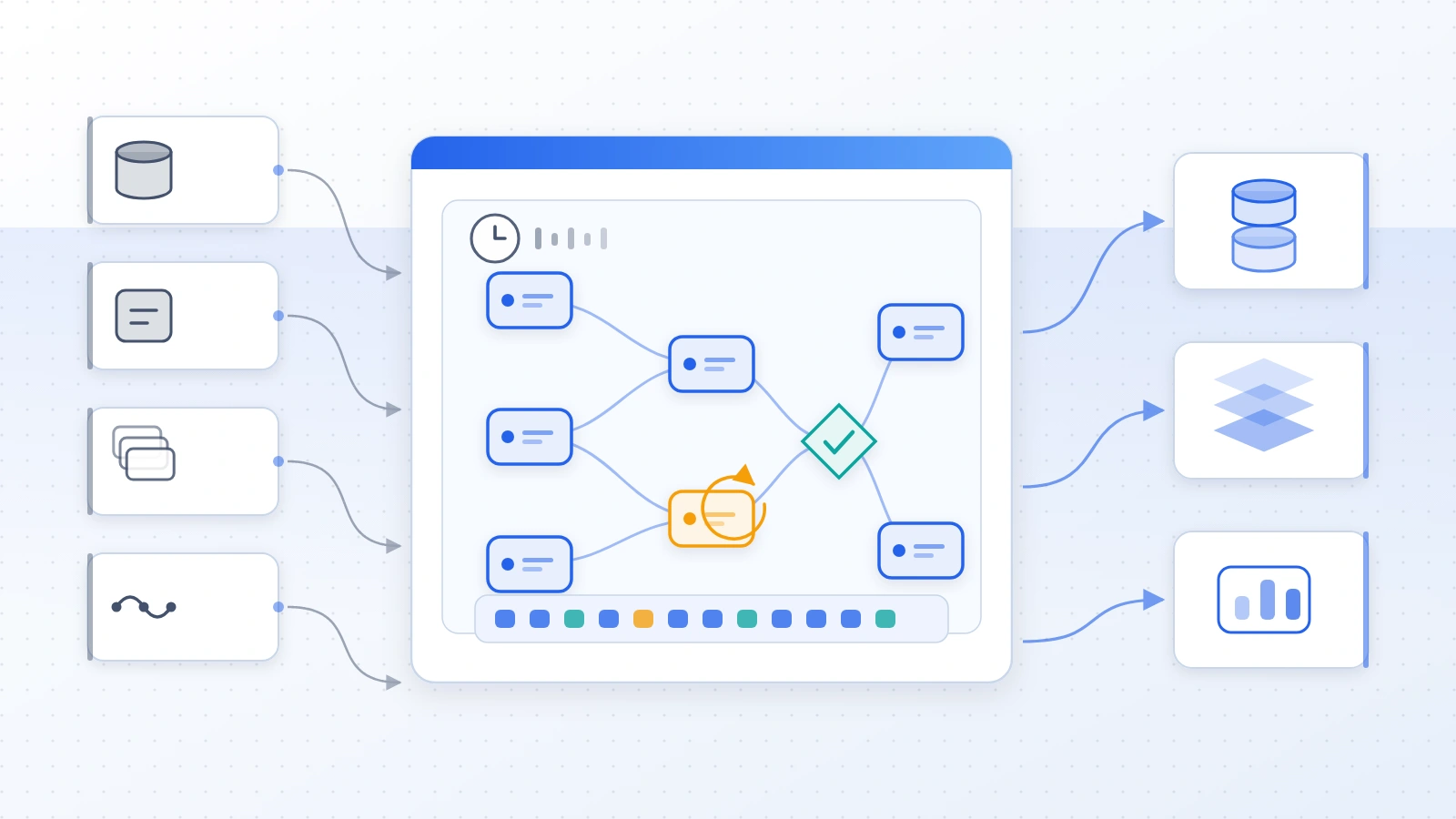
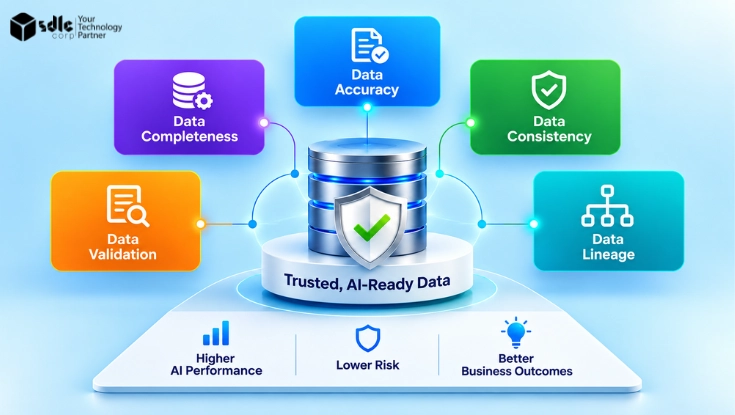
A data quality framework for AI defines the checks that keep data fit for a specific AI consumer before and after deployment. It covers quality dimensions, thresholds, ownership, exception handling, incident response, and production monitoring.
Data quality is only one part of AI readiness in enterprise AI development, and the wider set of checks is covered in the AI Data Readiness Assessment Checklist.
Readiness also depends on access, metadata, lineage, security, privacy, and operational interfaces, so a technically clean dataset should not automatically be treated as production-ready AI input.
- Separate data-quality failures from readiness, drift, and governance issues.
- Define thresholds according to risk and consumer impact.
- Make issue ownership and recovery paths explicit.
- Use monitoring to detect quality change after release, not only before it.
Data Quality Is Not the Same as Data Readiness
How this fits with the wider architecture: This framework owns measurable quality dimensions, thresholds, control points, incident handling, and continuous monitoring.
Readiness uses that evidence to make a use case go/no-go decision; it is not a substitute for operating the controls after deployment.
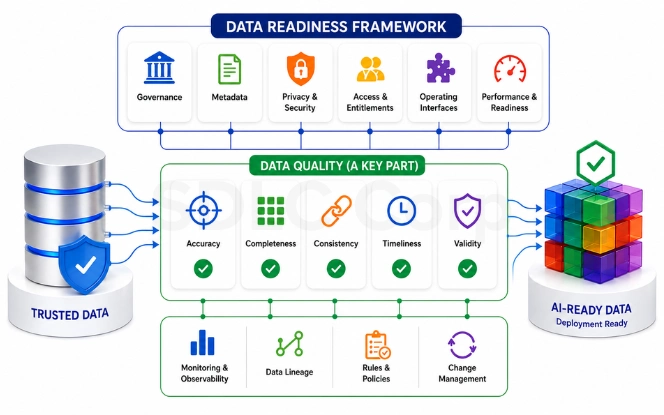
Data quality is the part of readiness that focuses on values, formats, and coverage for a specific AI consumer.
Readiness also includes access, governance, metadata, security, privacy, and operating interfaces. Separating the two stops teams from treating a cleaned table as production-ready AI input.
Define quality by the checks at the point where the AI system uses data. A feature store may be clean yet lack the speed or lineage a real-time predictor needs.
A governed dataset may be accessible but still lack values needed for accurate scoring.
Practical tradeoffs matter. Broad readiness work before risk-ranking datasets creates high compliance cost with limited return.
Pair quality rules with a readiness checklist for the same dataset and version, and require both a quality sign-off and an access or metadata sign-off before production use.
- Compare dataset readiness and quality with a two-column checklist before QA sign-off.
- Document which readiness items (access, privacy, latency) are out of scope for a given model.
- Require lineage and business owner metadata alongside quality acceptance for production datasets.
- Link dataset versions to the AI model version to avoid mismatched assumptions about freshness and schema.
- Use the readiness gap to size remediation work and communicate release risk to stakeholders.
Treat quality as the functional checks on values; treat readiness as the operational and governance stack that enables safe consumption.
Core Quality Dimensions for AI
| Critical data element | Downstream AI impact | Quality dimension | Rule | Threshold | Owner | Exception path |
|---|---|---|---|---|---|---|
| Customer identifier | Identity gaps break joins, attribution, and audit trails. | Completeness | Every scored record must resolve to one active customer record. | 100 percent present on production-scored records | Master-data owner | Escalate to data steward and hold release for unresolved gaps |
| Document version | Outdated content increases retrieval and response risk. | Currency | Retrieval content must use the latest approved version. | No stale approved content older than the policy window | Content owner | Temporary exception requires legal or compliance approval |
| Consent flag | Invalid consent creates direct privacy and compliance exposure. | Validity | Only customers with the required consent state may enter the AI workflow. | Zero invalid records in customer-facing flows | Privacy owner | Block the workflow until the source state is corrected |
| Product classification | Inconsistent classes distort routing, pricing, and recommendations. | Consistency | Codes must map to the governed reference list. | At least 99 percent valid mapping before release | Domain owner | Fallback requires a time-boxed data-quality waiver |
| Feature freshness timestamp | Stale features degrade inference quality and trust. | Timeliness | Production features must meet the approved freshness SLA. | Within the approved SLA for the use case | Platform owner | Escalate through on-call operations and business owner |
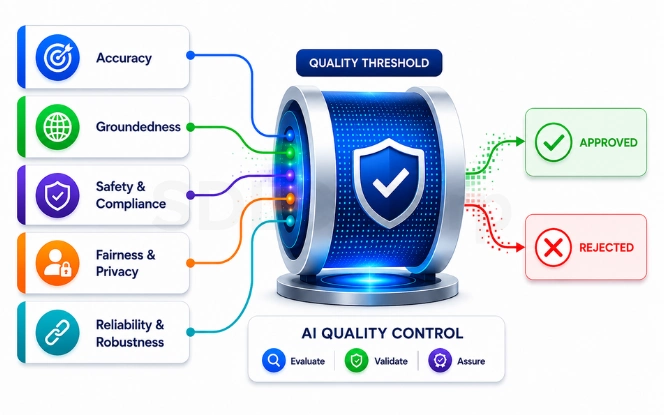
For AI, define completeness, accuracy, consistency, validity, timeliness, uniqueness, and representativeness.
Representativeness asks whether training and live data cover the people, features, and conditions the model will face, which is also the starting point for bias mitigation in AI. In a large business, sample across business units, geographies, and document types.
Translate each dimension into operational checks. Completeness becomes per-field presence by record type and frequency; accuracy becomes reconciliation with authoritative sources or sampled human review; timeliness becomes maximum allowable age per use case; validity becomes schema and pattern checks; uniqueness becomes near-duplicate detection with similarity thresholds.
Prioritize dimensions by use case rather than scoring them equally. A retrieval system for policies prioritizes document freshness and metadata trust, while a credit-risk model prioritizes outcome stability and label accuracy.
Create a prioritized matrix so engineering and business owners can decide where to invest limited remediation effort.
- Capture representativeness with stratified sampling across business segments and time windows.
- Define per-field completeness targets tied to whether a field is critical, recommended or optional.
- Map accuracy checks to authoritative references or periodic human validation workflows.
- Use schema validation for validity and pattern rules for complex fields like IDs or codes.
- Apply deduplication logic with configurable similarity thresholds for uniqueness tests.
Make representativeness explicit and convert dimensions into concrete, testable checks for each AI consumer.
Quality controls work best when paired with the ownership, oversight and documentation practices used in responsible AI development.
Set Risk-Based Quality Thresholds
Quality thresholds must reflect the severity of downstream harm from incorrect outputs.
Classify AI use cases into risk tiers (low, moderate, high) based on business impact, regulatory exposure and likelihood of error, in line with the risk-based approach described in the NIST AI Risk Management Framework.
For each tier, define what constitutes a tolerable failure rate, required human-in-the-loop controls and mandatory review gates.
Translate tiered risk into rules and acceptance criteria. Low-risk conversational assistants may allow looser metadata completeness and have passive monitoring.
High-risk scoring systems should require stricter completeness for critical fields, audit-ready reconciliation, deterministic abstention rules and defined approval authority for exceptions.
Operationalize thresholds with an approval and exceptions process. Document the business rationale for each threshold, the validation method, the owner who signs off, and a fallback plan if the threshold is breached.
Avoid fixed global numbers; record the risk reasoning and the validation evidence that supports the chosen thresholds.
| Quality area | Low risk | Moderate risk | High risk |
|---|---|---|---|
| Completeness of critical fields | Looser completeness on non-critical metadata | Critical fields complete, remaining gaps logged | Full completeness on every critical field before release |
| Timeliness | Best-effort refresh | Documented freshness window | Freshness SLA enforced, breach blocks the run |
| Validity and reconciliation | Format checks only | Rule-based validation on key fields | Audit-ready reconciliation with retained evidence |
| Monitoring | Passive monitoring | Scheduled checks with alerting | Continuous monitoring with paged response |
| Human review | No mandatory review | Sampled human review | Deterministic abstention rules and human-in-the-loop gate |
| Exception handling | Owner approval, logged | Quality lead approval, time-boxed | Named approval authority, fallback plan and fixed expiry |
- Produce a compact risk-threshold table mapping low/moderate/high risk to checks and escalation.
- Define critical fields per use case and require stricter targets for those fields.
- Specify abstention rules and human review triggers for high-risk decisions.
- Record who can approve exceptions and the maximum duration of an exception.
- Use runbooks that convert threshold breaches into clear operational actions and SLA expectations.
Set thresholds by consequence, not by convenience; require documented justification and an approver for every exception.
Profile and Diagnose the Data
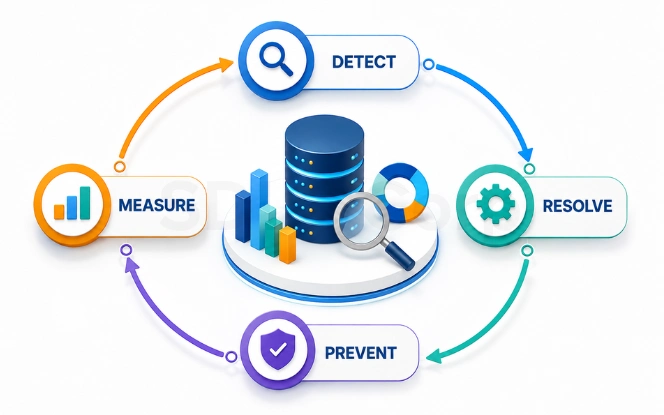
Begin with automated profiling to surface missing values, invalid formats, duplicates, distribution skews and label imbalance.
Use tooling that outputs time-windowed profiles so teams can detect shifts and seasonality. Automated profiling reduces manual triage time but must be paired with business context to avoid false positives.
Combine profiling with targeted business review. Some apparent issues are false positives. For example, a field may be empty for certain record types, or a code may change during a merger.
Use samples and clear profiling output so domain owners can confirm whether an anomaly is a risk or expected variation.
Trace repeated issues to root causes and choose remediation strategies accordingly: one-time backfill, pipeline transform fixes, source-system corrections, or user training.
Prioritize fixes that eliminate recurrence over point corrections when the failure mode stems from an upstream process or ambiguous data definitions.
Where a coverage gap cannot be closed at source, controlled synthetic data generation can fill thin segments, provided the method and its limits are documented.
- Run time-windowed profiling and store profiles for trend analysis.
- Flag anomalies with contextual metadata (record type, source, pipeline) to speed diagnosis.
- Use stratified sampling for business validation rather than blanket manual review.
- Classify root causes as source, transform, human entry or consumer interpretation.
- Prioritize root-cause fixes that reduce ongoing remediation effort over one-off corrections.
Automate profiling for scale, and pair with business review to convert anomalies into actionable root-cause remediation.
Quality Requirements by AI Type
Generative and retrieval systems require trusted content, clear document versions and rich metadata. For retrieval-augmented generation, quality checks must include content provenance, freshness windows, canonicalization and permission-aware retrieval.
Also validate retrieval relevance with human assessments and synthetic query testing to measure hallucination risk introduced by poor source quality.
Predictive AI depends on historical depth, consistent label definitions and feature stability. Quality rules should check outcome drift, label leakage, and feature distribution shifts.
Include retrospective reconciliation checks that compare model predictions to later realized outcomes to surface label mismatch or concept drift affecting model accuracy.
Document intelligence projects require representative layout samples, OCR accuracy monitoring and field-extraction validation across document variants. Build extraction test sets that reflect production diversity, and attach confidence thresholds that trigger human verification for low-confidence extractions that feed downstream systems.
| AI type | Data requirements | Quality checks | Validation method |
|---|---|---|---|
| Generative and retrieval (RAG) | Trusted content, clear document versions and rich metadata | Content provenance, freshness windows, canonicalization and permission-aware retrieval | Human relevance assessment and synthetic query testing for hallucination risk |
| Predictive | Historical depth, consistent label definitions and feature stability | Outcome drift, label leakage and feature distribution shifts | Retrospective reconciliation of predictions against realized outcomes |
| Document intelligence | Representative layout samples across document variants | OCR accuracy monitoring and field-extraction validation | Extraction test suites with confidence thresholds that trigger human verification |
- For generative AI, enforce content provenance, versioning and retrieval relevance checks.
- For predictive AI, validate label stability, outcome alignment and feature distribution consistency.
- For document intelligence, maintain extraction test suites covering layout, language and scanner variance.
- Define per-use-case abstention and human-in-the-loop policies tied to model confidence and data quality.
- Include specific test scenarios that simulate production changes such as new document templates or seasonal feature shifts.
Define quality rules at the point where each AI type consumes data; thresholds and controls vary by AI architecture and consequence.
Create an Ownership and Issue Process
Assign clear business and technical owners for each critical dataset and for the most impactful data elements. Owners must be empowered to approve exceptions, prioritize fixes and accept residual risk.
Publish an owner directory that includes contact, escalation steps and the expected response SLA for threshold breaches.
Define an issue lifecycle: detection, triage, owner assignment, remediation plan, validation and closure. Separate one-time remediation tasks (backfills) from durable process fixes (source correction or validation logic).
Track the causal category so recurring patterns point to process or system improvements rather than repeated manual fixes.
Integrate the issue process with change control and deployment pipelines. Require data quality sign-off as part of model release and pipeline deployment.
Capture exception approvals in a simple audit record and include the rationale, expiration, and compensating controls so reviewers can assess residual operational risk.
- Publish dataset owners with contact, escalation path and SLA for issue response.
- Use an issue lifecycle that separates one-off corrections from root-cause remediation.
- Log exception approvals with rationale, expiration and compensating controls.
- Prioritize issues by business impact and affected AI consumers during triage.
- Integrate quality gating into deployment pipelines so failing checks block production releases.
Operational ownership plus a structured issue lifecycle turns detected problems into durable fixes rather than recurring firefights.
Monitor Quality After Deployment
Turn quality signals into owned corrective action
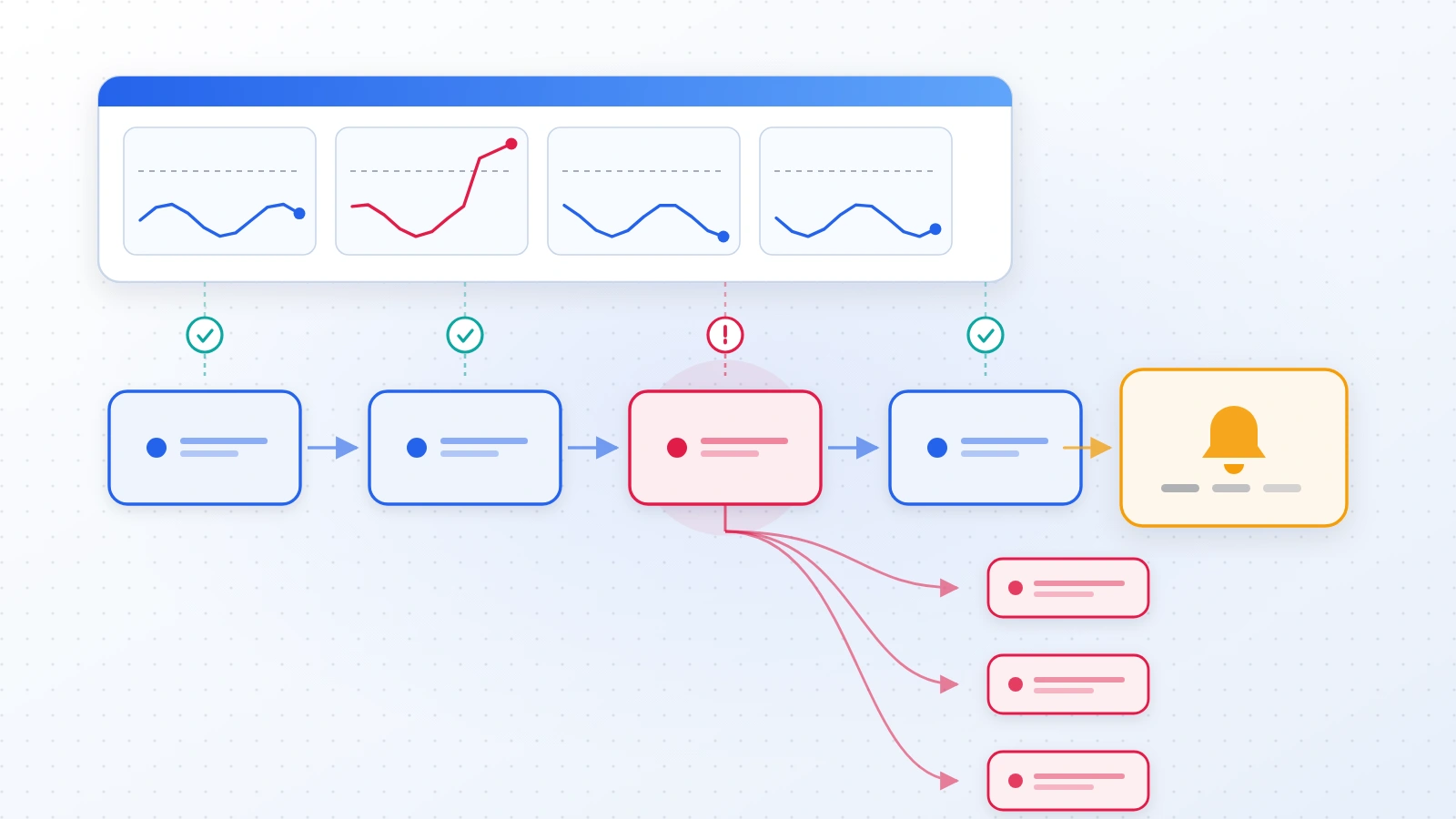
Continuous monitoring detects input shifts that precede AI performance decline. Monitor critical fields, record volumes, schema changes, label rates and distribution metrics.
Use windowed baselines and drift detection that alert to statistically significant changes, and route alerts to the dataset owner with context and suggested next steps.
Link input monitoring to AI output telemetry. When model performance deviates, correlate it with recent input alerts to identify whether the problem stems from upstream data change, label drift or model degradation.
This correlated view reduces mean time to resolution by surfacing likely causes and required remediation type.
Design alerting tiers and runbooks to avoid alert fatigue. Low-severity alerts can trigger data-health dashboards and periodic reviews, while high-severity thresholds should escalate to owners with immediate mitigation actions such as automatic fallback to human review or temporary feature disabling.
- Monitor critical fields, volumes, freshness and schema in production windows.
- Correlate input alerts with model performance metrics to speed root-cause identification.
- Define alert severity tiers and automated mitigations like model rollback or human review.
- Provide owners with diagnostic context and recommended runbook steps in every alert.
- Review monitoring thresholds quarterly and after major business changes or releases.
Tie input monitoring to model telemetry so alerts point directly to likely causes and immediate mitigations.
For production telemetry structure, use the standard signals defined by OpenTelemetry. For ML delivery and monitoring controls around data pipelines, see Google Cloud's MLOps guidance.
Measure Framework Effectiveness
The cadence below is an illustrative operating pattern, not a universal standard. Set review frequency according to business impact, rate of data change, incident history, regulatory obligations, and the cost of delayed detection.
CadenceDaily
- Review
- Critical-field failures, freshness breaches, and active exceptions
- Owner
- Operations owner
- Output
- Incident actions, mitigations, and reopened issues
CadenceWeekly
- Review
- Repeat defects, unresolved owners, and threshold tuning needs
- Owner
- Quality lead and domain owners
- Output
- Prioritized remediation backlog
CadenceMonthly
- Review
- Control effectiveness, exception trend, and downstream AI incidents
- Owner
- Governance, data, and AI leads
- Output
- Threshold changes and policy updates
CadenceQuarterly
- Review
- Control coverage and value-at-risk review
- Owner
- Executive sponsor and governance forum
- Output
- Funding or operating-model adjustments
Track KPIs that show whether the framework is reducing risk and cost. Measure critical-field completeness, issue recurrence, time to detect, time to resolve, ownership coverage, and active-monitoring coverage.
These measures show whether detection and remediation can keep pace with production change.
Also measure downstream effects on AI outcomes: change in prediction stability, retrieval acceptance rate, human override frequency, and percentage of model incidents attributable to data quality.
Use attribution where possible to quantify the fraction of performance issues that stem from data versus model or infrastructure problems.
Use the metrics to prioritize investments: if mean time to resolve is high for source-root causes, invest in source system fixes; if human override rates are climbing for generative outputs, strengthen retrieval quality and provenance checks.
Present these measures monthly to stakeholders and use them to justify resourcing decisions.
- Track critical-field completeness and the percentage of critical data with owners.
- Measure issue recurrence and mean time to detect and resolve to show operational improvement.
- Attribute model incidents to data, model or infra to prioritize investments accurately.
- Monitor downstream outcome signals like human override rates and retrieval acceptance.
- Use monthly metrics reviews to align remediation investments with business impact.
Operational KPIs plus outcome attribution show whether quality controls reduce real-world AI risk and remediation cost.
Frequently Asked Questions
Data quality for AI is the fitness of data for a specific AI consumer, assessed across dimensions such as completeness, accuracy, consistency, timeliness and representativeness. It focuses on the checks and rules an AI system needs to produce acceptable outputs and the validation methods used to prove those checks.
No. Clean data addresses formats and basic errors, but AI readiness also requires access, metadata, lineage, labeling, security, and operational guarantees like latency and monitoring. Both quality and readiness must be satisfied before production deployment.
There is no universal most important dimension. Prioritize dimensions based on the AI use case and the consequence of error. For example, representativeness and label accuracy matter more for predictive models, while freshness and provenance matter more for retrieval and generative systems.
Set thresholds according to business impact, risk tier, validation capability and human oversight. Document the rationale, designate an approver, define abstention behavior, and require evidence supporting the threshold. Avoid fixed global percentages without use-case context.
Generative AI emphasizes content provenance, document versioning and retrieval relevance to avoid hallucination. Predictive AI emphasizes historical depth, label integrity and stable feature distributions to preserve model accuracy. Map rules and monitoring specifically to those requirements.
Yes. Source systems, distributions, document templates and business definitions change over time. Continuous monitoring of critical fields, schema, volumes and distributions, correlated with model telemetry, is essential to detect and remediate emerging problems quickly.