Faster, Reliable Reporting
01Consistent reporting across departments, delivered in hours instead of days.
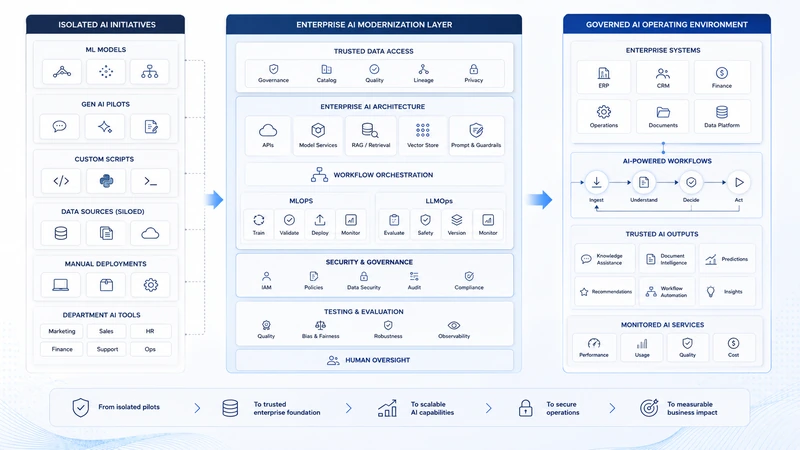
SDLC Corp helps organizations turn fragmented data, disconnected systems, and isolated AI projects into a shared, governed enterprise foundation. We connect legacy and modern systems, improve data quality, and modernize enterprise reporting. AI is then introduced into existing operations through a governed and secure approach.
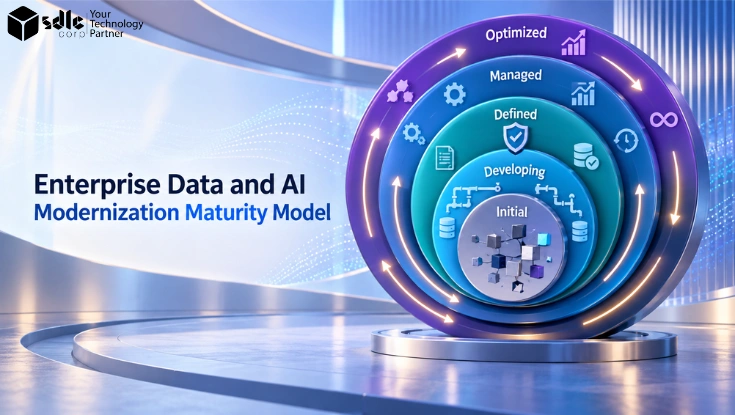
Enterprise data and AI modernization improves how an organization connects, governs, analyzes, and uses information across its systems. It combines data architecture, engineering, governance, analytics, AI integration, team enablement, and program delivery within one coordinated program not a single database migration or an isolated AI pilot. Planning typically begins with AI consulting to agree scope and sequencing.

If any of these match your current environment, a structured data and AI modernization program is the right path.

Fragmented data across systems. Critical information is distributed across ERP, CRM, finance, cloud applications, spreadsheets, and custom platforms.
Inconsistent and unreliable information. Duplicate records, conflicting definitions, and unclear ownership reduce confidence in reports and AI outputs.
Slow and manual reporting. Teams spend days collecting, reconciling, and preparing information before it can be used.
AI pilots that cannot scale. Projects stay isolated because data, governance, security, and integration requirements were never addressed.
Legacy platforms limiting modernization. Older systems remain operationally important but are difficult to connect with modern analytics, cloud, and AI.
Modernization is measured by operational results, not by the number of new tools deployed. Here is the value your teams see.
Consistent reporting across departments, delivered in hours instead of days.
A single, trusted version of key data shared across every enterprise system.
Reduced reconciliation and data preparation through governed, automated pipelines.
Clear data ownership and controlled access aligned with security requirements.
AI use cases move into production with governance, security, and human oversight.
Phased delivery reduces implementation risk and provides measurable value progressively.
Our services cover enterprise data integration, cloud and data platform modernization, governance, migration, and modern data architecture delivered as one connected program rather than isolated projects. Programs frequently run alongside digital transformation services and cloud transformation.
Review of current capabilities, AI readiness, and business priorities, leading to a phased modernization plan.
Target state design, data warehouse and lakehouse modernization, and integration architecture across cloud and on premises.
Batch and real time pipelines, ETL and ELT, enterprise data integration, and migration.
Ownership, stewardship, cataloging, lineage, classification, quality rules, access controls, privacy aligned to GDPR, and auditability.
Report consolidation, enterprise KPIs, semantic models, self service and executive dashboards.
Knowledge assistants, RAG systems, document intelligence, and predictive models delivered through our enterprise AI development capabilities.
Use case approval, risk classification, human oversight, output validation, and model monitoring.
Retain, integrate, replatform, refactor, rebuild, or replace each system with phased delivery that minimizes disruption.
Representative engagements showing how fragmented systems become one governed, synchronized data and AI environment.

Manual reconciliation of orders, inventory, and customers across a disconnected storefront and ERP.
Bidirectional integration layer with REST APIs, webhook listeners, and conflict resolution logic.
Real-time sync replaced manual work and created a reusable integration architecture.
Modernization programs can begin with discovery, planning, focused delivery, or a coordinated enterprise-wide transformation.
A focused review of your data environment, system landscape, governance maturity, AI readiness, and modernization priorities.
You need a clear understanding of your current position before committing to a larger program.
Delivery of one focused workstream such as integration, data quality, reporting consolidation, governance, or an AI proof of value.
You have one defined problem to solve and want measurable value quickly.
Target architecture, governance framework, use-case plan, investment priorities, and a phased implementation roadmap.
You know modernization is required and need a practical, sequenced plan for delivery.
Coordinated delivery across data, analytics, AI, applications, governance, adoption, and program-management workstreams.
Modernization spans multiple departments, systems, vendors, and business priorities.
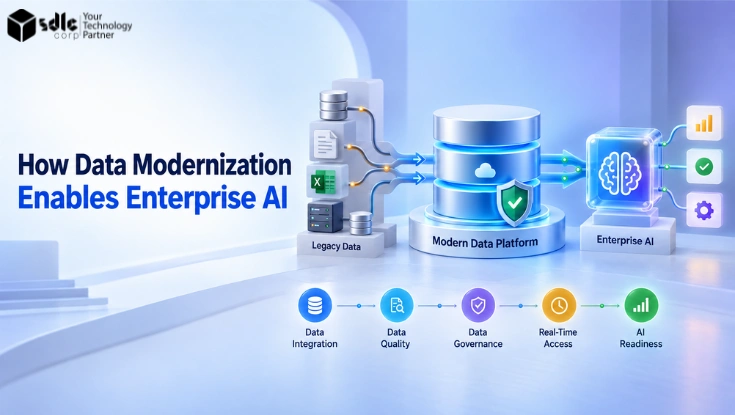
Our approach connects operational data, governance, analytics, AI, and business workflows through a common enterprise foundation, flowing from source systems to decisions and continuous improvement.
Core operational platforms that generate business data across the enterprise.
Reliable integration pipelines connect, validate, and prepare data from multiple business systems.
A trusted data foundation applies quality, ownership, security, and access controls.
Governed data is transformed into insights, predictions, automation, and intelligent assistance.
Insights and intelligent services are embedded into daily business workflows and decisions.
Governance controls remain active across platforms, data, AI services, and user access.
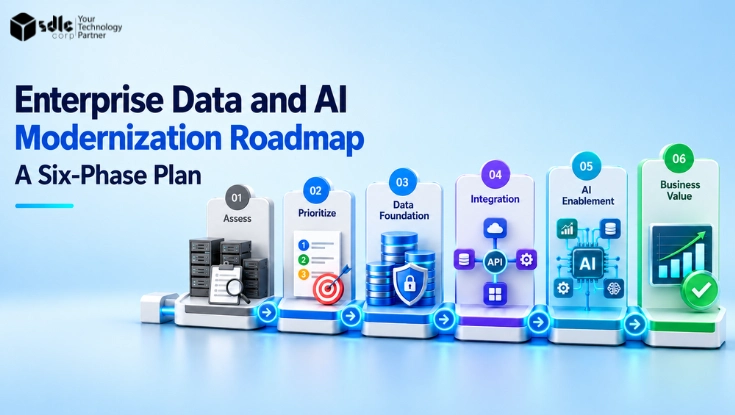
We deliver modernization through six phases, from assessment and architecture to data foundation, analytics, AI, validation, and enablement. Each phase produces clear deliverables your teams can review, test, and adopt.
We review systems, data sources, reporting processes, governance, AI initiatives, security requirements, and organizational readiness.
We create the target architecture, data and integration design, governance framework, AI adoption plan, and phased delivery roadmap. Model selection draws on our generative AI development practice.
Priority systems are connected through governed pipelines. This gives teams consistent information, clear data ownership, and controlled access across reporting and AI applications.
Reporting improves through consolidated dashboards and self service analytics, while selected AI use cases are implemented under approval controls.
Data, integrations, reports, AI outputs, performance, and security are tested and reconciled before user acceptance and production release.
Teams are trained, adoption is monitored, and governance reviews with a continuous improvement backlog keep the program moving after deployment.
Each use case is evaluated on business value, data availability, integration requirements, operational risk, and the human review needed before deployment.
Search policies, manuals, records, and internal knowledge using natural language.
Extract, classify, validate, and route information from forms, invoices, and operational documents.
Generate summaries, explain trends, and prepare recurring reports from governed information.
Identify missing values, duplicates, unusual changes, and inconsistencies across systems.
Support forecasting, capacity planning, risk review, and operational preparation with our machine learning services.
Combine business rules, AI analysis, approvals, and system actions to reduce manual work.
Provide recommendations while keeping authorized personnel responsible for final decisions, backed by our AI decision intelligence solutions.
Help employees find answers, route requests, and summarize cases from approved sources.
We modernize data environments across regulated industries with complex operations, adapting governance, access, and AI oversight to each sector's requirements.
Integrate departmental systems, improve reporting, and introduce AI with controlled access.
Connect administrative and student information systems and support responsible AI adoption.
Improve data quality, document processing, and risk analysis with governed AI. See our fintech software development work.
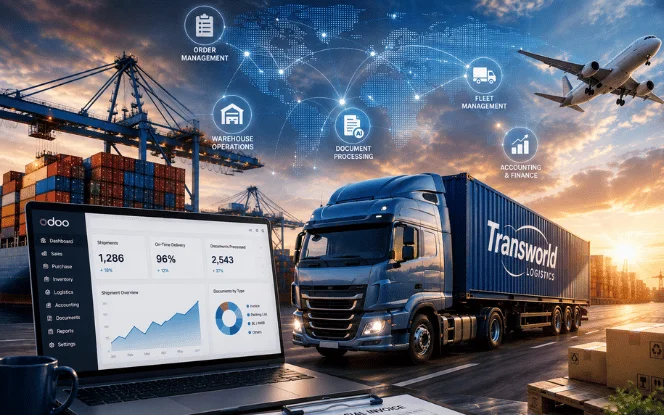
Connect operational and document data to improve shipment visibility and decisions.
Improve production forecasting, maintenance planning, and operational reporting. Backed by manufacturing software development.
Protect sensitive information while supporting governed analytics and human reviewed AI.
Connect customer, product, inventory, and transaction data for better forecasting.
Share your systems and requirements with our team for a tailored approach.
Data engineering, enterprise applications, analytics, AI, governance, and program delivery come from one connected partner built around the systems you already run.
We modernize what you already have instead of forcing every organization into the same platform. Existing platforms are reviewed through cloud consulting before migration.
Data quality, security, access, and AI controls are included throughout, not added later.
Complex programs are split into manageable phases that reduce risk and show value progressively.
Role-based training, documentation, and operating processes help your teams run and expand the platform independently.

Modernization begins by understanding your existing systems, data limitations, business priorities, and organizational readiness. Explore our AI development services and case studies, or share your systems and RFP requirements with our team.

Common questions about enterprise data and AI modernization, governance, timelines, and program delivery.
Enterprise data and AI modernization is the process of improving how an organization collects, integrates, governs, analyzes, and uses information. It creates the technical and organizational foundation required for reliable analytics, automation, and responsible AI.
No. Many programs begin by integrating and improving existing systems. We assess whether each platform should be retained, extended, migrated, replatformed, rebuilt, or replaced. Full rebuilds are delivered as enterprise software development.
Yes. We are not tied to a single cloud, data platform, or enterprise application, and can work with cloud, on premises, hybrid, and multi cloud environments.
Our data governance services establish ownership, quality rules, lineage, and access controls. We profile source data, define validation rules, standardize formats, reconcile records, monitor quality, and create processes for resolving recurring data issues, following practices set out in the DAMA DMBOK.
We begin with approved use cases, trusted data, clear access controls, defined human oversight, output validation, monitoring, and AI governance aligned to the NIST AI Risk Management Framework.
The timeline depends on the number of systems, data complexity, governance maturity, security requirements, and selected workstreams. We normally begin with an assessment and divide delivery into manageable phases.
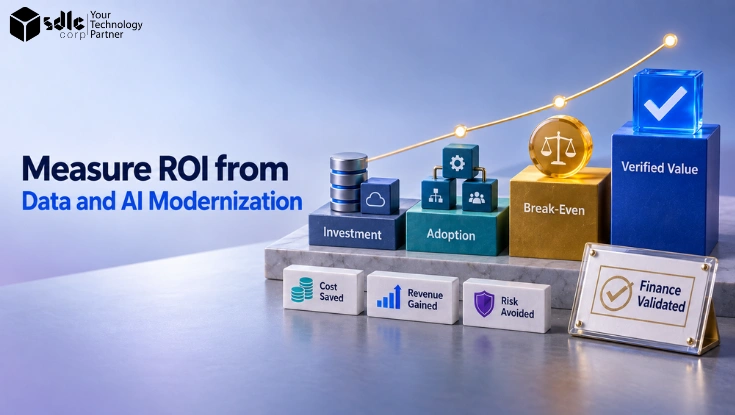
Success measures may include data quality, reporting time, system adoption, process efficiency, integration reliability, adoption of governance controls, AI performance, and measurable operational outcomes.

United States:
2457 Kane Lane, Batavia, Illinois
60510

United Kingdom:
30 Charter Avenue, Coventry
CV4 8GE Post code: CV4 8GF United Kingdom

United Arab Emirates:
Unit No: 729, DMCC Business Centre Level No 1, Jewellery & Gemplex 3 Dubai, United Arab Emirates

India:
715, Astralis, Supernova, Sector 94 Noida, Delhi NCR India. 201301

Qatar:
B-ring road zone 25, Bin Dirham Plaza building 113, Street 220, 5th floor office 510 Doha, Qatar

© 2026 SDLC Corp. All Rights Reserved.