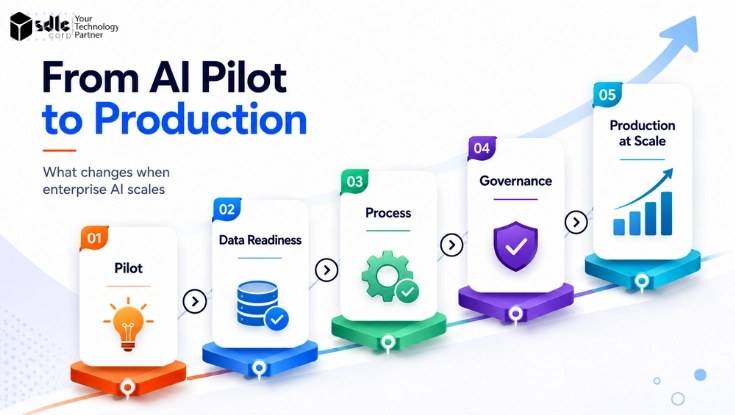
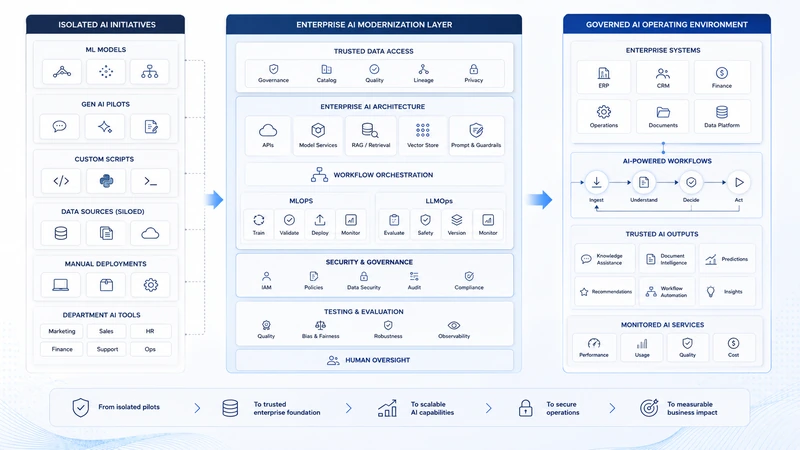
Enterprise AI modernization is the process of improving how an organization develops, integrates, deploys, governs, monitors, and scales artificial intelligence across its systems and operations.
It transforms disconnected experiments, departmental AI tools, manually deployed models, and isolated automation projects into reusable and governed enterprise capabilities.
Modernization can include upgrading AI infrastructure, integrating models with business applications, introducing MLOps or LLMOps, improving access to trusted data, establishing AI governance, and creating clearer processes for human oversight.
The objective is not simply to use more AI. It is to make AI reliable, secure, maintainable, and useful within real enterprise workflows.
A modern AI environment should allow an organization to move suitable use cases from experimentation to production without rebuilding the entire technical and governance foundation for every project.
- What it is: A coordinated approach to improving how AI is developed, integrated, deployed, governed, and operated
- What it is not: Only adopting new AI tools or replacing individual models
- Common starting point: An assessment of existing pilots, models, data readiness, and operational risk
- Main outcome: Reliable production AI integrated into enterprise workflows with governance and monitoring
- Relationship with data: A separate but coordinated workstream that depends on trusted, governed data
From Isolated AI Pilots to Production AI
Many organizations have already experimented with artificial intelligence. They may have predictive models developed by individual teams, generative AI proofs of concept, department-specific assistants, document-processing scripts, automation tools connected to a few systems, or machine-learning models running through manual processes.
These initiatives may demonstrate value, but they often remain disconnected from enterprise applications, governed data, and standard delivery processes. Some depend entirely on one developer or vendor.
A modern enterprise AI environment connects these capabilities through shared architecture, governed data access, standard deployment processes, and clear operational ownership.
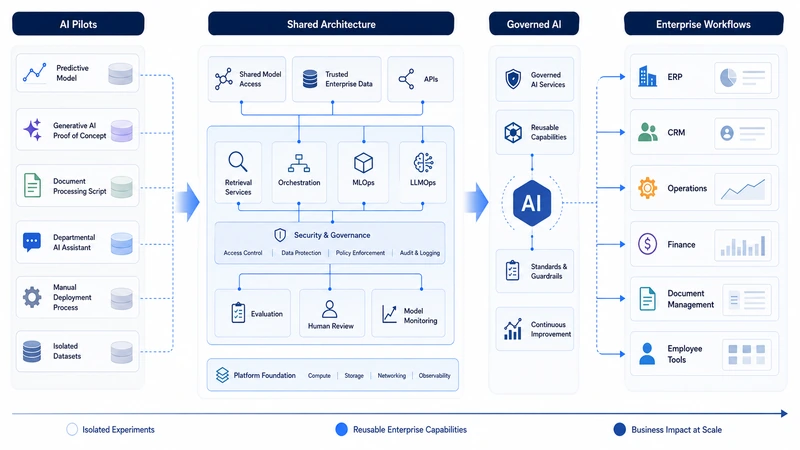
Enterprise AI modernization does not mean replacing every existing model or tool. Some existing capabilities can be retained, improved, and integrated into a modern operating environment.
Why Enterprise AI Pilots Struggle to Scale
AI adoption often begins with isolated experimentation. Different departments test tools independently, create their own datasets, and select technologies based on immediate requirements.
This can produce quick results, but the environment becomes difficult to manage as the number of use cases grows.
Pilots Cannot Move Into Production
A pilot may work with a small, manually prepared dataset but struggle when connected to live systems. The readiness gates, evaluation and controlled rollout a single use case needs are set out in how to move AI pilots into production.
At portfolio level the problem compounds. Without shared foundations, every pilot has to solve the same production problems on its own, and successful demonstrations may never become dependable operational systems.
AI Is Disconnected From Business Workflows
An AI model may generate useful predictions or responses but still require users to copy information manually between systems.
Real value usually appears when AI is connected to the applications and workflows employees already use, such as ERP, CRM, finance, support, document management, and logistics systems.
Models Are Deployed Manually
Some organizations rely on developers to deploy, update, and monitor models through manual steps. This makes releases slow and inconsistent.
It also becomes difficult to determine:
- Which model version is active
- What data was used
- Who approved the deployment
- How the previous version can be restored
- Whether outputs are being reviewed
Modern AI operations introduce repeatable processes for deployment, monitoring, and version control.
Architecture Is Inconsistent Between Teams
Different teams may use separate cloud services, models, databases, APIs, and monitoring tools. This increases cost, duplicates work, and lets security and governance controls vary between projects.
A shared AI architecture provides reusable components without forcing every use case into an identical design.
Output Quality Is Not Monitored
Traditional software monitoring is not enough for AI. An application may remain technically available while the quality of its outputs declines because of:
- Changes in incoming data
- Model drift
- Poor retrieval results
- Uncontrolled prompts
- New user behavior
- Changes to external models
Modernization introduces monitoring for both technical performance and output quality. Microsoft provides additional guidance on model monitoring in production, including data drift and performance signals.
Ownership Is Unclear
AI systems often involve business teams, data teams, developers, security teams, and external providers. Without clear ownership, no one may be responsible for output quality, risk review, monitoring, or improvement after deployment.
Enterprise AI modernization defines operating responsibilities across the AI lifecycle.
Employees Do Not Trust or Adopt AI
Users may avoid AI systems when outputs are difficult to understand, inconsistent, or disconnected from their work.
Modernization therefore includes workflow design, training, documentation, and feedback processes, not only technical development.
What Does Enterprise AI Modernization Include?
Enterprise AI modernization brings together six connected capability layers that move a use case from strategy into governed, monitored production.
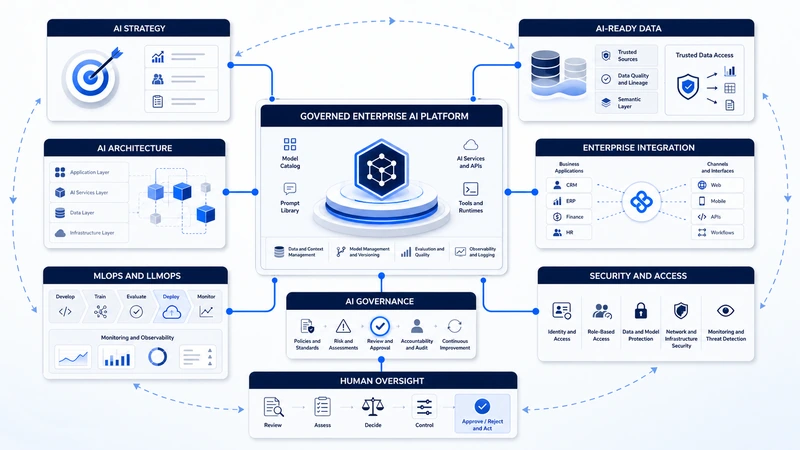
AI Strategy and Portfolio
An AI strategy defines where artificial intelligence can create meaningful value and where it may introduce unnecessary risk. Organizations can use AI consulting services to assess readiness, prioritize use cases, and create a practical roadmap. The goal is to avoid a portfolio of disconnected experiments that cannot be maintained or expanded.
- Business priorities
- Use case selection
- Risk classification
- Expected outcomes
- Ownership
- Success measures
Data and Knowledge Access
AI systems require access to relevant and trusted information. Enterprise AI modernization and enterprise data modernization are separate workstreams, but they are closely connected: an organization does not need to modernize every data source before starting AI, but it does need a dependable foundation for the specific data used by each production use case.
- Governed data access
- Documents and retrieval
- Metadata
- Permissions
- Lineage
- Data change monitoring
The broader data foundation should be planned as a coordinated workstream that supports trusted access, governance, metadata, lineage, and production AI requirements.
AI Architecture and Integration
AI architecture defines how models, data, applications, workflows, users, and governance controls work together. AI creates more value when it becomes part of business operations, and integration should respect the permissions and business rules already established within enterprise systems.
- Model providers and model serving
- Retrieval systems and vector databases
- AI gateways and APIs
- Workflow orchestration
- Enterprise application integration
- Identity and access controls
- Human review interfaces
AI Delivery and Operations
MLOps creates repeatable processes for building, testing, deploying, monitoring, and updating machine-learning models. LLMOps applies related operational controls to applications using large language models. Google Cloud provides a detailed overview of continuous delivery and automation pipelines for MLOps. The required level of operational maturity should reflect the importance and risk of the use case. Larger model or application rebuilds may require a separate enterprise AI development workstream.
- Automated testing
- Deployment pipelines
- Model and prompt versioning
- Model registries
- Rollback procedures
- Incident management
- Cost and performance monitoring
Governance, Security, and Human Oversight
AI governance defines how use cases are approved, implemented, monitored, and reviewed, and it should be proportional to risk. The NIST AI Risk Management Framework provides a useful reference for incorporating trustworthiness and risk management across the AI lifecycle. A system that summarizes internal meeting notes does not require the same controls as one that influences financial, employment, or operational decisions. An AI assistant should not be able to access information merely because that data exists somewhere in the enterprise, and not every AI output should result in an automatic action.
- Use case approval and ownership
- Evaluation requirements
- Access controls and data isolation
- Output validation and human review
- Prompt injection protection
- Audit logging
- Incident handling
Monitoring and Workforce Adoption
Enterprise AI systems need continuous visibility after deployment, and modernization changes how people perform work. Role-based training and clear operating procedures improve adoption and reduce misuse.
- Model performance and drift
- Retrieval quality
- Output accuracy
- Cost per transaction
- User feedback and escalation
- Role-based training
- Operating procedures
Enterprise AI Modernization vs AI Adoption
AI adoption and AI modernization are related, but they describe different stages.
AI adoption introduces artificial intelligence into an organization. It may begin with one tool, one department, or one use case.
AI modernization improves the overall environment and operating processes needed to scale and manage AI reliably.
| AI Adoption | AI Modernization |
|---|---|
| Introduces AI capabilities | Improves how AI is developed and operated |
| Often begins with tools or pilots | Builds reusable enterprise foundations |
| May remain within one department | Connects AI across systems and workflows |
| Focuses on initial value | Focuses on scale, governance, and reliability |
| Can rely on manual processes | Introduces repeatable operational processes |
| May use isolated data | Establishes governed data access |
An organization can adopt AI without modernizing its AI environment. However, isolated adoption becomes difficult to manage as the number and importance of use cases increase.
AI modernization can also be one workstream within a broader digital transformation program, alongside application, cloud, workflow, and data modernization.
Common Enterprise AI Modernization Approaches
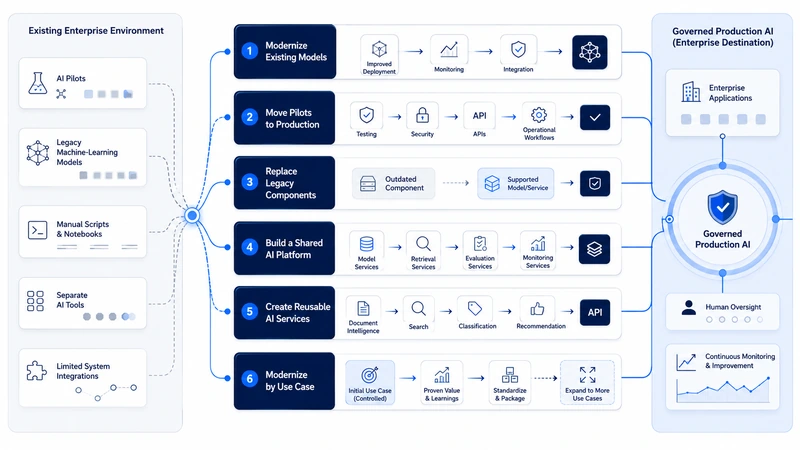
Organizations can modernize AI through different approaches depending on their existing capabilities.
Modernize and Integrate Existing Models
Useful models can be retained while their deployment, integration, monitoring, and governance are improved. This is suitable when the core model remains valuable but the surrounding operational environment is weak.
Move Pilots Into Production
A successful proof of concept can be redesigned for production use. This usually requires stronger data pipelines, application integration, testing, security, monitoring, and ownership.
Replace Outdated AI Components
Legacy models, libraries, or infrastructure may need to be replaced when they are unsupported, difficult to maintain, or unable to meet current requirements.
Introduce a Shared AI Platform
A common platform can provide reusable services for model access, retrieval, evaluation, deployment, security, and monitoring. It should reduce duplication without preventing teams from selecting suitable technologies.
Build Reusable AI Services
Capabilities such as document extraction, enterprise search, summarization, classification, and anomaly detection can be made available through reusable services, reducing development effort across multiple business applications. Custom predictive components can be created through machine learning development services and then reused across approved workflows.
Modernize by Use Case
An organization may start with one high-value use case and modernize the required data, integrations, infrastructure, and governance around it, creating a practical foundation for later projects.
Introduce Governed AI Assistants and Agents
AI assistants can help users retrieve information, create content, and complete selected tasks, while AI agents can coordinate tools and actions across multiple steps. Organizations planning custom assistants can use generative AI development services to design retrieval, model, integration, and guardrail components. Both assistants and agents require controlled permissions, monitoring, and clear boundaries before they are introduced into enterprise workflows.
A Typical Enterprise AI Modernization Process
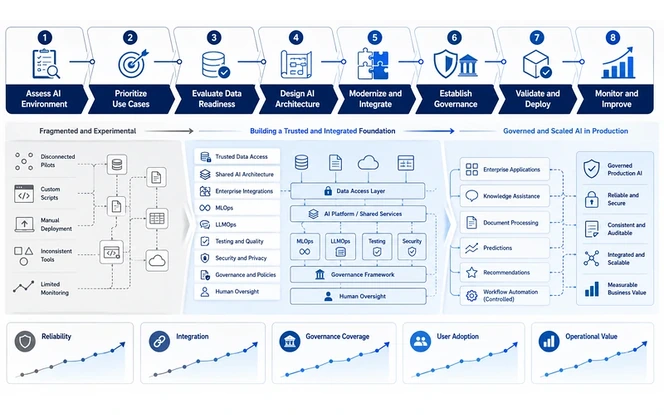
An AI modernization program moves through six phases, each focused on getting AI use cases into governed production rather than expanding experimentation.
Phase 1: Assess AI Pilots and Capabilities
The organization reviews existing pilots, models, tools, data sources, infrastructure, application integrations, deployment processes, governance controls, and vendor dependencies.
The assessment should identify which capabilities should be retained, modernized, consolidated, or retired.
Phase 2: Prioritize Production Use Cases
Use cases are evaluated on business value, data availability, technical feasibility, integration effort, operational risk, and the human oversight they require.
A technically impressive use case is not always the best starting point.
Phase 3: Confirm Data, Risk, and Integration Readiness
Teams determine whether the required data is available, accessible, suitable, and governed, and whether the target systems can support the planned integration.
Gaps may need to be addressed through targeted data modernization before deployment, and risk classification determines the controls each use case will need.
Phase 4: Design the Enterprise AI Architecture
The architecture defines the model strategy, data access, application integration, deployment approach, security, monitoring, human review, and development standards.
It should support immediate use cases while remaining flexible enough for future requirements. The AWS Well-Architected Machine Learning Lens offers additional lifecycle and architecture guidance for production ML workloads.
Phase 5: Build, Govern, and Deploy
Existing AI components are improved, replaced, or connected to enterprise applications, and reusable services, APIs, and workflow components are introduced. Ownership, approval processes, access, and evaluation criteria are established before release.
Testing covers output quality, data handling, security, integration reliability, failure scenarios, and user acceptance, using realistic scenarios rather than demonstration examples alone.
Phase 6: Monitor, Improve, and Expand
After deployment, the organization tracks performance, costs, adoption, and operational outcomes. Models, prompts, retrieval systems, and workflows are improved continuously as data and business requirements change.
The reusable foundation then supports additional use cases with less effort than was required for the first.
Benefits of Enterprise AI Modernization
Reusable architecture, governance, and deployment processes reduce the work required for each new use case.
AI can support real workflows rather than remaining isolated in separate tools.
Testing, monitoring, trusted data access, and human feedback improve the dependability of deployed systems.
Shared services for search, document intelligence, models, and monitoring can support multiple applications.
Clear ownership, approval, monitoring, and system inventories improve accountability across production AI.
Modern infrastructure and deployment practices allow AI workloads to support more users and transactions.
Security controls, human oversight, and monitoring reduce the risk of unintended actions, unreliable outputs, and inappropriate access.
AI systems designed around real workflows are easier for employees to understand and use.
How Data Modernization Supports AI Modernization
AI modernization depends on a suitable data foundation, but the two should not be treated as the same activity. Data modernization improves integration, quality, accessibility, governance, metadata, lineage, security, and analytics foundations. AI modernization improves model development, AI infrastructure, enterprise integration, deployment, monitoring, AI governance, human oversight, and adoption.
The relationship can be represented as:
Organizations do not need to complete an enterprise-wide data modernization program before starting AI. A focused approach can modernize the specific data required for a high-priority AI use case while still following the organization's long-term data architecture.
For organizations planning both workstreams, data modernization and AI modernization can be coordinated within one program while retaining separate ownership, milestones, controls, and success measures.
Common Enterprise AI Modernization Challenges
These are failure patterns that can stall enterprise AI programs.
A new model or platform will not provide value without a clearly defined operational problem. Connect use cases to measurable outcomes.
A demonstration may hide manual preparation and controlled conditions. Validate the pilot with real users, systems, and data before scaling it.
Models cannot compensate for missing, inconsistent, or poorly understood information. Assess data readiness for every production use case.
AI that depends on manual copying may never become part of normal operations. Begin integration planning early.
Every production AI system needs defined business and technical owners, and ownership must continue after deployment.
Availability monitoring does not reveal whether AI responses remain useful or accurate. Include output evaluation and user feedback.
Controls added after development can require major redesign. Consider risk, access, and oversight from the beginning.
Some use cases should begin with recommendations and human approval before more automation is introduced.
Employees need training, clear expectations, and workflows that make the AI system useful in practice.
AI platforms change quickly. Architecture should reduce unnecessary vendor dependence and allow important components to be replaced when practical.
How to Know Whether Your Organization Needs AI Modernization
An organization may need AI modernization when:
- Several departments are running disconnected AI pilots
- Useful models cannot be moved into production
- AI tools are not integrated with enterprise applications
- Deployment depends on manual technical work
- No central inventory of AI systems exists and ownership is unclear
- AI outputs are not monitored
- Employees use public AI tools without common policies
- Different teams repeatedly build similar capabilities
- AI costs are difficult to track and models are difficult to update
The first step should normally be an assessment of existing capabilities, business priorities, and operational risk.
How to Measure Enterprise AI Modernization Success
Success should be measured through operational, technical, and governance outcomes.
Progress can be tracked through measures such as:
- Time required to move a use case into production
- Percentage of pilots reaching production
- Output acceptance or correction rates
- User adoption and reduction in manual work
- Number of reusable AI services
- Percentage of production AI systems covered by required governance controls
- Percentage of production AI systems covered by active monitoring
- Cost per AI transaction and incident frequency
- Business outcomes achieved by each use case
Metrics should reflect the purpose of the system. A document-processing solution should not be measured in the same way as a knowledge assistant or forecasting model.
Frequently Asked Questions
No. Implementing AI may involve one tool or use case. AI modernization improves the broader architecture, integration, governance, and operating processes required to scale AI.
No. Existing models can often be retained and improved through better deployment, integration, monitoring, and governance.
Not every organization needs an extensive MLOps platform. However, production AI systems need repeatable processes for testing, deployment, versioning, monitoring, and change control.
MLOps supports the lifecycle of machine-learning models. LLMOps addresses additional requirements associated with large language model applications, including prompt management, retrieval evaluation, model provider changes, and response monitoring.
No. AI systems can operate in the cloud, on premises, in restricted environments or through a hybrid deployment. Deployment depends on security, performance, cost, and data requirements.
Yes. A focused use case can establish reusable architecture and governance for later projects, provided it aligns with the broader enterprise direction.
A focused modernization workstream may take several months. A wider enterprise program involving multiple systems, teams, and use cases is normally delivered through several phases.
Governance defines who owns each system, what data it can use, how it is evaluated, when human review is required, and how performance is monitored.
Not every enterprise dataset must be modernized first. The data required for the selected AI use case must be reliable, accessible, governed, and suitable for its intended purpose.
Conclusion
Enterprise AI modernization improves how artificial intelligence moves from experimentation into real enterprise operations.
It is not limited to replacing models or adopting new AI tools. It brings together AI strategy, trusted data access, architecture, enterprise integration, infrastructure, governance, security, monitoring, human oversight, and workforce adoption.
The most practical approach is usually phased. Organizations can begin with a high-value use case, modernize the required data and technical foundation, establish reusable controls, and then expand to additional workflows.
Enterprise data modernization and enterprise AI modernization should remain separate but coordinated workstreams. Data modernization provides trusted information, while AI modernization turns suitable information and models into governed operational capabilities.
A coordinated modernization program can align data readiness, AI delivery, governance, security, and enterprise integration while keeping each workstream clearly defined.