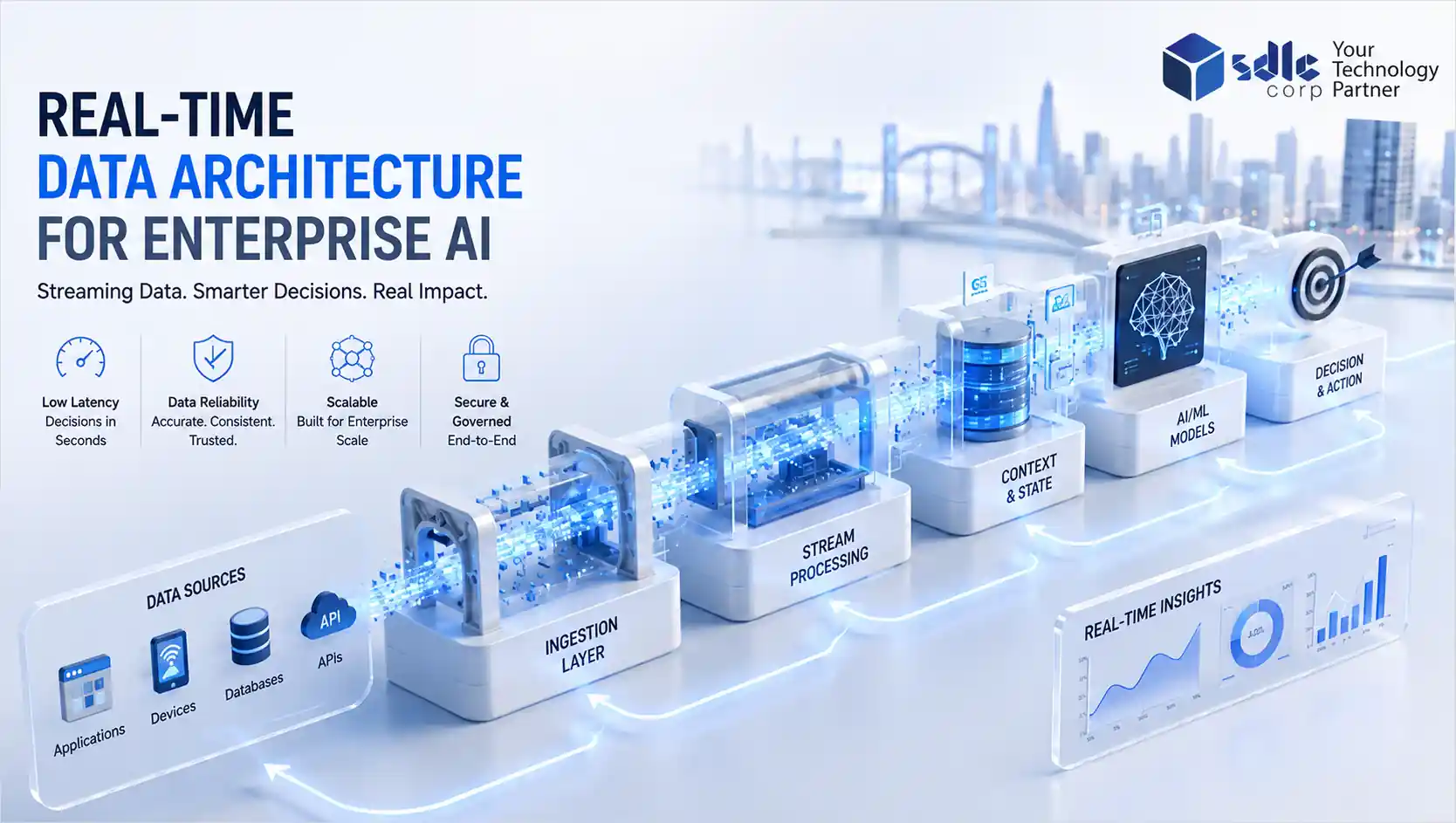
Machine Learning Production Ready

Machine Learning
Development Company

Build machine learning systems that turn business data into predictions, scores, recommendations and actionable insights.

Our machine learning development services cover custom ML models, predictive analytics, classification, regression, forecasting, anomaly detection, recommendation systems, model evaluation and production deployment.

Proven Machine Learning Delivery

50+AI Projects Delivered
400+AI Specialists
98%On-Time Delivery
10+ Yearsof Experience

Trusted by Fortune Global 500 leaders, governments & top universities across 30+ countries


Powered by leading cloud & AI platforms

AWS
Google Cloud
Microsoft Azure
NVIDIA
OpenAI
Anthropic
Gemini
Grok
Perplexity
Google AI
AWS
Google Cloud
Microsoft Azure
NVIDIA
OpenAI
Anthropic
Gemini
Grok
Perplexity
Google AI

Recognized by leading industry reviewers

Awards & industry recognition

Top AI Development Company by Selected FirmsTop IT Consulting, SI & Managed Services Company by ITRateTop Web Development Company by Selected FirmsTop Service Provider 2025 by RightFirmsTop App Development Company by AppDevelopmentCompaniesTop Software Development Company by Selected FirmsBest Support Company 2025 by SoftwareSuggestTop AI App Developers by C2C Reviews
Capabilities

Machine Learning
Development Services

Build custom ML systems around your data, workflows and measurable business outcomes.

Model

Custom ML Model Development

Design and train machine learning models using your business data and defined performance targets.

Predict

Predictive Analytics

Forecast future outcomes such as demand, risk, customer behavior, equipment failure and operational performance.

Classify

Classification Models

Assign records, transactions or events to defined categories using supervised machine learning.

Estimate

Regression Models

Predict continuous values such as price, demand, revenue, duration or resource requirements.

Rank

Recommendation Systems

Build personalized recommendation models around user behavior, product data and business objectives.

Detect

Anomaly Detection

Identify unusual patterns, transactions or events that require review.

For language-specific classification and extraction, explore our Natural Language Processing Services.

Solutions

Machine Learning
Solutions We Build

The shapes an ML project usually takes once the prediction task is clear.

Forecast

Demand Forecasting

Predict future demand using historical patterns and relevant business signals.

Score

Fraud Detection

Score transactions or activities according to the likelihood of unusual or fraudulent behavior.

Retain

Churn Prediction

Identify customers with a higher likelihood of leaving so teams can act earlier.

Maintain

Predictive Maintenance

Use equipment and operational data to identify potential failure before unplanned downtime occurs.

Personalize

Recommendation Engines

Personalize products, content or services according to user behavior and relevant context.

Prioritize

Risk Scoring

Convert multiple data signals into scores that support operational review and prioritization.

Outcomes

What Machine
Learning Can Improve

Where predictive models change how a business actually operates.

Forecasting

Better Forecasting

Use historical data to estimate future demand, risk or operational outcomes.

Detection

Faster Detection

Identify anomalies and patterns that are difficult to monitor manually at scale.

Relevance

Personalized Experiences

Use customer and product data to improve recommendations and relevance.

Timing

Earlier Intervention

Surface churn, failure or fraud signals before the business impact becomes larger.

Consistency

Consistent Scoring

Apply repeatable statistical logic across high-volume decisions.

Planning

Data-Driven Planning

Give teams measurable signals for inventory, operations, finance and resource planning.

Architecture

Machine Learning
Architecture

A production ML system needs more than a trained model.

Layer 01

Business Data

Use approved historical and operational information relevant to the prediction task.

Layer 02

Feature Preparation

Transform raw business data into useful model inputs.

Layer 03

ML Model

Apply the selected classification, regression, forecasting or recommendation algorithm.

Layer 04

Prediction

Return a score, forecast, probability or recommendation.

Layer 05

Validation

Apply thresholds and business rules before predictions affect downstream workflows.

Layer 06

Business Workflow

Deliver ML output into the application where users can act on it.

Layer 07

Monitoring

Track model quality and production behavior over time.

Evaluation

Model Development
and Evaluation

Machine learning quality should be measured against the actual business task.

01

Baseline

Establish how the existing process performs before introducing a new model.

02

Model Training

Train candidate models using representative historical data.

03

Validation

Evaluate performance against data not used during training.

04

Feature Evaluation

Measure which inputs contribute useful predictive information.

05

Error Analysis

Review where the model makes incorrect predictions.

06

Explainability

Use appropriate techniques to make important model behavior easier to understand.

07

Business Evaluation

Measure whether improved model performance creates a meaningful operational outcome.

Techniques

Common
ML Techniques

We select techniques according to the problem rather than forcing every use case into the same algorithm.

Categorize

Classification

For categorical outcomes such as fraud/not fraud or high/medium/low risk.

Estimate

Regression

For continuous predictions such as demand, value or duration.

Group

Clustering

For discovering groups or patterns in unlabeled data.

Sequence

Time-Series Forecasting

For predicting future values from historical sequences.

Flag

Anomaly Detection

For identifying unusual behavior or observations.

Order

Ranking and Recommendation

For ordering options according to expected relevance or value.

Industries

Machine Learning
by Industry

Where predictive models are already doing operational work.

Finance

Financial Services

Fraud detection, risk scoring, forecasting and transaction intelligence.

Commerce

Retail and E-Commerce

Demand forecasting, recommendations, customer segmentation and churn prediction.

Industry

Manufacturing

Predictive maintenance, process optimization and operational forecasting.

Supply

Logistics

Demand planning, delay prediction, capacity forecasting and operational risk scoring.

Care

Healthcare

Operational forecasting, risk models and data-driven decision support where appropriate.

Product

SaaS and Digital Products

Recommendations, churn prediction, behavioral scoring and personalization.

Stack

Machine Learning
Technology Stack

Tooling chosen for the workload, not for novelty.

ML Frameworks

Where the modelling happens

scikit-learnPyTorchTensorFlowXGBoostLightGBM
Data Science

How data becomes features

PythonPandasNumPyJupyter
Model Serving

How predictions reach the application

FastAPIREST APIsDocker
Data

Where business information lives

PostgreSQLSnowflakeDatabricksEnterprise Data Platforms
Infrastructure

Where it runs

AWSMicrosoft AzureGoogle CloudKubernetes
Portfolio

Machine Learning
in Production

Real implementations showing predictive models operating inside business workflows.

3 entries · scroll to reveal
01 / 03 Implementation
Predictive Maintenance SDLC Corp

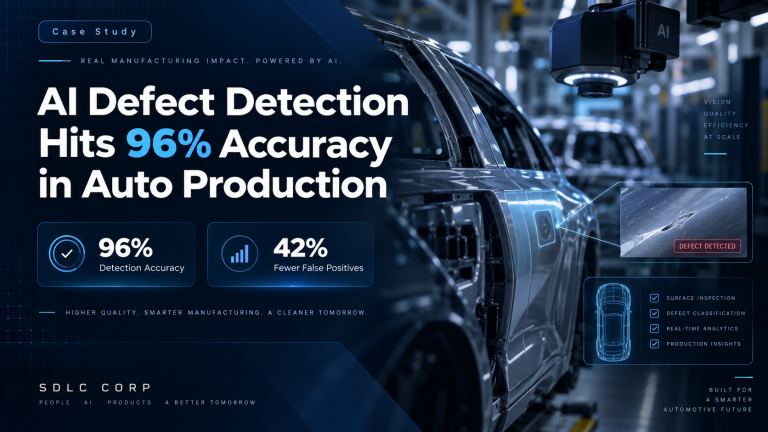
Predictive Maintenance for Manufacturing

A predictive analytics system uses time-series machine learning to identify equipment-failure risk before unplanned downtime occurs.

The model analyzes operational patterns and supports earlier maintenance intervention rather than waiting for equipment to fail.

  • TensorFlow
  • scikit-learn
  • Python
  • Time-Series Forecasting

Explore AI & ML Implementation
40%Reduction in Downtime and Maintenance Costs
02 / 03 Implementation
Recommendation Systems SDLC Corp

E-Commerce Recommendation Engine

A machine learning recommendation engine personalizes product suggestions using customer and product behavior.


The system helps digital-commerce teams improve relevance and increase the value of each customer session.

  • Python
  • scikit-learn
  • Cloud Infrastructure
Explore AI & ML Implementation
35%Increase in Average Order Value
03 / 03 Implementation
Predictive Analytics SDLC Corp

Enterprise Financial Forecasting

A financial forecasting platform uses custom machine learning models to analyze historical data, market signals and enterprise financial information.

The predictive layer supports faster forecasting and scenario analysis for finance leadership.

  • Custom ML models
  • Historical analysis
  • Market signals
  • Scenario modeling
  • Finance workflows
  • Enterprise integration
Explore Enterprise AI
3 Weeks → 2 DaysForecasting Cycle
34%Improvement in Forecast Accuracy
10+Revenue Scenarios
3 Weeks → 2 DaysForecasting Cycle
34%Improvement in Forecast Accuracy
10+Revenue Scenarios
Client Stories

What Clients Say
About SDLC Corp

Founders, CEOs, and operating leaders share what it's like to build with SDLC Corp.

Client story

Eric Leist

CEO, Edgerton Strategies

Client story

Doug Schmidt

CEO, Roofaid USA

Client story

Reyzal Razmi

All Star Influencers

What clients say
01 / 05
They approached our Salesforce discovery with real technical depth, uncovered structural gaps others missed, and delivered a solution that worked exactly as promised.
SDLC CORP built a mobile application that met our strategic requirements with strong technical execution. The solution performs reliably and has become an important operational asset.
They saw inefficiencies in our Salesforce workflow and redesigned our entire quote-to-cash system. We now operate faster, cleaner, and with better accuracy.
From planning to post-launch, SDLC Corp guided us every step of the way. Their support makes them more than a vendor. They're a trusted partner.
The SDLC Corp team scaled our platform with impressive technical expertise, ensuring it's secure, robust, and ready for future growth.
What clients say
01 / 05
The SDLC Corp team scaled our platform with impressive technical expertise, ensuring it's secure, robust, and ready for future growth.
From planning to post-launch, SDLC Corp guided us every step of the way. Their support makes them more than a vendor. They're a trusted partner.
They saw inefficiencies in our Salesforce workflow and redesigned our entire quote-to-cash system. We now operate faster, cleaner, and with better accuracy.
SDLC CORP built a mobile application that met our strategic requirements with strong technical execution. The solution performs reliably and has become an important operational asset.
They approached our Salesforce discovery with real technical depth, uncovered structural gaps others missed, and delivered a solution that worked exactly as promised.
Process

Our Machine
Learning Process

From prediction task to a model running inside a business workflow.

01

Discover

Define the prediction task, business outcome, available data and success metrics.

02

Assess Data

Review historical coverage, quality, labels and potential predictive features.

03

Prototype

Test multiple approaches before committing to a final model architecture.

04

Train and Evaluate

Train candidate models and compare performance against agreed metrics.

05

Integrate

Connect predictions with the business application or workflow where they will be used.

06

Deploy

Release the validated model into the required production environment.

07

Monitor

Track model performance and review when business conditions or data patterns change.

Why Us

Why Choose SDLC Corp
for Machine Learning

How we approach machine learning work.

Outcome

Business-Driven ML

Start with the decision or prediction the business needs instead of starting with an algorithm.

Custom

Custom Model Engineering

Build models around your actual data and operating context.

Integrate

Production Integration

Connect predictions to real applications and workflows.

Measure

Model Evaluation

Measure performance using representative unseen data and business outcomes.

Explain

Explainable Results

Use appropriate explainability techniques for workflows where model reasoning needs review.

Team

Specialist AI Teams

Connect ML projects with dedicated data, integration and AI engineering expertise when required.

Get Started

Build Your
Machine Learning Solution

Turn historical and operational data into predictions your teams and applications can use.

From forecasting and recommendation systems to anomaly detection and custom scoring models, our machine learning team can take your project from data assessment through production deployment.

Contact Us

Share a few details about your project, and we’ll get back to you soon.

Let's Talk About Your Project

FAQ

Machine Learning Development
FAQs

Straight answers on model types, data requirements, evaluation and how a machine learning project actually starts.

Machine learning development services cover the design, training, evaluation, integration and deployment of predictive models built around business data.

We can build classification, regression, forecasting, clustering, anomaly-detection, recommendation and scoring models.

Custom ML development means training and integrating a model around a specific business problem, dataset and measurable performance requirement.

Predictive analytics uses historical and current data to estimate future outcomes such as demand, churn, risk or equipment failure.

A recommendation system ranks products, content or other options according to expected relevance for a user or context.

Anomaly detection identifies observations or behavior that differ significantly from expected patterns.

No. Many business problems can be solved effectively with traditional machine learning methods.

The model architecture should match the data and the problem.

The required data depends on the target outcome.

A project typically needs representative historical information and a clear relationship between available inputs and the result the model is expected to predict.

Evaluation depends on the task.

Common measures include accuracy, precision, recall, F1 score, MAE, RMSE, ROC-AUC and business-specific performance metrics.

Yes. Predictions can be exposed through APIs and integrated with ERP, CRM, web applications, internal software and enterprise workflows.

Machine learning is a broad field covering predictive and pattern-recognition models across many types of data.

NLP focuses specifically on understanding and processing human language.

Machine learning often predicts or classifies based on existing data.

Generative AI creates new outputs such as text, images, video or code.

Production ML requires deployment, monitoring and lifecycle management.

Detailed MLOps is handled as a dedicated capability rather than as part of this page's scope.

Yes. We can review data quality, features, model selection, evaluation, thresholds, errors and production performance to identify where accuracy or reliability can improve.