
Data Engineering
Services
Build reliable data pipelines and platforms that make enterprise data usable for analytics, automation and AI.
We design, build and operate ingestion, ETL and ELT, warehouse and lakehouse layers, orchestration and pipeline monitoring — on the cloud platforms you already run.
Delivery at Scale
Trusted by Fortune Global 500 leaders, governments & top universities across 30+ countries

























Powered by leading cloud & AI platforms
 AWS
AWS Google Cloud
 Microsoft Azure
 NVIDIA
 OpenAI
 Anthropic
 Gemini
 Grok
Grok Perplexity
 Google AIAWSGoogle CloudMicrosoft AzureNVIDIAOpenAIAnthropicGeminiGrokPerplexityGoogle AI



Awards & industry recognition





Data Engineering
Services We Deliver
Design, build and operate the pipelines and platforms that move enterprise data from source systems to the teams and applications that depend on it.
Pipelines
Data Pipeline Development
Build batch and streaming pipelines that ingest from databases, APIs, files and event streams, with retries, idempotent loads and recovery paths.
Transformation
ETL & ELT Engineering
Implement transformation logic in the layer that fits the workload, with tested models, incremental builds and documented business rules.
Integration
Data Integration
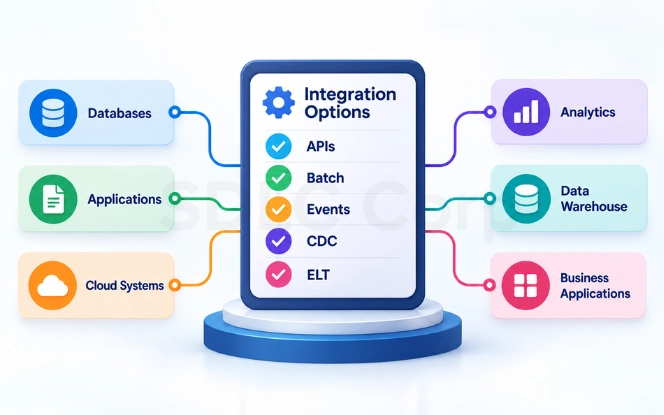
Connect ERP, CRM, finance, operational databases and third-party services into consistent datasets, including CDC and API-based extraction.
Storage
Warehouse & Lakehouse Engineering
Model and build warehouse, lake and lakehouse layers, from raw landing zones through conformed dimensions and serving tables.
Control
Data Orchestration
Express real dependencies rather than start times, with scheduling, retries, backfills, concurrency limits and clear run state.
Reliability
Data Quality & Observability
Instrument freshness, volume, schema and latency, so a pipeline that finishes without delivering correct data does not pass silently.
Data Engineering
Solutions
Common engagements, described by the outcome they deliver rather than the technology underneath.
Customer
Customer 360 Pipelines
Resolve customer records across CRM, billing, support and product systems into one identity-matched view that downstream teams can rely on.
Finance
Finance and Reporting Pipelines
Deliver the loads behind month-end close and statutory reporting, with reconciliation checks and a defined position on late-arriving data.
Operations
Operational Data Integration
Move data between ERP, warehouse management, logistics and field systems so operational teams work from the same numbers.
Analytics
Analytics Foundations
Build the modelled layer BI tools sit on, so metric definitions live in version control instead of inside individual dashboards.
AI
AI-Ready Data Pipelines
Supply training and inference workloads with documented lineage, stable schemas and the freshness guarantees a model actually needs.
Streaming
Real-Time Event Pipelines
Process event streams for operational dashboards, alerting and time-sensitive decisions, with replay and ordering handled explicitly.
What Data
Engineering Improves
The operational changes enterprises see once pipelines are engineered rather than accumulated.
Reliability
Reliable Data Delivery
Loads land inside their window, failures surface as alerts rather than discoveries, and recovery does not depend on one person.
Speed
Faster Analytics
Modelled, tested tables replace ad-hoc extracts, so new reports start from existing datasets instead of new plumbing.
Effort
Fewer Manual Data Processes
Scheduled jobs, validated loads and automated reconciliation replace spreadsheets, manual exports and overnight babysitting.
Consistency
Consistent Data Models
One definition per metric, versioned alongside the pipeline that produces it, so finance and operations stop arguing about whose number is right.
Freshness
Fresher Operational Data
Latency is set against the decision it supports, from nightly batch to sub-minute streams, rather than inherited from an old schedule.
AI
Improved AI Readiness
Documented lineage, stable schemas and quality checks turn raw estate data into something a model can be trained and evaluated on.
Data Engineering
Architecture
A reference flow for enterprise data platforms. Each stage is a place where reliability is either engineered in or lost.
Stage 01
Ingestion
Extract from databases, APIs, files and event streams using the method each source supports, including change data capture where available.
Stage 02
Transformation
Apply cleansing, conformance and business logic as tested, version-controlled models rather than embedded scripts.
Stage 03
Storage
Land raw data, build conformed layers and expose serving tables shaped for the queries that actually run against them.
Stage 04
Quality
Validate freshness, volume, schema and referential integrity at the point data enters each layer, with defined failure handling.
Consumption covers BI and reporting, analytics workloads, operational applications and AI or machine learning systems. The serving layer is shaped by which of those a dataset is built for.
ETL and ELT
Engineering
Both patterns are in scope. The decision is where transformation belongs for a given source, not which approach is modern.
ETL
Transform Before Load
Used where data must be masked, tokenised or validated before it reaches the warehouse, or where the destination cannot transform at scale.
ELT
Transform After Load
Used where the warehouse or lakehouse has the compute, and keeping raw data available makes reprocessing and auditing cheaper.
Hybrid
Mixed by Source
Both patterns coexist in one estate. Sensitive feeds transform in flight while everything else lands raw and is modelled in place.
For a detailed comparison of the two patterns, including cost, governance and reprocessing trade-offs, see our guide to ETL vs ELT for enterprise data pipelines.
Batch and Real-Time
Pipelines
Latency is a requirement set by the decision a dataset supports, and it drives the engineering decisions that follow.
Batch
Scheduled Batch Pipelines
Windowed loads for reporting, finance and analytics, where correctness and reconciliation matter more than minutes.
Micro-batch
Frequent Incremental Loads
Minute-scale refreshes for operational dashboards and inventory views, without the state management a stream requires.
Streaming
Event-Driven Pipelines
Sub-second processing where the business must react to individual events, with ordering, replay and idempotency handled explicitly.
Streaming adds state, replay and ordering concerns that batch does not have. Our guide to real-time data architecture for enterprise AI covers when that cost is justified.
Warehouse, Lake
and Lakehouse
We engineer across all three patterns, including estates that run more than one of them side by side.
Warehouse
Data Warehouse Engineering
Modelled, governed tables for reporting and analytics, with defined grain, conformed dimensions and predictable query performance.
Lake
Data Lake Engineering
Cost-effective storage for raw, semi-structured and high-volume data that has to be retained and reprocessed.
Lakehouse
Lakehouse Implementation
Open table formats over object storage, giving transactional guarantees and schema evolution without duplicating data into a separate warehouse.
The selection depends on workload mix, governance requirements and existing cloud commitments. See data warehouse vs data lake vs data lakehouse for the trade-offs.
Data
Orchestration
Orchestration is what turns a set of jobs into a platform with predictable behaviour when something goes wrong.
Dependencies
Real Dependency Graphs
Tasks run when their inputs are ready, not when the clock says so, which removes the stale-input failures that scheduled jobs hide.
Scheduling
Scheduling and Triggers
Time-based, sensor-based and event-based triggers, with clear ownership of what starts a run and what blocks it.
Recovery
Retries and Failure Handling
Retry policies matched to failure type, so a transient API timeout and a schema change are not treated the same way.
Backfills
Backfills and Reprocessing
Idempotent tasks and concurrency caps, so a thirty-day rebuild does not overwhelm shared warehouse capacity.
Workflow
Workflow Control
Run state, task-level logging and lineage between jobs, so an incident can be traced to the stage that caused it.
Isolation
Environment Separation
Development, staging and production pipelines separated at the orchestration layer rather than by naming convention.
Our guide to data orchestration for modern data platforms covers dependency modelling, idempotency and migration from scheduled jobs.
Data Quality
and Observability
A pipeline can finish successfully and still deliver nothing. Observability is what makes that visible before a consumer finds it.
Freshness
Freshness Monitoring
Per-dataset expectations for when data should have arrived, checked against the consumer that depends on it.
Volume
Volume and Completeness
Row counts and per-partition presence checks, so a missing region or an empty file is caught before it reaches a report.
Schema
Schema Drift Detection
Column additions, type changes and renames surfaced at ingestion rather than discovered as a downstream failure.
Latency
Latency and Runtime
Stage-level runtime tracking, so gradual degradation is visible before it breaches a delivery window.
Failures
Pipeline Failure Handling
Alerting routed to owners with enough context to act, and dead letter queues treated as a first-class check.
Operations
Operational Monitoring
Run identifiers propagated through every stage, so a vague complaint becomes a specific answer about which run produced the data.
See data pipeline monitoring and observability for the signals, thresholds and incident practice behind this work.
Legacy Pipeline
Modernization
Replacing pipelines that still produce numbers the business depends on, without breaking a single report.
Assess
Inventory and Lineage
Map every pipeline, its real consumers and the business rules buried in stored procedures and scripts before anything is rewritten.
Decide
Retain, Replatform, Refactor, Replace
Treat each pipeline independently, and choose the option the evidence supports rather than rewriting the whole estate.
Validate
Parallel Run and Cutover
Run old and new side by side, reconcile outputs, and keep the legacy flow available until consumers confirm stability.
The engineering sequence is set out in our guide to modernizing legacy data pipelines. Where the work is part of a wider programme covering governance, operating model and enterprise AI readiness, that belongs with Enterprise Data & AI Modernization.
Cloud Data
Engineering
We build on the cloud platforms and data warehouses our clients already run, rather than moving them onto a preferred stack.
AWS
AWS Data Engineering
Pipelines and storage layers built on AWS data services, including object storage, managed compute and Redshift.
Azure
Azure Data Engineering
Data platforms on Azure, covering managed pipelines, lake storage and warehouse or Fabric-based serving layers.
Google Cloud
Google Cloud Data Engineering
Ingestion, transformation and serving on Google Cloud, with BigQuery as the analytical layer where it fits.
Snowflake
Snowflake Engineering
Warehouse modelling, incremental transformation and workload separation on Snowflake.
Databricks
Databricks and Lakehouse
Spark-based processing and open table formats for lakehouse platforms that serve both analytics and machine learning.
Hybrid
Hybrid and On-Premise
Pipelines that span on-premise systems and cloud platforms, including estates where data residency constrains where processing can run.
Data Engineering
Technology Stack
Established tools chosen for the workload and the platform a client already operates.
Batch and distributed transformation engines.
Dependency-aware scheduling and workflow control.
Event transport and stream processing.
Analytical platforms and warehouses.
Operational databases, object storage and table formats.
Validation, testing and metadata.
Data Engineering
Across Industries
Sectors where we build and operate enterprise data pipelines.
Financial Services
Financial Services
Reconciliation-heavy pipelines, regulatory reporting feeds and auditable transformation logic. Payment workflows can be designed around applicable PCI DSS requirements.
Logistics
Logistics and Supply Chain
Shipment, document and telemetry pipelines feeding operational visibility across carriers and sites.
Retail
Retail and E-commerce
Order, inventory and clickstream integration across marketplaces, stores and fulfilment systems.
Manufacturing
Manufacturing
Production, quality and maintenance data joined with ERP for operational and analytical use.
Healthcare
Healthcare
Integration across clinical and administrative systems, with access control and residency treated as engineering requirements. HIPAA-aligned controls can be applied where US healthcare data is involved.
SaaS
SaaS and Technology
Product event pipelines, usage analytics and customer data platforms built for scale.
Data Engineering
in Practice
Integration and data quality work from SDLC Corp engagements, described as delivered.
Manufacturing · CRM Data Bridge
Hercules Industries: ActiveCampaign–Phocas Data Bridge
Cleaned 5,000+ CRM account and contact records, standardized 13 fields and defined match keys to create a repeatable import framework for Phocas reporting updates, delivered in three months.
Read the case studyMembership · Scheduled Sync
Outdoor Adventures: Salesforce to ActiveCampaign Sync
Replaced manual CSV exports with a daily one-way middleware sync of member, account and lead records, with custom field mapping, bulk writes, transaction-logged runs and failure alerts.
Read the case studyNonprofit · Event-Driven Validation
No Baby Blisters: Real-Time Email Verification
Built an event-driven webhook and API connector that validates every new contact before it settles in the CRM and tags the result, improving data quality at the point of ingestion.
Read the case studyEngineering
at Scale.
The delivery capacity behind our engineering work.
Our Data
Engineering Process
Seven stages from discovery to steady-state operation.
Discover
Define the decisions the data supports, the consumers who depend on it, and the delivery windows that matter.
Assess Data
Profile sources, quantify quality, and record the business rules currently buried in scripts and stored procedures.
Design Architecture
Choose ingestion methods, transformation layer, storage pattern and latency targets, then document the contract between layers.
Build Pipelines
Implement ingestion, transformation and load with tested models, idempotent tasks and version-controlled logic.
Validate Data
Reconcile against source systems, run parallel where a legacy flow exists, and clear every validation gate before cutover.
Deploy
Promote through environments with orchestration, access control and rollback defined in advance.
Monitor
Operate with freshness, volume, schema and latency checks, alert routing and an owner for every dataset.
Why Choose SDLC Corp
for Data Engineering
One team for ingestion, transformation, orchestration and the operational practice that keeps it all running.
Production
Production Engineering
Pipelines built to run unattended, with failure handling, recovery and ownership defined before go-live rather than after the first incident.
Integration
Enterprise Integration Depth
Experience connecting ERP, CRM, finance and operational systems, including the awkward sources that have no clean API.
Flexibility
Cloud and Platform Flexibility
We build on the platform a client already runs, across AWS, Azure, Google Cloud, Snowflake and Databricks.
Quality
Data Quality by Default
Validation, reconciliation and testing are part of the pipeline, not a separate project added once numbers are questioned.
Observability
Observability Built In
Freshness, volume, schema and latency instrumented from the start, so silent failures do not reach consumers.
AI
AI-Ready Foundations
Lineage, stable schemas and documented quality, so analytics and AI workloads can both be served from the same platform.
Security, Privacy and Responsible AI
Applicability depends on geography, industry, the data processed, the deployment model, the use case and your own legal and regulatory obligations.
Services Related to
Data Engineering
Adjacent practices that sit either side of data engineering.
Modernization
Enterprise Data & AI Modernization
Organization-wide modernization programmes, roadmaps, governance and operating-model change.
Explore Enterprise Data & AI ModernizationAI
AI Development Services
Custom AI applications built on the data foundations engineering provides.
Explore AI Development ServicesML
Machine Learning Development
Predictive, forecasting, recommendation and anomaly detection models.
Explore Machine Learning DevelopmentIntegration
AI Integration & Implementation
Putting AI capabilities into ERP, CRM, applications and workflows.
Explore AI Integration & ImplementationData Engineering
Resources
Engineering guides on pipelines, orchestration, observability and the architecture they sit in.
 Transformation
ETL vs ELT for Enterprise Data Pipelines
Where transformation belongs for each source, and how hybrid estates run both patterns.
Read Article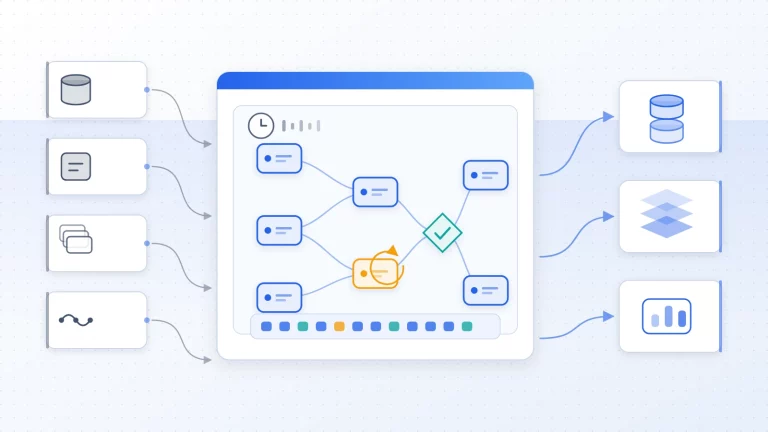 Orchestration
Data Orchestration for Modern Data Platforms
Dependencies, idempotency, backfills and migrating away from time-based scheduling.
Read Article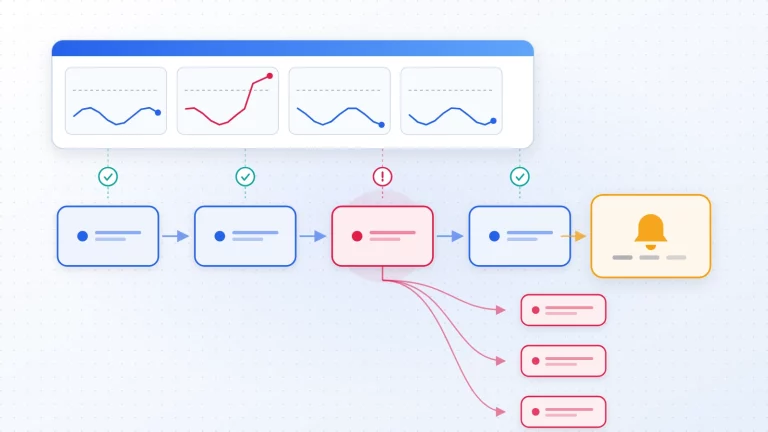 Observability
Data Pipeline Monitoring and Observability
Freshness, volume, schema and latency signals, and how to catch silent pipeline failures.
Read Article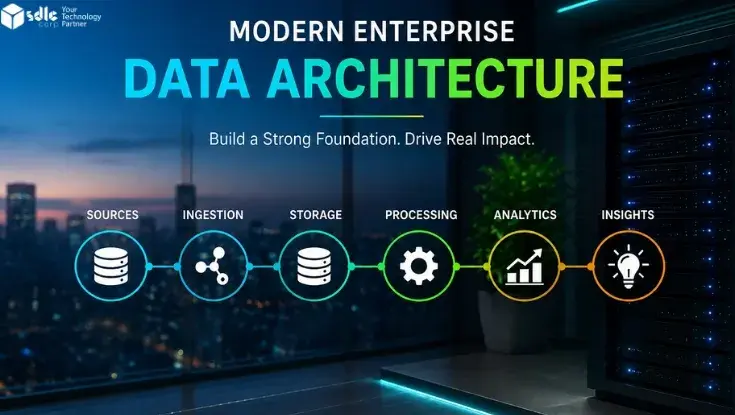 Architecture
Modern Enterprise Data Architecture Explained
The layers of a modern data platform and how ownership and contracts hold them together.
Read Article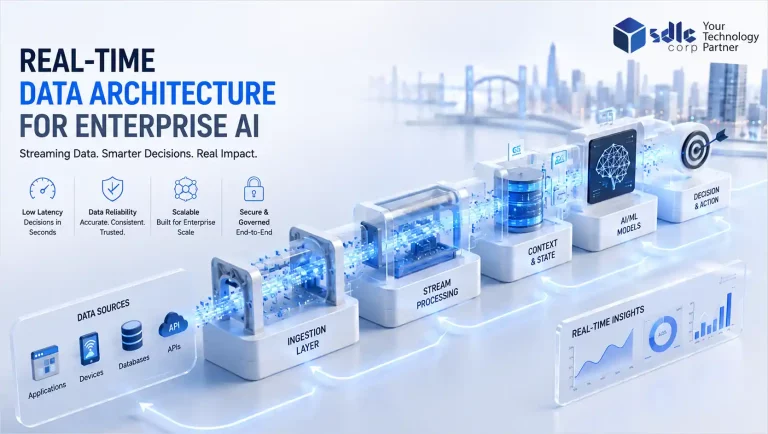 Real-Time
Real-Time Data Architecture for Enterprise AI
When streaming is justified, and the state, replay and ordering concerns it introduces.
Read Article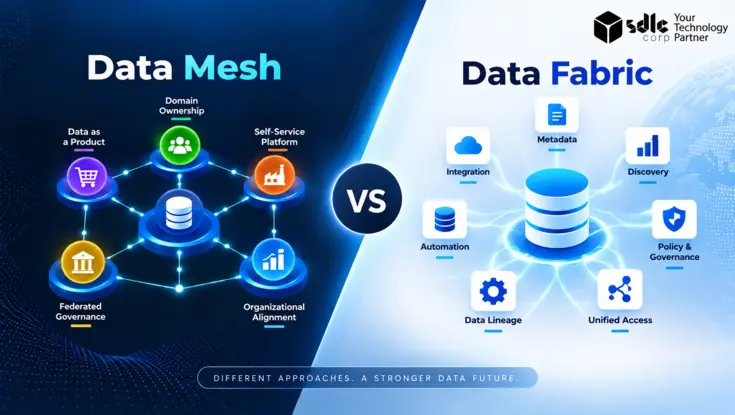 Architecture
Data Mesh vs Data Fabric for Enterprise AI
How domain-owned data products compare with a centrally integrated, metadata-driven fabric, and when each fits.
Read ArticleBuild a Reliable
Data Foundation
Build pipelines and platforms that keep analytics, applications and AI supplied with reliable enterprise data.
Tell us which sources, systems and delivery windows you are working with, and we will come back with an architecture and a delivery plan.
Contact Us
Share a few details about your project, and we’ll get back to you soon.
Let's Talk About Your Project
- Free Consultation
- 24/7 Experts Support
- On-Time Delivery
- sales@sdlccorp.com
- +1(510-630-6507)