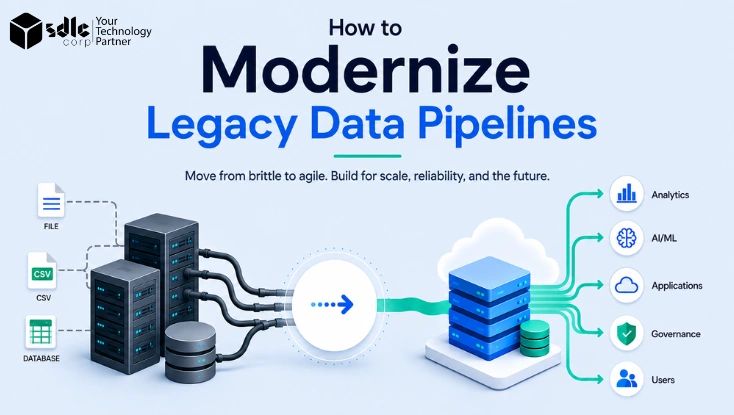
Legacy data pipeline modernization works best as a risk decision, not a rebuild project. So start by learning what the current pipeline does, who depends on it, and where a failure would hurt the business.
Most modernization programmes stall because they begin with tooling. Instead, begin with facts. Map every source, rule and consumer first. Then decide, pipeline by pipeline, whether to retain, replatform, refactor or replace it.
Because each option carries a different cost and a different rollback risk, one shared decision table keeps the programme honest.
This guide gives you that framework in a usable order: inventory and lineage, disposition scoring, three proven migration patterns, validation gates, a worked example, and the mistakes that derail most migrations.
The scope here is deliberately narrow. This article works at pipeline level: one flow, its consumers, its cutover. Estate-level questions sit one layer above it.
For workload scoring across the whole data estate, target cloud architecture and migration waves, read the companion guide to cloud data modernization strategy.
- Modernize a pipeline because it is fragile, not because it is old.
- Score each pipeline, then choose retain, replatform, refactor or replace.
- Map lineage and consumers before you change any code.
- Run old and new pipelines together, and clear every validation gate.
- Keep the legacy flow ready until consumers confirm stability in writing.
Treat each pipeline independently. Retain it when it is reliable and supportable. Replatform it when the runtime is the constraint. Refactor it when logic and observability need work.
Replace it only when the design can no longer meet business or operational requirements.
Signs a Pipeline Needs Modernization
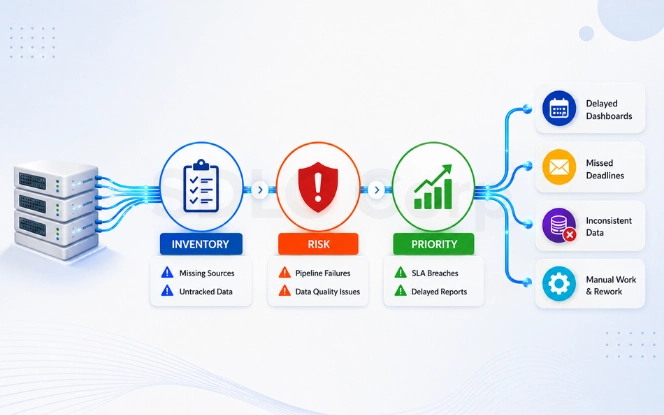
Operational signals give you the clearest warning. Frequent failures, manual restarts and repeated data workarounds all point to systemic fragility. Long processing windows are a second warning.
When a backlog pushes a report into the next business day, the design no longer meets its SLA.
Technical signals matter just as much. Watch for end-of-life components, single-person knowledge of critical steps, missing environment separation, and no automated tests or version control. Each one raises mean time to repair.
As a result, a small source change can become a business incident. Weak lineage then makes the downstream impact hard to trace.
Where the underlying environment is the real blocker, an IT infrastructure consulting review usually surfaces it faster than another round of pipeline patches.
Business signals are subtler. Look for inconsistent report metrics, unexplained movements in totals, and slow onboarding of new sources or consumers.
A pipeline that breaks only after a schema change is still risky, because it looks stable until the impact is large. Therefore, prioritize the flows that feed decisions or regulatory reporting.
- Frequent manual interventions or daily restarts required to keep the flow running.
- Unsupported software components or scripts with no test coverage.
- No documented owners or on-call rotations for pipeline incidents.
- Processing windows that exceed business reporting deadlines.
- Reports or dashboards show inconsistent metrics for similar datasets.
Operational fragility justifies modernization. Age on its own does not.
Why a Full Rewrite Is Often the Wrong Approach
A full rewrite looks clean on a slide. In practice, it moves every risk onto a single date. You rebuild logic nobody documented, you re-test years of edge cases, and you ask the business to trust one large cutover.
Incremental change works better for most estates. The strangler fig pattern describes the idea well: route one slice at a time to the new flow, and keep the old flow alive until that slice proves itself.
Consequently, every release stays small, reversible and easy to explain to a business owner. That sequencing is also easier to fund, which is why most digital transformation consulting engagements phase delivery rather than schedule one large switch.
- Hidden rules get lostLegacy pipelines carry undocumented fixes. A rewrite drops them quietly, and finance discovers the gap at month end.
- Value arrives too lateA rewrite delivers nothing until the final switch. Slices, by contrast, deliver measurable reliability every sprint.
- Rollback becomes expensiveOne large cutover is hard to reverse. A single routed slice rolls back in minutes, with a known blast radius.
Reserve the rewrite for genuine dead ends. For example, choose it when the platform is unsupported, when licensing blocks you, or when the current design simply cannot meet a new latency or compliance requirement.
Modernize in slices by default. Rewrite only when the existing design cannot be saved.
Inventory Sources, Logic and Consumers
Build a structured inventory for every pipeline. Record source systems, extraction schedules, transformation logic, destinations and known consumers. Capture owner contacts, SLAs, failure modes and recovery steps.
Also record retention policy and any business rule that lives outside code, such as a spreadsheet override or a hard-coded threshold.
Include downstream dependencies: reports, dashboards, downstream pipelines, APIs and third-party consumers. Mark which fields feed regulatory reports or critical operations. Where possible, attach sample rows that show real business exceptions.
These samples make validation concrete, and they cut the number of repeated business questions during testing.
Record the nonfunctional constraints too: peak volumes, latency needs, windowed loads and upstream change frequency. Keep a change log of schema changes and past migrations.
A complete inventory removes blind spots at cutover, and it feeds a prioritization model that balances risk, cost and business value.
Map Data Lineage and Dependencies
An inventory tells you what exists. Lineage tells you what breaks. So trace each significant field from its source column to the final report, and record every hop between them.
Start from the loudest consumers, then work backwards. Query warehouse logs, BI metadata and scheduler dependencies to find real usage rather than assumed usage.
Next, confirm that list with the named owners, because extracts and dashboards often outlive the people who built them. Open standards such as OpenLineage let you capture much of this automatically instead of by interview.
- Column-level lineage for every field used in financial or regulatory output.
- Job-level dependencies, including upstream schedules and downstream triggers.
- A consumer register covering reports, APIs, extracts, partners and downstream pipelines.
- Shadow dependencies such as spreadsheets, email exports and manual overrides.
- Last-access evidence, so you retire dead outputs instead of migrating them.
Then record the operational detail that engineers need on day one.
- Source system, authentication method, schedule and typical row volumes.
- Transformation summary, business rules, and where each rule is implemented.
- Downstream consumers, reports and the SLAs tied to the output.
- Known exceptions, reconciliations and who approves business rule changes.
- Runbook entry: failure detection, restart steps and escalation contacts.
Source schemas and target models often need work of their own at this stage. Our data engineering services cover that modelling layer alongside the pipeline itself.
A complete inventory plus real lineage stops you from replacing visible components while missing hidden dependencies.
Choose Retain, Replatform, Refactor or Replace
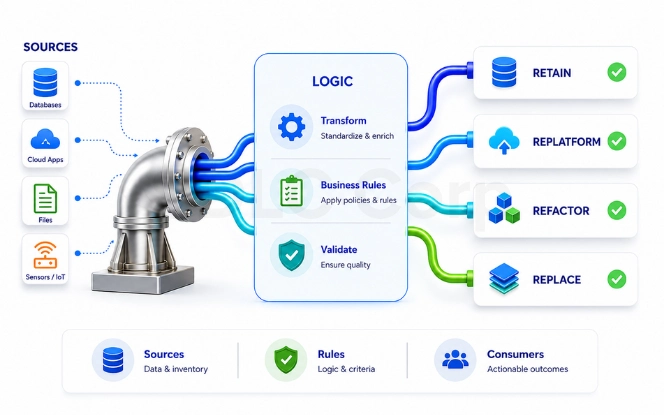
Make the decision at pipeline level, and make it with a table. Score supportability, operating cost, target-architecture fit and business impact. Retain a pipeline when it is observable, supportable and still fits future needs.
Replatform it when the infrastructure causes most of the pain but the transformation logic remains sound.
Refactor when transformations are hard to test, poorly modularized or unable to recover cleanly. Replace when the logic is unreliable, the platform is unsupported, or new requirements demand schema evolution, event-driven processing or stronger access controls.
Above all, decide against measurable criteria rather than developer preference.
The 4R Decision Table
| Option | Choose it when | Typical effort | Rollback risk | Watch out for |
|---|---|---|---|---|
| Retain | The flow is supported, observable, cheap to run and rarely changes. | Under 1 engineering week | Low | Quiet drift in undocumented business rules. |
| Replatform | Infrastructure causes the pain, while the transformation logic still works. | 3 to 8 engineering weeks | Low | Runtime differences in dates, sorting, rounding and types. |
| Refactor | Logic is sound but hard to test, modularize, observe or recover. | 6 to 16 engineering weeks | Medium | Scope creep that turns the work into a rewrite. |
| Replace | The platform is unsupported, or the design cannot meet new requirements. | 16 to 40 engineering weeks | High | Lost business rules and long, costly parallel runs. |
Record the rationale for each decision alongside estimated effort, rollback complexity and any backfill you will need. That record keeps planning realistic. It also stops the team from spending migration budget on low-risk pipelines that add little value.
Score these five fields for every candidate pipeline:
- Risk score, based on failure frequency and support gaps.
- Business impact, weighted for regulatory and financial output.
- Effort estimate in engineering weeks, benchmarked against the ranges above.
- Rollback complexity, from routed switch to full backfill.
- Backfill volume and the window it needs.
When the runtime is the deciding factor, plan the replatform inside your wider cloud transformation roadmap. Platform choices then stay consistent across pipelines instead of drifting per team.
Select the migration path from risk, value and dependency scores. Never from pipeline age.
Design the Target Pipeline Pattern
Pipeline-modernization boundary: This section covers disposition, redesign, reconciliation, cutover, rollback and ongoing ownership for an existing pipeline estate. API and event-pattern selection sits outside that boundary, in the companion guide to enterprise data integration strategy.
Here, you apply the selected pattern safely to a legacy flow.
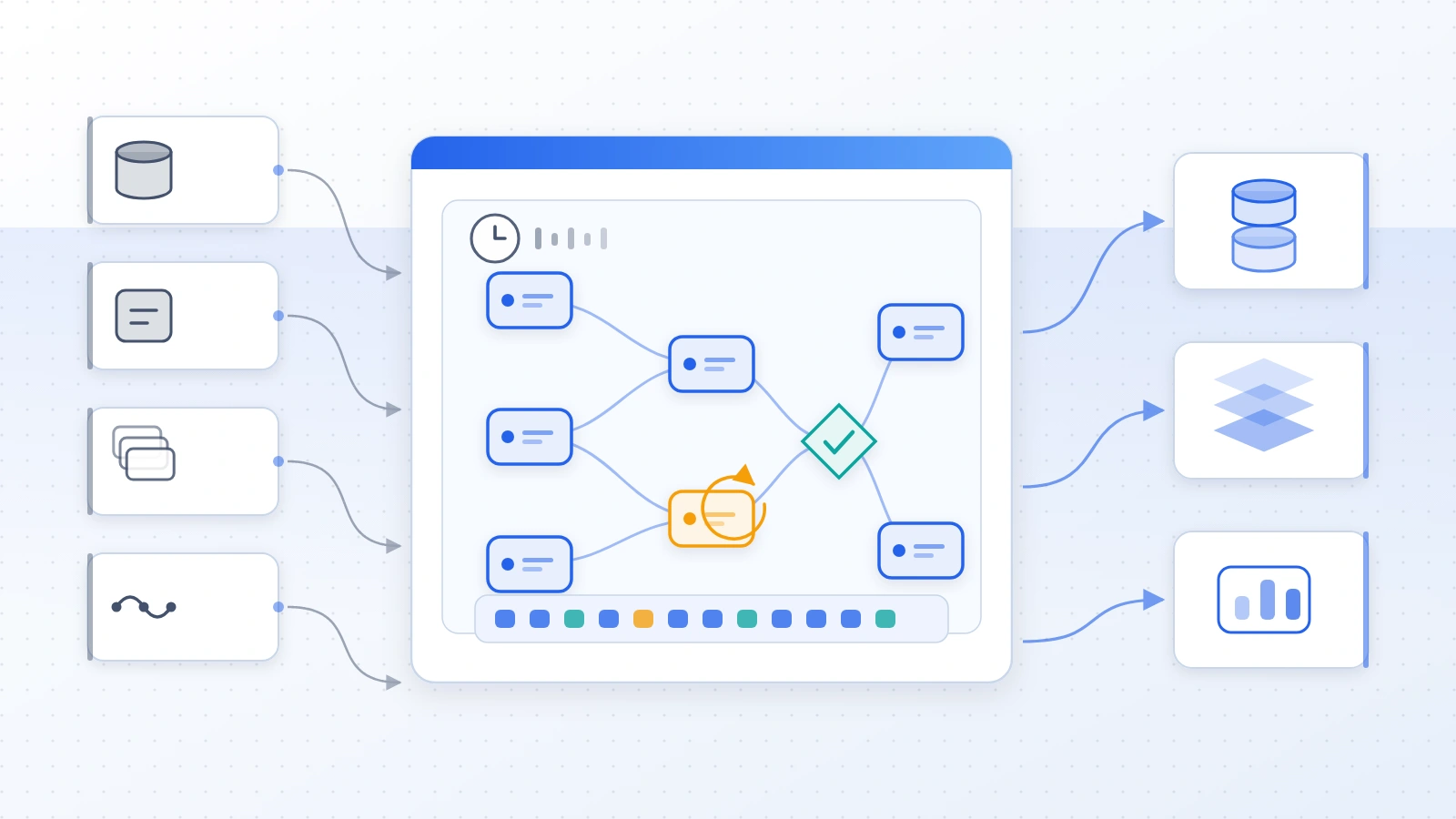
Define the target pipeline in operational terms: ingestion mechanism, validation points, transformation layering, storage model and monitoring. Separate reusable transformations, such as cleansing and normalization, from source-specific logic. Teams can then reuse components instead of duplicating them.
Document the expected SLA and the recovery approach for each failure class.
Choose batch, micro-batch, near-real-time or event-driven processing from business need. For example, a financial close tolerates a batch window with strong reconciliation, while fraud detection needs near-real-time ingestion and alerting. Avoid a single house pattern.
Instead, assign a pattern per pipeline, and include scalability and cost limits in the design.
Cover the nonfunctional design as well: idempotency, schema evolution, versioning, environment promotion and access control. Provide a before-and-after diagram that shows where lineage, test hooks and reconciliation points now sit.
Publish the output contract explicitly too, because many consumers reach the data through service endpoints rather than tables. Our API development and integration services cover that contract and versioning layer in more detail.
Three Common Modernization Patterns
- Parallel run with routed cutoverBuild the new flow beside the old one, then move consumers group by group and compare outputs on every cycle. Best for finance and regulatory reporting.
- Replatform first, refactor laterMove the existing logic to a supported runtime, then improve transformations behind a stable contract. Best when the runtime is end of life and the date is fixed.
- Layered rebuild behind a stable contractKeep the published output identical, but rebuild internals as ingest, canonical, business and publish layers. Best when logic is tangled and consumers cannot change.
- Layer transformations: ingest, canonicalize, apply business rules, then publish.
- Define validation gates at source ingestion and before publish to consumers.
- Specify SLA, expected latency and recovery time objectives per pipeline.
- Document the schema evolution and backward compatibility strategy.
- Add versioning and environment promotion to support safe deployments.
Map every design pattern to a business SLA, and give each one an explicit recovery strategy.
Validate Data and Business Rules
Technical completion does not prove correctness. So run the legacy and new pipelines in parallel. Compare record counts, row-level hashes, aggregates and key business fields.
Test the normal path, the exceptions and the historical edge cases that once needed a manual fix.
Reconciliation needs a documented process, named owners and written acceptance criteria. Triage every difference into one of four buckets: an acceptable semantic change, a fixable bug, a timing effect or genuine data loss.
For semantic changes, get written approval from the business owner and record the reason. For data loss, define the repair or rollback action immediately.
Use Four Validation Gates
| Gate | Runs when | What it checks | Pass criteria |
|---|---|---|---|
| 1. Ingestion | Every load | Row counts, schema conformity, null rates, data types. | Row counts land within 0.1% of the source, financial control totals match at 0% variance, and no schema break appears. |
| 2. Transformation | After business logic runs | Row-level hashes, key field comparison, exception handling paths. | Zero unexplained differences across the compared keys. |
| 3. Business reconciliation | Weekly during the parallel run | Control totals, aggregates, historical edge cases, period-end runs. | The business owner signs off on every accepted difference. |
| 4. Consumer acceptance | Before legacy retirement | Reports, extracts, APIs and downstream jobs on real output. | Each named consumer confirms the output in writing. |
Set the Gate 1 tolerance in writing before the first comparison run. A workable default is 0.1% on row counts for operational data, and zero variance on any figure that reaches a financial or regulatory report.
Late-arriving records are the usual cause of a small gap, so record the reason rather than widening the tolerance.
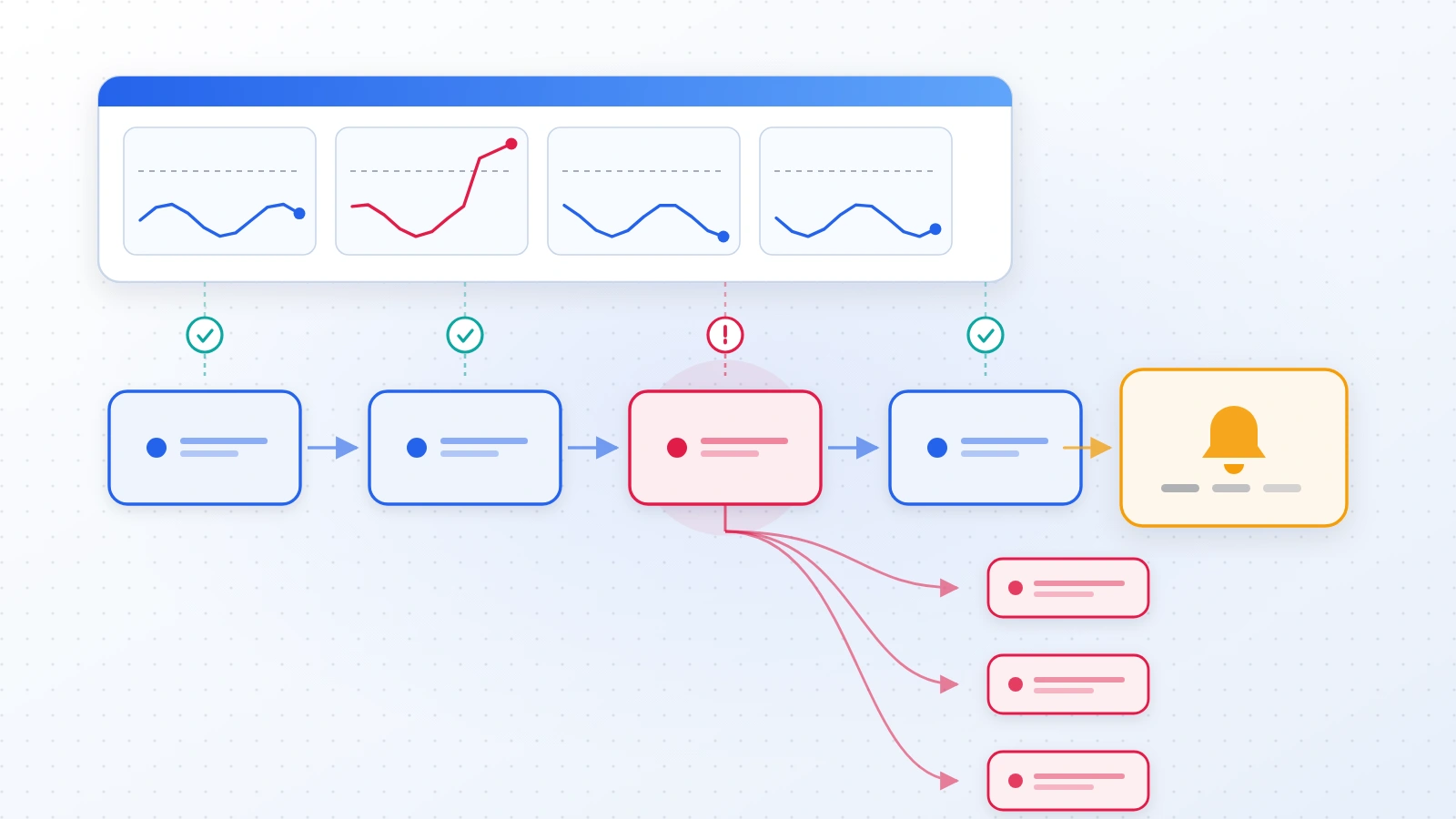
Automate these checks wherever practical. Store the baseline evidence too, including histograms, null counts and sample mismatches. Give engineers and QA a flow diagram that shows where each gate runs, how alerts fire, and which approval finally allows retirement.
Above all, keep the comparison window long enough to catch periodic exceptions such as month-end and year-end. Teams without spare QA capacity often run this phase with software testing services so the parallel run is not squeezed by delivery deadlines.
- Run both pipelines and compare counts, totals, hashes and key fields.
- Include historical backfill checks and exception case simulations.
- Classify every difference: semantic change, bug, timing or data loss.
- Require documented sign-off from business owners for accepted changes.
- Automate validation reports, and retain artifacts for audit and rollback.
Reconciliation with business owners sits at the centre of a safe migration.
Plan Cutover and Rollback
Rehearse recovery before switching consumers
Use clear cutover stages: pre-cutover checks, a pilot for selected consumers, a full traffic switch, then a monitored stabilization window. For high-risk flows, roll out by consumer group or by account.
Before you begin, confirm the baseline evidence, the communication channels and the named on-call support.
Agree the rollback criteria in advance, and automate rollback where you can. The rules should state which failures trigger a reversal, how far to revert and who to tell first.
Meanwhile, keep the legacy pipeline available and ready to re-enable until the new flow clears several validation cycles and consumer confirmations.
Write the cutover sequence as an ordered checklist, and publish a static cutover diagram for engineers and operators. Include any data freeze, the required backfills and the expected monitoring duration.
A rehearsed cutover removes ambiguity during execution, and it speeds up incident resolution when something does go wrong. Named on-call cover for the switch window matters just as much.
Managed IT services can supply that cover without pulling your engineers onto a night rota.
- Pre-cutover: complete parallel validation and secure stakeholder sign-offs.
- Pilot: switch a small consumer set and monitor key metrics for one full cycle.
- Full switch: route production traffic after pilot success, then begin stabilization.
- Rollback triggers: data loss, critical consumer failures or unrecoverable exceptions.
- Keep the legacy flow operational until the agreed stability window passes.
For event-driven delivery semantics, replay and ordering limits, use the Apache Kafka references on delivery semantics and idempotence and partition-scoped ordering.
Define and rehearse both cutover and rollback before you schedule the switch.
A Worked Example: Nightly Finance Extract
Retailer, on-premise ERP to finance mart
A retailer runs a nightly extract from an on-premise ERP into a finance mart. The job is a 900-line stored procedure with three manual overrides. It fails about twice a week, so close reporting slips.
Stored procedure on an unsupported database, two restarts per week, a six-hour window, no tests and a single owner.
Layered pipeline on the managed warehouse, tested transformations, a ninety-minute window, alerting and a named owner.
Migration Timeline, Week by Week
- Week 1: inventory and lineageTrace 42 fields to three reports and one partner extract. Two dashboards show no access in twelve months, so drop them instead of migrating them.
- Week 2: dispositionScore the pipeline. The logic is sound, but the runtime is end of life. Therefore choose replatform first, then refactor.
- Weeks 3 to 5: build in parallelRebuild in four layers behind the same output contract. Add unit tests for the three manual overrides so they stop being tribal knowledge.
- Weeks 6 to 8: parallel runRun both flows nightly. Gates 1 and 2 pass from night four. Gate 3 then surfaces two differences: one rounding rule and one timezone shift.
- Week 9: classify and sign offFinance accepts the rounding change in writing. The timezone shift is a bug, so fix it and rerun a thirty-day backfill.
- Week 10: pilot cutoverSwitch the partner extract first. Monitor freshness, volume and failure rate across one full cycle before going further.
- Weeks 11 to 12: full switchRoute all remaining consumers. Keep the legacy job scheduled but paused, with a documented restart path.
- Week 13: retireRetire the legacy job only after a clean month-end close and written confirmation from every consumer.
The result: the window falls from six hours to ninety minutes, and restarts drop from two per week to none in the first quarter.
The three manual overrides also moved into scheduled logic through workflow automation services, so nobody has to remember them at close.
Common Modernization Mistakes
Most failed migrations repeat the same small set of errors. Review this list at the start of each pipeline, and again before every cutover.
- Starting with the toolTeams pick a platform, then discover the business rules. Do discovery first, because the rules shape the target design.
- Migrating dead outputsUnused reports get rebuilt because nobody checked last access. Retire them instead, and cut the scope immediately.
- Skipping the parallel runA short comparison window misses month-end, quarter-end and year-end behaviour. Those are exactly the runs that matter.
- Treating every difference as a bugSome differences are correct improvements. Classify each one, then get written sign-off rather than silent acceptance.
- Retiring the legacy flow too earlyKeep it warm and restartable until consumers confirm stability. Otherwise a rollback becomes a rebuild.
- Leaving ownership undefinedA pipeline without a named owner and an on-call path drifts straight back into the fragility you just removed.
Scope discipline and a long enough parallel run prevent most migration incidents.
Operate and Improve the Modern Pipeline
A migration is complete only when the pipeline is ready to run. Monitor availability, freshness, volume, quality and recovery time. Tune alerts to real business impact rather than noise. Set on-call rotations and incident playbooks for the common failures.
Include a runbook for manual reconciliation when automation cannot resolve an issue. Downstream reporting has to stay trustworthy after the switch too, which is where business intelligence services connect the new pipeline to the dashboards people actually use.
Next, shift the team toward removing root causes. Track recurring incidents, prioritize permanent fixes and reserve sprint capacity for reliability work. Add tests for the edge cases that failed before, and run them in CI so regressions never reach production.
Keep a living backlog of the technical debt that actually affects reliability and cost. Engineering practices such as version control, code review and automated testing for transformations, described in dbt Labs guidance on pipeline best practices, apply directly here.
Continuous improvement also needs governance. Set SLOs, run post-incident reviews with owners and action items, and measure success by fewer incidents, faster recovery and lower operational overhead.
Finally, update the inventory, runbooks and validation artifacts after every change, and use the mistake list above during operational onboarding.
- Monitor freshness, availability, volume and key quality metrics per pipeline.
- Tune alerts to actionable thresholds, and avoid alert fatigue.
- Establish on-call responsibilities and incident playbooks for fast response.
- Fix recurring incidents permanently instead of repeating manual workarounds.
- Maintain a reliability backlog, and update inventories after each change.
Measure migration success as sustained operational reliability, not as deployment completion.
Conclusion
Legacy data pipeline modernization is a risk-managed programme, not a rebuild. Start with lineage and prioritization. Then apply the right option per pipeline: retain, replatform, refactor or replace, decided with a shared table rather than opinion.
Safety comes from the validation gates and a reversible cutover. Run both flows together, get business sign-off on every accepted difference, and keep the legacy pipeline warm until consumers confirm stability.
Success then shows up as fewer incidents, faster recovery and pipelines you can change without disrupting the business.
Share your current pipeline estate, and our data engineering team will map lineage, score each flow against the 4R framework, and outline a validated migration path with rollback built in.
Talk to a Data Engineering ExpertFrequently Asked Questions
What Is Legacy Data Pipeline Modernization?
It is the process of improving or replacing outdated data flows so they become reliable, testable, observable and aligned with the target architecture. A practical program includes discovery, prioritization, parallel validation and controlled cutovers with rollback criteria.
Should Every Legacy Pipeline Be Rebuilt?
No. Stable, well-supported pipelines can be retained or replatformed if their logic is sound and meets SLAs. The decision table should weigh supportability, operational cost, dependency risk and business impact to choose the right action.
How Should Old And New Pipelines Be Compared?
Run both in parallel and compare deterministic checks: record counts, row-level hashes, aggregates, key fields, and exception handling. Include historical cases and require business owners to sign off on any accepted semantic changes before retirement.
What Is The Biggest Migration Risk?
Hidden dependencies and undocumented business rules are common causes of disruption. An incomplete inventory or missing consumer mapping can lead to surprises at cutover; prioritize discovery and traceability to reduce this risk.
When Can The Legacy Pipeline Be Retired?
Retire only after completing agreed validation cycles, receiving downstream consumer confirmation, and observing stable monitoring metrics for the agreed stabilization window. Ensure rollback options remain documented for a specified period after retirement.
Does Pipeline Modernization Require Real-Time Processing?
No. Choose batch, near-real-time or event-driven patterns according to business requirements. Real-time is appropriate when latency materially affects decisions; otherwise, batch or micro-batch is often simpler and more cost-effective.
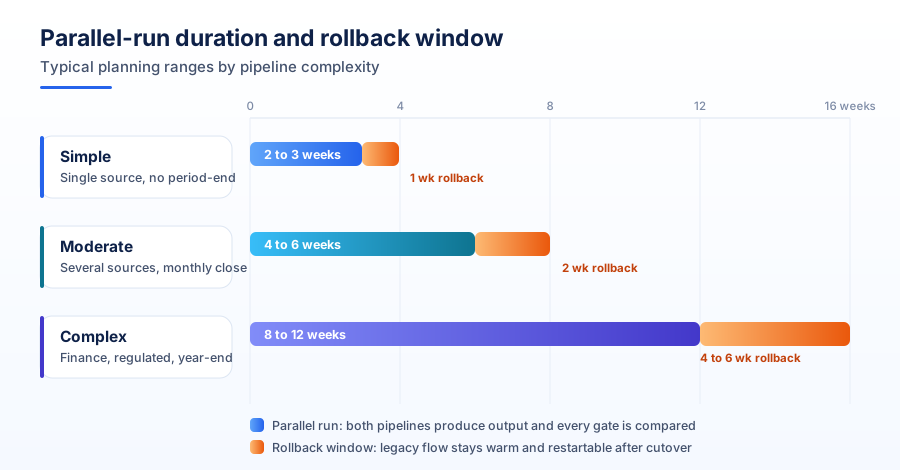
How Long Should The Parallel Run Last?
Long enough to cover at least one full reporting cycle, including a month-end close. Simple operational flows usually need a short window.
Finance and regulatory pipelines need a longer one, because the exceptions that matter only appear at period end. Set the window by risk tier, not by project deadline.