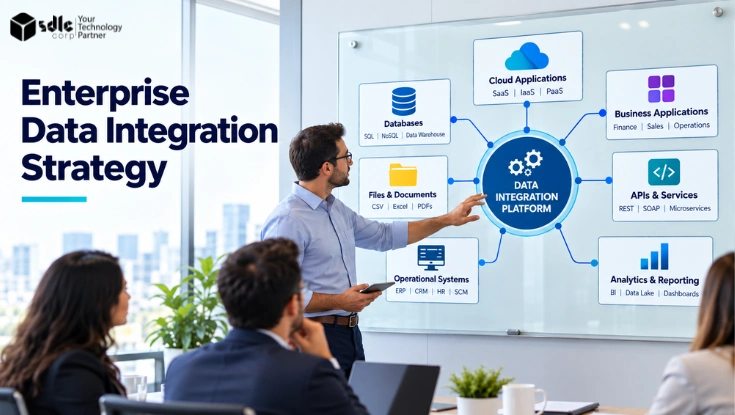
An enterprise data integration strategy decides how systems exchange information reliably. It also settles who owns each flow, and what counts as correct when data moves between systems.
Most integration problems in large estates are not really technology problems. They come from unclear ownership, inconsistent business definitions, and no agreed rule for what happens when a flow breaks at 2am.
The approach in this guide works outward from the business process. Quantify what each flow needs in latency, accuracy, and recoverability.
Those requirements then select the pattern, the contract, the controls, and the service level. Legacy-pipeline modernization is a separate execution problem, and the strategy sets the standards those pipelines follow.
What Is an Enterprise Data Integration Strategy?
An enterprise data integration strategy is the documented set of decisions and standards that governs how data moves. It covers movement between applications, databases, analytics platforms, and third-party services.
It starts from business flows rather than tools. Every flow states its latency, accuracy, and recovery needs. Those needs then select the pattern, whether that is an API, an event stream, CDC, ETL, or ELT.
The strategy then fixes the supporting rules. Those cover data contracts and identifiers, data quality and lineage controls, and governance and stewardship.
They also cover security and access boundaries, observability and recovery, and named ownership backed by service levels. Done well, every integration behaves the same predictable way in production.
Strategy or architecture? Integration strategy decides how data moves: in which pattern, under which contract, and at which service level. Data architecture decides where data is stored, processed, and governed.
That is where warehouse, lake, lakehouse, data fabric, and data mesh choices belong. The two depend on each other but are not interchangeable.
A well-designed lakehouse will still deliver late, duplicated, or unexplainable records if the flows feeding it have no contract, no reconciliation, and no owner. Treat architecture as the destination and integration strategy as the rules of movement.
Start With Business Processes and Critical Data Flows
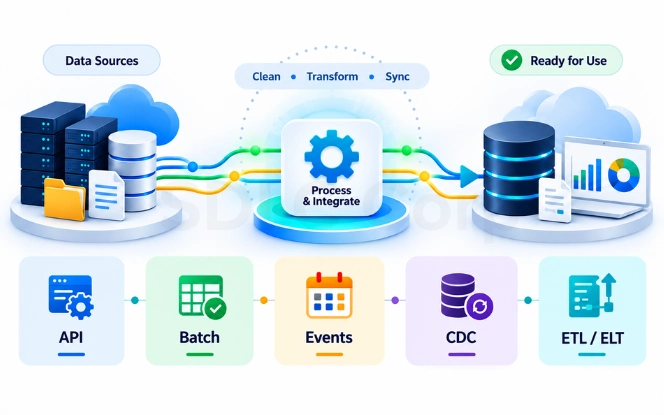
List the business processes that depend on integrated data. Quantify their tolerance for latency, duplication, and error. Customer onboarding may accept minutes of delay, while payment reconciliation may require near-perfect accuracy.
Capture required data elements, freshness targets, and the reconciliation window. Teams can then compare API, event, and batch patterns against business impact. Start by quantifying process-level impact, not by selecting a tool.
Translate process needs into technical acceptance criteria and use those criteria to score candidate patterns. Below is a compact scoring example you can adapt for each flow:
Score Patterns Against Business Requirements
| Criteria | Example requirement | Weight |
|---|---|---|
| End-to-end SLA (latency, availability) | ≤ 30s latency; 99.95% availability | 30% |
| Allowed data loss / reconciliation | Near-zero loss; reconcile within 1 hour | 25% |
| Identity matching / duplicates | Deterministic matching; idempotent ops | 15% |
| Auditability, observability, retention | Full audit trail; 90-day retention | 15% |
| Rollback and corrective actions | Automated rollback + manual compensating steps | 10% |
Prioritize integrations that reduce manual handoffs, shorten decision cycles, lower operating cost, or protect revenue, compliance, and customer experience (CX). Batch low-risk updates when real time adds more complexity than value.
Record One Integration Brief per Flow
Produce one concise integration brief per flow and keep it to a single page. The brief is the contract between engineering, operations, business owners, and third-party vendors.
It is also the artifact everything later in this guide feeds into, rather than a document to rewrite at every stage.
| Brief field | What to record |
|---|---|
| Business flow | The process being served and the outcome it protects, for example payment reconciliation or order fulfillment. |
| Owners | Business steward, engineering owner, and operations contact, named individually rather than by team. |
| Producer and consumer | Source of truth, downstream consumers, and any system that quietly depends on the same feed. |
| Pattern | API, event, CDC, ETL, or ELT, with the reason it beat the alternatives. |
| SLA | Latency, availability, freshness, and the reconciliation window the business will accept. |
| Contract | Schema, identifiers, validation rules, versioning policy, and the change process. |
| Quality controls | Completeness, duplicate handling, validation thresholds, and who is alerted when they breach. |
| Security | Identity, scopes, encryption, masking rules, retention, and residency constraints. |
| Recovery | Retry policy, dead-letter handling, replay path, RTO and RPO. |
| Rollback | Cutover gate criteria, fallback route, and the trigger that reverses the change. |
| Success metrics | The measures that prove the flow works, taken from the KPI set later in this guide. |
Business flowPayment reconciliation
Recommended patternEvent-driven / CDC with API fallback for interactive queries
- SLA / tolerance
- Near-real-time; near-zero data-loss tolerance
- Key data elements
- transaction_id, amount, timestamp, status, ledger_id
Map Systems, Ownership and Data Dependencies
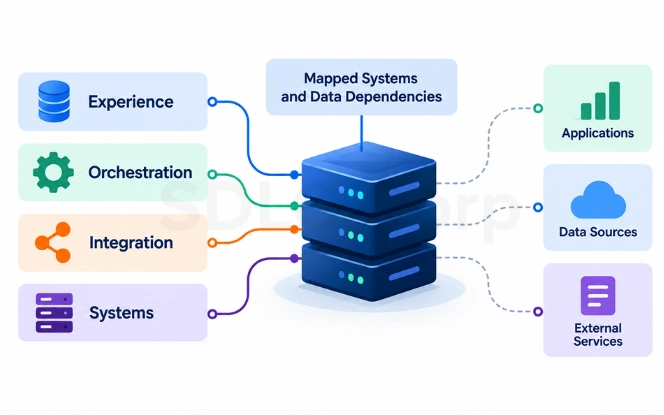
Inventory systems and their data domains: source-of-truth applications, downstream consumers, analytical platforms and third-party SaaS. For each system record supported access patterns (API, database, export), authorized owners, data volume and retention policies.
This inventory surfaces brittle points. Common examples are single-vendor APIs with rate limits, or legacy databases without change tracking.
With packaged SaaS the interface is whatever the vendor exposes. That is why platform-specific integration work, on Salesforce or any other packaged SaaS, is usually scoped separately.
Ownership here means system, data, and domain ownership rather than support rosters. Each data domain needs a primary steward accountable for its contracts and definitions, an engineering owner for the endpoints, and an operations contact for incidents.
When those three names are missing, schema changes and identity conflicts stall in committee. Operational support, escalation, and service levels are handled separately, later in this guide.
Setting those roles out formally is the job of an enterprise data governance framework.
Annotate every upstream and downstream dependency with its integration risk. That means hard real-time dependencies, regulatory reporting routes, and the manual reconciliation paths that teams rarely admit to.
Dependency maps then drive sequencing and cutover windows. Where a source system is volatile, a staging tier or cache is usually worth the extra hop, because it decouples downstream consumers from that variability.
- Create a system inventory that lists access patterns and data domains.
- Assign a business steward, engineering owner and ops contact per domain.
- Annotate dependencies with risk level and required cutover constraints.
- Introduce staging tiers to decouple high-risk consumers from sources.
For the platform boundaries and architecture choices that support this approach, review modern enterprise data architecture.
Choose Between APIs, Batch, Events, CDC, ETL and ELT
How this fits with the wider architecture: This section selects the interface and movement pattern that fits a business flow. Pipeline inventory, cutover, and rollback are execution concerns and are handled later under phased modernization. Building and running those pipelines is data engineering work, whichever pattern you choose.
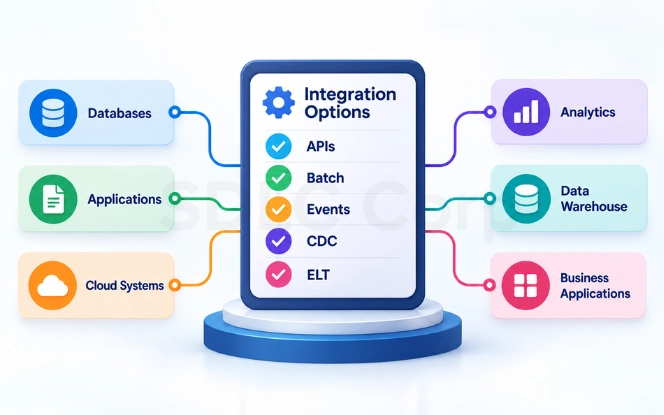
Match integration patterns to the flow requirements derived earlier. Synchronous APIs suit interactions that require transactional confirmation or a user-facing latency guarantee. Building or exposing those interfaces is normally scoped as custom API development and integration services.
Events or CDC fit low-latency replication where eventual consistency is acceptable. Batch ETL or ELT remains the sensible choice for high-volume analytical loads and historic backfills.
Compare the Patterns Side by Side
| Pattern | Best use | Typical latency | Main advantage | Main limitation |
|---|---|---|---|---|
| Synchronous API | Transactional, user-facing requests that need an immediate answer | Milliseconds to seconds | Immediate confirmation and simple error handling | Couples caller availability to the source system |
| Event streaming | Fan-out of state changes to several independent consumers | Sub-second to seconds | Producers and consumers stay decoupled | Eventual consistency and ordering only within a partition |
| Change data capture | Low-latency replication out of databases with limited API surface | Seconds to minutes | Very low load on the source system | Needs strong identity mapping and schema-drift handling |
| Batch ETL | High-volume loads where the target cannot transform at scale | Minutes to hours | Predictable windows and simple reconciliation | Latency, plus reprocessing cost when logic changes |
| ELT | Analytical loads landing raw data into a modern warehouse or lakehouse | Minutes to hours | Raw history is retained and transforms can be replayed | Shifts compute cost and governance burden to the target |
Technical constraints narrow the shortlist quickly. They include source capabilities, network bandwidth, whether change data capture is available, and how complex the transformation is.
A legacy ERP with no CDC support may leave you with scheduled exports and file-based ingestion. A modern SaaS with webhooks can publish domain events straight to a broker.
Where the database itself can be tapped, the connector-level behavior is worth reading before committing. The Debezium documentation sets out how snapshotting, offsets, and schema changes are handled in practice.
Whichever way the trade-off falls, record it against the flow so the next team does not relitigate it.
Weigh Operational Cost, Not Only Latency
Operational cost deserves equal weight. Real-time patterns widen the error surface and raise monitoring demands. Batch patterns add latency but make reconciliation far easier to reason about.
CDC and ELT cut duplicate extraction work for analytics. Both depend on robust identity mapping and schema-evolution controls.
Real time is not automatically better. Teams that assume it is tend to inherit an alerting problem they did not budget for.
Sometimes event timing, replay, state, and action gating genuinely are first-class requirements. In that case, real-time data architecture for enterprise AI covers the design in more depth.
- Use APIs for synchronous, transactional business interactions.
- Use events or CDC for low-latency replication with eventual consistency.
- Use ETL or ELT for high-volume analytical loads and backfills.
- Document trade-offs: latency, operational cost, and monitoring needs.
Pick the pattern that meets process SLAs and operational capacity, not the latest technology trend.
It helps to see one of these patterns end to end before committing. The Salesforce REST API integration guide walks through authentication, request handling, and error cases on a real flow.
Standardize Contracts, Identifiers and Business Definitions
A data contract is machine-readable. It specifies required fields, types, formats, validation rules, and a versioning policy. Contracts reduce coupling because producers and consumers share one schema and one change process instead of a mailing list.
The right serialization depends on transport and performance needs. Use JSON Schema for HTTP payloads, Apache Avro where schema evolution matters on a stream, and Protocol Buffers where payload size and speed dominate.
Agree unique identifiers and canonical business definitions across systems. Use a single source for enterprise identifiers wherever that is feasible, and a fallback reconciliation rule where it is not.
Identity mismatches are a frequent source of integration failures. The contract should therefore carry the matching strategy, confidence scoring, and the manual reconciliation procedure, rather than leaving them to tribal knowledge.
Contract governance is the part teams skip and later regret. Agree how changes are proposed, what backward compatibility means in practice, who tests what, and when deployments land.
Enforcement then belongs in CI and the integration test suite rather than in a review meeting. Consumer-driven contract tests are worth the effort wherever a consumer can fail silently against an evolving producer.
- Publish machine-readable contracts with explicit validation and version policy.
- Standardize enterprise identifiers and reconciliation rules for conflicts.
- Automate contract validation in CI and integration test suites.
- Use consumer-driven tests to protect downstream integrations from changes.
Build Data Quality, Lineage and Reconciliation Controls
A contract states what good data looks like. Quality controls prove that what actually arrived matches it.
Without them, an integration can run green for months while quietly dropping a percentage of records. The discovery usually happens in a finance review rather than a dashboard.
Attach quality checks to the flow itself, at the point of ingestion and again after transformation, so defects surface where they were introduced.
The control set behind this is laid out in the enterprise data quality framework for AI.
Reconcile Source and Target on a Cadence
Reconciliation is the control that catches what monitoring misses. Compare row counts, control totals, and business aggregates between source and target on a defined cadence.
Treat unexplained variance as an incident rather than a data cleanup task. Where a flow feeds regulated reporting, keep the reconciliation evidence for as long as the report itself is auditable.
| Control | Metric to track | Action when it breaches |
|---|---|---|
| Completeness | Records received against records expected per window | Hold the load and alert the data steward when the gap exceeds the agreed threshold |
| Freshness | Age of the newest record against the agreed SLA | Raise a freshness alert before consumers act on stale data, not after |
| Duplicate handling | Duplicate rate by natural key or business key | Deduplicate on a stable key and keep consumers idempotent so replays stay safe |
| Validation | Share of records failing contract validation | Quarantine failures rather than dropping them, and route them to a named owner |
| Schema drift | Unannounced field, type, or nullability changes at the source | Fail the build in CI, version the contract, and notify consumers before deployment |
| Source-to-target reconciliation | Row counts and control totals compared across both ends | Reconcile on a fixed cadence and treat unexplained variance as an incident |
| Failed records | Dead-letter volume and age of the oldest unresolved record | Set a clearance target and review the backlog in the operations cadence |
| Lineage | Share of critical fields with traceable source-to-consumer lineage | Publish lineage from pipeline metadata and assign lineage ownership per domain |
Make Lineage and Stewardship Explicit
Lineage turns these numbers into something a team can act on. When a consumer questions a figure, lineage answers where it came from, which transformation touched it, and who is accountable for that step.
Standardized lineage metadata is easier to sustain than hand-drawn diagrams. OpenLineage provides an open model for emitting it from pipelines. Pair it with metadata management and data catalogs so definitions, owners, and classifications live in one place.
Quality accountability then has somewhere to sit. Data governance works when stewardship is named per domain. Quality thresholds are agreed with the business rather than assumed by engineering, and lineage ownership follows the same boundaries.
The DAMA-DMBOK body of knowledge is a reasonable reference point for the stewardship and metadata management practices behind this, without adopting a heavyweight program.
- Validate against the contract at ingestion and again after transformation.
- Quarantine failed records to a dead-letter path with a named owner and clearance target.
- Reconcile source-to-target counts and control totals on a fixed cadence.
- Detect schema drift in CI before it reaches production consumers.
- Maintain data lineage for critical fields, with lineage ownership named per domain.
Design Security, Access and Data Movement Controls
Every integration channel needs access controls aligned to least privilege. Build them on fine-grained service identities, short-lived credentials, and scoped tokens.
Where role-based access control exists, map integration identities to roles. Avoid embedding a broad service account that nobody dares rotate. Allowed operations and data scopes belong in the flow record alongside the contract.
For control selection and wording, the NIST SP 800-53 control catalog is a practical reference. The OWASP API Security Top 10 covers the failure modes that show up most often on integration endpoints.
Secure movement is mostly about narrowing the path the data can travel. Encrypt in transit and at rest, and keep network routes private through VPC peering or private endpoints.
Stage file-based transfers somewhere controlled rather than on a shared drop. Sensitive fields usually warrant field-level encryption or tokenization, with masking rules written down for non-production environments.
Audit logging should capture both the movement events and the access attempts. The second set is what an investigation actually needs.
Compliance and data residency are cheaper to address at design time than after a flow is live. Identify regulated fields, then carry retention, anonymization, and deletion rules in the contract itself.
Cross-border flows usually work best when processing sits close to residence. Use controlled transfer mechanisms where that is not possible.
Assuming the application layer handles compliance is a common and expensive mistake. The controls belong in the integration architecture too.
- Apply least-privilege service identities and short-lived credentials.
- Encrypt data in transit and at rest; use private network paths where possible.
- Mask or tokenize sensitive fields in non-production environments.
- Document retention and residency rules for regulated data elements.
Build Observability and Failure Recovery
Instrument integrations with end-to-end tracing, request identifiers, and context propagation, so incidents can be traced back to a business event.
Capture producer and consumer timestamps, message IDs and processing outcomes. This telemetry enables root cause analysis and supports SLA reporting across teams and vendors.
Alerting works best when thresholds map to business impact rather than log volume. Separate transient failures from data anomalies and SLA breaches, and route each to the team that can actually resolve it.
Transient errors deserve automated retries with backoff. Anything needing human judgement belongs on a durable queue or dead-letter path, where it can be inspected instead of silently retried forever.
Runtime recovery is a design decision, not an incident-day improvisation. Write runbooks for the common failure modes, and define replay mechanics for events and rehydration steps for analytical targets.
Keep consumers idempotent so reprocessing is safe by default. Recovery time and recovery point objectives should be agreed with the business before the first outage.
Nobody should be negotiating acceptable data loss while the pager is going. Migration rollback is a different concern and is covered in the next section.
- Add trace IDs and context propagation for end-to-end visibility.
- Differentiate alerts by transient error, data anomaly and SLA breach.
- Implement retries, dead-letter queues and idempotent consumers.
- Publish runbooks and recovery playbooks for common failure scenarios.
Observable integrations with clear recovery playbooks reduce mean time to resolution.
For a standard signal model behind integration observability, use OpenTelemetry's metrics, traces, and logs guidance. For event delivery semantics and ordering limits, see the Apache Kafka references on delivery semantics and partition-scoped ordering.
Modernize High-Risk Integrations in Phases
Protect the Business Flow While Interfaces Change
High-risk integrations are best segmented into discovery, pilot, parallel run, and cutover phases. A pilot on non-critical traffic validates the contract, the performance envelope, and the operational process.
Parallel runs then mirror production traffic to the new pipeline and compare outputs against the legacy path. Divergence surfaces while users are still safely on the old route.
Reserve the final cutover for a low-activity window. Define the rollback trigger before you need it: a named metric, a named threshold, and a named person who can call it.
Traffic shifting through feature flags or splitters keeps the blast radius small while consumers move across. Keep the legacy integration as an immutable fallback path until post-cutover validation is complete.
Stakeholders also need to sign off on data quality and latency. Migration rollback is about reversing a change safely, which is a different problem from the runtime recovery covered above.
A phased rollout plan is also what keeps cross-team tasks from colliding. Schema updates, credential rotations, monitoring configuration, and incident playbook readiness rarely finish in the same week.
A simple gate model covering readiness, validation, approvals, and cutover gives everyone the same go or no-go criteria. It also removes most of the surprise dependencies.
- Run discovery, pilot, parallel run and controlled cutover phases.
- Mirror production traffic during parallel runs to validate outputs.
- Use traffic splitters and feature flags for gradual cutover.
- Keep legacy paths as immutable fallbacks until validation is complete.
The same phasing applies when the constraint is a packaged ERP rather than a custom pipeline. Vendor connectors still need pilots, parallel runs, and a fallback path.
That delivery work is typically scoped as Odoo integration services or its equivalent on whichever platform holds the system of record.
Set Service Levels, Support Ownership and Escalation
This section is about running the flow, not owning the data. Domain and system ownership were settled earlier, and what matters here is who answers the page.
Each integration flow needs an SLA and supporting SLOs. These reflect the business tolerance for latency, error, and data loss, tied to observable metrics so compliance can actually be measured.
On-call expectations and mean-time-to-acknowledge targets belong in the same place. Engineering and the business should agree them together.
Turning a tolerance into a measurable objective and an error budget takes practice. The Google SRE guidance on implementing SLOs is a useful starting point.
Handoffs between producer teams, the integration platform team, and consumer teams should be written down before an incident tests them. A simple RACI covering change approvals, incident response, and contract evolution is usually enough.
Where external vendors sit in the path, their commercial contract needs clauses that map to the same operational metrics and escalation route. Otherwise the escalation stops at the first support desk.
Support windows, maintenance windows, and response times for non-urgent changes need to be written down somewhere consumers can find them.
An operating-control runbook covering access management, rotation schedules, backup verification, and integration test status keeps routine work from becoming tribal knowledge. Review SLO adherence on a regular cadence, because a support model that fitted five integrations rarely fits fifty.
- Define SLAs/SLOs tied to measurable telemetry and business tolerance.
- Use a RACI model for ownership of changes and incidents.
- Include vendor SLAs and escalation paths in contractual agreements.
- Agree escalation paths and response times before the first incident tests them.
Concrete SLAs and ownership reduce finger-pointing during outages and changes.
Measure Enterprise Data Integration Success
An enterprise data integration strategy earns its budget through measurable outcomes, not through the number of connectors deployed.
The SLAs and SLOs defined above give you the operational half of the picture. The business half comes from effort removed and cycle time recovered.
Report both to the same audience, on the same cadence, so a reliability improvement and a cost saving are visible side by side.
| KPI | What it shows | Suggested target |
|---|---|---|
| Integration availability | Whether the flow is up when the business needs it | Set per flow, typically 99.5% to 99.95% |
| Delivery success rate | Share of records delivered without manual intervention | Above 99.9% for critical flows |
| End-to-end latency | Time from source event to consumer availability | Within the SLA agreed for that flow |
| Data freshness | Age of the newest record in the target | Inside the agreed freshness window at every check |
| Quality defect rate | Records failing contract validation | Trending down quarter on quarter |
| Reconciliation failures | Unexplained variance between source and target | Zero unexplained variances, all differences accounted for |
| MTTR | Mean time to restore a failed integration | Reducing against your own baseline |
| Incident volume | Integration incidents by severity per month | Falling as controls mature |
| Manual effort removed | Hours of manual reconciliation or re-keying eliminated | Tracked per flow and reported to the sponsor |
| Cycle-time reduction | Process time saved in the business flow served | Measured against the pre-integration baseline |
| Operating cost | Platform, compute, and support cost per flow | Stable or falling as volume grows |
Baseline the Metrics Before Go-Live
Publish the set where the business already reads its numbers, rather than in an engineering dashboard nobody opens. In most organizations that means the existing business intelligence reporting layer.
Baseline the metrics before the first flow goes live, too. Retro-fitting a baseline after a migration is possible but rarely convincing, and it removes the strongest argument for funding the next phase of work.
Enterprise Data Integration Strategy Checklist
Use this as the final review before a flow is approved for build. If any line is blank, the enterprise data integration strategy is not yet complete for that flow.
- Business outcome: the process this flow protects and the value it delivers.
- Sources and consumers: system of record, every downstream consumer, and hidden dependencies.
- Ownership: named business steward, engineering owner, and operations contact.
- Selected pattern: API, event, CDC, ETL, or ELT, with the reason recorded.
- SLA: latency, availability, freshness, and the reconciliation window.
- Contract: schema, identifiers, validation rules, and versioning policy.
- Quality controls: completeness, duplicates, validation, and schema-drift checks.
- Lineage: source-to-consumer traceability for critical fields, with an owner.
- Security: identities, scopes, encryption, masking, retention, and residency.
- Monitoring: trace IDs, alert thresholds, and the escalation route.
- Reconciliation: cadence, control totals, and the variance escalation rule.
- Rollback: cutover gate, fallback path, and the trigger that reverses it.
- Success metrics: the KPIs that will be baselined and reported.
Frequently Asked Questions
An enterprise data integration strategy is the documented set of decisions and standards governing how data moves. It covers applications, databases, analytics platforms, and third-party services.
It defines the business flows in scope and the integration pattern each flow uses. It also fixes the data contracts and identifiers, the quality, security, and observability controls, and the ownership and service levels that keep it running.
At minimum: prioritized business flows with measurable requirements, a system and ownership map, and a pattern-selection rationale per flow.
It also needs machine-readable data contracts and identifier standards, data quality, lineage, and reconciliation controls, and security and access rules.
Finally, add observability and recovery design, a phased modernization plan for high-risk integrations, and the SLAs, escalation routes, and KPIs used to measure success.
Five patterns cover most enterprise needs. Synchronous APIs suit transactional, user-facing requests. Event streaming decouples producers from multiple consumers.
Change data capture replicates database changes at low latency. Batch ETL handles high-volume loads where transformation must happen before landing. ELT lands raw data into a modern warehouse or lakehouse and transforms it there.
Decide based on source capabilities and where transformation should happen. ELT fits when the analytical platform can transform at scale and you want a raw landing zone.
ETL fits when sources or networks require transform-before-load. CDC fits when you need incremental updates at low latency with minimal extract overhead on the source.
Events fit when producers can emit state changes and consumers can tolerate eventual consistency. They suit fan-out to several independent consumers.
APIs fit when synchronous confirmation or direct request-response is required. Many flows use both: events for propagation and an API for interactive queries.
A data contract should include field schemas, required types and formats, validation rules, versioning policy, backward-compatibility expectations, and named owners. It should also specify error handling, retention rules, and test coverage requirements so downstream consumers are protected from breaking changes.
Measure both reliability and business outcome. On the operational side, track integration availability, delivery success rate, end-to-end latency, data freshness, quality defect rate, reconciliation failures, MTTR, and incident volume.
On the business side, track manual effort removed, cycle-time reduction in the process served, and operating cost per flow. Measure all of them against a baseline captured before go-live.
Run phased pilots, mirror production traffic during parallel runs, and define rollback criteria before cutover.
Keep the legacy path as an immutable fallback until validation is complete. Automate output comparison between old and new paths, and shift traffic in small increments with feature flags to limit blast radius.