Metadata management for enterprise AI is the practice of capturing and governing the context around data: what an asset means, who owns it, where it came from, and who may use it.
A data catalog is the interface to that context. Together they decide whether analytics, model training and RAG applications run on data your teams can actually trust.
Key Takeaways
- Best Fit Teams cannot find, trust, or govern the datasets, lineage, and definitions behind analytics or AI work.
- Metadata Priorities Ownership, business definitions, lineage, access context, and workflow automation that improve day-to-day adoption.
- Reader Outcome A metadata operating model that strengthens discovery, traceability, and control evidence.
Start with the decision problem: can your AI teams reliably find data, understand its meaning, know who owns it, and trace its history? Metadata management answers those questions. A catalog makes the answers searchable.
This guide covers what a metadata platform must capture, how catalogs, glossaries and metadata management differ, how active metadata changes the operating model, and how lineage, ownership and access controls support AI, RAG and agent workloads.
The success measure is not the number of assets harvested. It is whether a user can find the right asset, understand its restrictions, identify its owner, request access, and judge whether it is current enough for the intended use.
What Enterprise Metadata Management Includes
How this fits with the wider architecture: This discussion focuses on discovery, glossary terms, classification, certification, ownership metadata, access workflows, and catalog adoption.
It summarizes lineage and governance policy only to show how metadata connects to them; detailed trace reconstruction and decision authority belong in their specialist guides.
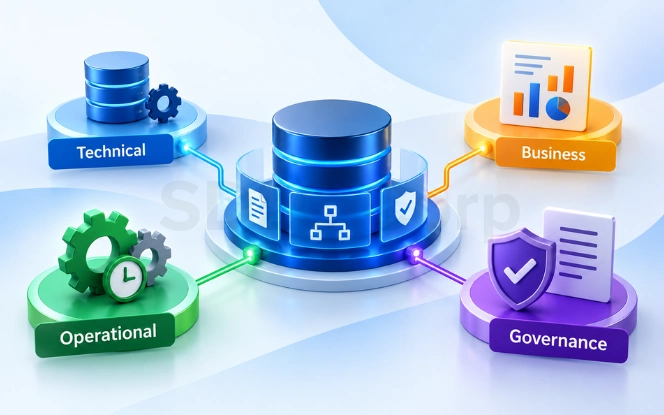
Types of Enterprise Metadata
Enterprise metadata management groups capabilities into four practical categories. Designing around these categories avoids mixing discovery needs and governance controls in the same workflow.
| Metadata type | Typical examples | Why AI teams need it |
|---|---|---|
| Technical | Schemas, data types, partition keys, storage location, sample statistics | Confirms an asset is structurally usable for training or retrieval |
| Business | Glossary definitions, canonical calculations, business rules, SLAs | Prevents models and prompts from being built on misread fields |
| Operational | Refresh cadence, last load time, error rates, volume trends | Shows whether an input is fresh enough for the intended use |
| Governance | Owners, stewards, sensitivity labels, retention, approved use cases | Determines who may use the asset and what evidence exists later |
Implement each category with explicit owners and SLAs. Technical and operational metadata can be harvested automatically at scale. Business and governance metadata cannot.
Governance metadata is the bridge to compliance and access control. Record stewardship assignments, sensitivity labels, retention obligations and approved use cases, then tie those fields to access policies and audit logs. Avoid keeping governance artifacts only in separate spreadsheets.
For the master and reference-data controls that keep AI inputs trustworthy, review master data management for AI.
Data Catalog vs Metadata Management
These two terms are often used interchangeably, and that causes budget and scope confusion. Metadata management is the discipline: the policies, models, standards and lifecycle that govern metadata across the estate.
A data catalog is a product within that discipline, focused on making assets discoverable and understandable.
| Dimension | Data catalog | Metadata management |
|---|---|---|
| Scope | A searchable inventory of assets, terms and lineage views | The full lifecycle: capture, modelling, curation, quality, retirement |
| Primary users | Analysts, engineers, data scientists searching for assets | Stewards, governance leads, platform and architecture teams |
| Main question | Which asset should I use, and can I trust it? | How is metadata produced, approved, maintained and enforced? |
| Delivery | A tool you deploy and populate | An operating model the tool supports |
| Failure mode | A populated catalog nobody trusts or uses | Policies written down but never reflected in any system |
The practical reading: buying a catalog does not give you metadata management, and running a metadata programme without a catalog leaves users with nowhere to consume the results. Enterprise AI needs both.
Data Catalog vs Business Glossary
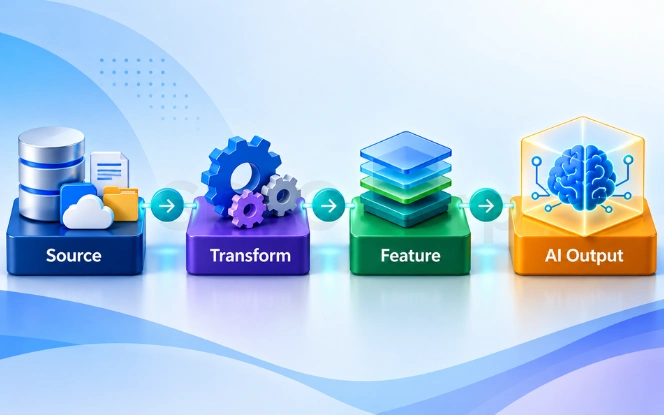
A data catalog is a searchable asset inventory. It combines automated scans with curated entries for tables, files, models and APIs, and it can show lineage, usage metrics and sample records.
A business glossary defines business concepts in agreed terms. Both are needed, but they serve different users. Catalogs support engineers and analysts; glossaries support business stakeholders and model-governance reviewers.
Do not expect a catalog scan to generate reliable business definitions. Glossary entries need human curation, versioning and governance approval. Keep a light review process with explicit acceptance criteria so definitions stay authoritative.
Connecting Technical Metadata to Business Meaning
Technical metadata lists columns and types. Teams also need business context. Add fields that link tables and columns to glossary terms, business processes, metrics and KPIs, so a column carries the canonical metric it feeds and the process it supports.
Implement mapping workflows where data engineers propose mappings from technical fields to glossary terms and domain stewards approve them. Record the rationale, examples of valid values, and known exceptions.
Keep mappings versioned so retraining teams can reproduce the exact dataset-to-concept mapping used in earlier experiments.
Expose these mappings in catalog search and API endpoints so both humans and automation can use them. Search results should show glossary relationships, owner contacts, and example queries that produce canonical values. That reduces misinterpretation and duplicated feature engineering.
For the field-level controls required to operationalize this work, review the enterprise data quality framework for AI.
Active vs Passive Metadata Management
Passive metadata sits in a catalog and waits to be read. Active metadata is pushed back into the systems that make decisions: pipelines, access policies, alerting, and retrieval layers.
The distinction matters for AI because a model or agent cannot browse a catalog page before it runs.
| Aspect | Passive metadata | Active metadata |
|---|---|---|
| How it is used | Read by people during discovery | Consumed by systems through APIs and events |
| Update pattern | Periodic scans and manual edits | Continuous signals from pipelines and query logs |
| Typical action | A user reads an owner name and sends an email | A policy engine blocks, masks or routes the request automatically |
| AI relevance | Helps humans prepare datasets | Filters retrieval, enforces permissions, triggers freshness alerts at runtime |
A practical enterprise example: a sensitivity label applied in the catalog is passive if it only appears on a search result.
It becomes active when the retrieval service reads that same label through an API and excludes restricted documents from the context of a Retrieval-Augmented Generation (RAG) assistant before the answer is generated.
Most organizations start passive and move selected fields to active use. Ownership, sensitivity, certification status and freshness are usually the first four worth wiring into systems.
How Metadata Supports AI, RAG, and AI Agents
AI workloads consume metadata differently from dashboards. The same catalog fields have to serve a training pipeline, a retrieval index, and an autonomous agent that assembles its own context.
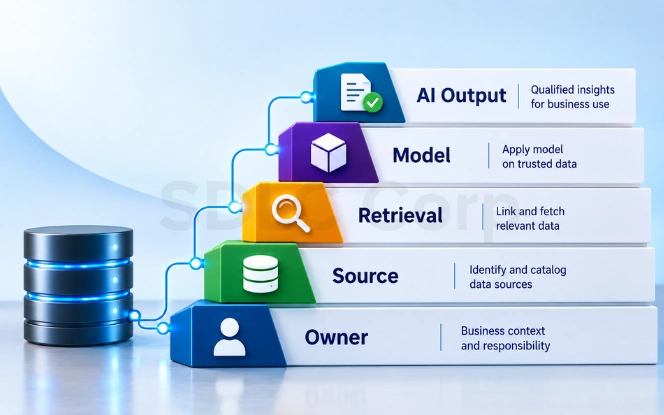
AI Training
Training teams need to reproduce a dataset months after the fact. Versioned schemas, transformation lineage, certification status and approved-use flags make that possible, and they let reviewers confirm that restricted data never entered a feature set.
The same records are what feed model documentation during ML model engineering services work.
Retrieval-Augmented Generation
RAG is the case where metadata does the most work.
Each chunk written to the index should carry source system, document owner, last refresh time, sensitivity label and approved audience, which is why chunk-level metadata design belongs in the same conversation as vector databases for AI.
The retrieval layer uses those fields to filter candidates before ranking, so stale or restricted content never reaches the prompt. Provenance fields then let the application cite where an answer came from.
AI Agents
Systems built on agentic AI select their own tools and sources, which removes the human check that normally sits before a query runs.
They need machine-readable metadata: which datasets are certified, which actions require approval, and which assets are out of scope. Publishing that through an API is what keeps agent behaviour inside policy.
Monitoring and Impact Analysis
When a source table changes, lineage plus usage metadata answers the question that follows: which features, indexes, models and reports are affected.
The same links support drift investigation and incident response, because the path from an output back to its inputs and owners is already recorded.
Metadata, Lineage, Ownership, and Access Control
Ownership and Accountability
For each critical dataset, capture the accountable owner, source system, refresh status and downstream use. The catalog should expose this during discovery and route users to the correct owner or access workflow rather than to a shared mailbox.
Lineage and Provenance
AI teams need enough lineage to judge whether an asset is trustworthy: source system, major transformations, and where the output is consumed.
Detailed trace reconstruction and audit-grade lineage capture belong in the dedicated data-lineage guide; the catalog's job is to surface enough of it to support a decision.
Sensitivity and Access
Metadata must carry access attributes that integrate with your authorization systems: sensitivity classification, permitted use cases, approved roles and mandatory masking rules.
When an analyst or a model requests data, the request should trigger policy checks that consult those attributes and grant access, require approval, or return a redacted view.
Operationalize policy decisions with metadata-driven pipelines. Sensitive-data tags can trigger approved masking, access review, retention or privacy workflows.
Differential privacy should be applied only through a validated mechanism with documented parameters and a utility trade-off review, not as an automatic consequence of tagging.
Audit and Traceability
Link access logs and data-request audits back to catalog entries: who accessed which asset, for what purpose, and which model or pipeline used it.
These links support post-incident analysis and regulatory reporting, and they make it possible to revoke access across systems after a reclassification.
Access decisions should derive from metadata held in the catalog, not from a separate spreadsheet that drifts out of date.
For permission-aware retrieval and access-control context that depends on metadata and document attributes, see Microsoft's guidance on document-level access.
How to Implement Metadata Management for Enterprise AI
Sequence the work so early effort lands on assets people actually use. A workable order for a first year:
- Pick the use casesChoose two or three AI workloads that are blocked today, and scope metadata work to their data.
- Connect the systemsConnect the warehouses, lakes, BI tools and pipelines behind those workloads.
- Harvest technical metadataAutomate schema, lineage and operational signals before asking anyone to curate.
- Build the glossaryDefine the business terms those workloads depend on, not the whole enterprise.
- Assign ownershipName an owner and steward per critical asset, and publish both in search results.
- Certify assetsAdd a lightweight certification with owner signoff on freshness and privacy review.
- Automate and reviewKeep crawlers running, and route definitions, sensitivity and ownership to human review.
- Wire metadata into AIExpose ownership, sensitivity, certification and freshness through APIs for retrieval and agents.
- MeasureTrack adoption and metadata quality, then decide where stewards spend time next.
Design Catalog Workflows Around Real User Tasks
Design workflows for discovery, certification, access and change management around who uses the catalog. Data engineers need quick export of schema and lineage; analysts want query examples and sample rows; stewards want approval queues and definition edit workflows.
Keep the access request path short. Pre-fill forms with metadata-derived defaults such as owner and sensitivity, route requests automatically based on policy, publish SLA targets, and escalate when owners are unresponsive.
Track approval times and denial reasons to refine both policy and owner assignments.
Automate Collection but Preserve Human Stewardship
Automation should seed entries, not finalize them. Crawlers and connectors keep schema, samples, statistics and pipeline lineage current at scale. Human reviewers still validate business definitions, sensitivity labels and ownership, especially where data semantics are context-dependent.
Flag items for steward review using heuristics: high usage, PII-like columns, or inclusion in model features. Give reviewers a lineage snapshot, sample rows and suggested glossary matches with a simple accept-or-edit action.
Log automated changes as separate events and require reapproval for critical fields before they affect production models.
Worked Example: Metadata Flow for an Enterprise RAG Application
Illustrative example, not a client engagement. A support assistant answers policy questions for internal staff, drawing on documents from three systems.
1. Harvest. Connectors register every source document with its system of origin, last modified date and folder-level classification.
2. Curate. Stewards confirm the owner for each document set and map it to the glossary term the assistant is expected to answer on.
3. Certify. Only document sets with a named owner, a current refresh date and a completed privacy review are marked eligible for indexing.
4. Index. Each chunk inherits owner, sensitivity, source and refresh date as retrieval metadata.
5. Retrieve. The retrieval service filters on the requester's entitlements and on the freshness threshold before ranking candidates.
6. Answer and trace. The response cites source documents; the log records which chunks were used, so a wrong answer can be traced to a specific document and its owner.
The point of the example is the order. Certification happens before indexing, and entitlement filtering happens before ranking. Reversing either step turns a governance control into an after-the-fact report.
What to Look for in an Enterprise Metadata Management Platform
Evaluate platforms against the workloads you named in step one, not against a generic feature grid.
| Capability | What to check |
|---|---|
| Connector coverage | Native support for your warehouses, lakes, BI tools, pipelines and file stores, with a documented path for the gaps |
| Lineage depth | Column-level lineage where it matters, and whether lineage is parsed from queries or only declared manually |
| Business glossary | Versioning, approval workflow, and term-to-asset mapping that survives schema changes |
| Ownership and stewardship | Owner fields on every asset type, bulk assignment, and escalation when an owner leaves |
| Active metadata | Events, webhooks and policy hooks, not just a read-only UI |
| APIs | A complete API surface so retrieval services and agents can query metadata programmatically |
| AI and RAG support | Ability to attach and serve retrieval metadata such as sensitivity, freshness and approved audience |
| Auditability | Change history on every metadata field, with who changed what and when |
| Adoption features | Search quality, usage signals, and integration into the tools people already work in |
Measure Metadata Quality and Adoption
Measure adoption with metrics tied to value, not inventory. Total catalog entries tell you nothing about whether the catalog lowered friction.
| KPI | What it tells you | Starting target |
|---|---|---|
| Owner coverage | Share of critical assets with a named, current accountable owner | 95% of critical assets |
| Glossary mapping coverage | Share of critical fields mapped to an approved business term | 90% of critical fields |
| Certified asset usage | Share of production models and reports running on certified assets | 100% of production workloads |
| Search-to-use rate | Share of catalog searches that end in the user actually querying the asset | 40% or higher |
| Access approval time | Median hours from request to decision, and where requests stall | Under 24 hours median |
| Freshness coverage | Share of assets publishing a reliable last-refresh signal | 90% of certified assets |
| Sensitivity label accuracy | Share of automated labels confirmed correct on manual review | 95% or higher |
Set minimum thresholds per KPI and alert when quality drops. Use the results to direct steward effort toward high-usage and high-risk assets first.
Report to engineering and business leaders in one concise dashboard, and tie improvements to outcomes such as faster model deployment, fewer data incidents and shorter onboarding.
Measure real usage and quality, not inventory growth.
Metadata Standards and Frameworks
For external reference points, use the EDM Council's DCAM framework for governance capability structure and OpenLineage as an open standard for lineage metadata collection. These sources support the distinction between business definitions, ownership, discovery and runtime lineage evidence.
Where AI risk documentation is in scope, the same metadata becomes the evidence base: ownership shows accountability, lineage shows provenance, and certification records show which assets were approved for a given system.
That evidence trail is a practical starting point for responsible AI development.
Frequently Asked Questions
Metadata management is the discipline that defines how metadata is captured, curated, approved and retired across the estate. A data catalog is the product that makes that metadata searchable for analysts, engineers and data scientists.
A catalog without a metadata operating model fills up with entries nobody trusts, and a metadata programme without a catalog gives users nowhere to consume the results.
Active metadata is metadata that systems consume automatically through APIs and events, rather than metadata people read in a catalog page.
A sensitivity label is passive when it only appears in search results, and active when a retrieval service reads it at query time and excludes restricted documents.
Ownership, sensitivity, certification status and freshness are usually the first fields worth activating.
Each indexed chunk should carry its source system, document owner, last refresh time, provenance, sensitivity classification and approved audience.
The retrieval layer uses those fields to filter candidates before ranking, so stale or restricted content never reaches the prompt, and provenance fields let the application cite where an answer came from.
No. Automation scales capture of technical metadata and suggests classifications, but human stewards must validate business definitions, sensitivity labels and ownership for production AI use. Combine automated discovery with lightweight human review workflows to preserve accuracy without blocking scale.
Owner and certification status. An assigned owner who has certified a dataset for production use gives teams a clear contact and a documented approval.
Certification status then lets teams filter assets for training and RAG ingestion, which removes most ad hoc vetting.
Scope the first release to the assets behind two or three blocked workloads, publish owners and certification status in search results, and integrate the catalog into the tools people already use.
Then track the search-to-use rate and access approval time, and fix whichever step users abandon most often.