Introduction
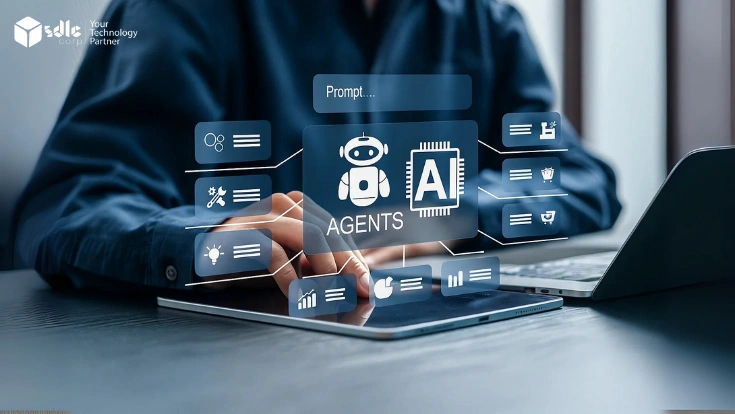
Agentic AI is the next step in the evolution of artificial intelligence, enabling autonomous systems that think, plan, and act with purpose. If you’re asking what an AI agent, it’s a system that operates with memory, goals, and adaptability more like a teammate than a tool. A common AI agent example is a digital assistant that manages tasks or makes decisions independently.
In this blog, we’ll explore Agentic AI fundamentals, how it differs from traditional models, and how it’s reshaping AI development services across industries.
1. What is Agentic AI?
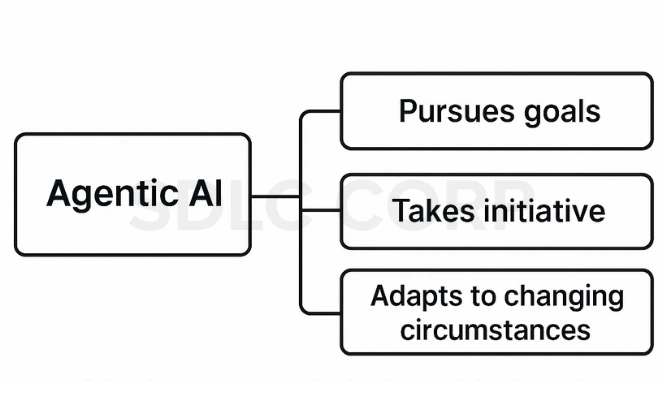
Agentic AI refers to intelligent systems that act with autonomy, purpose, and adaptability. Unlike traditional AI, which only responds to inputs, Agentic AI works like an AI agent—capable of setting goals, making decisions, and adjusting actions in real-time. If you’re wondering what is an AI agent, think of it as a self-directed system that behaves more like a teammate than a tool. A simple AI agent example could be a smart assistant that not only completes tasks but also plans, learns, and improves over time. These features form the core of Agentic AI fundamentals, reshaping the future of AI development services.
Key Points:
- Agentic AI enables intelligent systems to operate with autonomy, purpose, and adaptability.
- It answers the question: what is an AI agent? a system that can act independently with minimal human intervention.
- These agents sense, reason, plan, and execute tasks in real-time based on goals.
- Unlike traditional AI, Agentic AI can adjust strategies, learn from feedback, and self-correct.
- A common AI agent example is a digital assistant that manages workflows, suggests improvements, and acts without prompts.
- Core to Agentic AI fundamentals are features like goal-setting, memory, self-initiation, and reflective decision-making.
Also read – AI for Finance
Agentic AI vs Chatbots, Copilots and Generative AI
The words are used interchangeably in marketing, but they describe different systems with different failure modes.
| System | What it does | Who decides the next step | Typical failure |
|---|---|---|---|
| Generative model | Produces text, code or images from a prompt | The user, on every turn | Fluent but wrong output |
| Chatbot | Answers questions, often over retrieved content | The user, guided by a script or retrieval | Unanswerable or ungrounded replies |
| Copilot | Suggests actions inside an application a person is already using | The person accepts or rejects each suggestion | Suggestions that look plausible in the wrong context |
| Agentic system | Pursues a goal across several steps, calling tools and systems along the way | The system, inside limits it was given | Compounding errors and unintended actions |
The practical difference is accountability. A chatbot produces an answer someone reads. An agent takes actions in real systems, so it needs permissions, approval points and an audit trail that a reviewer can follow afterwards.
How an Agentic System Is Put Together
Most production agents share the same building blocks, whatever framework is underneath.
- Goal and task representation. What the agent is being asked to achieve, expressed in a form the system can decompose and check against.
- Planner. Breaks the goal into steps, decides ordering and revises the plan when a step fails or returns something unexpected.
- Memory and context. Working state for the current run, plus retrieval over durable knowledge the agent is allowed to see.
- Tool layer. The APIs, databases, search, code execution and business systems the agent can call, each with its own schema and permissions.
- Executor. Runs the chosen step, handles errors, retries and timeouts, and records what happened.
- Guardrails. Input and output validation, prohibited actions, spending and rate limits, and escalation rules.
- Observability. Traces of reasoning steps, tool calls, inputs and outputs, because without them an agent failure cannot be diagnosed.
The orchestration layer, not the model, owns sequencing and permissions. A model proposes; the orchestrator decides what is allowed to run.
Planning, Reasoning and Tool Use
Planning approaches
Plan-and-execute agents produce a full plan first, then work through it, which makes review easy but adapts poorly to surprises. Interleaved approaches decide the next step after each observation, which adapts well but is harder to audit. Reflection adds a review pass where the agent critiques its own output before continuing, useful for drafting work and wasteful for simple lookups.
The reasoning-and-acting loop that most implementations build on is described in ReAct, where the agent alternates between reasoning about state and calling a tool.
Tool use and permissions
Every tool needs a typed schema, a clear description of when it applies, validated arguments and its own permission scope. Read tools and write tools should not carry the same trust level: reads can usually run freely, writes should be limited, logged and in many cases approved. Give each agent the narrowest credential that lets it finish its task, and keep destructive operations behind an explicit confirmation step.
Memory and context
Working memory holds the current run. Retrieval brings in documents or records the agent is allowed to use. Longer-term memory, where it exists, needs a retention rule and a way to correct wrong entries, because an agent that remembers a mistake will repeat it. Context limits are a design constraint, not a detail: summarisation and selective retrieval usually beat stuffing everything into the prompt.
Common Agent Patterns
Four patterns cover most of what enterprises actually build.
- Single-task agent. One bounded job with a fixed tool set, such as enriching a record or triaging a ticket. Predictable and easy to evaluate. This is the task-oriented agent pattern.
- Workflow agent. A sequence with known stages where the agent chooses how to complete each stage but not the order of the stages themselves.
- Supervisor and workers. A coordinating agent that delegates to specialised agents, useful when tools and knowledge differ sharply between steps, and expensive when it is used for problems a single agent could solve.
- Open-ended autonomous loop. The agent sets its own subtasks and continues until the goal is met. The AutoGPT and BabyAGI projects made this pattern popular and also exposed why it is hard to run in production without strict limits.
Pattern choice should follow the cost of being wrong. The more consequential the actions, the more structure and approval the design needs.
Where Agentic AI Is Working in Production
- Service operations. Ticket triage, data gathering across systems and draft resolutions for an agent to approve.
- Back-office processing. Document intake, validation against business rules, exception routing and system updates.
- Research and analysis. Multi-source information gathering with citations, producing a draft an analyst edits.
- Sales and revenue operations. Account research, CRM hygiene, follow-up drafting and meeting preparation.
- Engineering support. Test generation, dependency triage, log analysis and change summaries under review.
The common thread is that the agent assembles and proposes, while a person or a deterministic rule approves anything consequential.
Limitations and Failure Modes
- Error compounding. A wrong step early becomes a wrong plan later, because the agent treats its own output as fact.
- Silent partial success. Some steps complete and some fail, leaving systems in a half-updated state unless the design handles rollback.
- Tool misuse. Correct-looking calls with wrong arguments, particularly with ambiguous schemas.
- Cost and latency drift. Loops that keep reasoning, retrying or re-planning become slow and expensive without step limits and budgets.
- Prompt injection through retrieved content. Untrusted documents and web pages can carry instructions; treat retrieved content as data, never as commands.
- Evaluation difficulty. Output quality alone says little. Trajectory, tool-call correctness and end-state validation all need measuring.
Governance, Evaluation and Production Readiness
Agents change state in real systems, so governance is part of the build rather than a later review.
- Risk classification per use case, with approval gates scaled to consequence.
- Permission model covering every tool, with separate credentials for read and write paths.
- Human approval points for financial, contractual, customer-facing and irreversible actions.
- Full traces retained: plan, reasoning steps, tool calls, arguments, outputs and final state.
- Evaluation sets covering both successful trajectories and known failure cases, run before every release.
- Runtime limits: maximum steps, spend, time and blast radius per run.
- Incident path: how to stop an agent mid-run, reverse its actions and report what it did.
The controls above are the practical boundary between an interesting prototype and something an organisation can defend. Teams building past that point usually need engineering support for the orchestration, permissions and evaluation harness rather than for the model itself, which is where agentic AI development work tends to concentrate.
2. Key Characteristics of Agentic AI
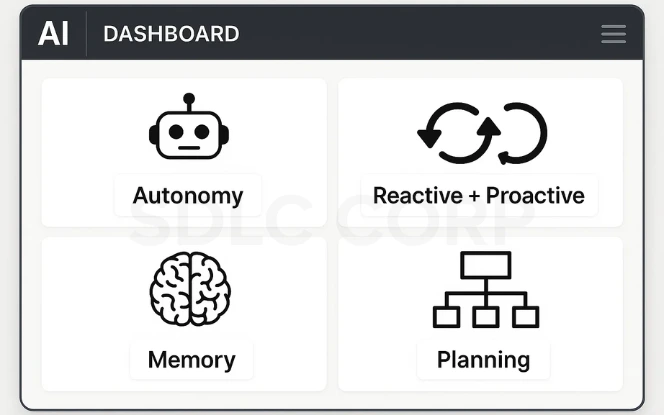
Agentic AI stands out from traditional models by combining autonomy, adaptability, and intelligence in a goal-driven framework. These systems don’t wait for instructions they act, learn, and evolve on their own. They can respond to dynamic environments, retain past experiences, and use that memory to plan future actions. What truly sets them apart is their ability to integrate multi-modal learning, self-reflection, and recursive planning, making them far more capable than rule-based or static AI models.
Key Characteristics:
- Autonomy: Operates without human prompts
- Reactive + Proactive: Adapts to change and initiates actions
- Memory & Planning: Learns from past to shape future decisions
- Advanced Reasoning: Uses reflection and multi-step planning
- Unique Edge: Combines multi-modal input, self-awareness, and goal-oriented thinking
3. Agentic AI vs Traditional AI
| Feature | Traditional AI | Agentic AI |
|---|---|---|
| Goal Definition | Externally defined tasks and objectives | Internally generated or learned goals |
| Autonomy | Reactive decision-making | Proactive planning and execution |
| Context Adaptation | Limited; operates under fixed assumptions | Continuously adapts to evolving environments |
| Learning Loop | Offline learning with periodic updates | Real-time learning and continual improvement |
When comparing traditional AI and Agentic AI, the main differences appear in autonomy, adaptability, and decision-making. Traditional AI stays task-focused and reactive, responding only when prompted. Agentic AI, however, can learn, plan, and act on its own. It behaves more like a proactive digital teammate than a basic tool. This shift marks a major step forward in AI and machine learning development.
For teams ready to apply these ideas, For implementation, our AI consulting company can help you operationalize the strategies and use cases discussed in this article.
4. Core Components of Agentic AI Systems
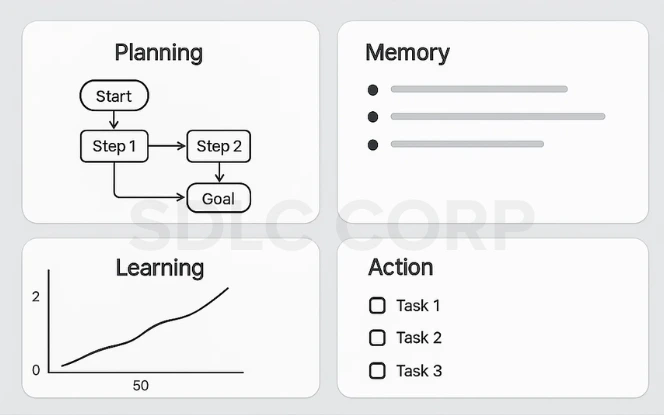
At the heart of Agentic AI lies a robust agent architecture that mimics human-like cognition. These systems combine sensing, memory, planning, and action to operate independently. Built on cognitive models in AI, Agentic systems often leverage powerful Large Language Models based agents like GPT-4 or Claude, integrated with tools and APIs to reason, decide, and act intelligently in real-world environments.
Key Components:
- Perception & Sensing: Awareness of surroundings and context
- Memory: Short- and long-term retention for informed decisions
- Planning: Goal setting and task sequencing
- Actuation: Taking actions digitally or physically
- LLM Backbone: Models like GPT-4 enhance reasoning, tool use, and adaptability
5. Popular Frameworks and Examples
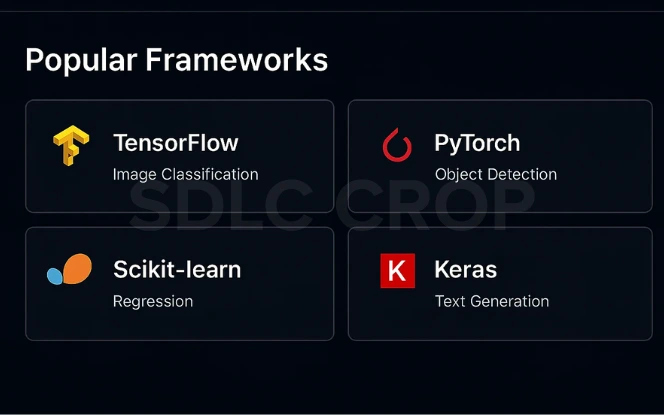
Several modern frameworks are driving the growth of Agentic AI, enabling systems to think, plan, and act with increasing autonomy. Tools like AutoGPT, LangChain Agents, and the ReAct pattern showcase how AI can execute multi-step tasks using memory and reasoning. Platforms such as Microsoft’s AutoGen and OpenAI’s function-calling agents push this further, allowing agents to integrate tools, APIs, and data sources seamlessly. A standout aspect is how Agentic AI’s tool use mirrors early human evolution marking AI’s transition from passive intelligence to a tool-using digital species.
Examples & Frameworks:
- AutoGPT: Autonomous agent chaining tasks with memory and reasoning
- LangChain Agents: Modular, tool-using agents with contextual awareness
- ReAct Pattern: Combines reasoning and action through LLMs
- Microsoft AutoGen: Multi-agent orchestration for enterprise AI
- OpenAI Function Calling: Enables agents to interact with real tools and data
Use Cases:
- Customer support automation
- AI-driven code generation
- Intelligent robotic process control
Also read – Transfer Learning Essentials
6. Challenges in Developing Agentic AI
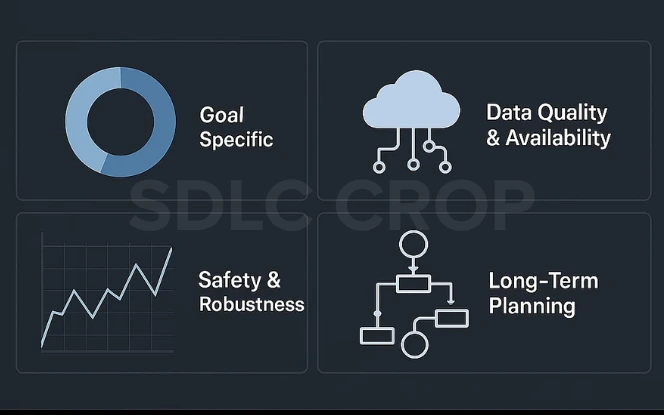
While Agentic AI offers powerful capabilities, it also brings unique challenges that go beyond typical AI development. Ensuring stability, managing hallucinations in planning, and addressing the ethics of autonomy are major hurdles. As these agents gain more independence, we must rethink traditional ideas of control, accountability, and trust redefining how humans and machines collaborate.
Key Challenges:
- Stability & Reliability: Maintaining consistent performance across changing tasks
- Planning Hallucinations: Preventing agents from generating flawed or unrealistic action plans
- Ethical Concerns: Managing autonomy without sacrificing human oversight
- Human Control Paradigms: Redefining delegation, trust, and responsibility in AI systems
7. Future of Agentic AI: What’s Next?
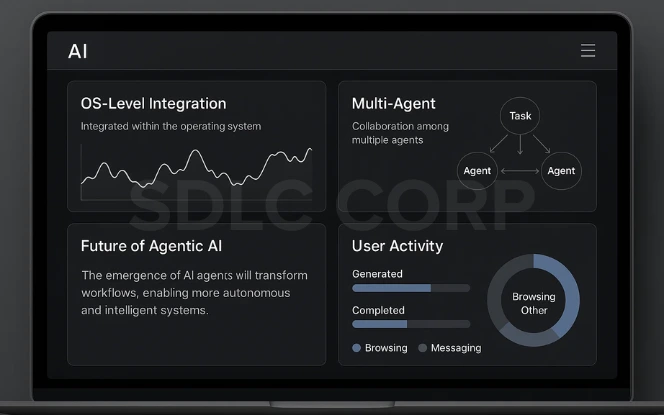
The future of Agentic AI lies in deeper integration, collaboration, and evolution. These agents will move beyond isolated tools to become OS-level co-pilots, capable of seamless assistance across apps and workflows. We’ll also see multi-agent ecosystems emerge, where agents coordinate and solve problems together. Most exciting is the rise of self-improving agents systems that evolve through digital experience, much like biological learning, leading to increasingly intelligent and adaptive AI.
What’s Ahead:
- OS-Level Integration: AI co-pilots embedded into operating systems and daily tools
- Multi-Agent Collaboration: Teams of agents working together, delegating and optimizing tasks
- Human-AI Synergy: Agents that plan, create, and make decisions alongside humans
- Self-Improving Intelligence: Agents that learn and evolve over time through digital feedback, similar to how living organisms adapt
8. Agentic AI as a Socio-Technical Layer
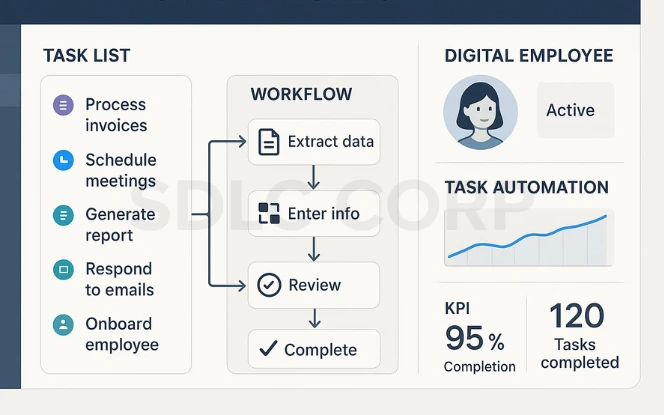
Agentic AI is more than a technological breakthrough it’s becoming a transformative socio-technical layer that reshapes how we work, interact, and manage organizations. As AI agents take on more complex roles, businesses will begin to treat them not just as tools, but as digital team members with tasks, goals, and performance metrics. This shift will redefine how we think about collaboration, leadership, and workforce structure.
Key Shifts Ahead:
- Workflows Reimagined: AI agents embedded in day-to-day operations
- Digital Employees: Agents with defined roles, tasks, and even KPIs
- Organizational Change: Hierarchies adapt as agents handle decision-making and execution
- Human-AI Collaboration: Teams will include both people and autonomous agents working together
9. Emotional Intelligence in Agentic AI
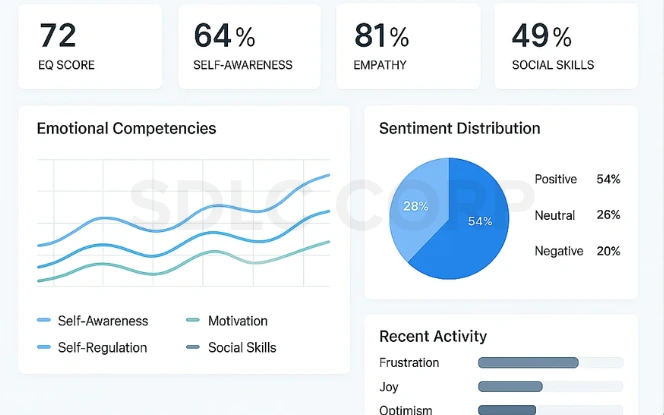
As Agentic AI evolves, it’s beginning to integrate emotional intelligence through technologies like affective computing. These agents can now detect tone, sentiment, and stress levels, allowing them to respond with empathy and adapt communication in real time. This capability transforms interactions from transactional to emotionally aware, paving the way for more meaningful, human-like engagement. For example, an AI therapist could adjust its approach over time based on a user’s emotional patterns and progress.
Key Highlights:
- Affective Computing: Enables agents to sense and interpret emotions
- Emotion-Aware Interaction: Responses adjust based on tone or stress levels
- Long-Term Adaptation: Agents evolve communication strategies over time
- Example: AI therapist personalizing care based on ongoing emotional feedback
10. Language as Operating System
| Aspect | Traditional Systems | Agentic AI Systems |
|---|---|---|
| Interface | Code-based commands | Natural language prompts |
| User Requirement | Requires programming knowledge | Accessible to developers and non-developers |
| Flexibility | Fixed commands or scripts | Dynamic, context-aware instructions |
| Programming Style | Syntactic coding (e.g., Python, Java) | Conversational logic (e.g., “Schedule my meeting”) |
| Control Layer | Manual task execution | Language-driven orchestration |
| Outcome | Task-specific response | Goal-oriented, multi-step action |
11. Legal and Ethical Agency
As Agentic AI systems gain more autonomy, important questions arise around accountability and responsibility. When an AI agent makes a decision especially in critical areas like finance or negotiation who is liable for the outcome? This growing independence may push governments and institutions to define new legal frameworks, including the possibility of “digital personhood” or AI agency rights, to ensure transparency, fairness, and control.
Key Considerations:
- Accountability Gap: Who is responsible for AI-driven decisions?
- Legal Frameworks Needed: Especially for high-impact autonomous agents (e.g., in finance, healthcare)
- Digital Personhood: Possible recognition of AI agents with legal identity or limited rights
- Ethical Design: Developers must embed safeguards, consent mechanisms, and explainability
12. What is Agentic AI vs Generative AI: A Detailed Comparison
| Feature | Agentic AI | Generative AI |
|---|---|---|
| Purpose | Goal-oriented action and decision-making | Content creation (text, image, code) |
| Autonomy | High – acts independently | Low – responds to prompts |
| Architecture | Agent-based with memory, tools, and reasoning | Neural networks (e.g., transformers like GPT) |
| Interaction | Proactive & reactive | Reactive only |
| Memory | Includes short- and long-term memory | Usually stateless |
| Planning Ability | Multi-step planning and task execution | Single-step generation |
| Examples | AutoGPT, LangChain Agents, Microsoft AutoGen | GPT-4, DALL·E, Midjourney |
| Best For | Automation, task agents, workflow orchestration | Creative content, writing, design |
Also read – Unsupervised Learning Overview

Conclusion
AI agents are changing how intelligent systems work, shifting them from reactive tools to proactive, self-directed models. With advances in the architecture of intelligent agents, these systems can now learn, plan, and adapt in real time. Their growing use across industries marks a major step forward in AI agent design, bringing together autonomy, memory, and stronger decision-making.
At SDLC Corp, we continue to explore how Agentic AI can reshape workflows, products, and digital experiences. With support from an experienced enterprise AI development company, teams can build and deploy agents that deliver real value. Follow our blog for practical insights and stay ahead as AI-driven innovation continues to grow.
FAQs
1. What is Agentic AI and how is it different from traditional AI?
Agentic AI refers to autonomous systems that can perceive, plan, and act toward achieving goals. Unlike traditional AI, which is task-specific and reactive, Agentic AI is proactive and self-directed. It mimics human agency by learning from context and adapting its behavior over time.
2. What are the core components of an Agentic AI system?
Agentic AI systems are built using a combination of perception, memory, planning, and action. They often use large language models (LLMs) like GPT-4 as a reasoning engine, layered with tools and APIs. This architecture allows them to make decisions and take actions autonomously.
3. What are some real-world examples of Agentic AI?
Examples of Agentic AI include systems like AutoGPT and LangChain Agents that can complete multi-step tasks, manage digital workflows, or even simulate human-like reasoning. These agents are used in areas like customer support, software automation, and robotic control.
4. What challenges are associated with developing Agentic AI?
Building Agentic AI comes with challenges like maintaining stability, preventing planning errors (hallucinations), and ensuring ethical behavior. Developers must also address questions about accountability, especially as agents make decisions with minimal human oversight.
5. How can businesses benefit from Agentic AI?
Businesses can use Agentic AI to automate complex workflows, reduce manual effort, and enable real-time decision-making. By integrating intelligent agents into their systems, companies can boost efficiency, personalize services, and scale operations with less human input.