Agentforce use cases help companies move from basic AI answers to controlled business action. Because of this, the strongest starting points are high-volume workflows where Salesforce data, approvals, handoff rules, and clear KPIs already exist.
An Agentforce use case is a business task where an AI agent reads a request, checks trusted CRM or company data, takes an approved action, and sends complex cases to a human team.
In this guide, you will see the best Agentforce use cases for 2026, where they can save time or improve revenue, what you need before setup, and which KPIs to track before launch.
Key Takeaways
- First, Agentforce works best when it is mapped to a real business process. Good candidates include support tickets, lead follow-ups, scheduling, order updates, internal helpdesk requests, and knowledge search.
- Next, the first use case should be selected by business outcome. Revenue growth, cost reduction, customer experience, and employee output each point to a different rollout path.
- Also, clean data and workflow rules matter more than hype. Agentforce implementation needs CRM readiness, access controls, connections, handoff logic, and clear success metrics.
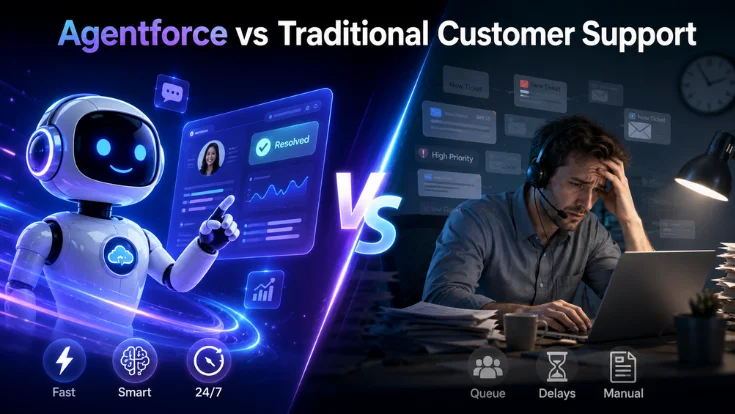
- For many teams, customer support is often the fastest starting point. It usually has high request volume, clear fix rules, existing knowledge bases, and visible KPIs such as FCR, CSAT, cost per case, and handoff rate.
- Finally, ROI should be measured by function. Sales teams should track pipeline speed, service teams should track case deflection, and operations teams should track workflow cycle time and automation coverage.
Find the right first Agentforce use case before you build
Map your business workflows, data readiness, connection gaps, and expected ROI so your first Agentforce rollout starts with a clear business case.
Why Agentforce Is Gaining Company Momentum
Business teams are moving beyond generic AI assistants because the next stage of automation is not only about generating answers. It is about helping teams complete approved actions inside the systems they already use.
Also, Salesforce describes Agentforce as an AI agent platform for building and rolling out AI agents across business workflows, while Gartner predicts that task-clear AI agents will become a major part of business apps by 2026.
Source context: For external validation, this blog can reference Salesforce Agentforce, Gartner's 2026 AI agent forecast, and Salesforce sales output research. However, use these links only where they naturally support the point.
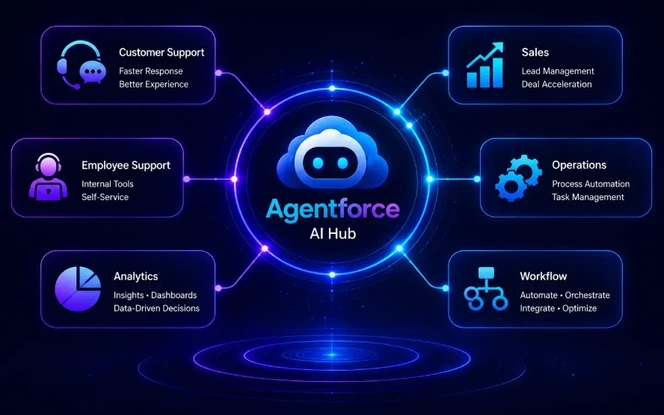
Agentforce Use Cases at a Glance
Next, the table below gives a fast view of the top Agentforce use cases by objective, business impact, and setup effort. So, use it as a starting point before choosing the first workflow for rollout.
| Use Case | Primary Objective | Expected Business Impact | Effort |
|---|---|---|---|
| Customer Support | Cost reduction | Faster answers, better deflection, lower cost per case | Medium |
| Lead Screening | Revenue growth | Quicker response, better pipeline quality, higher conversion | Medium |
| Sales Pipeline Management | Deal acceleration | Cleaner CRM data, shorter cycles, stronger rep follow-up | Medium |
| Marketing Improvement | Campaign ROI | Better segmentation, faster content testing, more conversions | High |
| Order Management | Customer experience | Fewer status tickets, proactive updates, lower support load | High |
| Employee Helpdesk | Output | Faster IT, HR, and policy support for employees | Medium |
| Company Search | Knowledge access | Less time searching, better answers, faster decisions | Medium |
| Appointment Scheduling | Service efficiency | Fewer no-shows, better use, smoother coordination | Medium |
| Claims and Billing | Accuracy | Faster processing, fewer manual errors, stronger audit trail | High |
| Workflow Orchestration | Cross-system automation | Less middleware friction, fewer data handoffs, faster cycles | High |
Top 10 Agentforce Use Cases Changing Company Operations
Before rollout, every Agentforce project should begin with a clear business problem. Then, the sections below explain where each use case fits, what it can improve, which systems are usually required, and which KPIs help prove value.
-
Customer Support and Case Fix
For example, support teams often deal with repeat tickets, slow handoffs, and inconsistent answers across channels. Then, Agentforce can help identify customer intent, pull CRM and knowledge base context, run approved workflows, and escalate exceptions with a useful summary for human agents.
Business value Lower cost per case, faster fix, better self-service coverage, and less pressure on Tier-2 support teams.Requirements Service Cloud, knowledge base, customer data access, handoff paths, approval logic, and support workflow mapping.KPIs First contact fix, CSAT, cost per case, handoff rate, average handle time, and human agent use.Best fit Retail, e-commerce, telecom, utilities, consumer technology, travel, and any business with high support volume.Medium effort Fast ROI potential Service-led rollout -
Lead Screening and Deal Ranking
Also, inbound leads lose value when response times are slow or static scoring sends low-intent prospects to the sales team. So, Agentforce can engage leads quickly, collect screening data, update CRM records, book meetings, and route high-intent prospects to the right owner.
Business value Faster lead response, better SDR output, improved pipeline quality, and fewer missed opportunities from delayed follow-up.Requirements CRM connection, lead scoring rules, marketing automation connection, email or messaging channels, and routing logic.KPIs Lead response time, lead-to-deal conversion, meeting booking rate, pipeline velocity, and SDR output.Best fit B2B SaaS, professional services, manufacturing, logistics, real estate, and high-volume inbound sales teams.Revenue use case CRM dependent SDR support -
Sales Pipeline Management and Deal Acceleration
Meanwhile, sales reps lose momentum when they spend too much time updating CRM fields, writing follow-ups, finding account context, or searching for deal material. As a result, Agentforce can support reps by preparing next-step emails, surfacing missing deal details, logging activities, and recommending relevant content.
Business value Shorter sales cycles, cleaner pipeline data, faster stakeholder responses, and stronger deal follow-through.Requirements Deal workflows, activity tracking, role-based access rules, sales content library, and CRM data quality rules.KPIs Sales cycle length, win rate, forecast accuracy, CRM completeness, quote turnaround time, and quota attainment.Best fit Technology, medical devices, industrial sales, commercial insurance, and B2B teams with long deal cycles.Sales output Medium effort Rep enablement -
Marketing Campaign Execution and Improvement
In marketing, teams often struggle to create enough right segments, content variants, and performance reviews across channels. Because of this, Agentforce can support campaign teams by using customer journey signals to recommend segments, generate approved variants, monitor performance, and suggest campaign adjustments.
Business value Better campaign relevance, faster execution, improved conversion rates, and more efficient marketing spend.Requirements Data Cloud readiness, marketing automation connection, journey tracking, content approval rules, and control rules.KPIs Click-through rate, conversion rate, marketing ROI, campaign build time, content testing speed, and audience engagement.Best fit Travel, hospitality, media, entertainment, retail, B2B subscriptions, and campaign-heavy teams.High effort Data Cloud important Campaign ROI -
Order Management and Delivery Support
In operations, order questions create heavy service volume when customers ask about shipment status, cancellations, returns, or delivery changes. Then, Agentforce can connect customer service with order, inventory, logistics, and notification systems to provide updates or start approved actions.
Business value Fewer repeat tickets, proactive customer communication, lower support overhead, and better post-purchase experience.Requirements ERP connection, order management system, shipping data, inventory view, customer communication rules, and exception handling.KPIs Order change cycle time, delivery-related CSAT, proactive notification open rate, and transit-to-fix time.Best fit E-commerce, D2C brands, logistics, shipping, wholesale distribution, and businesses with frequent order updates.High effort Operations heavy CX improvement -
Employee Helpdesk and Internal Support
Inside the company, teams spend a lot of time answering policy questions, resetting access, access setup tools, and handling repeat IT or HR requests. So, Agentforce can work as an internal assistant inside Slack, Microsoft Teams, or employee portals while following access rules.
Business value Less employee downtime, faster internal support, fewer repeat tickets, and more capacity for IT and HR teams.Requirements Slack or Teams connection, HR and IT system access, identity management, internal knowledge base, and approval controls.KPIs Internal ticket fix time, employee experience, ticket cost, access setup speed, and repeat request volume.Best fit High-growth tech firms, financial services, healthcare networks, distributed companies, and large support-heavy organizations.Employee output Medium effort IT and HR support -
Knowledge Management and Company Search
Also, employees lose time when critical information is spread across Google Drive, SharePoint, PDFs, wikis, CRM notes, and internal documents. To fix this, Agentforce can help users find accurate answers by retrieving governed content and summarizing it with role-based access controls.
Business value Faster decisions, less time searching, better answer consistency, and reduced risk from outdated information.Requirements Document repository connection, semantic search setup, data control rules, and access-control mapping.KPIs Time-to-information, search relevance, knowledge usage rate, answer accuracy, and content freshness.Best fit Legal services, life sciences, engineering, finance, consulting, research-heavy teams, and regulated companies.Knowledge access Medium effort Control critical -
Appointment Scheduling and Service Coordination
For service teams, scheduling becomes difficult when teams manage field staff, customer availability, service types, locations, cancellations, and route changes manually. Then, Agentforce can help book, reschedule, notify, and coordinate service appointments using rules and calendar data.
Business value Fewer no-shows, better field use, smoother customer communication, and faster scheduling cycles.Requirements Calendar connection, field service system, workforce rules, service location data, and customer messaging channels.KPIs Field technician use, schedule density, no-show rate, rescheduling time, and first-time fix rate.Best fit Healthcare clinics, field services, telecom installations, utilities, automotive service, and home services.Service efficiency Medium effort Field coordination -
Financial Services, Claims, and Billing Support
In finance, claims, disputes, billing checks, and finance workflows often require strict rules, records, approvals, and audit view. After that, Agentforce can help gather details, check records, prepare next steps, and route exceptions for human approval.
Business value Faster processing, fewer manual errors, better SLA performance, and stronger rule view.Requirements Claims or billing system connection, secure document handling, audit logs, approval workflows, and role-based access.KPIs Claim cycle time, billing SLA rule, exception rate, touchless processing rate, and audit accuracy score.Best fit Banking, insurance, fintech, healthcare payers, accounting teams, and regulated finance operations.High effort Audit sensitive Human approval needed -
Workflow Automation and Cross-System Orchestration
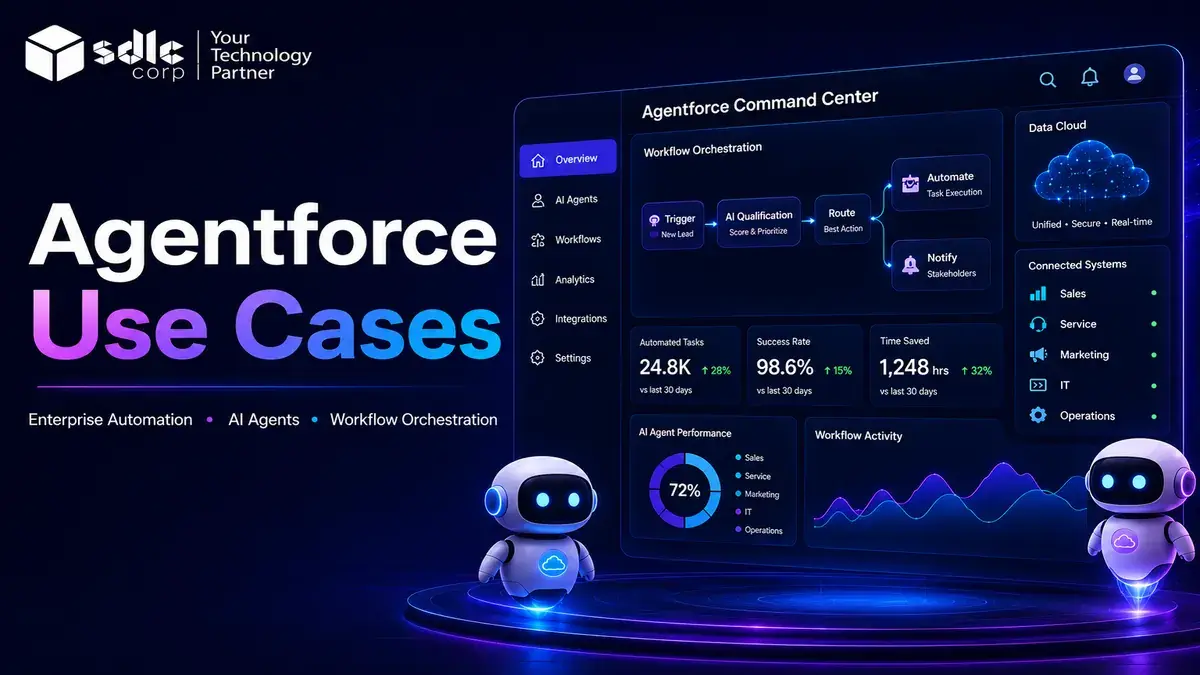
Many companies still depend on disconnected systems, manual copy-paste work, and fragile connections between Salesforce, ERP, HR, finance, and service platforms. In that case, Agentforce can support orchestration by triggering approved actions across connected systems and reducing manual handoffs.
Business value Shorter workflow cycles, fewer data-sync issues, less middleware maintenance, and better end-to-end automation coverage.Requirements Company API landscape, connection design, workflow control, monitoring, fallback logic, and change management.KPIs Workflow cycle time, middleware cost reduction, sync error rate, automation percentage, and manual handoff reduction.Best fit Large companies, supply chain networks, financial groups, energy companies, and multi-system operations.High effort Company scale System workflow control
Need help choosing the highest-impact Agentforce workflow?
SDLC Corp can help review business impact, setup effort, connection needs, and expected ROI before you start building your first agent.
Which Agentforce Use Case Should Your Business Set Up First?
However, the best starting point depends on the result your business needs first. A company trying to increase revenue should not begin with the same workflow as a company trying to reduce support cost. So, start with one business outcome, prove the KPI change, and then expand.
Revenue Growth
- Use AI SDR support for inbound lead response.
- Connect CRM, calendar, and lead scoring rules.
- Prioritize high-intent opportunities faster.
- Track pipeline velocity and conversion quality.
Cost Reduction
- Start with Tier-1 customer service requests.
- Automate order status, basic troubleshooting, and FAQs.
- Keep approval paths for sensitive actions.
- Track cost per case and deflection rate.
Customer Experience
- Focus on order support, appointment changes, and service updates.
- Send proactive notifications across preferred channels.
- Reduce waiting time and repeat handoffs.
- Track CSAT, FCR, and customer effort score.
Employee Output
- Launch internal IT, HR, and knowledge support agents.
- Automate password, access, and policy requests.
- Use role-based access rules and handoff controls.
- Track internal SLA speed and ticket volume.
Quick selection checklist: choose the first Agentforce use case where the request volume is high, rules are clear, system access is available, risk is manageable, and KPI improvement can be measured within the first rollout cycle.
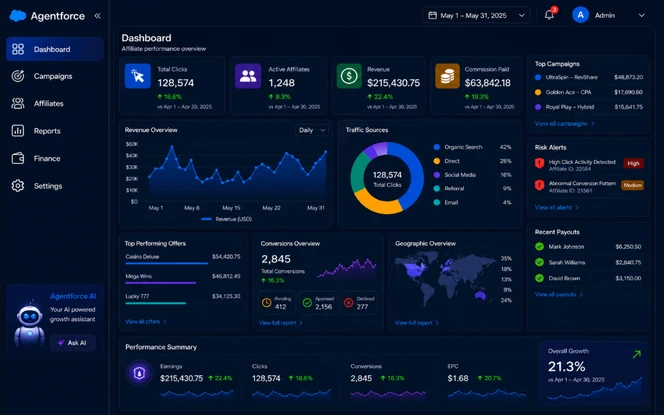
How to Measure Agentforce ROI Across Business Functions
For ROI, Agentforce should not be measured with one generic metric. Instead, each business function needs its own baseline, target, and success window. The goal is simple: connect the agent rollout to a business number that leadership already understands.
Revenue Growth Metrics
- Pipeline acceleration from inbound lead to qualified deal.
- Lead-to-deal conversion rate after automated screening.
- Added expansion revenue from guided upsell or cross-sell actions.
- Sales pipeline velocity after faster follow-ups and cleaner CRM updates.
Operations and Cost Metrics
- AI-led case fix rate for repeat support tickets.
- Cost per interaction compared with human-only support handling.
- First-contact deflection rate for common Tier-1 requests.
- Middleware or manual workflow maintenance savings.
Customer Experience Metrics
- First contact fix lift across chat, web, email, and voice channels.
- Average wait time reduction for common customer requests.
- Customer effort score improvement for multi-step processes.
- CSAT change after faster responses and better handoffs.
Employee Output Metrics
- Average handle time saved by pre-filled context and summaries.
- Internal SLA improvement for IT, HR, and access setup tickets.
- Reduction in repeat admin work for support, sales, and operations teams.
- Increase in high-value work completed after routine tasks are delegated.
Estimate Agentforce ROI before setup starts
Build a practical roadmap around baseline metrics, target improvements, workflow readiness, data access, control, and connection effort.
Case Study Insight: Why Customer Support Is Often the First Agentforce Rollout
Often, customer support is the first Agentforce rollout because the business problem is easy to see. Many support teams receive a steady flow of repeat questions about order status, account changes, appointment updates, product information, billing basics, and service requests.
- Discovery The team reviews ticket categories, request frequency, fix steps, handoff reasons, and knowledge base coverage.
- Workflow design High-volume, rule-based requests are selected for agent handling, while sensitive or unclear issues are routed to humans.
- Setup Agentforce is connected to Salesforce data, approved knowledge, customer context, and service workflows with clear guardrails.
- Outcome Routine work moves faster, support specialists spend less time on repeat interactions, and customers receive answers with less waiting.
So, the practical lesson is simple. Do not begin with the most complex company-wide automation problem. Start with a repeatable workflow, prove the outcome, and then expand Agentforce into adjacent processes.
How SDLC Corp Helps Businesses Set Up Agentforce Successfully
For a safe rollout, Agentforce implementation needs more than creating an AI agent. The business needs clean data, mapped workflows, connection planning, control rules, testing, and ongoing improvement. SDLC Corp helps companies plan, build, and scale Agentforce solutions around clear business outcomes.
Also, as a certified Salesforce development company, SDLC Corp supports use case discovery, Salesforce customization, API connections, workflow automation, security planning, performance tracking, and long-term improvement. For advisory-led projects, businesses can also explore our Salesforce consulting services to define the right roadmap before development begins.
- Use case discovery Identify workflows where Agentforce can reduce cost, improve customer experience, support employees, or accelerate revenue.
- Data and workflow readiness Review CRM objects, access rules, knowledge sources, approval paths, handoff rules, and process gaps.
- Agent design and setup Build agents around clear roles, approved actions, connected systems, testing scenarios, and human fallback paths.
- Connection and control Connect Salesforce with company systems while keeping access, monitoring, audit trails, and rules in place.
- Improvement and scale Track KPIs, improve prompts and workflows, expand to new departments, and keep the rollout aligned with business value.
Final Thoughts
In the end, Agentforce use cases are most valuable when they solve a clear business problem instead of acting as a broad AI experiment. The right first rollout should have clear request volume, reliable data, defined workflows, access controls, clear KPIs, and a safe handoff path.
For most companies, the fastest path is to begin with customer support, lead screening, employee helpdesk, or knowledge search. Once the team proves ROI, Agentforce can expand into more advanced areas such as campaign improvement, claims support, order management, and cross-system workflow control.
Build a practical Agentforce setup plan
Connect with SDLC Corp to identify the right business uses, define success metrics, and create a controlled roadmap for Agentforce adoption.
FAQs
The most common Agentforce uses are customer support, lead screening, sales help, employee helpdesk, order support, appointment booking, and workflow automation.
Traditional automation usually follows fixed rules. Salesforce Agentforce use cases can use business context, retrieve data, follow approved steps, take actions, and escalate exceptions when human review is needed.
Industries such as retail, healthcare, financial services, insurance, technology, manufacturing, logistics, telecom, and professional services can benefit when Agentforce is mapped to the right workflow.
Before Agentforce setup, businesses should review data quality, Salesforce readiness, workflow rules, connections, approval paths, access rules, compliance needs, and the KPIs that will prove success.
The first use case should be high-volume, rule-based, easy to measure, and safe to escalate. Customer support, lead screening, employee helpdesk, and company search are often strong starting points.
Agentforce ROI can be measured through metrics such as cost per case, first contact fix, lead conversion rate, pipeline velocity, internal ticket fix time, customer effort score, and workflow cycle time.
Yes. Agentforce can help customer support teams answer common questions, check customer records, create or update cases, share order updates, and send complex issues to human agents.
Yes. Agentforce can support sales teams by qualifying leads, updating CRM records, preparing follow-up messages, suggesting next steps, and helping reps focus on active deals.
Agentforce works best when CRM data, customer records, knowledge base content, workflow rules, user access rules, and system connections are clean, updated, and easy to access.
Yes. Agentforce can help employees with IT, HR, policy, access, and internal support questions. It can also route complex requests to the right team when human help is needed.