
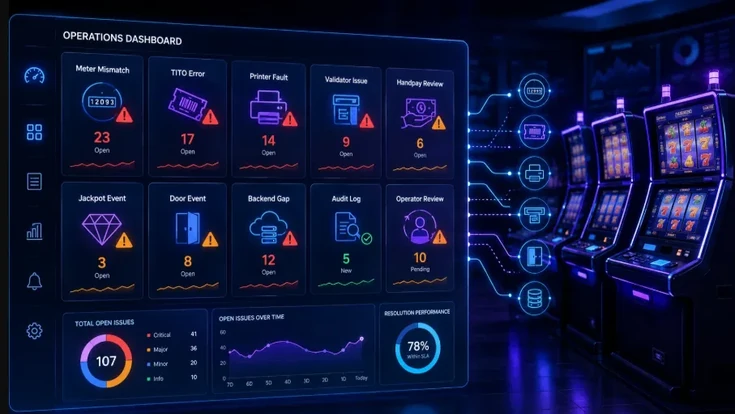
EGM operational issues include machine faults, ticket errors, meter differences, alerts, and reporting problems. To find the cause, operators check machine data, TITO records, audit logs, cashbox details, and staff notes before taking action.
In simple terms: EGM issue review is the process of connecting machine events, financial records, ticket activity, floor notes, and backend reporting into one clear operating story.
Quick Summary of Common EGM Operational Issues
| Issue Area | Common Sign | Records Operators Review |
|---|---|---|
| Meter mismatch | Machine values do not match expected report values | Accounting meters, host records, cashbox notes, ticket values |
| TITO error | Ticket insertion, validation, print, or redemption issue | Ticket-in, ticket-out, printer event, validation record, cashier note |
| Printer or validator fault | Ticket jam, printer offline, bill acceptance issue | Fault events, audit log, machine status, attendant note |
| Handpay or jackpot review | Large win or condition needs review | Game recall, jackpot record, handpay record, attendant workflow |
| Backend reporting gap | Machine activity is not visible or delayed in reports | Host communication, protocol events, report timing, alerts |
| Audit log gap | Important event is missing or unclear | Machine log, significant events, door events, power reset records |
What Are EGM Operational Issues?
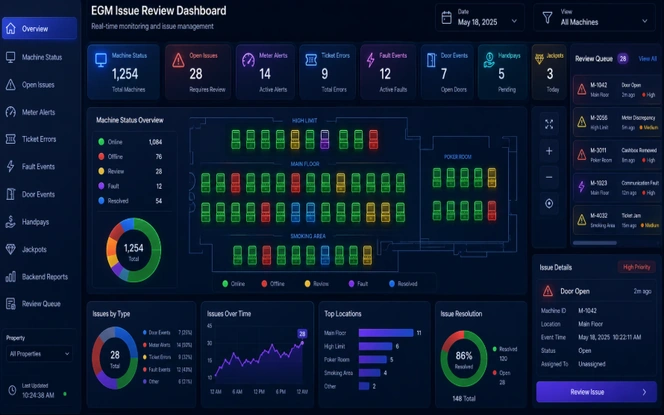
EGM operational issues are post-launch problems that can affect machine availability, player support, accounting reviews, ticket handling, event records, and backend visibility.
Each electronic gaming machine has several connected layers. A simple floor fault may involve cabinet status, game state, ticket records, meters, protocol messages, or reporting data.
Examples include:
- Meter mismatch
- Ticket-in or ticket-out gap
- Printer fault
- Bill validator issue
- Door event
- Power reset
- Handpay review
- Jackpot event
- Backend report gap
- Host communication issue
- Missing audit detail
- Configuration concern
Meter Mismatches
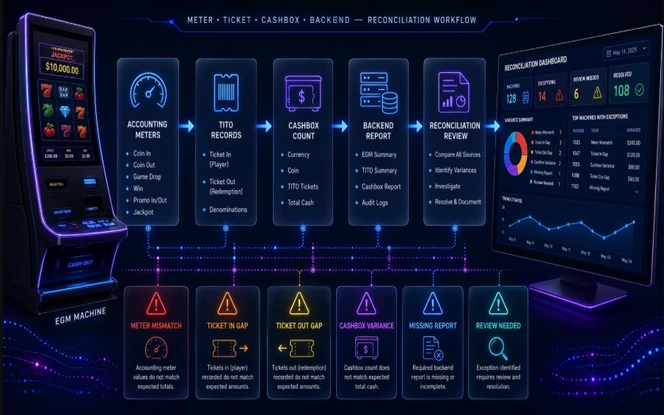
Meter mismatches need careful attention because they affect accounting, reconciliation, and confidence in the machine record.
A complete check compares the values explained in EGM accounting meters with backend reports, cashbox notes, handpay records, and ticket values.
Common Causes of Meter Mismatch
- Incorrect meter mapping
- Timing differences between machine and host
- Incomplete report pull
- Communication interruption
- Cashbox count variance
- Ticket value mismatch
- Handpay record mismatch
- Machine reset during activity
- Unclear meter baseline
- Wrong machine ID mapping
The review should start with the machine before moving to host records, backend reports, and floor documentation.
TITO and Ticket Errors
TITO issues can affect both player experience and accounting review. A ticket may fail to print or scan, appear twice, show the wrong status, or be missing from the expected report.
Operators can confirm the cause by comparing the TITO workflow in slot machines with machine records, validation data, cashier activity, and backend reports.
Printer and Validator Faults
Printer and validator issues remain common floor-level problems. They can make a machine unavailable, affect player support, and create extra ticket or accounting work.
Operators usually review the fault event, cabinet status, printer or validator state, ticket activity, and attendant note. Repeated issues may also require a service-history and machine-pattern check.
Printer Fault Examples
- Printer offline
- Ticket jam
- Paper low
- Failed ticket print
- Unclear barcode
- Repeated printer reset
- Delayed ticket event
- Cashout support issue
Validator Issue Examples
- Bill reject pattern
- Validator offline
- Door or stacker event
- Acceptance failure
- Machine lockup
- Cashbox concern
- Sensor warning
- Event log gap
Handpay and Jackpot Review Issues
Handpays and jackpots require careful review because several records may be involved. These cases can include machine data, attendant workflows, identity checks, tax steps, and backend reports.
The review may cover game recall, jackpot events, handpay records, meter movement, attendant notes, and report entries. An incomplete record should be escalated before closure.
Door Events and Cabinet Access Issues
Door events and cabinet access records show whether the machine was opened, serviced, reset, or inspected during the review window.
These records connect with EGM cabinet components and the access points that may create machine events. However, a door event does not automatically mean a problem occurred; it simply gives operators useful context.
Communication and Backend Reporting Gaps
Backend reporting gaps appear when machine records do not align with host or reporting data. Common causes include delayed reports, missing events, duplicated activity, incorrect machine mapping, and incomplete alert routing.
Operators should compare the issue with the process explained in EGM monitoring and backend reporting systems.
GLI-13 is useful here because monitoring and control environments include logging, searching, significant event reporting, financial and meter data collection, and reconciliation.
SAS and G2S Message Issues
Machine communication issues may appear as missing meter values, delayed status changes, incomplete ticket records, or misplaced alerts.
Operators do not always need to inspect raw protocol messages. They should understand how SAS and G2S protocols support machine-to-host activity.
Audit Log and Event Record Gaps
Audit log gaps make issue reviews harder because they remove the event timeline needed to explain what happened.
Useful records include door events, power resets, validator faults, printer faults, communication failures, handpays, jackpots, configuration changes, and recovery events.
These details should align with the expected EGM audit logs and event records.
Jurisdictions and technical standards may describe different expectations for gaming device integrity, accounting, monitoring, and auditability. Examples include Nevada Technical Standard 1, Singapore GRA EGM standards, and Victoria technical standards guidance.
Game Configuration and Paytable Concerns
Some issues involve the game setup rather than a device fault. Operators may need to confirm the active game, denomination, enabled features, paytable display, and approved configuration.
This review connects with EGM paytables and PAR sheets and EGM RNG and game outcome testing.
Player Support and Dispute Review
Player-facing issues need a clear review because the operator may need to explain what happened in plain language. The record should be factual, time-bound, and tied to machine data.
Useful inputs may include:
- Machine ID
- Game title
- Time window
- Ticket number, where available
- Displayed message
- Attendant note
- Machine event timeline
- Game recall record
- Meter movement
- Backend report record
How Operators Review EGM Issues
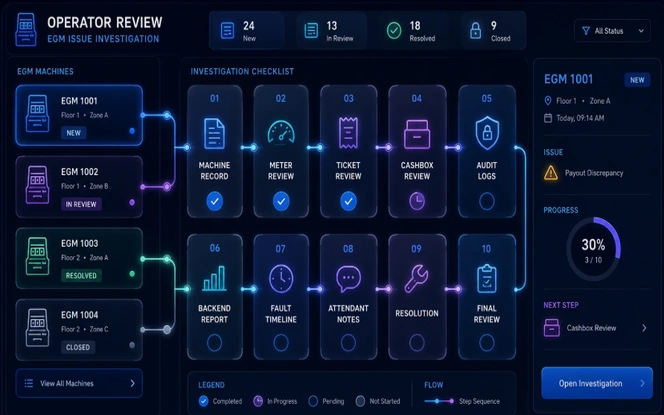
A strong EGM issue review follows a clear order.
Identify the machine and define the time window. Collect the records, compare values, check events, and document each action. Close the issue only after the record is complete.
| Step | Review Action | Why It Helps |
|---|---|---|
| 1. Identify | Confirm machine ID, floor zone, game, and time window | Prevents review of the wrong device or wrong period |
| 2. Collect | Gather meters, ticket records, event logs, alerts, and notes | Creates a complete review set |
| 3. Compare | Compare machine records with backend reports and floor notes | Finds gaps, mismatches, and timing issues |
| 4. Classify | Label the issue type and severity | Helps route work to the correct owner |
| 5. Resolve | Apply the required floor, accounting, or technical action | Moves the issue toward closure |
| 6. Document | Record what was reviewed, what changed, and final status | Supports future audit and repeat-issue review |
Common Mistakes During Issue Review
Reviewing the Wrong Time Window
For example, many mismatches look different when the exact machine event time and report timing are not aligned.
Checking Ticket Paper Only
In addition, ticket review should include validation records, printer events, meter values, and cashier or redemption records.
Ignoring Meter Baseline
As a result, it becomes harder to confirm later values when the starting value is unclear.
Closing Without Notes
However, an issue may look resolved on the floor while weak documentation makes later review harder.
Skipping Backend Records
Therefore, local machine activity should be compared with host and reporting records when the issue touches accounting or events.
Missing Floor Context
For instance, attendant notes, door events, and service actions can explain why a machine state changed.
Operator Review Checklist
- Machine ID confirmed
- Floor zone confirmed
- Issue time window defined
- Machine status reviewed
- Accounting meters checked
- Ticket-in values checked
- Ticket-out values checked
- Cashbox note reviewed
- Handpay record reviewed
- Jackpot record reviewed
- Printer events checked
- Validator events checked
- Door events reviewed
- Power reset events reviewed
- Communication status checked
- Backend report compared
- Audit log reviewed
- Attendant note reviewed
- Player support note reviewed
- Issue type classified
- Resolution owner assigned
- Final status recorded
- Follow-up action noted
- Repeat pattern checked
Need Help Resolving EGM Issues?
Improve issue tracking, machine monitoring, reporting, and operational review with an EGM solution built for your casino floor.
Talk to Our EGM ExpertsFAQs About EGM Operational Issues
What are common EGM operational issues?
Common EGM operational issues include meter mismatches, TITO errors, printer faults, validator issues, handpay review gaps, jackpot record issues, door events, communication failures, missing audit records, and backend reporting gaps.
How do operators review EGM issues?
Operators usually compare the machine record, accounting meters, ticket records, cashbox notes, audit logs, event timeline, attendant notes, and backend reports before marking an issue as resolved.
Why do meter mismatches happen on EGMs?
Meter mismatches may happen because of mapping errors, timing differences, host communication gaps, ticket record problems, cashbox count variance, or incomplete report synchronization.
How are TITO errors reviewed?
TITO errors are reviewed by comparing ticket-in records, ticket-out records, validation records, printer events, cashout activity, redemption records, and the related machine meters.
Why are printer and validator faults important?
Printer and validator faults affect ticket handling, bill acceptance, machine availability, player support, and reconciliation. They should be reviewed with event logs and machine status records.
How do audit logs help with EGM issue review?
Audit logs help explain when important events happened, such as door openings, power resets, printer faults, validator errors, handpays, jackpots, configuration changes, and communication failures.
Final Thoughts
In summary, common EGM operational issues are easier to review when operators connect the machine record, meter values, ticket flow, event timeline, fault details, floor notes, and backend reports.
However, the goal is not only to fix a visible machine problem. It is also to understand what happened, document the record, protect accounting accuracy, and reduce repeat issues.
As a result, EGM operations become easier to monitor, support, and audit when every issue has a clear machine ID, time window, record set, review owner, and closure note.