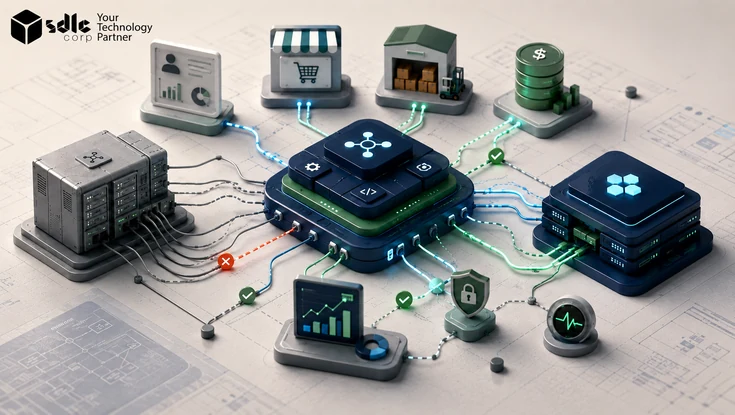

Enterprise blockchain initiatives are becoming more production-focused in financial services, supply chain, digital identity, and other complex sectors. As organizations move beyond isolated proofs of concept, they must address enterprise integration, smart contract security, data governance, scalability, and post-launch ownership.
The challenge is no longer finding a provider that simply offers blockchain development services. Enterprise buyers need a partner capable of designing, integrating, securing, and supporting the solution in a production environment, with implementation evidence that matches the proposed architecture.
Quick Answer
There is no single blockchain consulting firm that fits every enterprise. The right partner depends on the business problem, implementation complexity, regulatory obligations, blockchain architecture, integration requirements, and long-term support needs. Matching proven implementation experience to these requirements produces stronger outcomes than relying on reputation or rankings alone.
Key Takeaways
- No single blockchain development company is right for every enterprise project.
- Platform expertise should match permissioned, public, hybrid, scalability, interoperability, and governance requirements.
- Production deployments provide stronger delivery evidence than pilot projects or service-page claims.
- Smart contract security, governance, and compliance should be validated before development begins.
- ERP, CRM, identity, cloud, API, and data integrations are critical to successful implementation.
- Monitoring, upgrades, incident response, maintenance, and knowledge transfer sustain value after go-live.
Security and Evidence Standard
Security evaluation should be informed by recognized guidance such as the OWASP Smart Contract Top 10 and the risk-management principles of the NIST Cybersecurity Framework. Public implementation evidence, relevant case studies, and verifiable production references should carry more weight than self-reported capability claims.
Top Blockchain Development Companies in the USA
These providers were selected using publicly available information on blockchain technologies, implementation experience, platform coverage, industry focus, case studies, and post-launch support. Protocol-only projects, exchanges, audit firms, and infrastructure vendors without implementation capabilities were excluded.
SDLC Corp

Best for: Enterprises seeking blockchain solutions alongside AI, cloud, ERP, and broader digital transformation initiatives.
SDLC Corp supports organizations building scalable blockchain applications with enterprise-grade integration and long-term technology partnerships. Its broader engineering capabilities make it suitable for programs where blockchain must connect with existing business systems.
- HQ: San Francisco, California
- Primary services: Blockchain consulting, smart contracts, dApps, tokenization, crypto wallets, DeFi platforms, and blockchain integration
- Technical expertise: Ethereum, Hyperledger Fabric, Solana, Polygon, Corda, and enterprise blockchain architecture
- Industries: Finance, gaming, healthcare, supply chain, manufacturing, and retail
- Key consideration: Strong choice for enterprises requiring blockchain integrated with broader digital transformation.
Plan Your Blockchain Initiative
Clarify the business case, architecture, integrations, security controls, governance, and support model.
ScienceSoft

Best for: Organizations modernizing enterprise systems through secure blockchain implementation and integration.
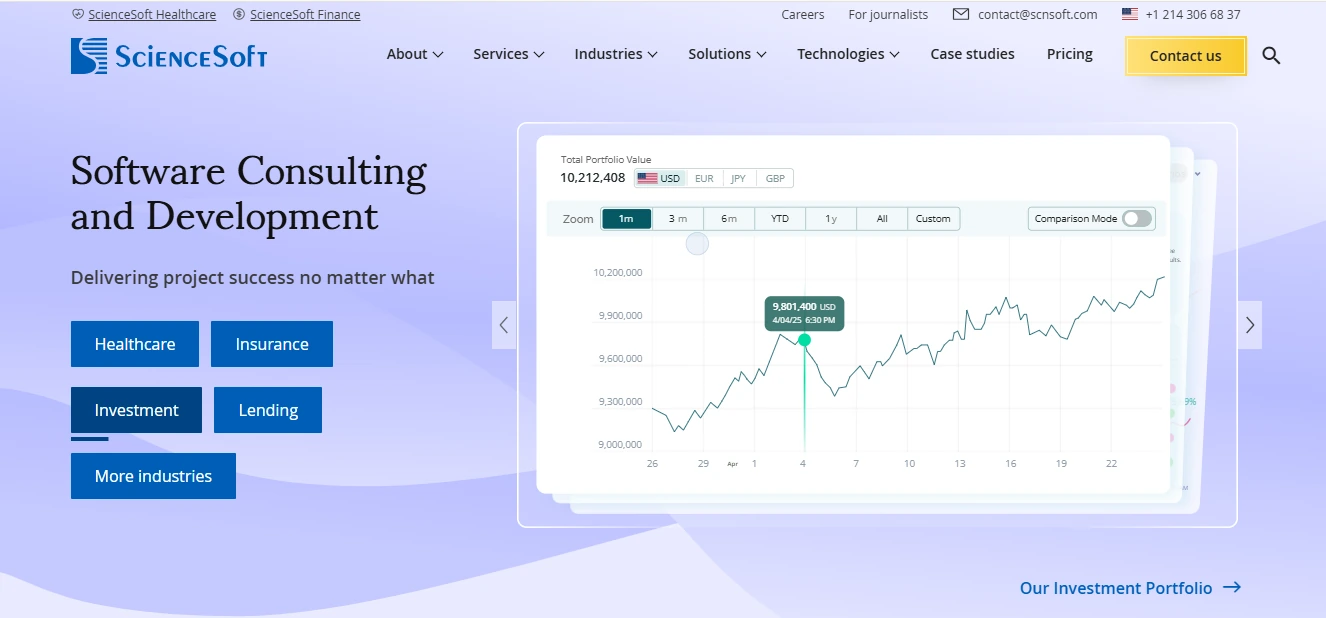
ScienceSoft is suited to businesses that need blockchain connected with established enterprise applications and operational workflows. Its positioning is especially relevant to modernization programs where integration, security, and maintainability are central requirements.
- HQ: McKinney, Texas
- Primary services: Blockchain consulting, private blockchain, smart contracts, tokenization, and blockchain integration
- Technical expertise: Hyperledger Fabric, Ethereum, Besu, Polygon, and Solana
- Industries: Healthcare, manufacturing, logistics, finance, and retail
- Key consideration: Well suited for enterprise integration and modernization projects.
PixelPlex

Best for: Businesses developing blockchain-native products, DeFi ecosystems, and tokenized digital platforms.
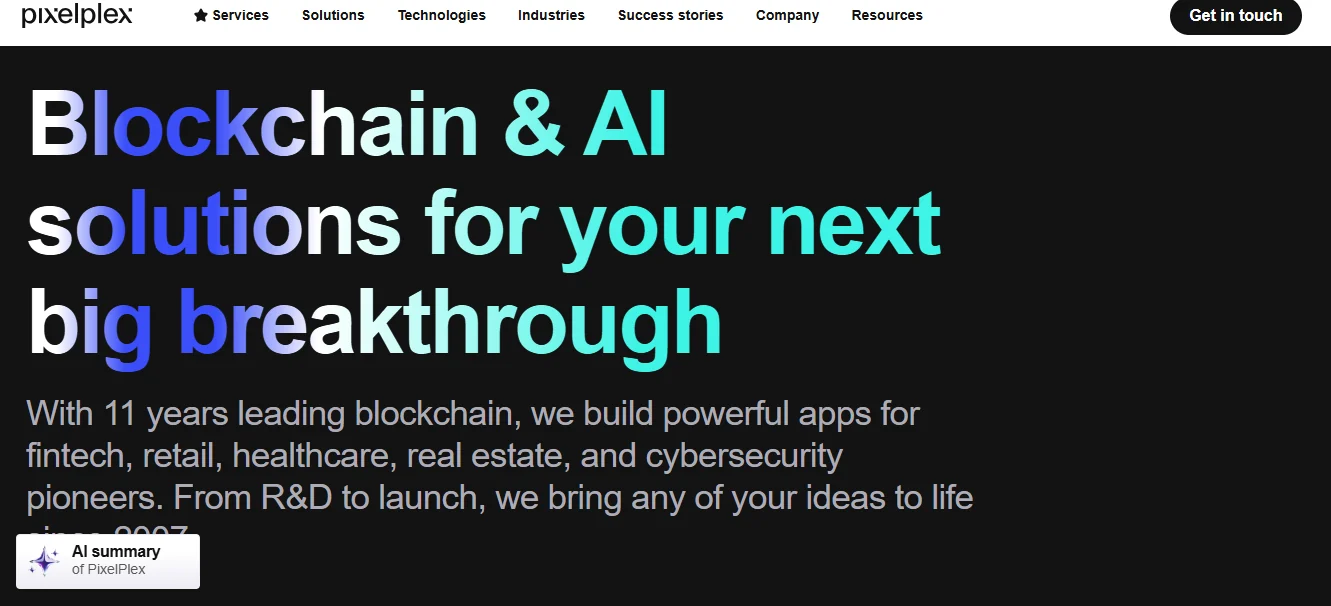
PixelPlex is positioned for blockchain-focused products that require advanced engineering across smart contracts, tokenization, wallets, DAOs, and multi-chain environments. It can suit teams building platforms where blockchain is the core product rather than one supporting component.
- HQ: New York, New York
- Primary services: Smart contracts, tokenization, DAO development, wallets, and blockchain consulting
- Technical expertise: Ethereum, Solana, Polygon, Hyperledger Fabric, Corda, and Canton
- Industries: FinTech, Web3, digital assets, healthcare, and supply chain
- Key consideration: Verify experience with the preferred blockchain network before engagement.
Vention

Best for: Enterprises requiring dedicated blockchain engineering teams for product development and modernization.
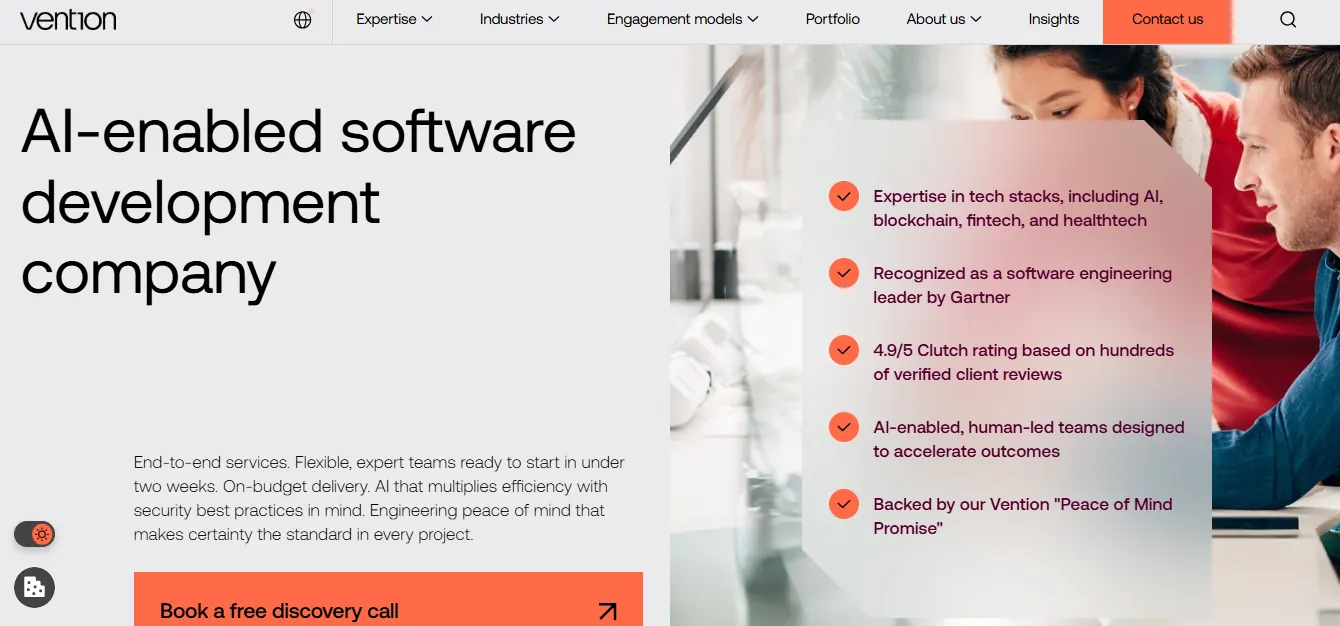
Vention supports organizations that need scalable engineering capacity for custom blockchain products and wider enterprise software initiatives. Its team-based delivery model can fit companies looking to extend internal development capacity over a longer engagement.
- HQ: New York, New York
- Primary services: Blockchain development, smart contracts, NFT platforms, crypto wallets, and consulting
- Technical expertise: Ethereum, Polygon, Solana, Hyperledger Fabric, and Corda
- Industries: Finance, healthcare, retail, logistics, and technology
- Key consideration: Ask for blockchain-specific production references during vendor evaluation.
Unicsoft

Best for: Organizations building tokenization platforms, digital assets, and regulation-aware Web3 applications.
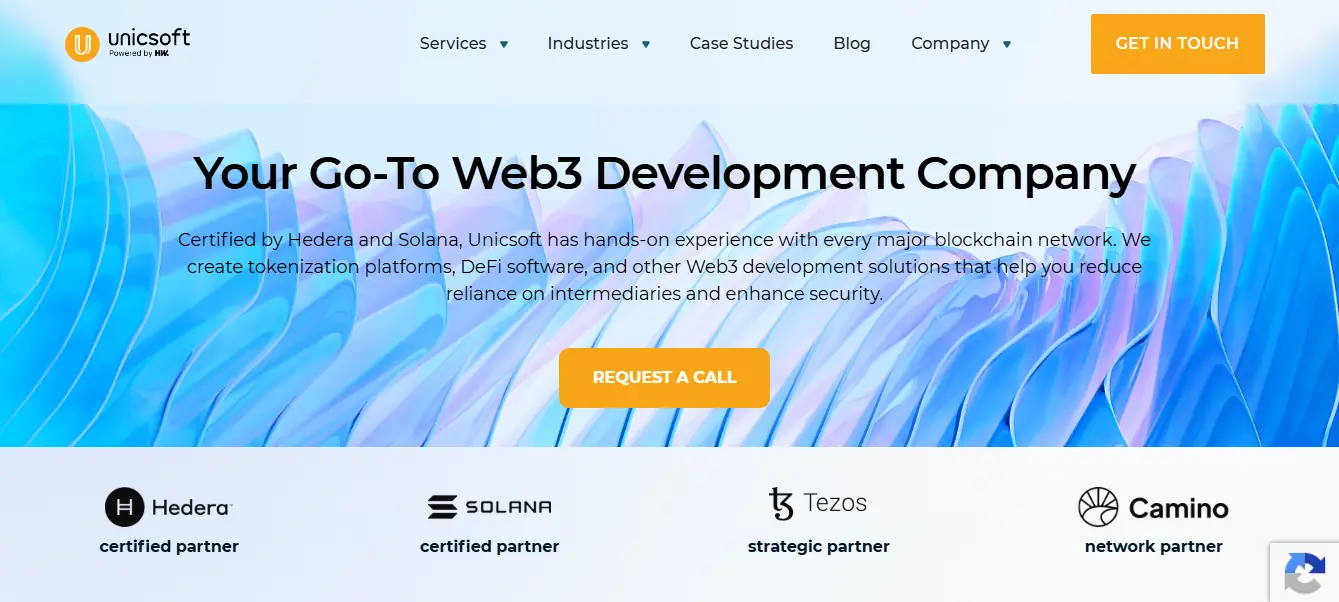
Unicsoft is suited to digital asset and enterprise Web3 programs where tokenization, analytics, identity controls, and compliance considerations must be addressed together. Buyers should evaluate its regulatory experience against the requirements of their market and industry.
- HQ: Lexington, Kentucky
- Primary services: Enterprise blockchain, smart contracts, tokenization, and AML/KYC integration
- Technical expertise: Ethereum, Hedera, Solana, Hyperledger Fabric, and Corda
- Industries: Finance, carbon trading, supply chain, insurance, and digital assets
- Key consideration: Review regulatory and compliance experience for your industry.
10Pearls

Best for: Enterprises implementing blockchain within larger transformation, cybersecurity, and cloud programs.
10Pearls can support organizations treating blockchain as one part of a broader enterprise technology initiative. Its cross-functional delivery capabilities are relevant where blockchain must align with cloud modernization, cybersecurity, customer platforms, or digital operations.
- HQ: Vienna, Virginia
- Primary services: Blockchain consulting, smart contracts, dApps, and enterprise blockchain
- Technical expertise: Ethereum, Hyperledger Fabric, Polygon, and permissioned networks
- Industries: Government, healthcare, financial services, retail, and education
- Key consideration: Request blockchain-focused case studies relevant to your project.
Consensys

Best for: Enterprises building Ethereum-based ecosystems, digital assets, institutional finance, and tokenization platforms.
Consensys is closely aligned with the Ethereum ecosystem and can suit organizations developing institutional blockchain, digital asset, tokenization, and enterprise Ethereum initiatives. Buyers should confirm that this ecosystem focus matches the project's architecture and long-term platform strategy.
- HQ: Fort Worth, Texas
- Primary services: Enterprise blockchain consulting, smart contracts, digital assets, and blockchain infrastructure
- Technical expertise: Ethereum, Linea, Layer 2 technologies, and Enterprise Ethereum
- Industries: Banking, financial services, supply chain, government, and trade finance
- Key consideration: Best suited for organizations committed to the Ethereum ecosystem.
Kaleido

Best for: Enterprises deploying consortium blockchain networks and multi-party business ecosystems.
Kaleido is designed around managed blockchain infrastructure, APIs, tokenization, and consortium network operations. It can fit multi-organization initiatives where governance, onboarding, shared infrastructure, and platform operations are as important as application development.
- HQ: Raleigh, North Carolina
- Primary services: Managed blockchain, APIs, enterprise blockchain integration, and tokenization
- Technical expertise: Ethereum, Hyperledger Besu, and EVM-compatible networks
- Industries: Manufacturing, supply chain, energy, financial services, and logistics
- Key consideration: Understand which features are platform-based versus custom development.
LITSLINK

Best for: Businesses combining blockchain with AI, cloud, mobile, and modern digital products.
LITSLINK supports cross-functional product development where blockchain is combined with cloud, AI, mobile, or user-facing digital experiences. Buyers should separate general software delivery evidence from blockchain-specific implementation evidence during evaluation.
- HQ: Palo Alto, California
- Primary services: Blockchain development, DeFi, NFT platforms, smart contracts, and crypto wallets
- Technical expertise: Ethereum, Polygon, Solana, Hyperledger Fabric, and BNB Chain
- Industries: FinTech, healthcare, retail, logistics, and gaming
- Key consideration: Validate blockchain project references independently from general software projects.
Altoros

Best for: Enterprises implementing permissioned blockchain infrastructure connected with existing systems and cloud environments.
Altoros is positioned for private and permissioned blockchain deployments that require architecture, migration, enterprise integration, and operational support. It can suit organizations adopting Hyperledger-based or other controlled network models.
- HQ: Pleasanton, California
- Primary services: Blockchain architecture, enterprise integration, smart contracts, and blockchain migration
- Technical expertise: Hyperledger Fabric, Ethereum, Quorum, and Corda
- Industries: Banking, insurance, manufacturing, logistics, and healthcare
- Key consideration: Best suited for private enterprise blockchain deployments requiring long-term operational support.
Blockchain Development Company Comparison Matrix
Use this matrix to compare enterprise focus, delivery approach, implementation evidence, core blockchain strengths, and long-term support before reviewing each provider in greater detail.
| Company | Enterprise Focus | Delivery Approach | Core Blockchain Strength | Public Implementation Evidence | Long-Term Support |
|---|---|---|---|---|---|
| SDLC Corp | Business modernization | End-to-end delivery | Multi-platform enterprise solutions | Published enterprise blockchain case studies | Managed maintenance and enhancements |
| ScienceSoft | Legacy system modernization | Consulting and integration | Permissioned enterprise blockchain | Named enterprise implementations | Maintenance and optimization |
| PixelPlex | Blockchain-native platforms | Product engineering | Multi-chain and tokenization | Published blockchain case studies | Product evolution and support |
| Vention | Engineering scalability | Dedicated engineering teams | Custom blockchain product development | Limited public blockchain references | Team extension and ongoing delivery |
| Unicsoft | Digital assets and Web3 | Full lifecycle delivery | Tokenization and blockchain analytics | Industry-focused case studies | Continuous maintenance and upgrades |
| 10Pearls | Enterprise innovation | Digital engineering | Blockchain within enterprise transformation | Selected public implementations | Managed application support |
| Consensys | Institutional blockchain | Advisory and implementation | Ethereum-based enterprise solutions | Extensive enterprise portfolio | Ecosystem guidance and technical support |
| Kaleido | Consortium ecosystems | Managed blockchain platform | Enterprise consortium networks | Enterprise deployment examples | Platform operations and governance |
| LITSLINK | Product acceleration | Agile product teams | Blockchain integrated with AI and cloud | Published project portfolio | Continuous feature enhancement |
| Altoros | Private blockchain adoption | Enterprise deployment | Hyperledger-based enterprise solutions | Limited public production references | Monitoring, upgrades, and knowledge transfer |
Selection Criteria: How the Companies Were Evaluated
Each provider was assessed using criteria that reflect how enterprise buyers evaluate blockchain implementation partners. The review focuses on implementation capability and public evidence rather than marketing claims alone.
Blockchain Platform Expertise
Experience across permissioned and public ecosystems should align with the required network architecture, governance model, scalability, and interoperability needs.
Buyer check: Confirm hands-on experience with the platform proposed for your project.
Enterprise Integration Capability
The provider should be able to connect blockchain solutions with ERP, CRM, identity, cloud, APIs, databases, and existing enterprise applications.
Buyer check: Request examples involving systems similar to your technology environment.
Smart Contract Security
Secure development, testing, access controls, threat analysis, and review practices should be informed by recognized smart contract security guidance.
Buyer check: Review testing, audit coordination, incident handling, and upgrade procedures.
Industry Experience
Regulated industries require stronger security, data governance, auditability, compliance awareness, and operational controls.
Buyer check: Validate implementation experience within your industry and regulatory context.
Delivery Maturity
A mature partner should be able to move an initiative from discovery and proof of concept to stable production through structured governance and delivery practices.
Buyer check: Ask how production readiness, testing, rollout, and ownership are managed.
Long-Term Operational Support
Post-launch services should cover monitoring, platform upgrades, governance, incident response, maintenance, documentation, and knowledge transfer.
Buyer check: Confirm service levels, support ownership, and upgrade responsibilities.
Turn Your Shortlist Into a Blockchain Delivery Plan
Define the use case, network architecture, integrations, security controls, governance, timeline, budget, and post-launch ownership before development begins.
Choosing the Right Blockchain Development Partner
Selecting a blockchain development partner is a strategic procurement decision. Evaluate proven delivery capability, security practices, blockchain integration services, and long-term operational support rather than platform familiarity alone.
Use these checks to compare technical fit, production evidence, integration readiness, security, governance, and long-term ownership.
- Align Business Goals with Expertise Match the provider's experience to the use case. Supply chain, payments, identity, digital assets, and consortium networks require different implementation capabilities.
- Prioritize Production Evidence Production implementations provide stronger proof of delivery capability than proof-of-concept projects, generic portfolios, or service-page statements.
- Validate Enterprise Integration Confirm experience connecting blockchain with ERP, CRM, identity, cloud platforms, enterprise APIs, data systems, and operational workflows.
- Review Security Practices Evaluate secure smart contract development, testing, access control, vulnerability handling, upgrade mechanisms, and audit coordination before delivery starts.
- Confirm Governance and SLAs Document governance responsibilities, service levels, monitoring, incident response, change management, and platform upgrade processes.
- Plan Long-Term Ownership Clarify maintenance, monitoring, enhancements, documentation, knowledge transfer, vendor dependencies, and internal ownership after go-live.
How to Verify a Blockchain Partner Before Shortlisting
- Request Recent ReferencesAsk for production implementations that match your use case, industry, architecture, and integration complexity.
- Validate Platform ExpertiseConfirm that the delivery team has hands-on experience with the exact blockchain platform proposed for the project.
- Review Smart Contract SecurityAssess development standards, testing, access controls, threat modeling, audit coordination, and upgrade mechanisms.
- Examine Integration CapabilityReview examples involving ERP, CRM, identity, cloud, APIs, data platforms, and existing enterprise workflows.
- Confirm Delivery GovernanceEvaluate discovery, architecture, testing, deployment, documentation, release management, and stakeholder reporting.
- Assess Operational SupportConfirm monitoring, incident response, maintenance, platform upgrades, service levels, and knowledge transfer.
Conclusion
Choosing among the top blockchain development companies in the USA requires more than comparing rankings or service portfolios. Enterprise buyers should evaluate blockchain expertise, production implementation evidence, smart contract security, enterprise integration capabilities, and long-term operational support.
Using consistent selection criteria and an evidence-based comparison process can reduce implementation risk and improve the likelihood of delivering a secure, scalable, maintainable blockchain solution that supports long-term business objectives.
Build a Secure Blockchain Solution Around Real Business Needs
Define the architecture, platform, integrations, security model, governance, delivery approach, and long-term support requirements before selecting a partner.
Frequently Asked Questions
Choose a partner with relevant production experience, enterprise integration capability, smart contract security expertise, and documented delivery evidence within your industry or use case.
Compare platform expertise, security practices, integration capabilities, industry experience, delivery methodology, production references, governance, and long-term support.
Common platforms include Ethereum, Hyperledger Fabric, Hyperledger Besu, Solana, Polygon, Corda, Hedera, and other EVM-compatible or enterprise blockchain technologies.
Integration allows blockchain solutions to connect with ERP, CRM, identity management, cloud platforms, APIs, and operational data, enabling reliable workflows across the wider business environment.
Many enterprise-focused providers offer monitoring, maintenance, platform upgrades, governance support, incident response, enhancements, documentation, and knowledge transfer after deployment.