An AI prototype can demonstrate what a model can do. A production-ready system must do more, because it has to work with real business data, integrate with existing systems, protect sensitive information, and deliver measurable results.
In practice, AI development and engineering services cover identifying suitable use cases, building or integrating AI solutions, testing their performance, and operating them reliably.
The right approach depends on the business problem, data readiness, risk, integration requirements, and total cost, rather than on which AI technology is most popular.
of EU enterprises with 10 or more employees used at least one AI technology in 2025, up 6.5 percentage points on 2024.
Eurostat, 20% of EU enterprises use AI technologies, 11 December 2025. View sourceaverage increase in issues resolved per hour across 5,179 customer support agents using a generative AI assistant.
Brynjolfsson, Li and Raymond, Generative AI at Work, NBER WP 31161, 2023. View sourceimprovement for novice workers in that same study, with minimal impact on experienced staff. Averages hide who benefits.
Brynjolfsson, Li and Raymond, Generative AI at Work, NBER WP 31161, 2023. View sourceTherefore, the practical lesson is to test AI against a real workflow, a credible baseline, and predefined success criteria.
What Are AI Development and Engineering Services?
AI development and engineering services cover the planning, design, development, integration, testing, deployment, and maintenance of AI applications, so the scope is wider than model building alone.
They may include specialisms such as machine learning, generative AI, large language models, retrieval-augmented generation, AI agents, data engineering, and MLOps.
AI development focuses on creating models or applications. By contrast, AI engineering also addresses the surrounding systems, including data access, software integrations, evaluation, security, monitoring, and operational ownership.
The distinction matters because most failed AI projects fail in the surrounding systems rather than in the model.
Although it is widely quoted, the 14% average from the customer support study should not be treated as a universal productivity forecast.
It came from one workflow, one deployment, and one set of agents, while the benefit concentrated among less experienced workers.
Which AI Approach Should a Business Choose?
In general, the simplest approach that meets the requirements is often the best starting point. Match the requirement to the approach before committing to a technology.
| Business requirement | Possible approach | Measure success by | Key limitation |
|---|---|---|---|
| Find information in structured documents | Conventional search | Relevant results and time to find information | Depends on indexing and document quality |
| Answer questions using approved internal documents | RAG application | Correct answers supported by authorized sources | Retrieval errors and unsupported answers remain possible |
| Forecast demand or identify anomalies | Predictive ML | Forecast error or detection performance | Sensitive to changing data patterns |
| Draft, classify, or summarize content | Generative AI | Output quality and review effort | Can generate inaccurate content |
| Execute approved multistep tasks | AI agent with restricted tools | Successful task completion and error rate | Tool misuse, partial failures, and unintended actions |
| Process invoices or forms | Document AI or OCR with validation | Cost per correctly processed document | Poor scans and unusual formats |
RAG retrieves relevant information and supplies it to a language model when generating a response. However, it can improve grounding in selected sources without guaranteeing accuracy. Document permissions, freshness, retrieval quality, and generated answers still require testing.
Use an agent only when a multistep workflow genuinely requires it. For example, a deployed agent and its guardrails are set out in this AI voice agent implementation.
If search, rules, or a simpler model can solve the problem, additional complexity may add cost and risk without enough benefit.
How to Select the Right AI Use Case
First, prioritize opportunities using four dimensions. Then score each from 1 to 5 as an initial screening exercise.
Could the solution reduce cost, delays, errors, or customer friction?
Are the required data, systems, and skills available?
Can privacy, security, and accuracy risks be controlled?
Can results be compared with a credible baseline?
Still, this is a suggested planning framework rather than a validated industry standard. Use the scores to shortlist opportunities rather than to approve projects automatically.
AI Readiness Checklist
Before funding development, confirm:
- The workflow and business problem are clearly defined.
- Current costs, processing times, error rates, or throughput are already documented.
- Data is accessible, sufficiently reliable, permissioned, as well as legally usable.
- Required integrations and security controls are understood.
- A business owner is responsible for acceptance and ongoing operations.
- Success criteria and conditions for stopping the project are agreed upon.
Consequently, if these foundations are missing, resolve them before investing in a complex AI solution.
The AI Development Lifecycle: From Discovery to Production
Overall, a practical lifecycle uses decision gates to prevent spending from growing without evidence. Each stage should produce something a sponsor can review before the next one is funded.
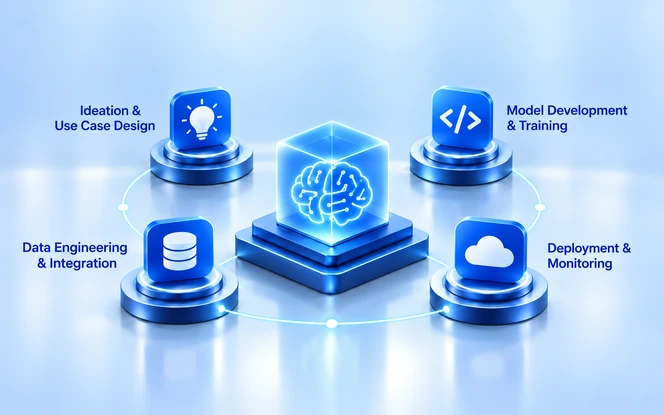
Define the users, problem, baseline, and intended outcome.
Check quality, permissions, relevance, and availability.
Compare existing products, simpler alternatives, models, and integrations.
Test a limited solution against representative examples.
Build the application, data flows, interfaces, and safeguards.
Test quality, security, latency, reliability, and operating costs.
Release with monitoring, incident handling, and rollback procedures.
Review actual results and change the system when evidence justifies it.
In addition, Google Cloud's MLOps guidance explains how testing, deployment automation, and monitoring support machine learning operations.
AI Development Costs: What Should You Estimate?
Importantly, there is no reliable universal price or timeline. Costs depend on factors such as scope, data readiness, engineering effort, integration complexity, security, model usage, and support requirements.
Estimated total cost = discovery + data preparation + development and integration + evaluation and security + deployment + ongoing operations.
Instead, for each proposal, document four cost categories rather than a single number.
Discovery, implementation, data preparation, and integration.
Hosting, model usage, monitoring, maintenance, and support.
Review, exception handling, training, and process changes.
Additional work caused by data issues or integration constraints.
Furthermore, ask every provider to use the same assumptions: expected usage, included systems, acceptance tests, exclusions, ownership terms, and support period. As a result, estimates become comparable without pretending that one price fits every project.
AI Risks, Security, and Governance
Nevertheless, AI systems can produce inaccurate answers, expose sensitive information, reflect bias, or take unintended actions when connected to business tools.
The NIST Generative AI Profile guides managing generative AI risks, while the OWASP Top 10 for LLM Applications identifies application risks such as prompt injection and sensitive information disclosure.
Practical Safeguards
- Apply least-privilege access to data and tools.
- Require human approval for consequential or irreversible actions.
- Test outputs against representative cases as well as known failure scenarios.
- Enforce document-level permissions and protect sensitive information.
- Monitor quality, cost, latency, and unexpected behaviour, using the practices set out in this guide to AI usage monitoring.
- Maintain audit logs, escalation procedures, and rollback mechanisms.
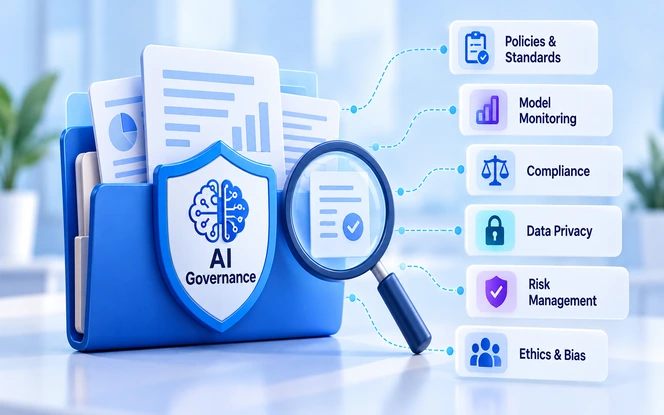
These safeguards work best inside a wider enterprise AI governance framework, which assigns the decision rights and evidence requirements behind them. Meanwhile, regulatory obligations depend on jurisdiction, intended use, and risk classification.
The EU AI Act has a phased implementation schedule, although some timelines have changed by amendment. The European Commission publishes its current AI Act guidance, and specific systems warrant appropriate legal advice.
How to Choose an AI Development Company
Above all, evaluate providers on the evidence they can produce rather than on presentations or demonstrations.
| Criterion | Weight |
|---|---|
| Understanding of the business problem | 20% |
| Architecture and integration fit | 20% |
| Evaluation method and acceptance criteria | 20% |
| Security, privacy, and governance | 15% |
| Production support and knowledge transfer | 15% |
| Pricing and ownership terms | 10% |
Then score each provider from 1 to 5, multiply each score by its weight, and add the weighted results.
This scorecard is a suggested starting point rather than an industry standard.
In an illustrative comparison, Provider A scores 4 of 5 on evaluation and 2 of 5 on production support, while Provider B scores 3 of 5 on evaluation and 5 of 5 on support.
Neither is automatically better, because the decision depends on project risk, the other criteria, and the evidence behind each score. These are examples, not real vendor assessments.
Questions to Ask Shortlisted Providers
- What simpler alternatives did you consider?
- What evidence will demonstrate that the solution works?
- Who owns the code, data, prompts, and deliverables?
- How will you detect regressions and roll back releases?
- Which costs and responsibilities continue after launch?
Finally, verify references, contract terms, data portability, relevant experience, and support commitments. Similarly, the supplier checks follow the same structure as an AI vendor risk assessment.
Production Readiness and Measuring AI ROI
Before launch, confirm that acceptance tests have passed, access controls and integrations are validated, operating costs meet agreed limits, and monitoring, escalation, fallback, and rollback procedures are ready. Before go-live, documentation and named operational owners must also be in place.
Similarly, measure outcomes against a baseline. Where feasible, use a control group or phased rollout to distinguish the system's impact from other changes.
What to Track
- Cost and time per transaction.
- Accuracy, error rates, and throughput.
- Adoption and successful workflow completion.
- Revenue impact where attribution is defensible.
- Engineering, model, infrastructure, review, and support costs.
Finally, distinguish time saved, capacity recovered, and cash costs reduced. If employees complete tasks faster but payroll remains unchanged, the organization may gain capacity without realizing direct cash savings.
Report actual benefits alongside quality and operating costs. Projected savings are not achieved ROI.
How We Built This Guidance
The frameworks on this page come from three inputs rather than a single source. Specifically:
- Published adoption and productivity evidence, read against the primary releases from Eurostat and the NBER working paper rather than secondary summaries of them.
- The risk guidance that constrains production AI, specifically the NIST Generative AI Profile and the OWASP Top 10 for LLM Applications.
- Delivery practice, where the lifecycle stages and gate structure follow published MLOps guidance on testing, deployment automation, and monitoring.
The use-case scoring dimensions, the cost model, and the vendor scorecard weights are planning aids for buyers rather than official standards, and each is labelled as such where it appears.
How SDLC Corp Supports AI Development and Engineering
SDLC Corp provides AI development and engineering services for businesses looking to build and integrate AI applications into existing workflows.
Its service portfolio includes capabilities such as machine learning, generative AI, large language models, retrieval-augmented generation, AI agents, computer vision, document intelligence, and AI integration.
Likewise, the delivery process covers solution design, development, evaluation, deployment, and ongoing improvement. Deployment practice follows a responsible AI implementation framework, and published AI case studies show how the process runs end to end.
Where a project needs governance alongside delivery, our AI governance consulting services and the Custos platform connect policy requirements to operational monitoring and controls.
In short, for businesses evaluating an AI development partner, the key consideration is how well a proposed solution fits their data, systems, security requirements, and measurable objectives.
Project scope, acceptance criteria, ownership, and ongoing support should all be agreed before development begins.
Scope Your AI Project Against Evidence, Not a Demo
Get a use-case assessment, a data readiness check, acceptance criteria, and a total cost of ownership estimate before development begins.
Talk to Our AI Engineering TeamConclusion
Successful AI development begins with a measurable business problem, an honest assessment of data and risk, and the simplest solution that meets the requirement.
Therefore, define acceptance criteria before funding a pilot, compare providers using consistent evidence, and measure results after deployment.
Ultimately, the goal is not to deploy AI for its own sake. Instead, it is to build or adopt a system that the business can operate, govern, and justify through verifiable results.
Frequently Asked Questions
They can include discovery, data engineering, AI or LLM integration, application development, evaluation, security testing, deployment, monitoring, and maintenance.
Timelines depend on scope, data readiness, integrations, testing, and approvals. A credible estimate requires a defined project scope.
Costs depend on engineering, data preparation, usage, infrastructure, evaluation, security, and support. Request an estimate based on explicit assumptions and total cost of ownership.
Compare providers using the same requirements, evaluation criteria, security checks, ownership terms, and production-support expectations.
AI development focuses on creating the model or application. AI engineering covers the surrounding systems as well, including data access, integrations, evaluation, security, monitoring, and who owns the system in production.
RAG suits questions that must be answered from a controlled set of internal documents, because the source material can be updated without retraining. It improves grounding but does not guarantee accuracy, so retrieval quality and document permissions still need testing.