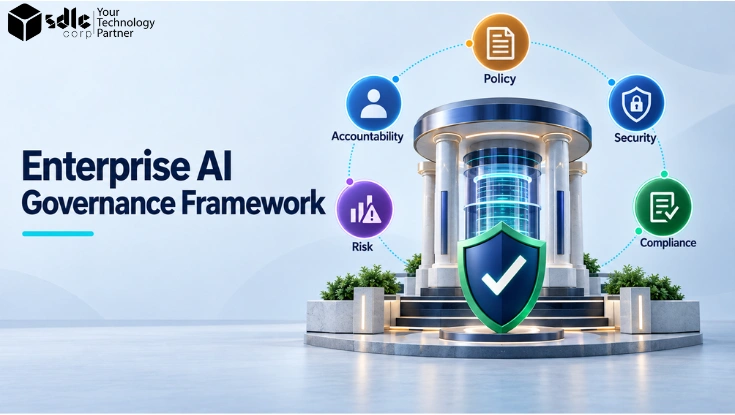
An enterprise AI governance framework defines the controls and evidence required to approve, change, monitor, and retire AI systems.
Each control should state the condition it protects, the evidence required to demonstrate compliance, the owner accountable for maintaining the control, and the event that triggers re-review.
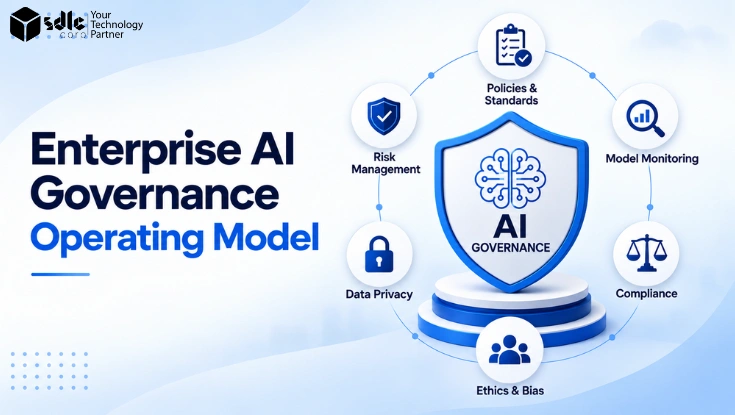
Roles, meeting structures, delegated authority, and decision SLAs are execution mechanics handled by the AI governance operating model.
Core Principles of an Enterprise AI Governance Framework
How this fits with the wider architecture: This article defines the policy requirements that apply across the AI portfolio: inventory, risk tiers, lifecycle gates, minimum evidence, exceptions, and retirement.
It does not prescribe forum mechanics, model-validation methods, or responsible-AI design controls; those are implemented through the linked specialist operating practices.
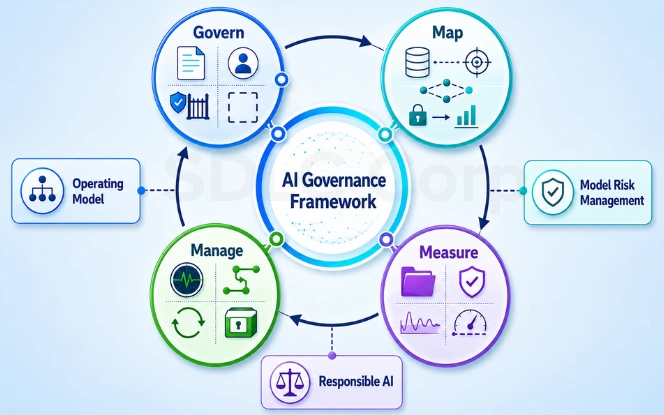
Use a continuous Govern-Map-Measure-Manage lifecycle to organize the framework. Govern sets the mandatory policies, ownership rules, and exception logic. Map identifies where AI is used, which data it touches, and what business decisions it influences.
Measure defines the evidence and performance signals required for trust. Manage defines monitoring, remediation, and retirement triggers.
This structure keeps the framework readable and prevents it from absorbing other pages. Detailed evaluation methods belong in model risk management. Fairness, transparency, and privacy implementation belong in responsible AI.
Decision rights and meeting cadence belong in the governance operating model.
- Govern: policy rules, approval conditions, and exception boundaries.
- Map: inventory, use-case scope, data exposure, and business impact.
- Measure: evidence packages, tests, and review thresholds.
- Manage: monitoring, remediation, revalidation, and retirement triggers.
A governance framework should define the control system clearly enough that the operating model, model-risk process, and responsible-AI reviews can attach to it without redefining the same baseline controls.
For an external control baseline on continuous AI risk governance, use the NIST AI Risk Management Framework and its Govern-Map-Measure-Manage core.
Organizations can also align the management system with ISO/IEC 42001:2023, which specifies requirements for establishing, maintaining, and continually improving an AI management system.
Teams operating in or serving the European Union should map inventory, classification, documentation, oversight, and monitoring controls to the EU AI Act requirements that apply to their role and use case.
Define AI Governance Scope and Build an AI Inventory
Set An Inclusion Rule Before Building The Register
Start by defining what must appear in the AI inventory. Include models, retrieval systems, embedded AI features, third-party inference services, and decision-support workflows that change customer, employee, operational, or financial outcomes.
Exclude only clearly low-impact utilities or static analytics that do not affect decisions.
The inventory is the entry point for every other framework control. If an asset is not registered, it cannot be risk classified, routed to the right lifecycle gate, or monitored against the required evidence package.
Tie inventory updates to deployment, procurement, and configuration changes so the register stays live instead of becoming an annual spreadsheet.
- Define inclusion rules in business language, not only model language.
- Require ownership, business purpose, data sensitivity, and deployment state.
- Link inventory records to procurement and deployment events.
- Treat inventory completeness as a framework control, not an admin task.
Sample Inventory Record Schema (Fields And Types)
{
  "inventory_id": "string",
  "asset_type": "enum(model|retrieval|feature|service|workflow)",
  "name": "string",
  "owner_id": "string",
  "business_purpose": "string",
  "data_sensitivity": "enum(public|internal|confidential|highly_confidential)",
  "deployment_state": "enum(dev|staging|production|retired)",
  "third_party": "boolean",
  "vendor": "string|null",
  "contract_id": "string|null",
  "risk_classification": "enum(low|medium|high)",
  "linked_procurement_id": "string|null",
  "linked_deployment_id": "string|null",
  "evidence_package_urls": "array[string]",
  "last_updated": "ISO8601",
  "approval_status": "enum(draft|pending|approved|rejected)"
}
Inclusion / Exclusion Rules (Business Language)
- Include any asset that directly or indirectly changes customer, employee, operational, or financial outcomes (examples: recommendation engines, fraud models, automated workflow decisions).
- Include third-party inference or data services used in decisioning, even if hosted externally.
- Exclude clearly low-impact utilities or static, read-only analytics that are never used for decisioning (examples: logging counters, basic dashboards that do not influence actions).
- When in doubt, register a minimal stub record and escalate for triage, registration is lightweight, classification happens later.
Example Event Triggers (What Should Update Or Create A Record)
- Procurement: Contract signature or purchase order creates or links a record; fill vendor, contract_id, and owner fields.
- Deployment: CI/CD pipeline deploy step must include inventory_id; a successful deploy updates deployment_state and linked_deployment_id.
- Configuration or model change: Weight/feature/flag changes emit an inventory update event to refresh risk_classification and evidence_package.
Enforcing Inventory Completeness: Hooks For Tooling And CI
- Pre-deploy CI check: fail the pipeline if deployment manifest lacks inventory_id or approval_status != approved.
- Procurement webhook: create a stub record on PO/contract and require completion before approval workflows advance.
- Git/PR linting: require inventory_id references in PRs touching model code or manifests; block merge if missing.
- Periodic automated audits: run scheduled scans of cloud resources and deployments, open tickets for unregistered assets, and alert owners.
- Make completeness a blocking control: integrate inventory checks into gate policies so missing records prevent production rollout.
Inventory is where governance becomes enforceable because every other control attaches to it.
Classify AI Systems by Risk Tier
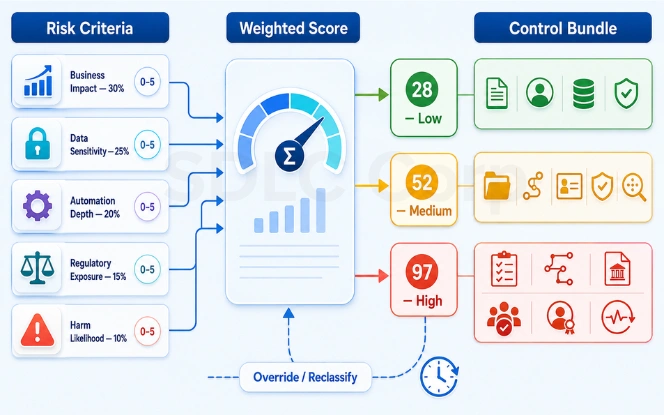
Use a small number of risk tiers with objective criteria: affected users, potential harm, regulatory exposure, automation depth, and data sensitivity.
The exact thresholds are policy decisions, but the framework should make the scoring logic explicit so teams can see why a use case landed in a given tier.
Do not present one cadence or one review schedule as universal law. The framework can define example policy defaults, but final intervals should stay tied to business impact, model behavior, and regulatory context.
That keeps the framework usable across both low-risk internal tools and high-risk decision systems.
Scoring Rubric (Example Policy)
Weighted attributes (scores 0-5). Weights are example defaults; thresholds are policy decisions:
- Business impact: weight 30%
- Data sensitivity: weight 25%
- Automation depth: weight 20%
- Regulatory exposure: weight 15%
- Harm likelihood: weight 10%
Compute the weighted sum: for each attribute, (score/5) * weight. Example tier thresholds (policy examples): Low < 30, Medium 30-70, High >= 70.
Example Scored Use Cases (Examples)
- Internal analytics dashboardBusiness 2, Data 2, Automation 1, Regulatory 0, Harm 1 weighted total 28 Low (example).
- Customer support triage chatbotBusiness 3, Data 3, Automation 3, Regulatory 1, Harm 2 total 52 Medium (example).
- Automated lending decision systemBusiness 5, Data 5, Automation 5, Regulatory 4, Harm 5 total 97 High (example).
Risk Classification and Control Requirements
| Risk tier | Illustrative score | Minimum evidence | Example review interval | Example retention period |
|---|---|---|---|---|
| Low | Below 30 | Owner, use-case summary, basic data inventory, smoke-test results | Quarterly automated check; annual owner review | Three years after retirement |
| Medium | 30–69 | Risk assessment, data lineage, model card, validation results, monitoring plan | Monthly automated check; quarterly human review | Five years after retirement |
| High | 70 or above | Impact assessment, provenance, independent validation, security review, stakeholder approval | Continuous monitoring; monthly formal review; event-driven revalidation | Seven years after retirement, or longer when law or contract requires |
Illustrative policy defaults: These score bands, review intervals, and retention periods are examples—not universal requirements. Adjust them to the use case, applicable law, contractual duties, organizational risk appetite, and records-retention policy.
Note: The weights, numeric thresholds, and cadence entries above are illustrative policy examples. Organizations must set thresholds and monitoring schedules based on their risk appetite, business context, and regulatory environment.
Use explicit override paths for edge cases and context changes, and tie risk tiers to control bundles so that tiers change controls, evidence, and monitoring expectations.
Risk tiers matter only when they change the required controls, evidence, and monitoring expectations.
Establish AI Lifecycle Control Gates
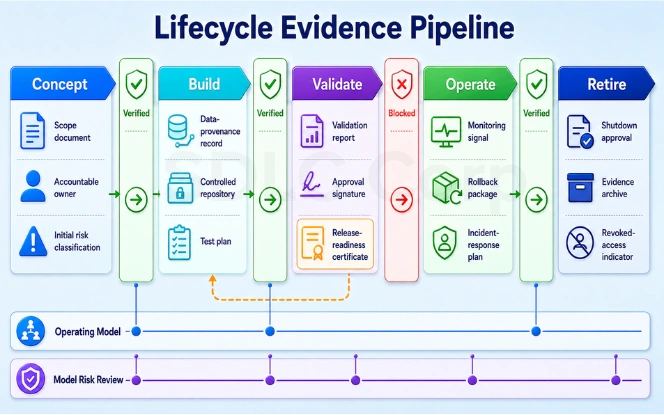
Lifecycle gates should answer one question at each stage: what evidence must exist before the asset moves forward? Concept gates need scope, ownership, and initial risk context. Development gates need data provenance, build controls, and test plans.
Pre-production gates need validation evidence and release readiness. Production gates need monitoring, rollback, and incident readiness.
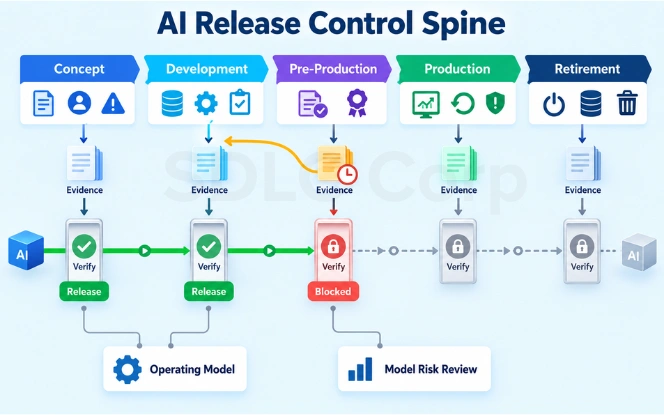
The framework should stay focused on required artifacts and pass conditions. It should not attempt to describe every committee discussion or every validation technique. Those details belong in the operating model and model risk pages that execute the framework.
- Define entry and exit evidence for concept, build, validation, and production.
- Keep pass conditions binary enough to support automation or checklists.
- Route specialist reviews through linked processes, not through duplicated framework text.
- Block promotion when required evidence is missing, stale, or unowned.
Lifecycle gates work when they are evidence-driven and simple enough to enforce repeatedly.
AI Lifecycle Gate Table
| Lifecycle gate | Required evidence | Pass condition | Re-review trigger |
|---|---|---|---|
| Concept | Business purpose, accountable owner, affected users, preliminary risk screen | Use case is registered, in scope, and assigned an initial tier | Purpose, user group, or decision impact changes |
| Development | Data provenance, access approval, design record, test plan, vendor evidence | Data and build controls are complete, current, and owned | Training data, model, prompt logic, or vendor changes materially |
| Pre-production | Validation results, security and privacy checks, impact assessment, release plan | Tier-specific thresholds pass and all blocking findings are closed | Validation expires or a material limitation emerges |
| Production | Monitoring thresholds, incident playbook, rollback plan, approval record | Monitoring is active and named owners can respond within policy targets | Drift, safety event, control failure, regulatory change, or major update |
| Retirement | Shutdown approval, dependency review, archive record, data-disposal evidence | Access is removed, dependencies are closed, and evidence is retained | Post-retirement claim, audit, incident, or legal hold |
Define Evidence Requirements for AI Governance
Evidence requirements should scale by risk tier and lifecycle stage. A low-risk internal assistant does not need the same package as an externally facing decision engine, but both still need a documented use case, owner, deployment record, and monitoring plan.
Keep the framework focused on minimum evidence categories: inventory record, data lineage, test results, performance metrics, security and privacy checks, deployment metadata, and exception status. Let model risk and responsible AI define the specialist depth for particular validation types.
- Define minimum evidence categories once and reuse them across the portfolio.
- Scale evidence depth by risk tier, not by team preference.
- Use templates so reviews compare like with like.
- Store evidence where it remains versioned, accessible, and auditable.
A strong framework standardizes what evidence is required before specialists debate whether the evidence is good enough.
Govern Third-Party AI Systems
Third-party AI belongs inside the same framework, not outside it. Vendors may change the technical implementation, but they do not remove the need for inventory, tiering, lifecycle gates, evidence, monitoring, or exceptions.
The framework should require vendor-specific evidence categories such as data handling terms, limitation disclosures, service boundaries, contractual controls, and incident obligations. If vendor evidence is incomplete, the framework should require compensating controls or restrict the use case.
High-risk vendor systems need deeper assurance because the organization may lack access to training data, model weights, or internal test methods. Require independent evaluation results, documented human-oversight points, security evidence, and traceable records for every material decision.
When a supplier will not disclose essential evidence, treat that limitation as a governance risk. Do not rely on contractual language alone. Reduce automation, add human review, isolate sensitive data, test outputs independently, or choose a more transparent provider.
Complete Due Diligence Before Procurement
Review the vendor before signing a contract or connecting production data.
Confirm where data is processed, whether prompts or outputs are retained, whether customer data trains shared models, which subprocessors are involved, and how the service handles deletion, encryption, access logging, and regional transfers.
Technical review should cover model limitations, evaluation evidence, change-notification practices, availability commitments, incident response, and the customer’s ability to export records.
Contract review should translate those findings into enforceable terms, including audit rights, breach notification, service-level commitments, data-return requirements, and termination assistance.
- Classify vendor AI with the same risk logic used for internal assets.
- Require contractual and technical evidence before production use.
- Define compensating-control rules when vendor transparency is incomplete.
- Track vendor obligations as part of the governed asset record.
Control Vendor Changes Throughout the Contract
Approval at onboarding is not permanent approval. Require re-review when a vendor changes its underlying model, hosting region, subprocessors, retention practices, safety controls, or material service terms.
High-risk services should have named internal owners, tested fallback procedures, and a documented exit path before production use.
If the vendor cannot provide evidence required for the assigned tier, record the gap and either add a compensating control, narrow the use case, prohibit sensitive data, or block deployment. Procurement urgency should not lower the evidence standard.
For high-risk AI, define material-change triggers in the contract and operating record. A new foundation model, safety filter, data-use term, subprocessor, or hosting location should pause affected use until the owner confirms that controls and evidence remain adequate.
Maintain service-continuity and exit controls before dependence grows. Preserve required records, test a safe fallback, define data-return and deletion steps, and confirm how teams will suspend automated decisions if the service fails or creates unacceptable harm.
Third-party AI changes who supplies the evidence. It does not remove the framework requirement for evidence.
Monitor AI Systems After Deployment
Monitoring is where the framework stays alive after launch. Define which signals each tier must produce, what thresholds trigger review, and which remediation paths must exist before production.
For example, a policy may use quarterly revalidation for medium-risk systems and monthly or event-driven review for high-risk systems, but the framework should label those as examples tied to risk and context.
Focus on what the framework demands: observable signals, accountable owners, response expectations, and documented remediation triggers. Detailed drift methods, prompt-evaluation logic, or alert tuning belong in the specialist observability and validation pages.
- Define mandatory signals by tier: uptime, quality, drift, business impact, or safety triggers.
- Attach each signal to an owner, response expectation, and remediation path.
- Use example cadences as policy defaults, not universal standards.
- Require ongoing review when behavior, data, or regulation changes materially.
Framework monitoring should define what must be watched and when action is required, not every method used to watch it.
For the monitoring mechanics behind those signals, use AI Observability for Enterprise Systems.
Manage AI Governance Exceptions
A governance framework needs a constrained exception path because unusual business cases will appear.
The framework should define when exceptions are allowed, what compensating controls are required, how long an exception can last, and which evidence is needed for renewal or closure.
Keep exceptions narrow and auditable. An exception should grant time-bounded relief from a specific control requirement, not broad permission to bypass the framework. That distinction prevents temporary waivers from turning into permanent shadow policy.
Some requirements should remain non-waivable. An exception must never legalize prohibited processing, remove a mandatory human decision, conceal a known safety issue, or permit deployment when the organization cannot meet a binding regulatory or contractual duty.
High-risk requests need independent challenge from legal, security, privacy, model-risk, or responsible-AI specialists as relevant. The business owner should demonstrate why delay creates greater harm and why the proposed safeguards reduce exposure to an accepted level.
Require a Complete Exception Record
Every request should name the exact control being waived, explain the business need, identify the exposed risk, list compensating controls, assign an accountable owner, and set both an expiry date and remediation milestones.
Approval authority should increase with the asset’s risk tier and the severity of the waived control.
Emergency approval should use a separate, shorter route with a fixed expiry and immediate notification to the normal authority. It should not bypass documentation. The requester must record the incident, affected assets, temporary safeguards, decision owner, and recovery deadline.
- Document the rule being bypassed, the risk reason, and the compensating controls.
- Set an expiry date and a remediation milestone before approval.
- Require tighter review for high-risk exceptions.
- Track open exceptions as first-class governance items, not private side agreements.
Review, Escalate, and Close Exceptions
As an illustrative policy default, review low-risk exceptions every 90 days, medium-risk exceptions every 30 days, and high-risk exceptions every 14 days. A high-risk exception should expire quickly, require senior approval, and trigger immediate escalation if a compensating control fails.
These intervals are examples and must be adjusted to legal duties and risk context.
Do not renew an exception automatically. Renewal should require current evidence, progress against remediation milestones, and confirmation that the original business need still exists.
Close the record when the control is restored, the system is retired, or the use case is no longer permitted. Retain the request, approvals, reviews, evidence, and closure decision according to the tier-based retention policy.
Connect exceptions to monitoring and incident workflows. If a compensating control fails, risk rises, harm occurs, or a legal condition changes, suspend the exception and escalate immediately. Report overdue and repeatedly renewed exceptions as governance indicators to senior oversight.
Exceptions protect business continuity only when they remain explicit, temporary, and measurable.
Frequently Asked Questions About AI Governance
What Belongs In An AI Governance Framework?
Define the policy statements, risk tiers, inventory rules, lifecycle control gates and required evidence templates. Assign owners for classification and monitoring but do not prescribe committee structure.
Next action: map these artifacts to your procurement and CI/CD tooling for enforceable checks.
How Is It Different From An Operating Model?
The framework defines decisions, artifacts and controls; the operating model defines roles, escalation and RACI for executing those controls. Use the framework to specify what must be produced and validated, then attach owners and escalation in the Governance Operating Model.
How Should Risk Tiers Work?
Use objective criteria such as data sensitivity, decision criticality, scale and visibility to map assets to Low, Medium or High. Automate scoring from inventory attributes, require owner review for overrides, and attach a defined control bundle to each tier.
What Evidence Is Required?
Minimum evidence includes a model card, data lineage, test results, performance metrics and security scans, scaled by tier. High-tier assets need independent validation, full lineage and signed artifact integrity; Low-tier requires a compact model card and owner attestation.
How Should Third-Party AI Be Governed?
Treat vendors as inventory items and require vendor evidence aligned to the asset tier, contract controls such as SLAs and audit rights, and compensating controls when vendor artifacts are incomplete. Map vendor obligations into procurement checklists before onboarding.