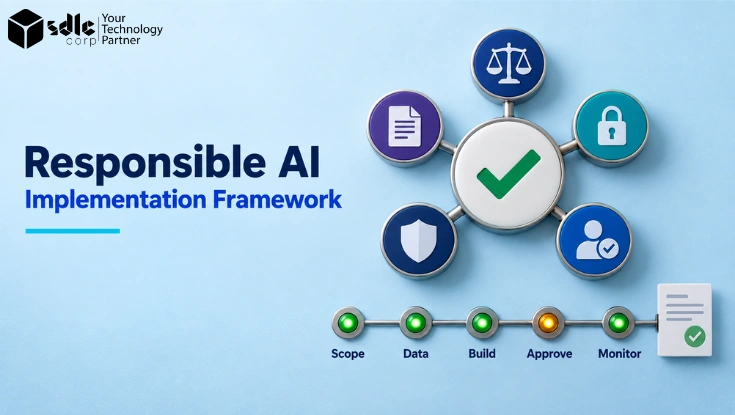
A responsible AI implementation framework turns principles such as fairness, privacy, transparency, safety, and human oversight into testable delivery controls. In other words, every principle needs a working control behind it.
Specifically, each control should define the risk it addresses, the test or evidence required, the owner responsible for remediation, and the condition that blocks or permits release.
Apply these controls at requirements, data preparation, evaluation, deployment, and post-deployment monitoring. Governance forums, however, decide who can approve exceptions or accept residual risk, while this framework defines the evidence those decisions rely on.
Responsible AI Lifecycle Control Checklist
| Lifecycle point | Required control | Evidence artifact |
|---|---|---|
| Use-case intake | Purpose, affected users, risk tier and human impact review. | Approved intake record and risk rationale. |
| Design and data selection | Fairness, privacy, explainability and access constraints. | Dataset card, control map and design review notes. |
| Testing and release | Bias checks, transparency review, fallback path and signoff. | Evaluation report, release gate and exception log. |
| Operate and improve | Monitoring, incident handling, periodic review and retirement criteria. | Monitoring dashboard, incident records and review decisions. |
Operationalizing Responsible AI: principles to controls
This practice translates fairness, privacy, transparency, safety, and human-oversight commitments into product and operational controls.
However, it does not replace model validation, enterprise policy, or governance decision routing. Instead, it supplies the human-impact evidence those practices need.
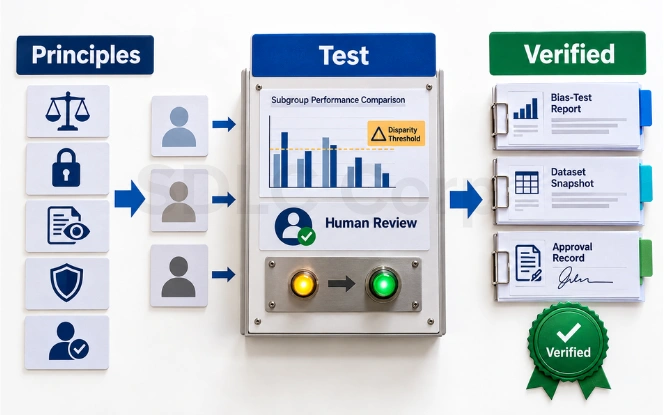
Principles must translate into concrete controls and verifiable evidence. To begin with, look at the business decision, the affected users, the data involved, and the potential harms.
After that, derive review checks, test rules, human-oversight points, and the release evidence that proves each control ran.
Consider automated candidate screening as an example. Here the principle is fairness in hiring, so the control is a set of pre-release subgroup performance and disparity tests with threshold gates.
In addition, a human panel must review any case where thresholds are exceeded. As a result, the evidence includes a bias-test report with metrics and a dataset snapshot, plus a review ticket with approver signatures.
The deployment checklist entry should also show whether the team remediated the gap or formally approved it.
This approach keeps the work concrete. Consequently, teams must be able to point to the exact artifact, test, or operating rule that implements each principle, and to the evidence showing it was applied.
- Tie each principle to a specific control or review step.
- Document what evidence proves the control was applied (reports, snapshots, tickets).
- Also keep the control set proportionate to business impact.
- Finally, reject principle statements that have no delivery consequence.
Define the responsible-AI principles that matter to the enterprise
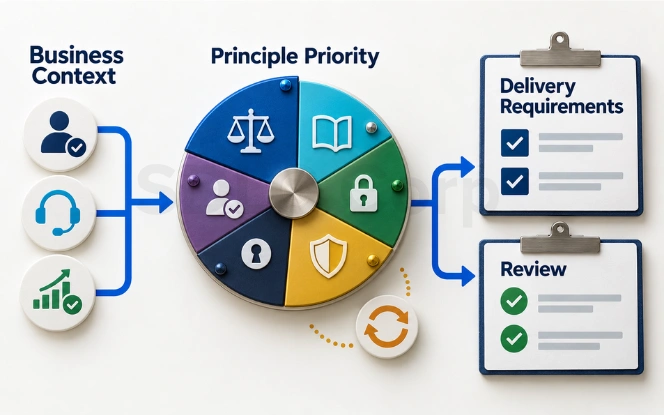
Choose only the principles that matter for the enterprise and the use cases it actually runs. Most programmes focus on fairness, transparency, privacy, safety, security, and human oversight. However, the weight of each principle changes by context.
Next, write the principles in plain language. As a result, people understand what they must do differently because the principle exists.
- Name the principle and the business reason it matters.
- Translate it into one or two delivery expectations.
- Similarly, drop vague wording that does not change design or review behavior.
- Then review the principle set whenever use cases or regulation change.
Translate principles into lifecycle checkpoints
Match controls to the people and harms affected
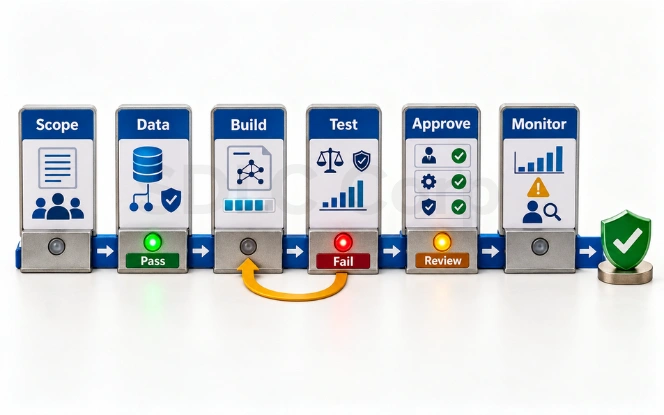
Break the lifecycle into six checkpoints: scoping and requirements, data acquisition and preprocessing, model design and development, pre-production testing and risk review, deployment authorization, and production monitoring.
For each checkpoint, list the mandatory artefacts, such as the requirements spec, data lineage, model card, bias and robustness tests, approval tickets and monitoring plans.
Set pass/fail criteria for each checkpoint
Next, define explicit pass/fail criteria per checkpoint. Data checkpoints, for example, should require completeness, provenance validation and skew analysis. Build checkpoints, in turn, need test coverage, performance stability and documented limitations.
Deployment, meanwhile, requires an approval ticket with signoffs from the business owner, model owner and an independent risk reviewer. Automation can then block deployments whenever these criteria are unmet.
Example checkpoint gates
| Data pass/fail checklist (example) | Pass condition | Fail condition |
|---|---|---|
| Provenance | Lineage recorded for >95% of records | Missing provenance for >5% of records |
| Skew / drift | Population drift <5% vs. training baseline | Drift ≥5% or unexplained distribution change |
| Missing values | Under 1% missing, or imputation documented | 1% or more missing, with no remediation |
| Deployment approval ticket (minimal template) | Required / example |
|---|---|
| Ticket ID | AUTO-1234 |
| Model version | v2026-05-01 |
| Signoffs | Business owner, Model owner, Independent risk reviewer (name + date) |
| Required artefacts | Model card URL, Data lineage URL, Test results URL |
| Rollout / rollback plan | Canary %, duration, rollback criteria |
| CI automation gate (example rules) | Failure condition (job fails) |
|---|---|
| Data quality job | Any provenance checksum mismatch or missing-rate ≥1% or drift ≥5% |
| Test suite | Any unit/regression test fails or coverage below agreed threshold |
| Performance gate | Key metric drop >2% vs. baseline on validation set |
| Deployment ticket check | Approval ticket missing or incomplete signoffs |
Connect checkpoints to tooling and pipelines
Use the lifecycle map to assign tooling and storage requirements. Teams buying AI development services should therefore treat these checkpoints as build-time delivery gates, not post-hoc review paperwork.
In practice, specify where lineage metadata and test results live, how automated checks integrate into CI pipelines, and how monitoring alerts reach response teams.
Above all, treat this map as the operating model for responsible AI, and align it with existing SDLC and change-control processes.
- Define checkpoints from scoping through monitoring with mandatory artefacts.
- Set pass/fail criteria for data, build, and deployment stages.
- Automate gating where possible, because manual approvals invite human error.
- Also align lifecycle checkpoints with existing SDLC and change-control systems.
In short, map every principle to a lifecycle checkpoint with clear artefacts and gates.
Map checkpoints to the EU AI Act and ISO/IEC 42001
For teams that build or deploy AI in the European Union, these checkpoints line up closely with the high-risk obligations in the EU Artificial Intelligence Act (Regulation (EU) 2024/1689).
Similarly, ISO/IEC 42001, the international standard for AI management systems, expects documented processes for impact assessment, lifecycle controls, data management and continual improvement.
As a result, one set of checkpoint evidence can support both regulatory readiness and management-system certification. The table below shows where each checkpoint typically lands.
| Checkpoint | EU AI Act (high-risk) | ISO/IEC 42001 | Evidence reused |
|---|---|---|---|
| Scoping and requirements | Article 6 classification and Article 9 risk management system. | Annex A.5, assessing impacts of AI systems. | Intake record, risk tier and impact rationale. |
| Data acquisition and preprocessing | Article 10 data and data governance. | Annex A.7, data for AI systems. | Dataset card, lineage report and bias analysis. |
| Model design and development | Article 11 technical documentation and Article 15 accuracy, robustness and cybersecurity. | Annex A.6, AI system life cycle. | Model card, design notes and robustness tests. |
| Pre-production testing and risk review | Article 9 testing within the risk management system. | Clause 8, AI risk assessment and treatment. | Evaluation report and residual risk register. |
| Deployment authorization | Articles 13 and 14 on transparency and human oversight, plus Article 43 conformity assessment. | Annex A.8, information for interested parties. | Approval ticket, user disclosures and oversight design. |
| Production monitoring | Article 12 record-keeping, Article 72 post-market monitoring and Article 73 serious incident reporting. | Clauses 9 and 10, performance evaluation and improvement. | Monitoring dashboard, incident records and review decisions. |
However, the obligations that apply depend on your role, such as provider or deployer, and on whether the system is classified as high-risk.
Therefore, confirm scope and application dates with legal counsel before relying on this mapping for compliance.
Assign Control Owners and Approval Inputs
Assign an owner to each responsible-AI control so identified gaps have a clear remediation path. For example, privacy and security specialists may own privacy controls, while business and model teams own fairness controls.
Likewise, product and legal stakeholders can own transparency controls, and the operational process owner can own human-oversight controls. In addition, record which evidence each owner must produce before release.
Assign clear decision rights
Next, map explicit approvals, accountabilities, consultation, and veto authority to the roles below so teams can operationalize signoffs and evidence collection. Use this table as the canonical decision-rights mapping for common approval points.
Approval / RightModel development signoff
- Business Owner
- A
- Model Owner
- R
- Privacy Specialist
- C
- Legal
- C
- Independent Risk Reviewer
- C
- Operational Owner
- I
- Executive Approver
- I
Approval / RightPre-release risk acceptance
- Business Owner
- R
- Model Owner
- R
- Privacy Specialist
- C
- Legal
- C
- Independent Risk Reviewer
- A,V
- Operational Owner
- I
- Executive Approver
- I
Approval / RightProduction deployment approval
- Business Owner
- R
- Model Owner
- R
- Privacy Specialist
- C
- Legal
- C
- Independent Risk Reviewer
- C,V
- Operational Owner
- A
- Executive Approver
- I
Approval / RightFinal override / veto
- Business Owner
- I
- Model Owner
- I
- Privacy Specialist
- I
- Legal
- I
- Independent Risk Reviewer
- V
- Operational Owner
- I
- Executive Approver
- V
Legend: R = Responsible, A = Accountable, C = Consulted, I = Informed, V = Veto authority.
Delegated authority and SLAs (examples)
- Minor model updates: Model Owner may approve routine non-high-impact changes within a 5 business-day SLA; record evidence and notify Business Owner.
- High-impact or irreversible changes: Escalate to Independent Risk Reviewer and Executive Approver; target decision SLA 10 business days and document explicit veto windows for each reviewer.
- Operational exceptions: Operational Owner may accept temporary production mitigations for up to 30 days with a documented rollback plan and signoff from Model and Privacy owners; log exception and schedule remedial work.
In a typical decision-rights flow, the business owner first proposes the use case. The model owner then supplies evaluation evidence, and privacy and risk reviewers can require changes or veto release.
For high-impact use cases, an executive approver finally accepts residual risk. Record every decision and exception in the release record.
Evidence packet example (high-impact use case)
Provide a concise packet that owners must produce before final signoff. For instance, it should include the following items.
- Executive summary of use case, intended users, and business objective
- Model card, training-data provenance, and version identifiers
- Privacy and security assessment outputs and required controls
- Fairness and performance test results, including known residuals and thresholds
- Operational runbook, monitoring SLAs, and rollback plan
- Residual risk register and proposed mitigations
For a high-impact release, the Model Owner, Business Owner, Privacy Specialist, Independent Risk Reviewer and Executive Approver must all sign.
Also record who produced each evidence item, and retain the packet with the release record.
Build fairness, privacy and security into design and data
Start threat and privacy modeling during requirements and data acquisition. First, classify data by sensitivity and regulatory context, document provenance and retention requirements, and identify attributes that need special handling.
In addition, use access controls and masked views in development environments. As a result, fewer sensitive records are exposed during model training and testing.
Conduct bias and fairness reviews on both data and labels. Specifically, require statistical parity checks, subgroup performance analysis and error-distribution reviews tied to operational thresholds.
If metrics show unacceptable disparities, require a mitigation plan before build signoff. Such plans might include reweighting, additional feature engineering or targeted data collection.
Embed security controls in the pipeline as well, including secure build environments, signed model artifacts and immutable experiment tracking. High-impact models also need adversarial robustness testing, with test coverage recorded.
Where necessary, apply privacy-preserving techniques. Furthermore, document residual privacy risks in the model card so that operational teams can apply compensating controls.
- Classify data sensitivity, capture provenance, and enforce retention rules.
- Run subgroup fairness checks, then require mitigation plans for disparities.
- Protect training data with access controls and masked development sets.
- Finally, perform adversarial robustness tests and sign model artifacts for integrity.
Overall, these design controls address fairness, privacy and security before models reach production.
For an external control baseline, use the NIST AI Risk Management Framework. In addition, when differential privacy is considered, apply it with the formal privacy and utility framing described in NIST SP 800-226.
Design transparency for users and operators
Transparency is not one document. Different people need different information at different moments, and a single model card rarely serves an affected customer, a claims handler and an auditor equally well.
Therefore, design transparency by audience. For each group, decide what they need to know, when they need it, which artefact carries it, and who keeps that artefact accurate as the model changes.
Set transparency requirements by audience
The table below is a starting map. However, adjust the artefacts to the use case, the channel people interact through, and any sector or regional disclosure rules that apply.
| Audience | What they need | Artefact | Update trigger |
|---|---|---|---|
| Affected users | That AI is involved, what it influences, and how to question an outcome. | Plain-language disclosure, decision notice and appeal route. | Change in purpose, data use or decision scope. |
| Frontline operators | Why a case was flagged, how confident the system is, and when to escalate. | Case-level rationale, confidence band and escalation guide. | New model version or threshold change. |
| Reviewers and auditors | How the system was built, tested and approved. | Model card, dataset card, evaluation report and approval record. | Each release and each material incident. |
| Model owners and developers | Known limitations, failure modes and open risks. | Developer rationale, limitations log and test coverage notes. | Any retraining, feature change or new finding. |
Write user disclosures people can act on
A useful disclosure tells people three things: that an automated system is involved, what part of the decision it shapes, and what they can do if they disagree. Anything beyond that should therefore earn its place.
Place the disclosure where the decision happens, not only in a privacy policy. For instance, a notice inside the application flow, the decision letter or the chat window reaches people when the information matters.
Also test disclosures with real users before release. If people cannot say in their own words what the system does and how to appeal, the wording needs another pass, whatever legal review concluded.
- State plainly when a person is interacting with, or being assessed by, an AI system.
- Describe how much the output influences the result, such as recommendation only or automatic decision.
- In addition, give a named appeal or contact route with an expected response time.
- Avoid technical terms such as model scores unless the user can act on them.
Give operators context, not only a score
Operators who see only a score or a label tend either to trust it blindly or to ignore it. Both habits weaken oversight. Consequently, the review screen should show why the case surfaced.
Useful context includes the top contributing factors, a confidence or uncertainty band, similar past cases, and any data quality warnings on the record. However, keep it short enough to read in the time a reviewer realistically has.
Where the model is known to perform worse, for example on thin-file applicants or rare document types, flag that condition on screen. Operators should not have to recall limitations from a training session months earlier.
Keep explanation artefacts versioned and auditable
Every explanation shown to a user or operator should trace back to a specific model version, feature set and threshold configuration. Otherwise, nobody can later reconstruct why a person received a particular outcome.
Store user notices, operator rationale templates and developer documentation with the release record. Then, whenever a model changes, confirm each explanation is still accurate before the new version goes live.
In addition, record the explanation actually shown for each high-impact decision, and keep a limitations log that product, legal and support teams can all read.
Define human oversight that operators can actually run
Human oversight usually fails in execution, not intent. For instance, a policy may say a person reviews high-impact decisions, yet reviewers lack the time, context, authority or training to change the result.
Instead, treat oversight as a designed process. In particular, specify who reviews, what triggers a review, what the reviewer can change, how quickly they must act, and what evidence shows the review was meaningful.
For systems placed on the EU market, Articles 13 and 14 of the EU Artificial Intelligence Act (Regulation (EU) 2024/1689) set transparency and human oversight requirements for high-risk AI. Therefore, map your controls to the obligations that apply before release.
Choose the oversight pattern by impact
Not every decision needs a person in the loop. Rather, match the oversight pattern to how severe, reversible and frequent the decisions are, and record that reasoning in the intake record.
| Pattern | How it works | Suited to | Evidence of control |
|---|---|---|---|
| Human in the loop | A person approves or rejects each output before it takes effect. | High-impact, hard-to-reverse decisions such as credit denial or clinical triage. | Reviewer, decision, reason and timestamp for every case. |
| Human on the loop | The system acts automatically while people monitor and can intervene. | High-volume decisions that are reversible and individually lower impact. | Monitoring logs, intervention records and sampled case reviews. |
| Human over the loop | People set thresholds, review aggregate outcomes and can pause the system. | Mature, stable use cases with strong monitoring in place. | Threshold change log, review minutes, pause and rollback records. |
Set review triggers and thresholds
Review triggers should be explicit and testable, so that the routing logic can be checked in the same pipeline as the model. Common triggers include the following.
- Confidence below an agreed band, or conflicting signals across model components.
- Cases in subgroups where measured performance is weaker than the overall population.
- Outcomes above a financial, safety or legal impact threshold.
- Records with missing, stale or unverified input data.
- A random sample of automated decisions, used to measure silent error rates.
Set a review SLA for each trigger and track breaches. Otherwise, a queue that grows faster than it clears quietly turns human oversight back into automation.
Guard against automation bias
Reviewers who agree with the system almost every time may be approving rather than reviewing. Indeed, automation bias is well documented, and it grows when queues are long and the model is usually right.
Design the review step to counter it. For example, some teams show the case evidence before the model recommendation, so that reviewers form a view first. Other teams seed queues with known test cases to check that errors get caught.
- Track agreement and override rates per reviewer and per case type.
- Investigate override rates near zero as closely as rates that suddenly spike.
- Measure how many seeded test cases reviewers correctly challenge.
- Also rotate reviewers and cap queue sizes to limit fatigue.
Make overrides and appeals traceable
An override is only useful if it is recorded in enough detail to learn from. To that end, capture who changed the outcome, what they changed it to, a reason category, and a short note.
Feed override and appeal data back to the model owner on a fixed cadence. This matters because clusters of overrides often reveal drift, a missing feature, or a threshold that no longer fits the population.
Route appeals from affected users to a reviewer who did not make the original decision. Then record the outcome, the time taken, and whether the finding led to corrections in similar cases.
Test oversight before release
Oversight controls deserve the same pre-release testing as the model. Before go-live, therefore, run the review workflow with realistic volumes and edge cases, and confirm that the pause and rollback paths work end to end.
- Confirm reviewers can see the context defined in the transparency requirements.
- Verify that every trigger routes to the correct queue and owner.
- Also test the pause control and time how long it takes to take effect.
- Train reviewers on known limitations and record completion before launch.
In short, human oversight is real only when reviewers have the time, context and authority to change outcomes, and the records show they used it.
These controls operate through the wider enterprise model. The enterprise AI governance operating model defines decision rights and escalation paths. The enterprise AI delivery operating model embeds the controls into delivery stages and release gates. Meanwhile, the enterprise DataOps operating model for AI applies the required data quality, lineage and monitoring checks across pipelines.
Create evidence for approval and accountability
Approval evidence should be short, direct, and reusable. In practice, it should show the use-case summary, the key risk decisions, the tests performed, the limits found, and the named owner who accepts the remaining risk.
That is enough to support review without turning every project into a long policy document. After all, the point is to make challenge and accountability possible later.
- Keep evidence short enough that reviewers can actually use it.
- Record unresolved limits as well as the strengths.
- Name the owner who accepts the residual risk.
- Finally, store the evidence where it can be found during later review.
For policy lifecycle controls, inventory, risk tiers, and exceptions, see the enterprise AI governance framework. Similarly, for model-specific validation, limitations, material changes, and revalidation, see model risk management for enterprise AI.
Monitor outcomes and update controls
Post-deployment monitoring should track application-specific KPIs, fairness metrics, data drift, and error cases. In addition, define alert thresholds and routed notification workflows so that subject-matter owners receive context-rich incidents.
User feedback is also a monitoring signal, so instrument channels that capture and triage complaints or unexpected behaviors.
Implement scheduled and event-driven review cadences that reflect model impact, rate of change, incident history, and regulatory context. High-impact systems often justify closer operational review.
However, define the control as a risk-based policy. It should set clear triggers for retraining, rollback, escalation, and retrospective updates whenever conditions change.
Capture incident handling and remediation as part of the evidence trail. For example, document root cause analysis, corrective actions, approvals for changes, and communication logs.
As a result, this operational record reduces repeat incidents. It also shows stakeholders that controls respond and evolve with the system context.
- Monitor KPIs, fairness metrics, data drift and user-reported issues continuously.
- Route contextual alerts to business and model owners with clear SLAs.
- Schedule periodic reviews with escalation triggers for high-impact deviations.
- Finally, record incident RCA, remediation steps and approvals in the evidence repository.
Monitoring must feed governance. Therefore, every alert should result in a defined remediation action.
Frequently Asked Questions
Model-risk management focuses on statistical validity, performance, and quantifiable financial or regulatory risks.
Responsible AI governance expands that scope to include fairness, privacy, transparency and human oversight. However, the two are complementary: integrate responsible-AI controls into model-risk processes to cover broader social and operational concerns without duplicating reviews.
Required evidence includes scoping documents, data lineage and provenance reports, training and test snapshots, evaluation metrics, fairness and robustness test outputs, risk-review notes, signed approvals and deployment tickets.
Store artefacts with metadata, authorship, timestamps and integrity checks in a controlled, searchable repository.
Shift reviews left into scoping and data checkpoints, automate routine checks within CI pipelines, and use proportionate controls by risk tier.
Define expedited paths for low-impact changes and reserve full board reviews for high-impact, irreversible decisions. In addition, clear SLAs, delegated authority and automated evidence capture reduce bottlenecks.
Assign principle owners drawn from business, privacy, security or risk functions depending on the principle.
Owners maintain definitions, thresholds and mitigation guidance, coordinate cross-functional reviews, and update controls as business context or regulations change. As a result, ownership avoids diffused accountability and unmanaged drift.
Run an intake assessment for an active project to classify its risk tier and generate the required checklist of artefacts and reviewers.
Then use that pilot to test automated gating, evidence capture, and a RACI for decision rights. Finally, apply lessons learned to update templates, thresholds and reviewer training.
Reviewers need the case evidence, the model recommendation, the main factors behind it, and a confidence indicator. They should also see data quality warnings and any known limitations for that type of case.
They also need clear authority to override, a reason code list, and enough time within the review SLA to assess the case properly.