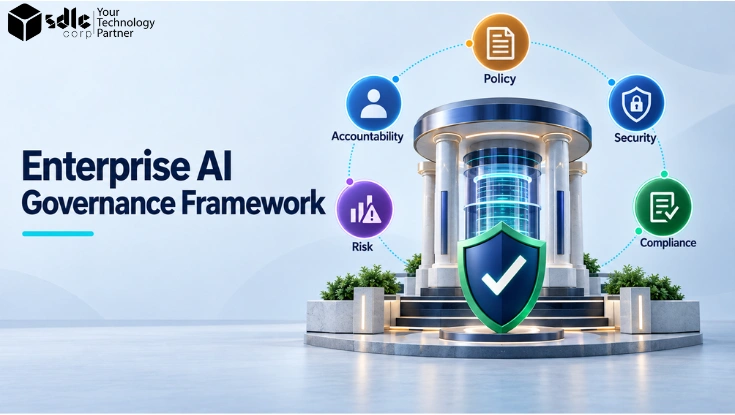
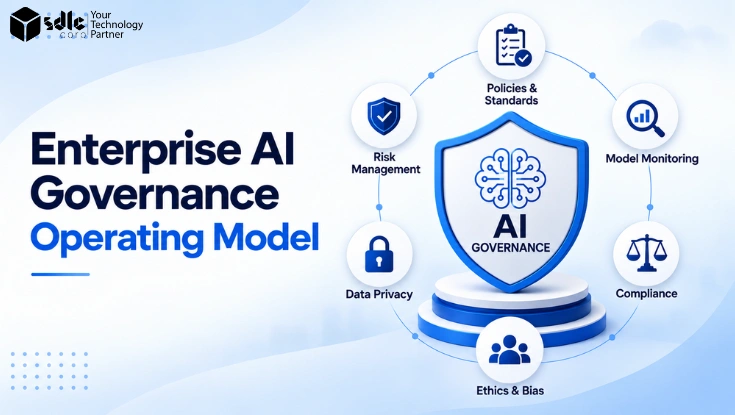
Most enterprises already have an AI policy. Far fewer can answer the questions that actually decide whether an AI system ships this quarter: who approves it, who reviews the evidence, what evidence is required, when a
case must be escalated, and who has the authority to stop a system already running in production. That gap between written policy and daily decisions is what an AI governance operating model closes.
An AI governance operating model defines how governance decisions are executed in day-to-day delivery. It assigns decision rights, review forums, delegated authority, escalation paths, decision SLAs, and evidence ownership so approved controls can be applied consistently without creating avoidable bottlenecks.
It does not redefine the control catalog. Instead, it decides who reviews the evidence, who can approve or reject a change, when a case must be escalated, how exceptions are recorded, and how decisions are handed back to delivery teams.
Key takeaways
A framework says what must happen; an operating model says who does it. Policies and control catalogs describe requirements. The operating model assigns owners, forums, authority and cadence.
Every recurring AI decision needs one accountable owner, one primary forum and one escalation path. Ambiguity, not missing policy, is what stalls enterprise AI delivery.
Risk tier should change the review path, not just the paperwork. Low-risk use cases run on delegated approval; high-impact or irreversible ones require cross-functional review and a named accountable executive.
Decisions must become controls. An approval condition that is never turned into a deployment gate, access policy or monitoring rule is not enforcement.
Agentic AI shifts governance from approving actions to bounding authority. Define allowed actions, limits, escalation triggers and audit trails instead of reviewing every agent step.
Cadence note: The forum cadences below are illustrative. Adjust them to the volume and risk of decisions, material changes, incidents, and applicable regulatory obligations.
What Is an AI Governance Operating Model?
An AI governance operating model is the working structure that converts AI policy into repeatable decisions across the AI lifecycle.
It answers seven operational questions for every governed system: who decides, who reviews, what evidence is required, how fast a decision must be made, when escalation is mandatory, what is enforced technically, and what is recorded afterwards.
It sits between two things that already exist in most enterprises. Above it is the governance framework principles, policies, risk tiers and required controls. Below it is delivery data teams, platform engineering, security and product owners shipping systems.
Without an operating model, the framework stays a document and delivery teams improvise approvals.
Three components make it operational rather than aspirational:
decision rights (named owners with real authority, including authority to say no), forums and cadence (a small number of standing meetings with defined charters), and evidence handoffs (a known packet that arrives before a decision is expected).
If a team cannot name the person who can approve an exception to a control, the enterprise has a governance framework but not a governance operating model.
AI Governance Operating Model vs AI Governance Framework
The two terms are used interchangeably and they are not the same thing. The framework defines the standard. The operating model defines execution of that standard.
Enterprises that struggle usually have a strong framework and no operating model extensive policy documentation, but no agreed reviewer, no decision SLA and no escalation authority.
| AI governance framework | AI governance operating model |
|---|---|
| Defines principles | Defines execution |
| Defines policies | Defines decision rights |
| Defines risk requirements | Defines reviewers and quorum |
| Defines required controls | Defines enforcement and gates |
| States what must happen | States who does it, and by when |
| Sets standards | Sets forums, cadence and records |
Use authoritative references to calibrate the model: the NIST AI RMF, ISO/IEC 42001, the EU AI Act, and the OWASP GenAI Security Project.
Both are required. A framework without an operating model produces unenforced policy; an operating model without a framework produces fast decisions against no standard.
For the control side of that pairing, see the enterprise AI governance framework, and align control definitions with recognised references such as NIST AI RMF and ISO/IEC 42001.
Why Enterprises Need an AI Governance Operating Model
The pressure is rarely a missing policy. It is that AI volume has outgrown the informal approval habits that worked when the enterprise had three models and one data science team.
Once dozens of use cases, embedded vendor AI features and agentic workflows are live at once, the absence of decision structure shows up as delay, inconsistency and unowned risk.
Five patterns appear repeatedly in enterprises without an operating model. Approvals are unclear, so teams route work to whoever answers first. Review takes weeks because no forum has a decision mandate. Exceptions are granted verbally and never expire.
Evidence differs from project to project, so reviewers cannot compare cases. And when an incident happens, no one is certain who can suspend the system.
Regulatory pressure raises the cost of that ambiguity. Obligations under the EU AI Act, sector supervisors and internal audit are increasingly about demonstrable process: who assessed the risk, on what evidence, under whose authority, and how it is monitored.
Those are operating-model artifacts, not policy statements.
- Unclear approval authority, which turns delivery timelines into negotiation.
- Slow governance, where risk review becomes the default project bottleneck.
- Undocumented exceptions with no expiry date or compensating control.
- Inconsistent evidence, making reviews subjective and audits expensive.
- Ownership gaps that surface only during an incident.
- Inability to scale, because every new use case is governed as a special case.
An operating model is what makes governance scale sub-linearly: the tenth use case should cost less governance effort than the first, not more.
The Three Levels of an AI Governance Operating Model
Decision authority should be distributed across three levels, each with a different job.
Confusing them is the most common structural error: executives get asked to review model test results, while engineering teams are left to decide questions of acceptable business risk.
Board, executive sponsor, legal and risk. Owns risk appetite, escalated exceptions, material incidents and the mandate of the governance function. Meets monthly or quarterly. Decides what the enterprise is willing to accept, not how a model was tested.
Governance office, business owners, risk and compliance, security, data and model owners. Owns intake, risk classification, evidence standards, review forums, time-bound exceptions and release approval. This is where most decisions should be resolved and where delegated authority must be explicit.
AI platform, engineering, security operations and monitoring. Owns the technical expression of governance decisions: deployment gates, access and data policies, evaluation pipelines, logging, alert routing and audit records. Nothing decided at Level 2 is real until it exists here.
The RACI and decision-rights matrix that follow are the bridge between these levels: each row states which level holds accountability, who is consulted, and where the decision escalates when the level cannot resolve it.
AI Governance Decision Rights Matrix
Decision rights are the core artifact of the operating model.
Each row below names the decision, the single accountable owner, the reviewers who must be consulted, the escalation path when the decision cannot be resolved, and the forum where it is normally taken.
If a decision your enterprise makes regularly is missing from a matrix like this, it is being made informally.
| Decision | Accountable owner | Required reviewers | Escalation path | Primary forum / cadence |
|---|---|---|---|---|
| Approve high-risk AI use cases | AI governance council | Governance office; risk or compliance; business owner | Executive risk committee when policy exceptions are requested | Use-case intake forum / weekly |
| Approve production release | Business owner (with control owners) | Platform lead; operations lead; governance office | Governance chair for urgent safety or compliance issues | Per release |
| Retire or suspend an AI system | Business owner with risk signoff | Governance office; risk or compliance | Governance chair for urgent safety or compliance concerns | As needed |
| Resolve control exceptions | Risk and compliance owner | Governance office; control owners | Named executive sponsor for unresolved business tradeoffs | Monthly oversight / as exceptions arise |
| Set lifecycle evidence requirements | Governance office | Model risk or security lead; data or model owner | Model risk or security lead when evidence is incomplete | Design & evidence review / biweekly or per major change |
| Approve a time-bound control exception | Governance office | Risk and compliance; control owners | Named executive sponsor for unresolved exceptions | As requested / reviewed at oversight council |
| Close an incident and corrective-action plan | Business owner | Governance office; risk or compliance; security or platform | Governance chair for unresolved safety/regulatory risks | As incidents are closed; reviewed monthly |
AI governance forums and cadence
Four standing forums are usually enough. More forums do not produce more control; they produce longer paths to a decision and more places for a case to stall.
ForumUse-case intake forum
- Core membership
- Business owner, AI product lead, governance office
- Cadence
- Weekly
- Typical decisions
- Accept the intake, assign a provisional risk tier, and request missing evidence.
ForumDesign and evidence review
- Core membership
- Governance office, risk or compliance, security, data or model owner
- Cadence
- Biweekly or per major change
- Typical decisions
- Approve required controls, evidence scope, and named exception owners.
ForumProduction release gate
- Core membership
- Business owner, control owners, platform lead, operations lead
- Cadence
- Per release
- Typical decisions
- Approve production promotion, rollback readiness, and monitoring ownership.
ForumMonthly oversight council
- Core membership
- Executive sponsor, governance chair, risk, operations, legal when needed
- Cadence
- Monthly
- Typical decisions
- Review incidents, overdue actions, open exceptions, and policy changes.
AI Governance RACI: Who Owns What?
The RACI translates decision rights into lifecycle activities. Read it with one rule in mind: A is a single named person, never a committee or a department.
Committees can recommend; only an individual can be accountable for the outcome of an AI decision.
ActivityPropose a new AI use case
- Business owner
- A
- Governance office
- C
- Risk or compliance
- I
- Security or platform
- I
- Data or model owner
- R
ActivityClassify risk and define required evidence
- Business owner
- C
- Governance office
- A
- Risk or compliance
- R
- Security or platform
- C
- Data or model owner
- R
ActivityApprove a time-bound control exception
- Business owner
- C
- Governance office
- A
- Risk or compliance
- R
- Security or platform
- C
- Data or model owner
- I
ActivityAuthorize production deployment
- Business owner
- A
- Governance office
- C
- Risk or compliance
- C
- Security or platform
- R
- Data or model owner
- R
ActivityClose an incident and corrective-action plan
- Business owner
- A
- Governance office
- C
- Risk or compliance
- C
- Security or platform
- R
- Data or model owner
- R
Allow deployment only after a named owner closes specific evidence gaps by an agreed review date.
Stop release when test coverage, monitoring, or human-oversight proof is missing for the assigned risk tier.
Allow a narrow exception with compensating controls, expiry date, and a named executive escalation owner.
Principles of Effective AI Governance
How this fits with the wider architecture: This article turns approved policy and risk inputs into repeatable decisions. It owns forums, delegated authority, RACI, evidence handoffs, decision SLAs, escalation, and decision records.
The governance framework defines the required controls; model-risk and responsible-AI teams define specialist assessment methods. Use the AI readiness assessment to confirm organisational prerequisites, and the government AI governance framework where public-sector procurement, records, and accountability rules change the boundary.
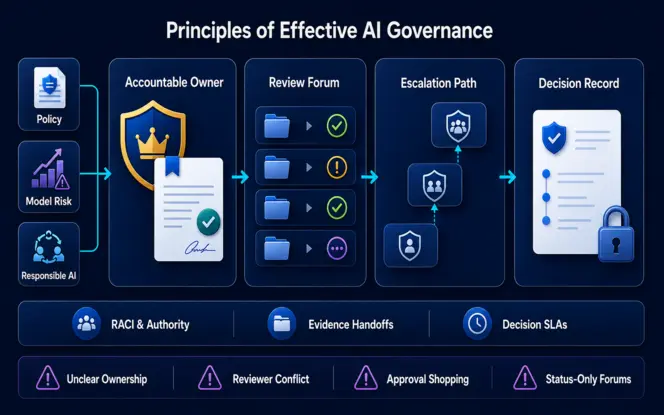
An effective operating model makes governance predictable. Every major AI decision should have one accountable owner, one primary review forum, and one escalation path. That prevents teams from shopping for approvals or waiting on meetings with no defined mandate.
The operating model also separates recurring review work from exception handling. Routine approvals, portfolio reviews, and incident escalation should happen through known channels with named roles.
Governance becomes operational when every recurring decision has a named owner, an appropriate review forum, an escalation path, and a documented evidence handoff.
- One accountable owner for each governance decision.
- One primary forum for recurring review of that decision type.
- One escalation path when the forum cannot resolve the issue.
- One record trail that shows who decided, when, and why.
A governance operating model is successful when teams know where to take a decision before a project becomes blocked.
In practice, weak governance models fail at ownership boundaries rather than at policy creation.
An enterprise usually knows which controls are required; what it lacks is a person with final authority to approve a narrow exception, and a rule for what happens when two reviewers disagree.
Reviewing where past decisions actually stalled is a faster diagnostic than rewriting the policy.
A second pattern worth naming: forums drift toward status reporting. A forum that spends most of its time hearing updates has stopped being a decision body.
If a meeting has produced no recorded decision in two cycles, either its charter is wrong or its authority sits elsewhere.
For an external governance baseline behind these operating routines, use the NIST AI Risk Management Framework and its core functions.
The AI Governance Operating Model
Design forums around decisions, not functions
Design the model around a small set of recurring forums: portfolio or intake review, higher-risk approval review, exception review, and incident escalation. Some enterprises combine these into a few meetings; others distribute them.
The important part is that each forum has a defined decision charter and clear attendees.
Use the operating model to define cadence, quorum, decision logging, and handoffs. Do not use it to restate every policy requirement or every technical validation method. That content belongs in the governance framework and specialist control pages.
- Define the purpose of each forum before setting the calendar.
- Separate routine intake from exception handling and incident review.
- Document quorum, voting or recommendation rules, and logging expectations.
- Tie forum outputs to the portfolio record and governed asset record.
The governance decision flow, end to end
Every governed AI system should move through the same spine, with the depth of each stage set by risk tier rather than by team preference.
- IntakeBusiness owner registers the use case, intended decision impact and data involved.
- Risk classificationGovernance office assigns a provisional tier that determines the review path.
- Evidence assemblyDelivery team prepares the evidence packet required for that tier.
- ReviewThe relevant forum tests the evidence against required controls and records gaps.
- ApprovalNamed owner approves, approves with conditions, rejects, or grants a time-boxed exception.
- DeploymentApproval conditions become deployment gates, access policies and monitoring rules.
- MonitoringOwners watch agreed signals; alerts route to a named first responder.
- Change or incidentMaterial change, drift or incident re-opens the decision rather than bypassing it.
- Re-reviewScheduled review confirms the tier, the controls and the accountable owner are still correct.
Good governance forums reduce ambiguity. Too many forums create it.
Route Use Cases to the Right Review Path
Use the risk tier produced by the governance framework to route each use case to the appropriate review path. Low-impact changes may follow delegated approval with automated evidence checks.
Higher-impact or irreversible use cases should require cross-functional review and explicit written approval. Define the routing rule, required reviewers, decision SLA, and escalation trigger for each tier.
Do not repeat the risk-scoring methodology here; this section is about how an existing classification changes the review path.
| Risk tier | Review route | Minimum quorum | Decision SLA | Escalation timeout |
|---|---|---|---|---|
| Low | Delegated platform or product-owner approval | 1 named delegated approver | 3 working days | Escalate to the governance office after 2 working days overdue or when sensitive data enters scope |
| Medium | Design and evidence review with risk and security | 3: business owner, governance lead, and one risk or security reviewer | 10 working days | Escalate to the governance council after 2 working days overdue or on unresolved reviewer disagreement |
| High | Cross-functional review plus written executive approval | 5: business owner, governance, risk/legal, security, and accountable executive | 20 working days | Escalate to the executive risk committee after 5 working days overdue; pause release until resolved |
Operating targets: Start the SLA only when the evidence packet is complete. Treat these figures as baseline targets and tighten them for incidents, material changes, or regulatory deadlines.
Assign Decision Rights Across the AI Lifecycle
Map each lifecycle checkpoint to a named decision owner. Intake should identify who accepts the business use case. Data approval should identify who accepts data access and usage conditions. Pre-production review should identify who can authorize deployment.
Post-deployment change control should identify who can approve material changes, emergency rollback, or retirement. Record the decision, evidence reviewed, conditions attached to approval, and the next trigger for review.
Define Evidence Handoffs and Decision SLAs
Define the minimum evidence packet each forum receives, where it is stored, and how quickly a decision is expected. Evidence may include the use-case summary, risk tier, validation result, security review, responsible-AI test summary, unresolved limitations, and named residual-risk owner.
The operating model should make evidence easy to find and decisions easy to trace; specialist pages define how the underlying tests are performed.
The standard evidence packet
One packet format, scaled by risk tier, removes most review friction. Reviewers stop asking for basics and spend the meeting on judgement calls instead.
| Risk tier | Minimum evidence packet |
|---|---|
| Low | Purpose and owner; assigned tier; data sources and retention; checklist test result; basic security controls; limitations; monitoring owner; delegated approval record |
| Medium | All low-tier evidence plus evaluation results, cohort checks where relevant, threat review, human-escalation design, incident route, residual-risk owner, and governance decision |
| High | All medium-tier evidence plus legal or regulatory assessment, independent validation, bias and impact testing, contestability route, rollback plan, executive sign-off, and scheduled re-review |
Set a decision SLA against the arrival of a complete packet, not the date the request was raised. That places the timeline burden where the evidence obligation sits and keeps forums from being blamed for incomplete submissions.
Assign Human Approval Authority
Specify which roles can approve, amend, reject, or override AI-assisted actions. Tie authority to the business consequence of the action, not only to the model type.
Define delegated authority for low-impact changes, mandatory cross-functional approval for high-impact or irreversible actions, and an escalation path when reviewers disagree or required evidence is incomplete.
How to Implement an AI Governance Operating Model
Implementation fails when it starts with a committee charter. It works when it starts with the AI that already exists in the enterprise, because the inventory itself reveals which decisions are being made informally today.
The sequence below usually takes one to two quarters for a first working version. Treat it as a delivery programme with an owner and milestones, not as a documentation exercise.
- Inventory AI in useInclude shipped models, pilots, embedded vendor AI features and agent workflows. Record owner, data used, decision impact and current approval status. Most enterprises find more systems than expected, and several with no named owner.
- Classify risk consistentlyApply the framework tiers to the whole inventory in one pass. Consistency matters more than precision at this stage; a shared tier language is what makes routing possible.
- Define decision rightsList the decisions the enterprise actually makes intake, tier assignment, evidence sufficiency, release, exception, incident closure, retirement and assign a single accountable owner to each.
- Establish forumsStand up the minimum set of forums with written charters, quorum rules and delegated authority for lower tiers. Publish what each forum will not decide.
- Standardise evidencePublish the evidence packet by tier and store it in one place linked to the asset record. Agree what an incomplete packet means for the SLA clock.
- Set decision SLAsCommit to turnaround times per tier and measure them. Governance credibility is built by predictable decisions, including predictable rejections.
- Integrate deployment gatesConnect approval status to the release pipeline so an unapproved or expired system cannot promote to production silently.
- Operationalise monitoringRoute production signals to named owners with defined escalation thresholds, so alerts trigger governance action rather than a dashboard nobody owns.
- Run a review cycle and adjustAfter one quarter, review decision throughput, overdue exceptions, escalation frequency and incident outcomes. Retire forums that produce no decisions and delegate further where the evidence supports it.
Two implementation choices carry most of the risk. First, delegating too little: if every tier reaches the same forum, the model collapses under its own volume within a quarter.
Second, launching without records: a model that produces decisions but no durable decision log cannot be audited and will be rebuilt from memory a year later.
Sequencing tip: Define decision rights before designing forums. Teams tend to schedule meetings first, then discover mid-cycle that no attendee holds the authority the meeting requires.
Technical Enforcement: Turn Governance Decisions Into Controls
A governance decision that exists only in meeting minutes is a preference. Enforcement is what makes it a control. The operating model should therefore specify, for each decision type, the technical artifact that carries the decision into the running system.
Approval granted with conditions attached
Deployment gate that blocks promotion until conditions are marked closed
Risk tier and permitted data scope
Access controls, data policies and lineage constraints applied at the platform layer
Human oversight requirement for a use case
Enforced review step, confidence thresholds and override logging in the workflow
Monitoring obligation and escalation threshold
Runtime signals, alert routing to the named responder and an immutable audit record
Time-bound exceptions deserve particular attention. An exception with an expiry date that is not encoded anywhere becomes permanent by default.
Where possible, express the expiry as a technical condition a configuration flag, a scheduled re-review task or a pipeline check so lapse is visible rather than silent.
- Every approval condition maps to an owner and a verifiable artifact.
- Deployment pipelines read approval status; they do not rely on the release manager remembering.
- Access and data policies reflect the tier assigned at intake, not the tier requested by the team.
- Audit records link decision, evidence version, deployed artifact and monitoring outcome.
How Agentic AI Changes the Operating Model
Committee-based approval assumes a discrete change that can be reviewed before it happens. Agents break that assumption: they take sequences of actions continuously, choose tools at runtime, and combine steps that were never individually reviewed.
Reviewing each action is not possible, and pretending otherwise produces governance theatre.
The workable shift is from approving actions to bounding authority. Human governance decides what an agent may do, under what limits, and when it must stop and ask.
The agent then operates inside that envelope, and the operating model reviews the envelope rather than every step inside it.
- Allowed actions: the explicit set of tools, systems and operations the agent may invoke.
- Prohibited actions: operations that are never permitted regardless of context, such as irreversible financial or account changes.
- Escalation conditions: the states in which the agent must hand control to a named human, including low confidence and out-of-policy requests.
- Spending and action limits: caps per task and per period, enforced technically rather than by prompt instruction.
- Data access limits: which data the agent may read and write, scoped to the task rather than to the user's full entitlements.
- Human override: a documented way to interrupt, reverse or suspend an agent, with a named owner for that action.
- Audit trails: a record of intent, tools called, data touched and outcome, retained for review.
Escalation speed matters more than meeting frequency here. If an agent can act hundreds of times a day, a monthly forum cannot be the first line of response.
Give delivery and security teams pre-authorised containment rights, and let the forum review how that authority was used.
Common AI Governance Operating Model Failures
Most failures are structural rather than technical, and they are visible early if you look for the right symptoms.
- Too many approval forums. Each one adds a queue and dilutes accountability.
- No single accountable owner. Shared accountability behaves identically to no accountability during an incident.
- Undefined escalation authority. Reviewers disagree and the case simply stops moving.
- The same process for every risk tier. Low-risk work starves high-risk work of attention.
- No decision SLA. Teams begin routing around governance because they cannot plan against it.
- Evidence scattered across tools. Reviews become archaeology and audits become expensive.
- Exceptions without expiry dates. Temporary tolerances quietly become the standard.
- Governance disconnected from deployment. Approval status has no effect on what actually ships.
- Monitoring alerts without governance ownership. Signals fire, nobody is required to act, and the record shows nothing was decided.
A useful health check: pick one recently deployed AI system and trace who approved it, what evidence was reviewed, which conditions were attached, whether those conditions are enforced today, and when it is next due for review.
If that trail takes more than an hour to reconstruct, the operating model is not yet working.
Monitor, Escalate and Respond
Monitoring, escalation, and incident response belong in the operating model because teams need a standing path for production issues. Define who receives alerts, who triages, who coordinates business communication, and who can trigger rollback or containment decisions.
Do not restate all observability metrics here. Reference the monitoring standard and focus on the operating rhythm: triage, investigation, escalation, decision, and follow-up review. That keeps the page focused on governance execution instead of duplicating telemetry design.
- Define the first responder and incident coordinator for governed AI systems.
- Set escalation rules for customer impact, policy breaches, or safety concerns.
- Route post-incident review into a standing governance forum.
- Tie remediation ownership back to the governed asset record.
An operating model is proven during incidents, not during slide reviews.
For production signal design, use AI observability and model monitoring for enterprise systems.
Documentation and Auditability
Documentation in the operating model is about durable decision records. Teams should be able to see which forum reviewed a case, which owner approved the next step, what exception was granted, and when the next review is due.
That record is what makes governance inspectable and repeatable.
Keep the document set practical: asset register, decision log, exception register, incident record, and review outcomes. Do not turn the operating model into a full evidence repository schema.
Its job is to specify which records must exist and who maintains them.
- Keep a decision log tied to the governed asset record.
- Track exceptions, expiries, and remediation milestones explicitly.
- Record incident outcomes and required follow-up reviews.
- Define who owns each governance record after the meeting ends.
Governance becomes real when decisions survive staff turnover and still make sense six months later.
Related decisions and guides
- enterprise AI governance framework
- model risk management for enterprise AI
- responsible AI implementation framework
Frequently Asked Questions
It is the operating model, roles and controls used to propose, evaluate, approve, deploy, monitor and change enterprise AI systems.
The framework specifies risk tiers, required evidence, decision rights, monitoring obligations and incident response steps so teams can balance speed and safety.
No. Data governance focuses on data quality, lineage, access and lifecycle. AI governance includes those elements plus model and prompt management, evaluation evidence, human oversight, provider controls and output incident handling. Both should be coordinated but remain distinct.
Classify use cases using impact, user population, data sensitivity, level of automation, reversibility and ability to provide human review. Map those criteria to a three-tier risk table that prescribes minimum approvals, testing and monitoring for each tier.
Governance is shared: a small governing body sets standards, but every use case needs a named business owner who accepts outcome risk, a technical owner who manages implementation, and data, security and risk reviewers for approvals.
Record the RACI for each use case.
Required evidence includes representative test sets, objective acceptance criteria, security and data-use reviews, evaluation results across relevant cohorts, documented limitations, monitoring plans and approvals from the business owner and relevant risk reviewers.
Review at defined intervals and after meaningful changes to data, model, prompt, provider, user population or autonomy. High-risk systems should have more frequent reviews and continuous monitoring; lower-risk systems may use periodic sampling and automated quality checks.