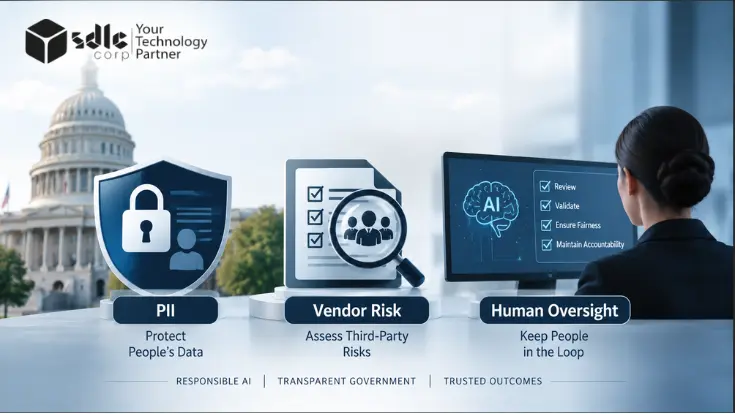
Government agencies can use AI development services to improve public services, review large amounts of data, automate routine tasks, and support faster decision-making. Strong AI governance helps agencies protect personal information, manage vendor risks, maintain clear human accountability for important decisions, and monitor AI systems after deployment.
Key Takeaways
Start with the use case, not the AI tool. Define the public need, the data involved, and the possible risks before choosing a model or vendor.
Match controls to the level of risk. High-impact AI should have stronger testing, human review, monitoring, and accountability.
Build vendor rules into the contract. Clearly define data use, PII protection, model changes, testing rights, portability, and deletion requirements
Keep people accountable after launch. Assign clear ownership, monitor performance, review major changes, and pause or stop AI when risks become unacceptable.
What Is a Government AI Governance Framework?
A government AI governance framework defines how an agency approves, buys, uses, reviews, monitors, and retires AI. NIST organizes AI risk work around four core functions: Govern, Map, Measure, and Manage.
For a government agency, these functions can sit alongside existing privacy, cybersecurity, procurement, records management, legal, compliance, accessibility, and program-management processes.
AI governance works best when it strengthens processes that already exist instead of creating a completely separate bureaucracy for every AI project.
In practice, the framework should help teams answer the same questions at every stage of an AI project. Who owns the use case? What data is being used? Which risks need review? What evidence is required before launch? Who can pause or stop the system if conditions change? Clear answers make governance easier to apply across different departments and vendors.
They also create a common record that privacy, security, procurement, legal, program, and technology teams can review without rebuilding the process for each project.
Govern
Set ownership, policies, responsibilities, and rules.
Map
Understand the use case, data, users, and possible impact.
Measure
Test privacy, security, accuracy, bias, and performance risk.
Manage
Monitor AI, reduce risk, respond to problems, and reassess.
Start With the AI Use Case, Not the Tool
Start with the government problem instead of choosing a model or vendor first. Define what AI may do, what information it needs, who reviews its output, and what could go wrong.
Federal agencies maintain AI use-case inventories to document where AI is being used and support transparency, reporting, and oversight. For a current example, see the GSA AI Use Case Inventory.
A clear use-case description also helps an agency decide whether AI is necessary at all. Some tasks may be handled better with a normal rules-based workflow, search tool, or process improvement. If AI is appropriate, the agency should define the expected benefit in practical terms such as reduced review time, better document discovery, faster response to routine requests, or improved support for staff.
The use case should also state what the AI must not do. These boundaries make later decisions about testing, human review, procurement, and monitoring much easier.
Protect PII Before AI Can Use It
Personally identifiable information, or PII, is especially important in government AI because public agencies often hold information about citizens, applicants, employees, businesses, taxpayers, students, patients, or program participants.
PII may include names, identification numbers, contact details, financial records, employment information, biometric information, or combinations of data that can identify an individual.
Before an AI system can use this information, the agency should understand exactly how the information moves.
Source → AI System → Vendor → Storage → Output → Retention → Deletion
Mapping this flow should be specific enough to show which system receives the data, which people or services can access it, whether a vendor can reuse it, where copies are stored, and when those copies are removed. Agencies should also distinguish between information that is required for the task and information that is simply available.
Reducing unnecessary data before it reaches an AI system can lower privacy exposure and simplify security controls. The same map can support privacy reviews, vendor discussions, records decisions, incident response, and later audits.
PII Exposure Checker
Map the PII Flow
Know where personal information enters the AI environment and where it goes next.
Put AI Governance Into Procurement
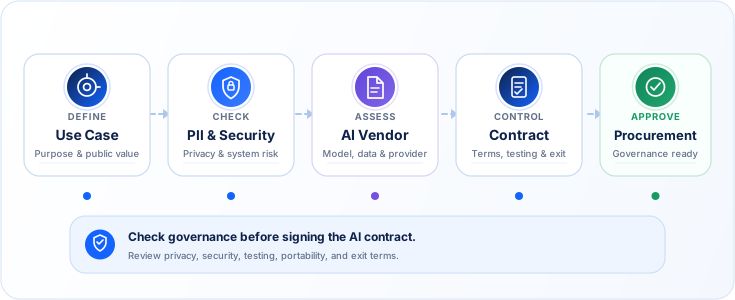
AI governance should begin before a contract is signed. Once an agency has committed to a vendor, it may be difficult or expensive to negotiate better data rights, access to testing, stronger deletion requirements, model-change notices, or exit support.
Current federal AI acquisition guidance emphasizes competition, data portability, long-term interoperability, government data, and avoiding costly dependency on a single vendor.
privacy, security, transparency, testing, portability, and exit
conditions before choosing a provider.
For cloud-based AI services, agencies should also determine whether the service falls within FedRAMP requirements and review the appropriate authorization and continuous-monitoring requirements.
Procurement is also the point where agencies can turn governance expectations into measurable vendor obligations. The solicitation and contract can define what documentation must be provided, how model or service changes will be communicated, what security evidence is required, how incidents will be reported, and what happens when performance falls below an agreed level.
Agencies should also understand which parts of the service depend on subcontractors or third-party models. Asking these questions before award gives the agency more leverage and reduces uncertainty after the system is already connected to government data and workflows.
AI Vendor Procurement Scorecard
Make Vendor Controls Part of the Contract
A vendor presentation is not a control. A vendor promise in an email is not a strong control either. Important requirements should appear in enforceable agreements, contract terms, security requirements, statements of work, or other appropriate procurement documents.
Agencies can map AI security and privacy requirements to NIST SP 800-53 Rev. 5 to connect AI governance with existing federal security and privacy controls.
Strong vendor controls should be written so that the agency can verify them. For example, a contract may require a deletion process, but the agency should also know what evidence confirms that deletion occurred. A model-change clause is more useful when it defines which changes require notice and how much notice is expected.
Security requirements are stronger when they are connected to logs, assessments, incident procedures, and access records. This evidence-based approach helps teams move from vendor promises to controls that can be reviewed during implementation, operations, renewal, and exit.
Data Controls
Keep agency data under clear control from collection through deletion.
Limit reuse, define access, and make sure sensitive information is handled only for approved purposes.
Security Controls
Set clear security expectations for access, logging, incidents, and vendor responsibility.
The agency should be able to see how risks are managed and how quickly problems are reported.
Model Controls
Require visibility into important model updates, performance changes, and known limitations.
Significant changes should trigger review or testing before they affect live government use.
Exit Controls
Plan for the end of the vendor relationship before the system goes live.
Make sure data, records, and operational knowledge can be transferred, then confirm proper deletion.
Vendor Control Matrix
| Control Area | Contract Requirement | Evidence |
|---|---|---|
| Data | Define agency ownership, approved use, PII handling, retention, and deletion requirements. | Data-processing terms, data-use restrictions, retention schedule, and deletion terms. |
| Security | Require access controls, incident reporting, subcontractor controls, audit logs, and security reviews. | Security assessment, access-control documentation, incident process, and audit records. |
| Model | Define testing rights, model-change notifications, performance reporting, known limitations, and audit support. | Test results, model documentation, change logs, performance reports, and audit materials. |
| Exit | Require data portability, export formats, termination support, knowledge transfer, and deletion confirmation. | Exit plan, export procedure, transfer documentation, and deletion certificate. |
Match Human Oversight to the Risk
Putting a person somewhere in an AI workflow does not automatically provide meaningful human oversight. The person must have enough information, authority, skill, and time to question the AI.
Current OMB guidance requires agencies to apply stronger risk controls to high-impact AI, including appropriate human oversight, periodic human review, operator training, intervention, and accountability.
These requirements are set out in OMB Memorandum M-25-21, Accelerating Federal Use of AI through Innovation, Governance, and Public Trust, issued April 3, 2025.
Policy note: Federal AI policy references in this article are current as of August 2026. Agencies should review the latest OMB guidance as federal AI requirements continue to evolve.
Meaningful human oversight depends on the decision, not simply on whether a person appears somewhere in the workflow. A reviewer should understand what the AI produced, what information was used, and when the output may be unreliable. The reviewer also needs authority to reject, correct, escalate, or override the result.
For higher-risk uses, agencies may need documented review steps, training requirements, escalation paths, and records showing why a final decision was made. These controls help prevent human review from becoming a routine approval step that adds little real protection.
| AI Activity | Risk | Human Control |
|---|---|---|
| Internal summary | ● Low | Quick review |
| Document recommendation | ● Moderate | Human approval |
| Benefit eligibility | ● High | Mandatory review |
| Rights or safety decision | ● High | Strong oversight + review or appeal path |
Define High-Impact AI Early
Use a simple risk assessment to identify AI systems that may need stronger privacy, testing, vendor, and human oversight controls.
Risk classification should happen early enough to influence the project plan. A use case that can affect access to services, rights, safety, employment, financial interests, or other important outcomes may require more testing and stronger review than an internal productivity tool. The classification should not be treated as permanent.
If the system begins using new data, supports a different decision, reaches a larger group of people, or receives a major model update, the agency should reassess the risk and adjust controls before relying on the changed system.
Government AI Risk Calculator
Recommended Controls
- Document the AI use case
- Basic human review
- Standard monitoring
Review the risk level again when any important part of the AI use case changes.
Test AI Before Deployment
Test AI using realistic government data, failure cases, privacy risks, security issues, and situations where the model may give a poor answer.
Pre-deployment testing should cover more than average accuracy. Teams should test how the system behaves when information is missing, documents are unclear, prompts are unexpected, or users provide unusual inputs. They should also check whether errors are easy for staff to detect and correct. For systems that support important decisions, test cases should include scenarios where a wrong output could create a meaningful impact.
Recording the test method, expected result, actual result, reviewer, and final decision creates evidence that the system was evaluated before production rather than approved only from a vendor demonstration.
AI Deployment Readiness
Complete the remaining controls before production deployment.
Pre-Deployment Readiness
Testing should also reflect the specific public-sector use case.
An AI system that performs well on generic test data may behave differently when working with agency terminology, old document formats, incomplete records, multilingual content, or unusual cases.
Monitor AI After Launch
Approval is not the end of governance. Models, vendors, data, operating conditions, and user behavior can change after deployment.
A monitoring plan should define what the agency will watch, who reviews the information, and what action follows a warning sign. Useful signals may include output quality, complaint patterns, human overrides, privacy or security incidents, changes in response time, unusual error rates, or repeated failures for a particular type of case.
Monitoring should also include vendor and model changes, because a system can behave differently even when the agency has not changed its own workflow. Clear review, pause, and stop thresholds help teams respond consistently instead of deciding what to do only after a problem becomes serious.
Illustrative example: The monitoring metrics below are sample values shown to demonstrate how an agency could track AI performance and governance signals.
AI Monitoring Dashboard
Keep One Person Accountable

Committees are useful for review, but accountability should not disappear inside a committee. Each AI use case should have a named owner.
A simple responsibility model may include:
The named owner does not need to perform every governance task, but that person should know whether required reviews have been completed and whether important risks remain open. Supporting teams still keep responsibility for their specialist areas. Privacy teams review data use, security teams assess technical risk, procurement teams manage contract controls, legal teams review applicable requirements, and human reviewers handle operational decisions.
The owner connects these activities and makes sure unresolved issues are visible before launch. This reduces the risk of assuming that another team has already approved a requirement when no clear decision was actually made.
AI Use Case Owner
Accountable for the outcome
Technology Team
Keeps the AI system reliable, stable, and working as expected.
Privacy Team
Makes sure personal data is used carefully and only when needed.
Security Team
Protects the system from misuse, unauthorized access, and security threats.
Procurement Team
Makes sure vendor terms support the agency’s needs before and after purchase.
Legal Team
Checks that AI use follows relevant laws, policies, and public-sector requirements.
Human Reviewer
Reviews important AI outputs and steps in when judgment is needed.
Role-Responsibility Matrix
| Role | Main Responsibility | Evidence / Output |
|---|---|---|
| AI Use Case Owner | Own the overall outcome, approve the use case, and remain accountable for residual risk. | Use-case approval, decision record, and risk acceptance. |
| Technology Team | Manage technical performance, system operation, testing, and model or integration changes. | Test reports, technical logs, performance records, and change documentation. |
| Privacy Team | Review PII use, data minimization, retention, privacy risk, and handling requirements. | Privacy review, data map, retention requirements, and privacy assessment. |
| Security Team | Assess system security, access controls, vendor risk, incidents, and audit requirements. | Security assessment, control review, incident process, and audit evidence. |
| Procurement Team | Put commercial, data, security, model, monitoring, and exit controls into the contract. | Contract clauses, statement of work, vendor requirements, and procurement record. |
| Legal Team | Review legal, regulatory, records, accessibility, and compliance obligations. | Legal review, compliance notes, required clauses, and approval record. |
| Human Reviewer | Review important AI outputs, question results, override when necessary, and document decisions. | Review records, override logs, approval history, and escalation records. |
A Simple Government AI Governance Process
Follow a consistent process from initial use-case definition through ongoing monitoring and reassessment.
The process should create a small set of reusable records instead of a large amount of paperwork that teams cannot maintain. A use-case record, risk decision, data map, vendor review, test evidence, approval record, and monitoring plan can provide a practical governance trail. Each record should have an owner and a clear update trigger.
When the use case, model, data, vendor, or operating environment changes, the relevant record should be reviewed. This keeps governance connected to the real system throughout its lifecycle rather than becoming a one-time approval exercise.
- 01
Define the Use Case
State the problem, users, expected public or operational value, and why AI is appropriate.
- 02
Classify the Risk
Identify potential effects on privacy, rights, safety, security, operations, finances, and public services.
- 03
Map the Data
Document what information enters the system, where it travels, who can access it, how long it remains, and how it is deleted.
- 04
Review the Vendor
Evaluate models, data practices, security, subcontractors, performance information, testing access, portability, and exit terms.
- 05
Build Procurement Controls
Put important data, security, monitoring, testing, change-management, and termination requirements into the contract.
- 06
Test Before Launch
Use realistic government scenarios, unusual cases, failure cases, and clear acceptance criteria.
- 07
Assign Human Accountability
Define who approves AI use, who reviews important outputs, who can override the system, and who accepts remaining risk.
- 08
Monitor and Reassess
Track performance after launch and reassess when models, data, vendors, uses, risks, or operating conditions change.
Government AI Governance Checklist
Before deploying an AI system, confirm that the agency can answer yes to the questions that apply to the use case.
If several important answers are no, the system may not be ready for production.
The checklist can also be used during procurement reviews, pilot approvals, major model updates, contract renewals, and periodic governance reviews. A missing control does not always mean the project must stop, but the agency should understand the gap, decide who will address it, and record whether any temporary safeguard is needed.
High-impact gaps should receive more attention than minor documentation issues. Using the same checklist at several points in the lifecycle gives teams a simple way to see whether governance readiness is improving or whether important controls have weakened over time.
Governance Controls Checklist
Conclusion
AI can help government teams work faster and deliver better services, but speed should not remove accountability. A strong government AI governance framework connects four areas that cannot be managed separately: PII protection, AI procurement, vendor controls, and human oversight.
When those controls start before procurement and continue throughout the AI lifecycle, agencies can use AI with clearer ownership, stronger data protection, and better control over decisions.
Effective governance also makes AI easier to manage over time. Teams know what evidence to keep, who must review changes, how vendor obligations are checked, and when a system needs to be reassessed. That structure supports responsible adoption without treating every AI use case as the same level of risk.
Ready to Strengthen Your Government AI Governance?
Get expert help building practical AI governance controls for PII, procurement, vendors, human oversight, testing, and ongoing monitoring.
Government AI Governance FAQs
A government AI governance framework defines how an agency selects, approves, procures, uses, monitors, and retires AI. It connects AI risk with privacy, security, procurement, data management, and human accountability.
Government AI may process information linked to citizens, employees, applicants, or other individuals. Agencies need to understand what information is used, why it is needed, where it goes, and how it is protected.
Review data use, model limits, security, testing, subcontractors, logs, pricing, licensing, portability, contract changes, and vendor exit terms.
AI vendor controls are contract and operating requirements defining how providers handle government data, protect systems, report changes, support testing, manage subcontractors, and return or delete information.
No. Human oversight should match the level of risk. Low-risk AI may need simple review, while systems affecting rights, safety, benefits, or access may need stronger intervention and accountability.
Review should continue after deployment. Reassess AI when models, vendors, data, use cases, risks, or performance change and maintain a regular monitoring schedule.