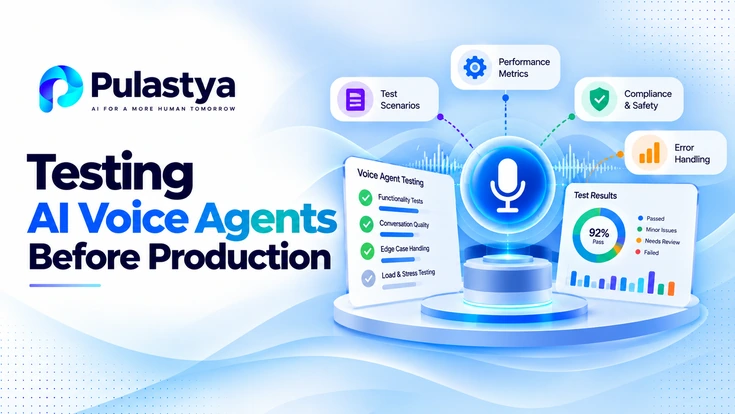
Testing AI voice agents before production reduces operational risk and protects customer experience. Focus on measurable validation steps: conversation accuracy, latency and capacity, fraud and safety controls, and integration with contact-center workflows.
Emphasize repeatable tests, realistic call surfaces, and clear exit criteria so engineering, operations, and compliance teams can sign off.
- Measure end-to-end metrics Track intent accuracy, latency, fallback/handoff rates, and transaction completion as primary release gates.
- Test at scale and in noise Combine load tests with varied audio profiles and network impairment to reveal real-world failure modes.
- Automate scenario validation Use scripted call scenarios, golden transcripts, and pass/fail rules to drive CI gates and regression checks.
Enterprises deploying AI voice agents must validate not just accuracy but behavior across real call conditions and business processes. Effective pre-production testing combines functional test suites, scenario-based voice dialogs, load and degradation testing, and security assessments.
Define acceptance metrics for intent recognition, slot-filling reliability, fallback rates, end-to-end latency, and successful handoffs to human agents before approving a release to production.
Testing must exercise the whole call stack: telephony gateway, ASR, NLU, TTS, dialog manager, enterprise data lookups, and downstream CRM updates. Use recorded conversational datasets and synthetic call generators to reproduce noisy environments, accented speech, and authentication edge cases.
Log formats, observability hooks, and post-call QA procedures should be in place so operations teams can trace failures back to model or integration faults.
Define Clear Acceptance Criteria and Test Plan
Start by converting business goals into quantifiable acceptance criteria that stakeholders understand. Examples: a target reduction in average handle time, a minimum intent recognition rate for the top 20 intents, and a maximum fallback or handoff rate during peak hours. Each criterion should map to observable metrics, required test types, and sampling rules for statistical confidence.
Build a test plan that lists required assets: annotated call transcripts, user personas, authentication flows, and integration endpoints. Specify environments for functional testing, performance tests, and security checks. Define test data management and masking rules for production-recorded calls so compliance teams can approve reuse under privacy constraints.
Assign explicit sign-off roles for engineering, QA, operations, compliance, and product. Establish gates such as unit test coverage, scenario regression success, load test pass, and security scan clearance. Include rollback thresholds and a production canary plan to limit exposure when releasing new models or dialog changes.
- Translate business KPIs to measurable test pass criteria and sample sizes.
- Inventory required assets: audio corpora, mock services, and synthetic callers.
- Document environment differences between staging and production telephony.
- Define roles that must sign off on each gate before deployment.
- Specify data masking and retention policies for test recordings.
Acceptance criteria must be measurable, testable, and owned by named approvers.
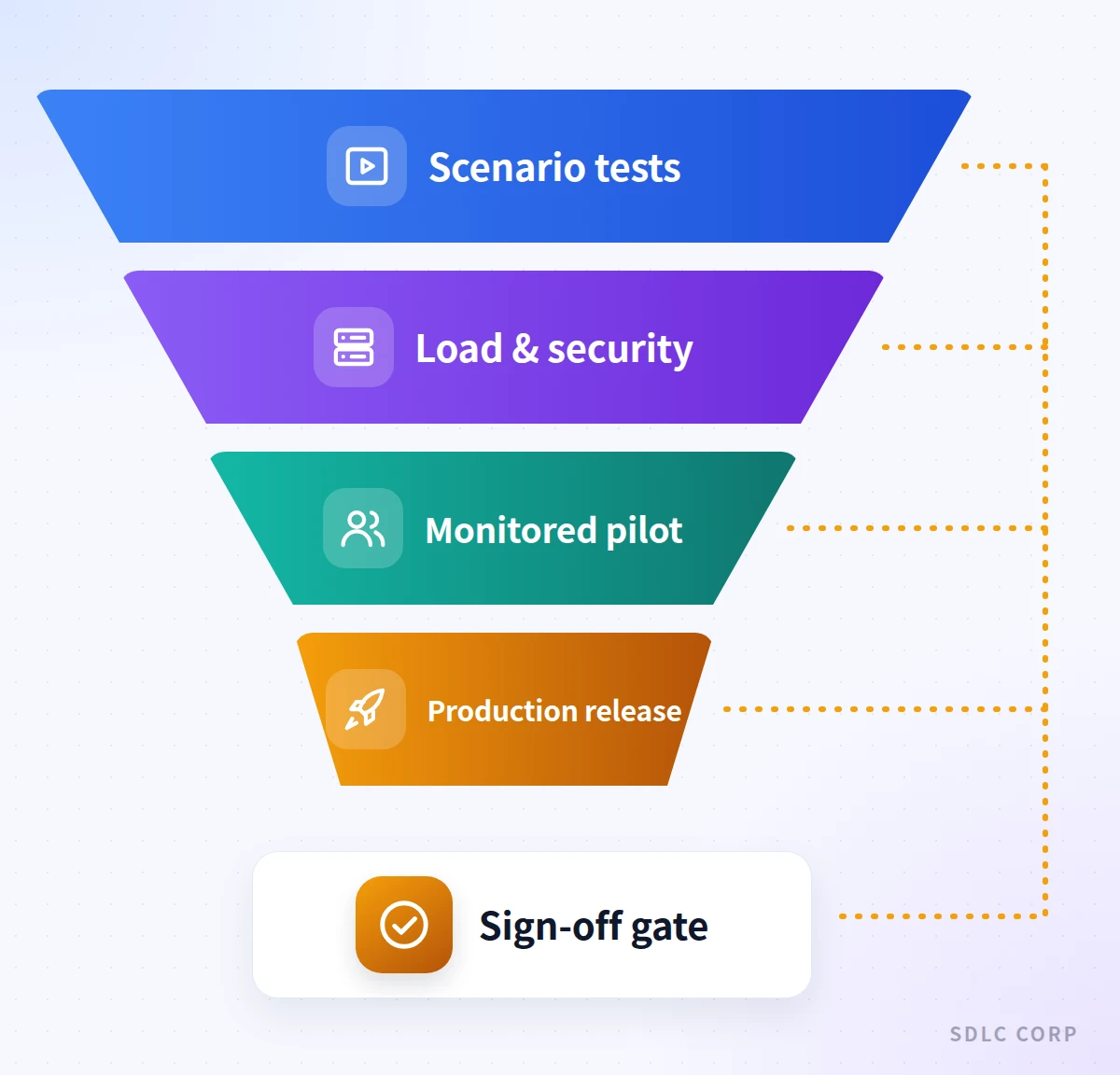
Pre-production test layers
The Test Layers a Voice Agent Should Pass Before Real Traffic
- Acceptance criteria and sign-off gatesMeasurable targets per intent, named approvers, rollback thresholds
- Scenario and negative testsGolden transcripts, out-of-scope requests, API timeouts, handoff context checks
- Audio and ASR resilienceNoise, codecs, packet loss and accents over the real phone path
- Load, degradation and chaos testsPeak concurrency, slow backends and component outages
- Security, fraud and compliance checksReplay and spoofing, prompt injection, PII masking, consent prompts
- Monitored pilot and canarySmall share of real calls, human scoring, automatic rollback on regression
Each layer gates the next, so real callers meet the agent only after lab, load and security tests have passed.
Design Scenario-Based Functional Tests
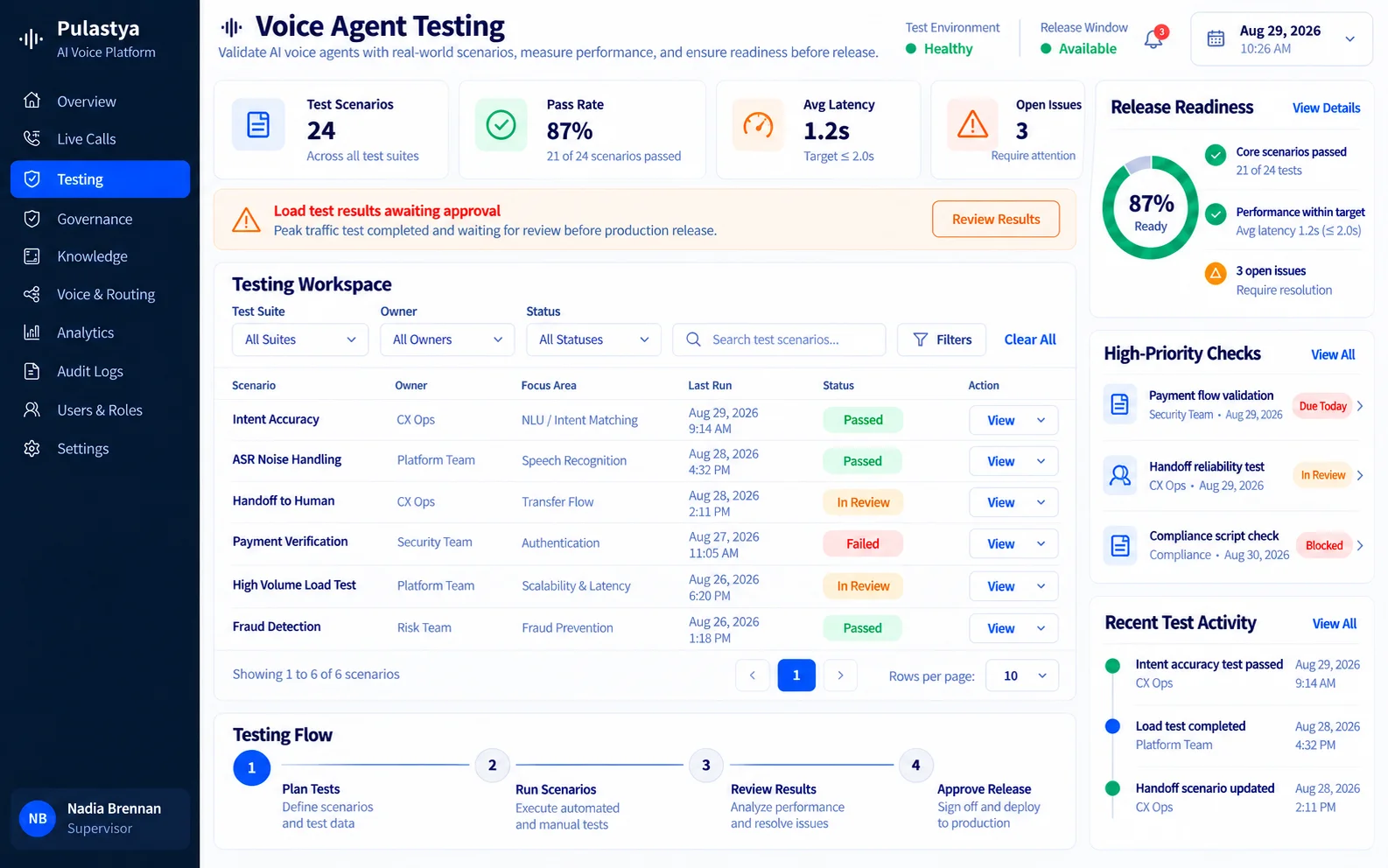
Create scenario scripts that represent core customer flows and known edge cases. Each scenario should include expected utterances, alternate phrasings, slot values, and desired system actions. For example, an account-balance scenario needs successful authentication, currency variations, and failure handling when account lookup fails.
Instrument scenarios with golden transcripts and expected NLU labels so automated comparators can assert correctness. Include negative tests for abusive language, out-of-scope requests, and API timeouts. When a scenario expects a human handoff, validate both the trigger condition and the integrity of transferred context to the human agent interface.
Incorporate multi-turn dialogs and interruptions to test state management. Use realistic timing: allow for user pauses, repeated confirmations, and simultaneous background noise. Capture transcripts and model confidences to tune thresholds and refine confidence-based routing logic before enabling automated resolution.
A quick browser test call, such as the one Pulastya AI provides before a number goes live, is useful for walking through scenarios early. Still run the same scenarios over the real phone path, because a browser session skips carrier codecs, network conditions, and telephony transfer behavior.
- Script primary flows and at least two variations per flow for linguistic diversity.
- Include negative tests to validate safe fallbacks and deny-handling behavior.
- Assert NLU labels and slot values against golden transcripts automatically.
- Validate context transfer and metadata integrity on human handoffs.
- Record confidence scores to set routing and escalation thresholds.
Scenarios must cover both expected paths and plausible error conditions.
Validate Voice Quality and ASR Resilience
ASR performance drives downstream accuracy. Test with varied audio conditions: low bitrate codecs, packet loss, background noise levels, and far-field microphone captures. Use audio augmentation techniques such as adding cafe noise, multi-speaker overlap, and simulated network jitter to ensure ASR tolerates realistic call surfaces.
Measure word error rate by intent class and by speaker subgroup such as accented speech or non-native speakers. Evaluate substitution and deletion errors that affect critical slots like account numbers or addresses. Track how ASR errors propagate into NLU misclassifications to prioritize model or grammar fixes.
Include TTS evaluation for clarity and latency in agent responses. Confirm playback compatibility across carrier platforms and IVR endpoints. Run A/B tests on voice prompts and confirmation phrasing to find options that reduce repetition and user friction without sacrificing compliance or brand tone.
- Load test ASR with augmented audio representing target network conditions.
- Segment WER metrics by intent, speaker accent, and slot-critical phrases.
- Simulate packet loss and codec changes that occur in carrier networks.
- Evaluate TTS latency and intelligibility on target telephony endpoints.
- Use A/B pilot prompts to measure repeat request and escalation rates.
ASR and TTS checks should replicate production voice paths and codecs.
Exercise Scale, Concurrency, and Degradation Behavior
Load and stress testing must reflect peak concurrent calls, parallel NLU requests, and backend API latencies. Use call generators that replay scripted audio and vary start times to simulate real arrival patterns. Measure end-to-end latency distribution, error rates, and system recovery time under controlled overload scenarios.
Define degradation policies: graceful degradation should preserve safety and critical transactions under load. For example, when downstream CRM latency spikes, the agent should offer to call back or initiate a limited offline transaction. Validate throttling, circuit breakers, and priority routing in multi-tenant setups.
Include chaos-style tests that introduce component failures such as DB timeouts, ASR service outages, or network partitions. Observe whether monitoring and alerting provide actionable signals, whether fallback prompts maintain compliance, and whether automatic failovers preserve core business continuity.
- Simulate peak and spike traffic with realistic arrival patterns and hold times.
- Measure latency percentiles and error budgets across the call stack.
- Validate graceful degradation scenarios for critical transactions.
- Test circuit breakers and throttles under sustained backend slowness.
- Run chaos tests for downstream API and infrastructure failures.
Scale testing must prove predictable behavior under expected and extreme load.
Verify Security, Fraud Prevention, and Compliance
Security tests should cover data in transit and at rest, authentication flows, injection attacks against NLU entities, and, for LLM-based agents, prompt injection spoken by callers. Verify that PII is masked in logs and recordings, that encryption keys rotate per policy, and that access controls limit who can replay user audio.
Include penetration tests focused on voice-specific attack vectors such as audio replay or voice deepfake spoofing.
Fraud controls require testing authentication fallbacks, voice biometrics thresholds, and challenge questions under adversarial conditions. Simulate account takeover attempts, synthetic voice submissions, and social-engineering patterns to verify that fraud signals trigger appropriate blocking or human review workflows.
Confirm regulatory compliance: recording consent flows, data retention periods, and regional data residency requirements. Validate redaction and export controls for regulatory audits. Ensure that automated agent prompts meet required disclosure language and that escalation to humans preserves audit trails for dispute resolution.
- Confirm PII masking in logs and ensure encrypted storage for recordings.
- Pen-test voice interfaces for replay, injection, and spoken prompt injection vulnerabilities.
- Validate voice-biometrics thresholds against false accept and reject rates.
- Simulate fraud scenarios to verify automated blocking and review queues.
- Audit consent prompts and retention policies for regulatory compliance.
Security and fraud tests must align with operational incident response plans.
Run Integrated End-To-End and Human-In-The-Loop Tests
End-to-end testing must include the human agent path and CRM integrations so handoffs run smoothly. Validate that transcripts, context tags, and interaction history appear correctly in the agent desktop, including on cold (blind) transfers, where the call goes straight to the receiving agent without a consult and context must arrive through the desktop or CRM.
Test warm transfers, where the AI or agent confirms availability or briefs the receiver before connecting the caller, and escalation to supervisors.
Include staged pilots where a small percentage of real traffic routes to the new agent in monitored mode. Use human reviewers to score conversation quality and identify mismatches between automated confidence thresholds and perceived customer success. Capture human corrections to retrain NLU models and tune dialog flows.
Before launch, run tabletop exercises with support teams to rehearse incident handling. Create playbooks that map observed failures to corrective actions. Example scenario: during a product recall week, simulated surge and elevated authentication failures revealed a missing rebate flow; the playbook directed a temporary routing rule that regained customer throughput within an hour.
- Validate context integrity and metadata on human handoffs in the agent UI.
- Pilot in monitored mode and use human scoring to refine thresholds.
- Capture human corrections for retraining NLU and updating dialog rules.
- Run tabletop incident response exercises for common production failures.
- Use staged rollouts with canary percentages and rollback thresholds.
Human-in-the-loop testing finds the mismatches automated tests miss.
Automate Regression Testing and Observability for Release
Integrate scenario tests into CI pipelines so NLU and dialog changes run regression suites automatically. Use golden transcripts and metric-based assertions to fail builds when critical regressions appear. Automate synthetic calls for nightly regression against both baseline and updated models to detect backward incompatibilities before deployment.
Instrument robust observability: transaction tracing across the telephony gateway, ASR, NLU, and backend services; standardized log schemas; and business dashboards for conversion and fallback rates. Implement alerting for anomaly detection on key metrics and sampling rules for full-call retention on unusual failures.
Before production release, document runbooks and establish SRE ownership for common faults. Ensure on-call rotation, escalation paths, and postmortem templates are in place. Teams without in-house tooling for synthetic callers, CI regression gates, and call tracing can bring in AI development services to build the harness, while runbook and on-call ownership stay with the operating team.
- Embed scenario regression tests in CI to prevent model-induced regressions.
- Standardize logs and traces for quick root cause analysis across services.
- Create dashboards and anomaly alerts for intent and fallback spikes.
- Automate nightly synthetic calls to monitor model drift and regressions.
- Document runbooks, SRE ownership, and postmortem procedures.
Automated regression and observability reduce release friction and mean time to repair.
A production test plan should cover call-continuity and failover behavior, security and privacy controls, and the metrics used after launch.
Conclusion
Testing AI voice agents before production requires more than proving that the agent understands sample conversations. A dependable release combines measurable acceptance criteria with scenario-based tests, real telephony audio checks, peak-load and failure simulations, security and fraud validation, and complete CRM and human-handoff testing. Teams should approve deployment only after those results meet agreed thresholds and named owners sign off.
Once the required gates pass, start with a monitored pilot and expand traffic gradually. Continue automated regression calls, end-to-end tracing, human quality reviews, and alerts for changes in latency, fallback rates, and transaction success. Document incident procedures and rollback triggers so engineering, operations, and compliance teams can respond quickly while improving the customer experience after launch.
Frequently Asked Questions
Cover core flows exhaustively and sample long tail intents. Test the top 20 intents with multiple utterance variations and at least two edge-case scenarios per flow. Include negative tests for out-of-scope queries and authentication failures so fallbacks and handoffs are validated.
Aim for statistically meaningful samples per intent. For high-volume intents, collect several hundred to a few thousand utterances. For lower-volume intents, combine synthetic augmentations and focused user tests to reach confidence thresholds, and plan continuous in-production monitoring for drift.
Run scale and degradation tests after integration of model changes and before full rollout. Verify that NLU and ASR changes maintain performance at target concurrency and under backend latencies. Repeat scaled tests for each major model or architecture change.
Include adversarial tests: replayed recordings, synthetic voice injections, and social-engineering patterns. Validate voice-biometrics thresholds and ensure fraud signals trigger human review. Combine automated detection with manual audits to tune detectors while minimizing false positives.
Instrument end-to-end tracing across telephony, ASR, NLU, and backend services. Monitor intent-level conversion, fallback rates, latency percentiles, and error budgets. Set alerts for sudden shifts and retain full-call samples for troubleshooting when anomalies occur.