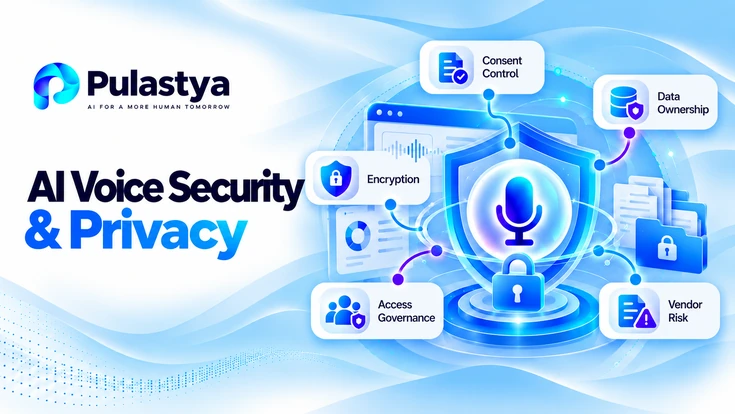
AI voice agents change how enterprises capture, process, and act on spoken customer and employee interactions.
Security and privacy must be designed into voice systems from data collection to model access, not added later. The priority is practical controls enterprises can adopt to own data, manage access, and reduce regulatory and operational risk.
- Ownership first Declare legal and operational owners for recordings and model outputs, then map data flows so controls target real risks.
- Minimize and isolate Collect only the voice signals necessary for the use case and isolate model training data from operational call streams.
- Access governance Use role-based, attribute-based, and time-limited credentials with cryptographic attestations to control who or what accesses voice assets.
Start with clear ownership of voice assets: recordings, transcripts, embeddings, and derived models. What each of those records is for, and how long it stays useful, is covered in call recording, transcription and summaries. Assign legal and operational owners, map where voice data flows, and classify each data element by sensitivity and retention need. That foundation lets security and privacy teams set targeted controls, from encryption to purpose-limited pipelines, instead of generic, ineffective rules that slow business.
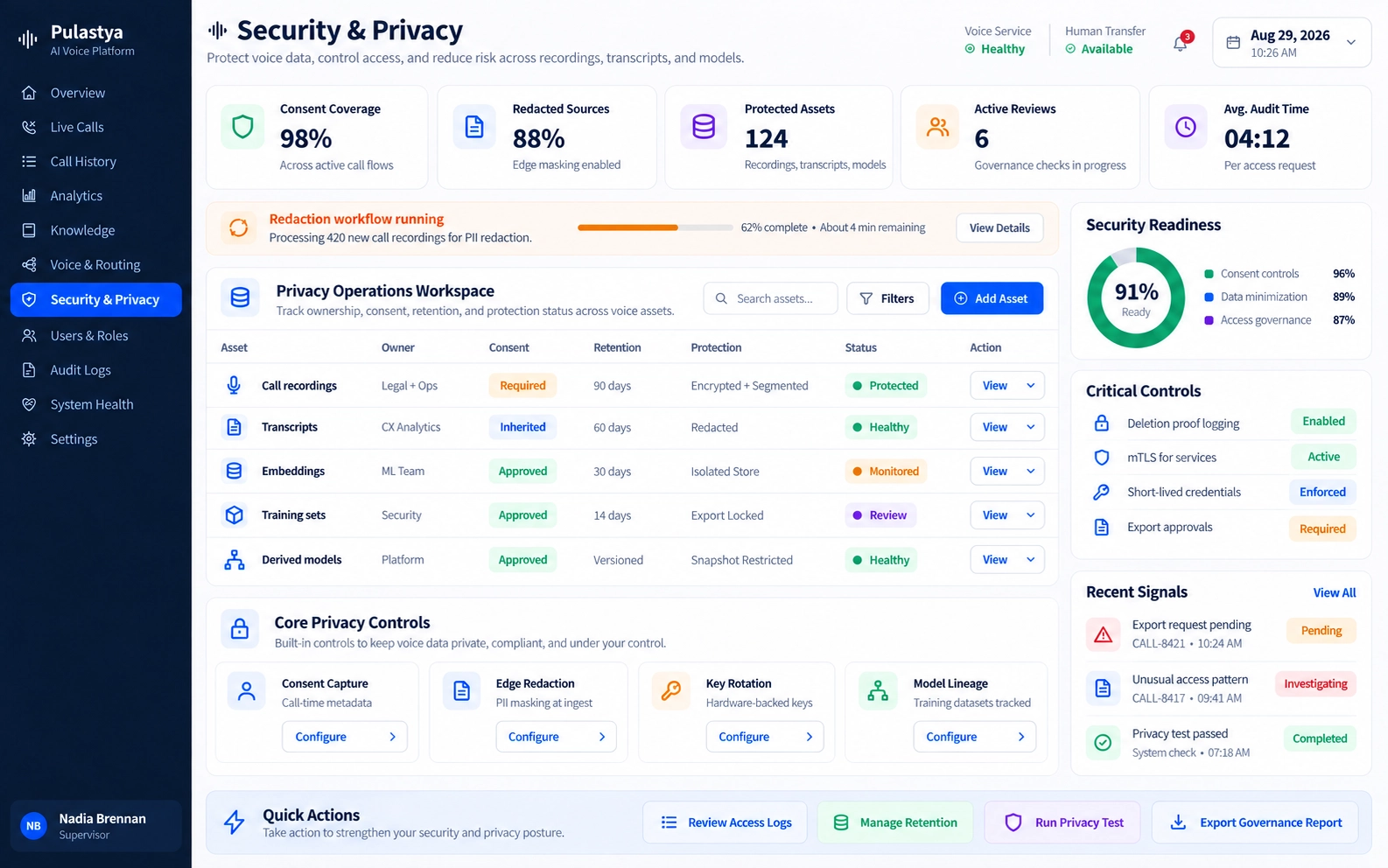
Translate ownership into enforceable controls across the voice-call lifecycle: capture, transmission, storage, model training, and real-time inference.
Define consent gates for live calls, sanitize or tokenize PII before model training, and require auditable access logs for humans and services that query or modify voice artifacts. These steps reduce breach scope and simplify compliance with sector rules and customer contracts.
Establish Clear Ownership and Consent for Voice Recordings
Assigning ownership means naming the team that will make retention, access, and deletion decisions for each voice asset. Legal, security, and product stakeholders should sign an ownership matrix that lists recordings, transcriptions, derived features, and trained models. That matrix should be reconciled with contracts and data subject expectations so rights are enforceable and traceable.
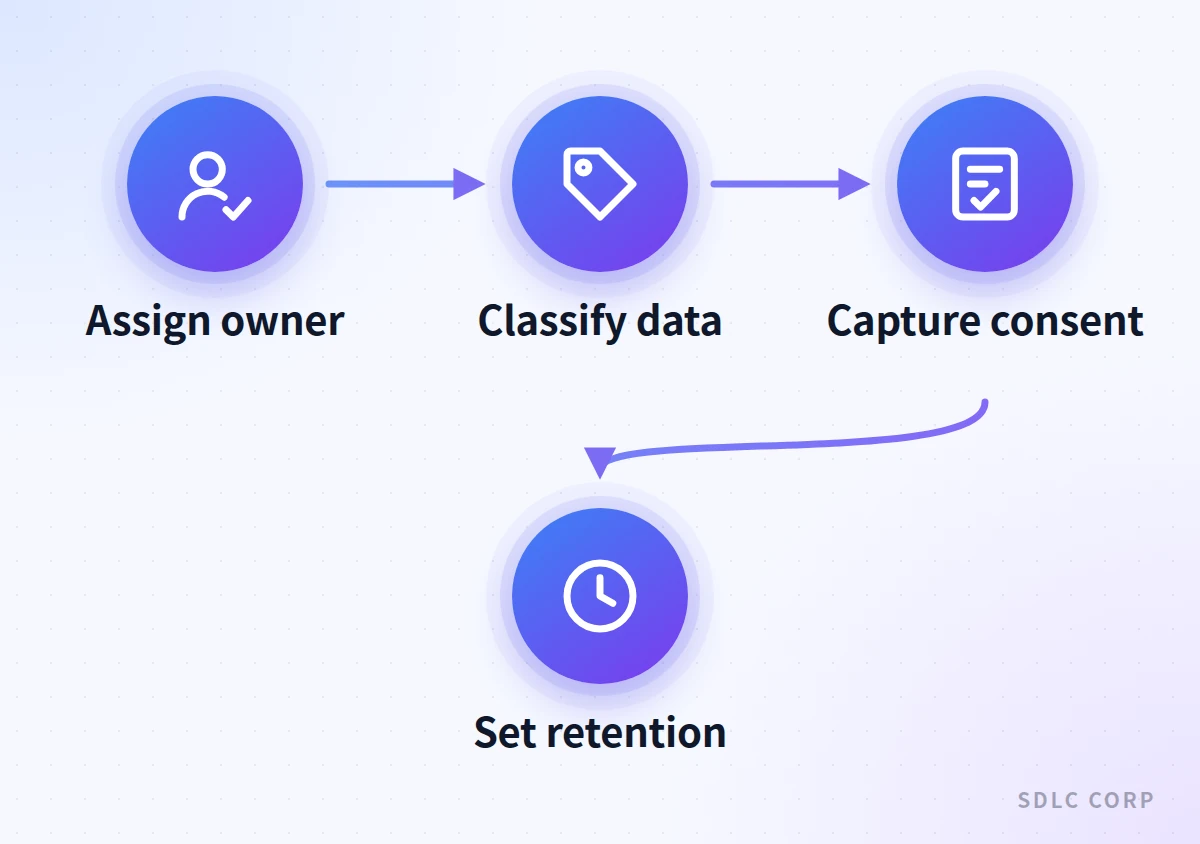
Consent models must be explicit and tied to ownership decisions: record only with consent, record with an opt-out, or serve the call without storing audio at all. Implement consent signals at call initiation and persist them with the recording metadata.
For multi-jurisdiction operations, apply the strictest consent rule that covers any party on the call, since caller and business can sit under different recording laws.
Operationalize deletion and retention with automation. Owners must define retention windows per class of voice asset and delegate deletion authority to an auditable service. Deletion should remove raw audio, transcripts, and any derived embeddings, and register a proof of deletion in an immutable log to demonstrate compliance when audited.
- Create an ownership matrix mapping voice assets to accountable teams and legal basis.
- Capture consent metadata at call time and attach it to the recording lifecycle.
- Apply the strictest consent rule that covers any party on the call.
- Automate retention enforcement and provide auditable deletion proofs.
Ownership and consent metadata are the single most effective levers for limiting regulatory and breach exposure.
Limit Collection and Preprocess to Remove Sensitive Content
Design capture policies that collect only the audio channels and features required for the use case. For example, voice biometric tasks need detailed acoustic features, while intent classification can usually run on the transcript alone without keeping the audio. Reducing captured data surface decreases the payload that must be protected and narrows the scope for downstream PII handling.
Use preprocessing to remove or mask PII before storage or model training. Techniques include real-time DTMF masking so keypad digits never reach recordings, named-entity redaction from transcripts, or automatic replacement of account numbers with tokens. Preprocessing as close to the edge as possible prevents sensitive content from moving into central repositories where it increases risk.
Track preprocessing provenance so teams know what transformations occurred. Store transformation metadata with each recording and transcript so reviewers can reconstruct or reprocess data under controlled conditions. That provenance supports both targeted reanalysis and compliance requests without exposing raw PII unnecessarily.
- Capture only required audio channels and features for the task.
- Apply edge-side redaction: mask card numbers, SSNs, and personal names before storage.
- Tokenize sensitive elements and store tokens instead of raw values.
- Record preprocessing provenance to support audits and controlled reprocessing.
Preprocess at the edge to minimize PII exposure and simplify central controls.
Encrypt, Segment, and Isolate Voice Data at Rest and in Transit
Encrypt audio and metadata with strong, industry-standard algorithms both in transit and at rest. Use separate keys for different data classes and rotate keys on a scheduled cadence. Protect cryptographic keys with a hardware security module or managed key service that supports fine-grained access controls and audit trails.
Segment voice data by risk and function: separate raw recordings, redacted transcripts, analytics outputs, and training sets into distinct repositories. Use network segmentation and access control lists to ensure that services or teams only see the repository they need. This reduces blast radius if one environment is compromised.
Use short-lived credentials and service identities for systems that access voice stores. Require mutual TLS for service-to-service calls and validate identity with signed tokens. Auditable access patterns should be enforced by gateway policies that can block suspicious access in real time.
- Encrypt audio and metadata with distinct keys per risk tier.
- Use hardware-backed key management and scheduled key rotation.
- Segment raw recordings, redacted assets, and training data into separate stores.
- Require mTLS and short-lived credentials for all service access to stores.
Segmentation and key separation reduce the scope of exposure and limit attacker value.
Controls by data type
Which Control Protects Each Kind of Voice Data, and Where
| Data type | Control | Where applied |
|---|---|---|
| Card digits and keypad entry | DTMF masking so digits never reach audio or transcripts | At capture, before anything is stored |
| Raw call audio | Separate store, its own encryption key, no default read role | Storage, playback and export |
| Transcripts | Redact names and IDs; replace account numbers with tokens | At the edge, before storage or training |
| Training sets and models | Dataset lineage, differential privacy, export approval | Before training and before any export |
| Consent and access records | Consent stored with the recording; every replay logged | At call start and on every access |
Controls differ by data type, so classify each voice asset first and apply the control at the earliest point in its path.
Control Model Training and Derived Artifacts to Protect Speaker Identity
Treat models and embeddings as primary assets that may contain latent speaker identifiers. Before training, review datasets for residual PII and apply differential privacy or noise injection where feasible to limit memorization of unique phrases or identifiers. Maintain an inventory of models and trace which training datasets created which artifact.
Apply access controls and governance to model use and export. Limit who can query black-box models, and prevent model snapshot exports unless approved. For externally trained models, require contractual protections and proof that the training used only appropriately consented and preprocessed datasets.
Monitor models for unexpected behavioral changes that could indicate leakage or poisoning. Implement a model assurance program with regular synthetic testing for memorization and privacy risk. When a risk is detected, quarantine the model and perform a dataset lineage review before redeploying.
- Inventory models and record their training dataset lineage.
- Use differential privacy or noise to limit model memorization of PII.
- Restrict model snapshot exports and apply export approvals.
- Run regular privacy tests to detect leakage or poisoning behavior.
Model artifacts must be managed as sensitive assets with lineage, testing, and export controls.
Enforce Granular Access Controls and Continuous Auditing
Implement least-privilege access with role-based and attribute-based policies that cover human users, service accounts, and downstream systems. Attribute-based controls allow time- and purpose-limited access, such as granting temporary transcription review rights tied to a ticket number. Avoid broad roles that grant read access to raw recordings by default.
Combine access controls with continuous auditing and anomaly detection. Log every retrieval, replay, and modification of voice artifacts with context: user, service, purpose, and consent state. Feed those logs into an analytics engine that flags unusual patterns such as bulk exports, repeated playback, or cross-account access attempts.
Add cryptographic attestation for high-risk operations. Require a signed approval for exporting datasets or training sets that include sensitive classes. Attestations create an auditable chain showing who approved access when and under what legal basis and help streamline incident response and compliance reporting.
- Apply least-privilege and attribute-based access controls for humans and services.
- Log all access with purpose and consent metadata for auditing.
- Detect anomalous access patterns with automated analytics and alerts.
- Require signed attestation for data exports and high-risk operations.
Combine fine-grained access controls with real-time auditing to catch misuse early.
Design Incident Response, Data Subject Requests, and Vendor Governance
Prepare an incident playbook tailored to voice assets: identify detection thresholds for anomalous access or exfiltration, define containment actions for recordings and models, and list required notifications to regulators and affected parties. Include technical runbooks to rotate keys, revoke credentials, and isolate repositories quickly to reduce exposure.
Operationalize data subject request handling with searchable, indexed metadata that ties recordings to consent and retention policies. Provide workflows that allow rapid identification, retrieval, or deletion of specific calls and their derivatives. When deletion impacts models, flag those models for retraining or quarantine and document mitigation steps.
Apply stricter governance to third-party vendors who process voice streams. Require vendor security attestations, contractual restrictions on reuse, and audit rights.
For outsourced model training or hosting, enforce encryption-at-rest with keys controlled by the enterprise and include termination clauses that require secure return or destruction of voice assets. For development engagements, require vendor teams to adhere to your data ownership matrix.
Include speech-to-text, text-to-speech, and language model providers in that review, because live audio and transcripts pass through their APIs; check each provider's data retention and training-use terms. With a bring-your-own-keys platform such as Pulastya AI, the customer connects their own Twilio and OpenAI accounts, so those account settings and terms apply directly.
- Maintain a voice-asset incident playbook with key revocation and isolation steps.
- Index consent and retention metadata to speed data subject request fulfillment.
- Quarantine models affected by data deletions and document retraining plans.
- Contractually require vendor compliance, key control, and audit rights, including speech and model API providers.
Prepare voice-specific incident and DSR playbooks and enforce vendor accountability contractually.
Security design also touches responsible and compliant call workflows, failover behavior, and pre-production validation.
Conclusion
Secure AI voice agents require safeguards throughout the lifecycle of recordings, transcripts, embeddings, and trained models. Start by assigning owners and consent rules to each asset, collecting only the data a workflow needs, and masking sensitive details before they enter storage or training pipelines. Encryption, isolated repositories, least-privilege access, and reliable audit trails then limit exposure and make decisions easier to verify.
Protection must continue after deployment. Review speech and model vendors, test derived models for memorization or leakage, enforce retention and deletion policies, and rehearse voice-specific incident response. When these practices are built into daily operations, enterprises can use AI voice agents while maintaining accountability for customer information, meeting applicable obligations, and responding quickly when risks change.
Frequently Asked Questions
Classify voice data by whether it contains PII, financial or health information, biometrics, or business secrets. Use that classification to set retention, encryption, and access controls. For example, recordings with financial data get a retention period set by the governing rule rather than a default, stronger encryption, and stricter export controls than generic intent-classification clips.
Yes. Options include training on redacted transcripts, using feature-level representations that exclude raw waveforms, applying differential privacy, or training in a controlled enclave where raw audio never leaves the secure environment. Choose the method that balances utility loss against privacy risk for your use case.
Mitigations include dataset scrubbing, noise injection, differential privacy, and regular privacy testing for memorization. Also limit training on high-risk classes and maintain dataset lineage so you can remove specific examples and retrain models when data subject requests or leakage are identified.
Execute the voice-asset incident playbook: isolate affected stores, rotate keys, revoke service credentials, and assess the exposure scope via logs and provenance data. Notify stakeholders per legal requirements, remediate systems, and document actions. Use the incident to close gaps in consent capture, segmentation, and monitoring.