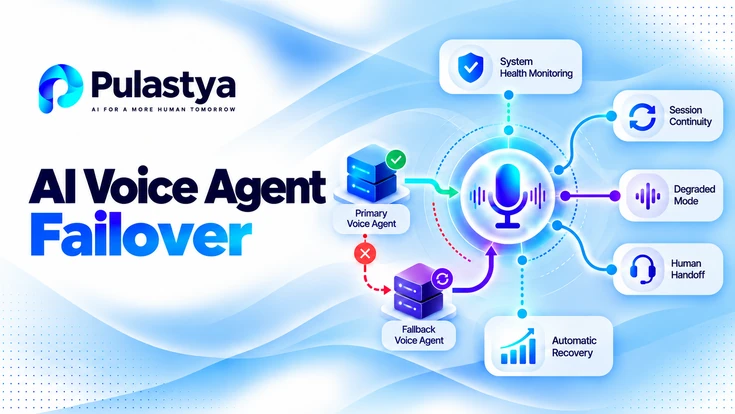
AI voice agent failover is the set of systems and procedures that keep live voice interactions productive when the primary AI model, speech layer, or integration path fails.
For enterprise contact centers, failover must preserve caller context, maintain compliance controls, and provide predictable escalation to human agents without amplifying operational risk or confusing customers.
- Failover is broader than redundancy Beyond duplicating components, failover must maintain session continuity, policy enforcement, and clear escalation so customer intent is preserved.
- Detect early, switch predictably Use layered health signals and deterministic thresholds to avoid oscillation and to provide graceful degraded experiences.
- Test and automate recovery Continuous chaos testing and automated runbooks shrink mean time to recovery and validate fallback behavior under real call patterns.
Enterprises deploying AI voice agents face three engineering constraints: availability of the voice stack, integrity of session state, and predictable human escalation.
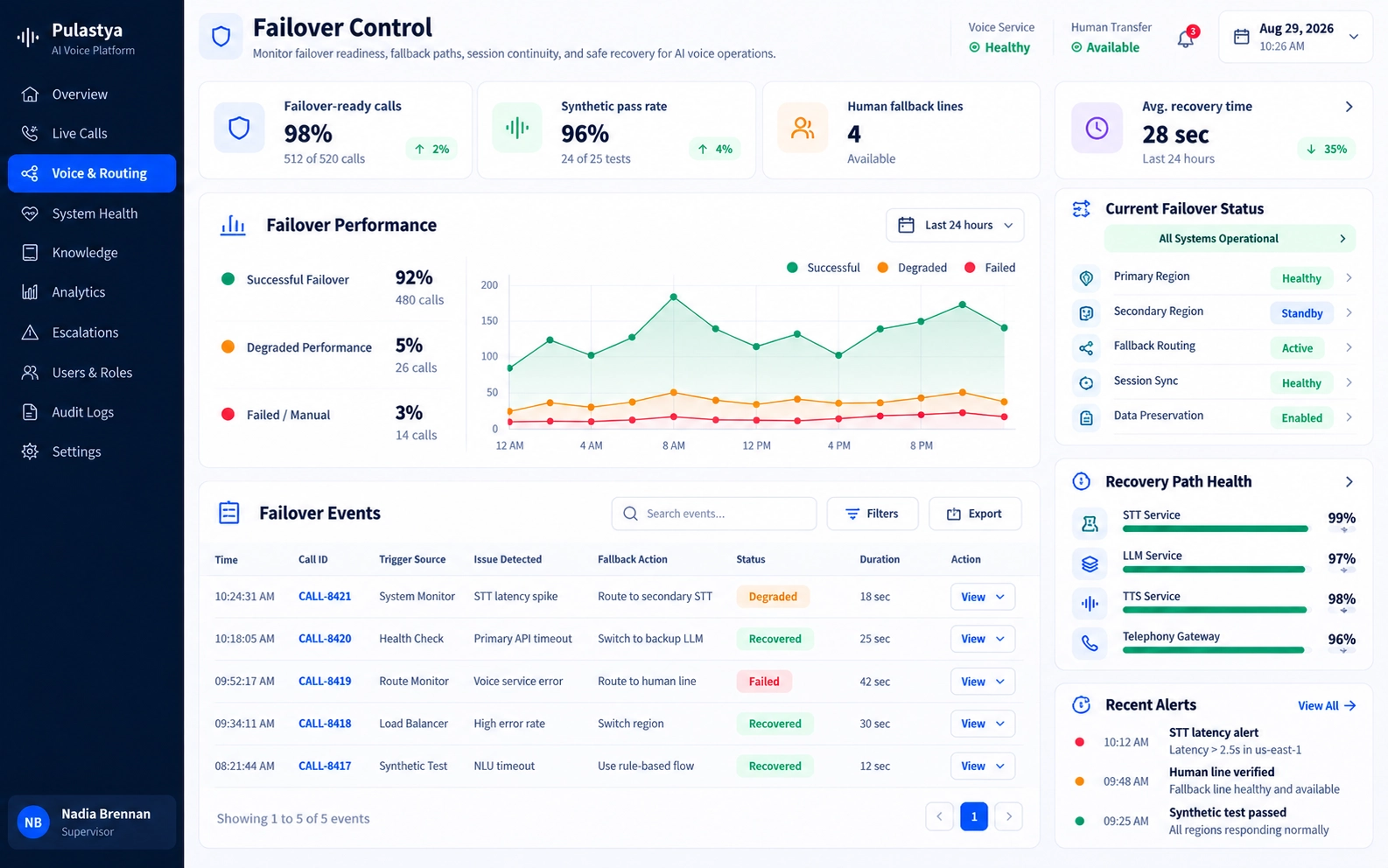
Designing failover requires choices about what gets restored, what is intentionally lost to avoid inconsistency, and how to validate that decisions meet legal and business policy. High-volume call centers depend on practical architectures, reliable detection, and well-understood recovery tradeoffs.
Technical product owners, contact center architects, and SRE teams responsible for voice channels need prescriptive patterns: monitoring signals to trigger failover, routing strategies for degraded performance, session serialization and rehydration options, and operational runbooks for post-incident recovery and testing.
Measurable objectives, low-latency transitions, and preserving revenue-sensitive interactions should anchor each of those choices.
What Does AI Voice Agent Failover Need to Achieve
Failover for AI voice agents must meet three enterprise objectives: minimize caller disruption, preserve business intent, and keep compliance and audit trails intact. Minimizing disruption includes clear prompts and minimal re-prompting.
Preserving intent means retaining extracted slots, transaction identifiers, and partial tasks. Compliance requires that audio and decisions remain traceable and that any human handoffs maintain consent and data handling policies.
Operational teams must define acceptable tradeoffs: is it better to drop an uncertain slot or re-ask for clarification under stress? For payments or sensitive tasks, conservative failover to human agents preserves compliance at the cost of agent capacity.
For low-risk flows, automated degraded modes that limit scope can maintain lower cost while keeping calls moving. Document these policies in SLOs and routing rules.
Business stakeholders need quantifiable metrics tied to failover: failed task rate after failover, average re-prompt count, escalation ratio to human agents, and time to state rehydration. These metrics drive capacity planning for fallback human pools and inform when to invest in tighter model SLAs, redundancy, or alternative cloud regions.
- Preserve extracted intent and transaction IDs across transitions
- Define per-flow risk tolerance for automated degraded modes
- Ensure audio and decision logs are available for audits
- Measure failed task rate post-failover for each flow
Failover must be an explicit business decision balancing compliance, cost, and customer experience.
Which Failure Modes Actually Break Voice Agents
Breaks occur at multiple layers: telephony transport, speech-to-text (STT), natural language understanding (NLU), decision logic, integrations, and downstream systems. Telephony drops or jitter cause audio gaps.
STT regressions create mistranscriptions and intent confusion. NLU model errors or latency degrade turn-taking. Integration failures with CRMs or payment gateways can block completion even if the conversational layer remains healthy.
Partial failures are common and trickier: the NLU may still understand intent but a downstream API returns 503. Silent retries, timeout mismatches, or partial acknowledgements can produce repeated prompts or duplicated transactions. Design detection and isolation so single-component errors do not cascade into whole-call failures.
External dependencies also introduce correlated risk: cloud provider outages, library updates, or model version rollouts. Correlated changes across regions or agents can produce large-scale degradation. Isolate upgrades by canarying and regionalizing critical components and maintain rollback paths that reduce blast radius.
- Transport failures: SIP/TLS drops, packet loss, call transfers failing
- STT failures: increased error rates or dramatic latency spikes
- NLU failures: misclassification, missing entities, or high timeout rates
- Integration failures: CRM, payment, or identity services returning errors
Plan for partial and correlated failures as the most common operational risks.
How to Detect Failures and Trigger Failover
Detect failures using layered observability: per-call telemetry, component health checks, and synthetic voice tests. Per-call telemetry captures STT confidence, NLU intent scores, latencies, and retry counts. Component checks monitor queue length, error rates, and resource saturation.
Synthetic tests exercise end-to-end call flows from PSTN numbers to simulate real conditions and detect regressions before customers are hit.
Define deterministic thresholds and hysteresis to avoid flapping. For example, trigger failover only when STT confidence stays below the floor set for that flow and the error rate stays above its limit for three consecutive minutes, and switch back only after both metrics have held inside a stricter recovery threshold for a sustained period.
Use weighted signals combining real-time confidence metrics with error percentages so temporary anomalies do not cause full failover. Alerting should be distinct from automatic failover thresholds to allow manual intervention for ambiguous cases.
When failing back, return a small share of new calls to the AI path first, and never move a call that a person is already handling back to automation.
Correlate logs and traces to identify root cause quickly. Trace unique call IDs across speech, NLU, router, and integration systems. Implement automated tagging of failed flows to enable downstream analytics, such as which intents fail most often under failover or which customers experience degraded service, so remediation can be prioritized against business impact.
- Per-call telemetry: STT confidence, intent score, latency, retries
- Component health checks: error rates, queue depth, CPU/memory
- Synthetic voice tests that run through critical flows on a short, fixed schedule
- Deterministic thresholds with hysteresis to prevent oscillation
Combine per-call signals and synthetic tests to trigger predictable failover.
Which Architectural Patterns Support Resilient Failover
Use layered redundancy and isolation: separate telephony ingress, speech, NLU, orchestration, and integrations into independent services with clear contracts. Replicate critical components across regions and providers where possible. Implement stateless orchestration backed by a durable state service so the orchestrator can be restarted or shifted without losing session data.
Adopt multi-path processing where alternative providers or degraded processing chains are available. For instance, route STT to a secondary vendor when primary confidence drops, or switch to a grammar-based fallback for high-value flows when NLU latency spikes. Maintain a scoring system to decide automated path switching based on cost, latency, and correctness tradeoffs.
Use circuit breakers and bulkheads to prevent contagion. Limit retries and queue depth in integration calls, and isolate slow or failing downstream services behind timeouts and fallback behaviors. Bulkheads preserve the ability to process other flows while one integration is failing, keeping overall system availability higher.
Plan the last line of defense at the telephony layer. If the AI service cannot be reached at all, the carrier or telephony platform should send calls straight to a staffed human line instead of playing an error or dropping them.
Twilio, for example, lets a phone number define a fallback URL, hosted separately from the primary service, that is used when the primary webhook fails or times out.
Some voice platforms expose this as a setting. In Pulastya AI, a failover setting routes calls directly to a configured human line if Pulastya is unavailable, so callers still reach a person during an outage.
- Stateless orchestrator with durable session store for continuity
- Multi-path processing: secondary vendors or grammar fallbacks
- Regional replication and provider diversity for critical components
- Circuit breakers and bulkheads to prevent cascading failures
- Telephony-level route to a human line when the AI is unreachable
Design for isolated failures with clear fallback paths and state durability.
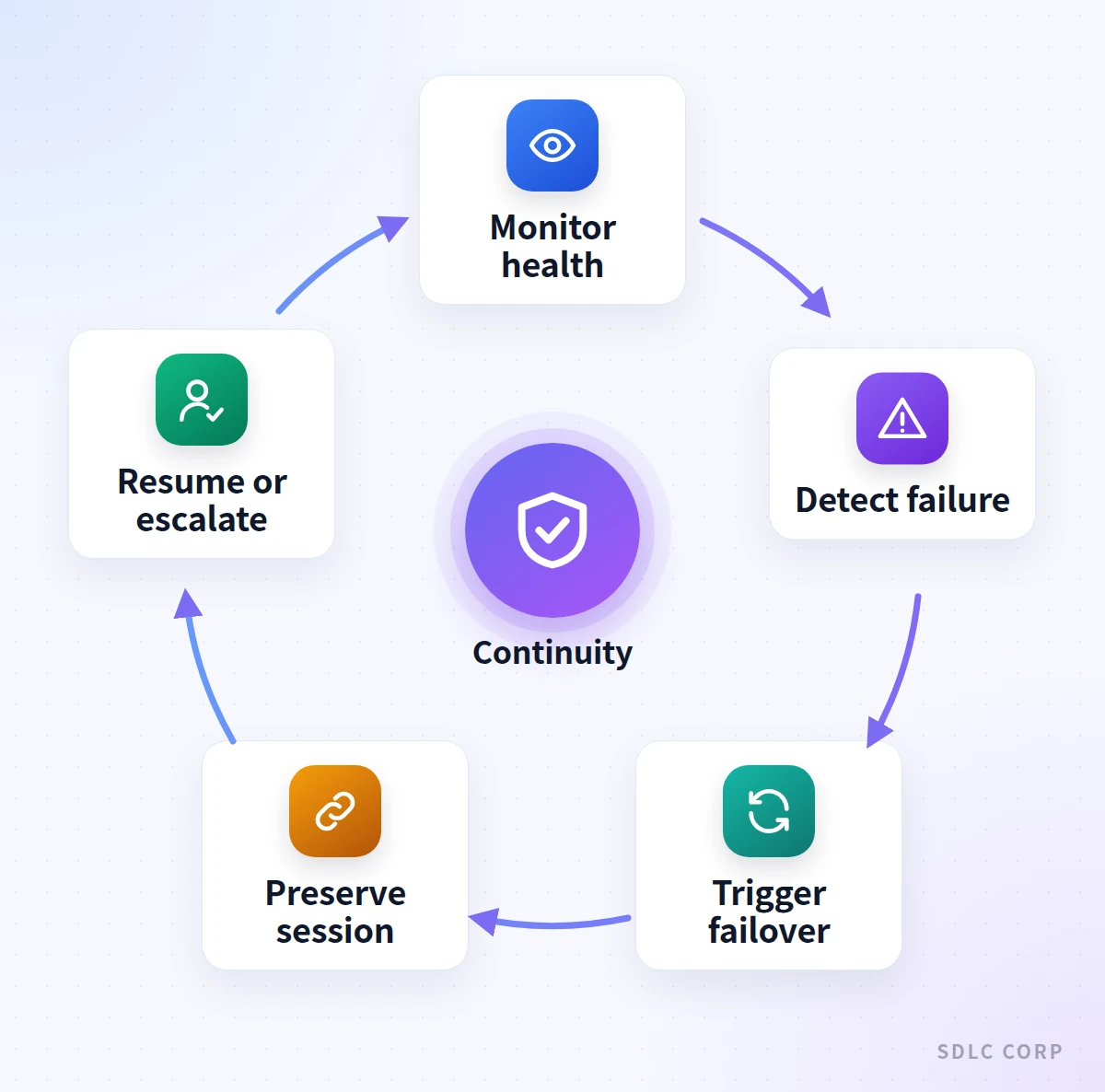
Failover sequence
From a Detected Failure to a Safe, Gradual Recovery
- Detect a sustained failurePer-call telemetry, health checks and synthetic calls breach thresholds for minutes
- Degrade to a safer pathSecondary STT or narrower scope; tell the caller what changed
- Hand risky calls to peopleEscalate with the saved session: intent, slots, transaction IDs
- Route to a human line if AI is downTelephony fallback sends calls straight to people when the AI is unreachable
- Recover and fail back graduallyReturn new calls only after recovery thresholds hold; replay with idempotency keys
Each step narrows what automation does, and fail-back waits for sustained health so calls do not bounce between paths.
How to Preserve Session Continuity and Recover State
Session continuity depends on how state is stored and rehydrated. Choose a compact canonical session model that records caller ID, intent, extracted slots, transaction IDs, and last successful system action. Persist this model at each dialog turn to a durable store with strong consistency guarantees for high-value flows, while lower-value flows may use eventual persistence to reduce cost.
Design rehydration strategies that avoid duplicate actions. Attach idempotency keys to downstream operations so retries during recovery do not create double charges or duplicate records. On failover, replay only the minimal action history needed to restore conversation context; avoid replaying external side effects that cannot be reconciled deterministically.
Example: a caller starts a refund request while payment gateway latency spikes. The voice agent extracts order ID and reason and persists a session with an idempotent refund request key.
Failover routes the call to a human agent with the preserved session, enabling the agent to complete verification without re-asking sensitive questions. This reduces average handle time and avoids duplicate refunds.
- Persist a compact canonical session after each agent turn
- Use idempotency keys for downstream operations to avoid duplicates
- Differentiate persistence guarantees by flow criticality
- Replay only minimal actions required to re-establish context
Durable, minimal session models and idempotency are core to safe recovery.
What Degraded UX and Escalation Should Look Like
Degraded UX must be explicit and predictable. When switching to degraded modes, tell the caller what changed and set expectations: announce possible limits, confirm required data, and offer immediate human assistance for critical tasks. Use short, clear prompts and avoid complex re-asks that amplify customer frustration during degraded performance.
Design escalation paths that are fast and auditable. Standardize how the agent packages session data for handoff: include transcript snippets, extracted entities, timestamps, and the last successful action. Route escalations with metadata that lets human agents pick up the conversation with minimal context switching and with appropriate permission levels for sensitive tasks.
Balance automation and human capacity by triaging calls for escalation. Use intent confidence and transaction risk to determine which calls go directly to humans and which stay in automated degraded mode. Maintain a small always-on human pool for high-risk flows and auto-scale additional agents based on failover volume patterns to avoid long wait times.
- Announce degraded mode and set caller expectations clearly
- Package transcripts and entity snapshots for fast human handoffs
- Triage escalation based on intent confidence and transaction risk
- Maintain a reserve human pool for high-risk failovers
Explicit degraded UX and structured handoffs reduce caller friction and risk.
How to Test, Runbooks, and Measure Readiness
Make failover part of continuous testing: run scheduled chaos tests that simulate STT failures, NLU regressions, integration timeouts, and region outages. Validate both automated failover switching and human handoff procedures. Capture key metrics during exercises: switch time, session rehydration time, successful task completion rate, and escalation load to plan capacity.
Maintain clear runbooks with automated playbooks for common failover scenarios. Each runbook should list detection criteria, immediate mitigation steps, longer-term recovery actions, communication templates for internal stakeholders, and postmortem checkpoints. Where possible, codify playbook steps into automation to shrink mean time to recover and reduce human error during incidents.
For long-term readiness, define SLOs tied to business outcomes: acceptable task completion rate after failover, maximum time to rehydrate state, and maximum percentage of calls escalated during sustained failure windows. Use synthetic voice tests and production canaries to validate SLOs.
- Scheduled chaos tests simulating STT, NLU, and integration failures
- Runbooks with detection criteria, mitigation steps, and templates
- Automated playbooks to reduce mean time to recover
- SLOs tied to task completion, rehydration time, and escalation rates
Operationalize failover with testing, runbooks, and measurable SLOs.
Continuity planning should be exercised through pre-production voice-agent testing, aligned with routing behavior, and connected to hybrid AI and human operations.
Conclusion
Reliable AI voice agent failover is more than adding a backup model or phone line. It requires early failure detection, predictable fallback routing, durable session state, and safe handoffs that preserve caller intent. Combining layered monitoring, idempotent transactions, and telephony-level escalation helps contact centers protect service continuity even when several components fail.
To make failover dependable in production, set risk-based thresholds for each call flow, regularly test degraded paths and human transfers, and maintain clear recovery runbooks. Track failover time, successful task completion, session recovery, and escalation rates to improve routing decisions and staffing. The goal is not just to restore automation quickly, but to keep every caller on a safe, understandable path to resolution.
Frequently Asked Questions
Escalate when the call involves sensitive transactions, when intent confidence falls below a preconfigured risk threshold, or when the session cannot be rehydrated reliably. Also escalate if downstream integrations required to complete the task are unavailable. Triage policies should be flow-specific and tied to business risk.
Use idempotency keys for all state-changing operations, persist transaction identifiers inside the canonical session, and implement deduplication logic in downstream systems. During replay or retry, check stored keys before executing to ensure single execution even if the orchestration retries.
Secondary STT vendors are useful for reducing single-vendor risk, but they introduce differences in transcription quality and latency. Test critical flows end-to-end with the secondary vendor and maintain mapping layers for entity extraction differences. Use vendor scoring to decide when to switch automatically.
Key metrics include time to switch paths, session rehydration time, task completion rate after failover, escalation rate to humans, and synthetic test pass rates. Track both technical and business metrics to prioritize engineering and staffing investments.
Runbooks should be exercised at least quarterly for major flows and monthly for high-risk flows. Include scheduled chaos experiments, tabletop drills for on-call teams, and post-exercise reviews to update detection thresholds, automation, and escalation rules.