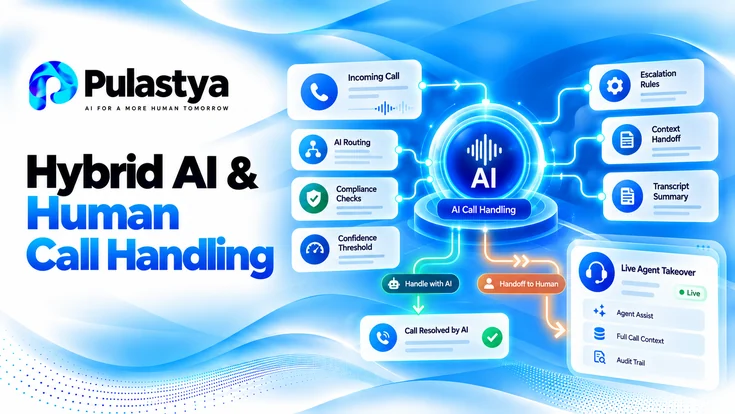
Hybrid AI and human call handling combines automated voice and chat systems with live agents to reduce cost, shorten resolution time, and protect customer experience.
An effective operating model keeps humans in the loop for judgment, compliance, and complex outcomes while assigning repeatable tasks to AI. It depends on practical rules, staffing guidance, and measurable controls for enterprise deployments.
- Operating model Treat hybrid handling as policies, playbooks, and staffing, not only as code.
- Handoff design Design clear, recoverable transitions from AI to human agents with context preservation.
- Control and metrics Measure safety, containment, and agent productivity to validate ROI and compliance.
Enterprises should treat hybrid call handling as an operating model, not a feature. Start with clearly defined handoff boundaries, failure modes, and recovery playbooks that live inside contact center runbooks. That prevents automation from creating dangerous silence or cascading transfers during peak periods.
Use real call data to identify high-volume, low-variance interactions where AI can own the entire interaction, and map the remainder to deterministic human-AI transitions.
Define success metrics up front that reflect business outcomes: containment rate, average handle time on escalations, regulatory adherence, and customer effort on partial-AI flows.
Build a prioritized roadmap: pilot automating intake for a narrow set of intents, then expand into resolution with supervised learning. Maintain human review sampling and rolling audits to catch drift, and tie change approvals to measurable rollback criteria so deployments are reversible.
Why Hybrid AI Human Call Handling Reduces Operational Risk
Hybrid call handling lowers operational risk by assigning routine, rule-based interactions to AI while reserving judgment, negotiation, and regulated decisions for humans. Enterprises that attempt full automation often face edge-case failures that harm brand and regulatory standing.
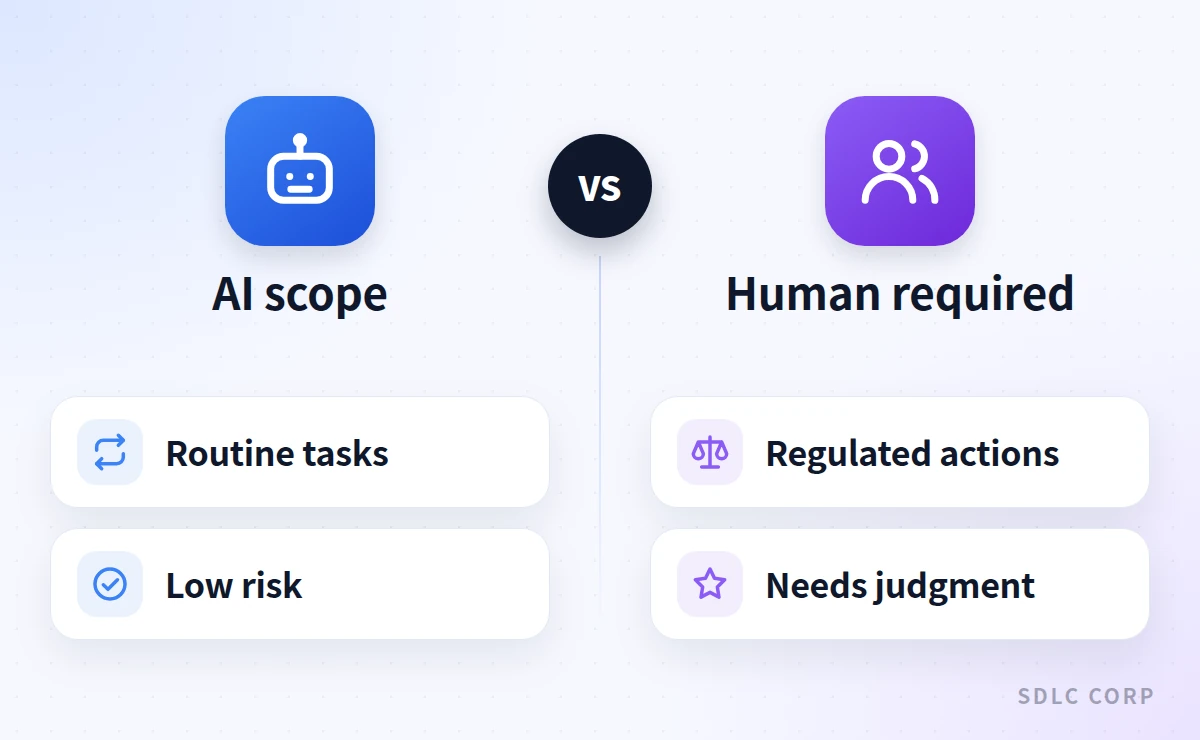
A hybrid approach enforces explicit boundaries so AI only acts within validated intent scopes and humans handle exceptions, reducing the probability of catastrophic errors during live traffic.
Risk management requires modeling failure scenarios and designing compensating controls. For example, implement automatic escalation triggers when confidence scores fall below a threshold, and require human review for any action that modifies contracts, accesses sensitive records, or impacts billing.
Maintain an incident taxonomy and rapid-response playbook so teams can isolate, roll back, and communicate clearly when automation causes unexpected outcomes.
Operational continuity depends on predictable behavior under load. Hybrid systems should default to agent-first routing when downstream dependencies fail, and support fast toggles between AI and human modes. These runtime controls are essential during maintenance, third-party outages, or regulatory inspections because they limit blast radius and preserve service levels without requiring code changes.
- Define the intent set AI can resolve without human intervention and publish it to operations teams.
- Set confidence thresholds for automated actions and map low-confidence paths to human queues.
- Create rollback and circuit-breaker controls in the call routing layer.
- Document regulatory decision points that must always be human-reviewed before execution.
- Use incident taxonomies and post-incident reviews to refine safe operating limits.
Operational risk falls when AI acts only within tightly defined, auditable boundaries.
Designing Human-AI Call Routing and Escalation
Start routing design with the caller experience and map the conversation path end to end. Capture context early: channel, customer profile, authentication state, and active case numbers.
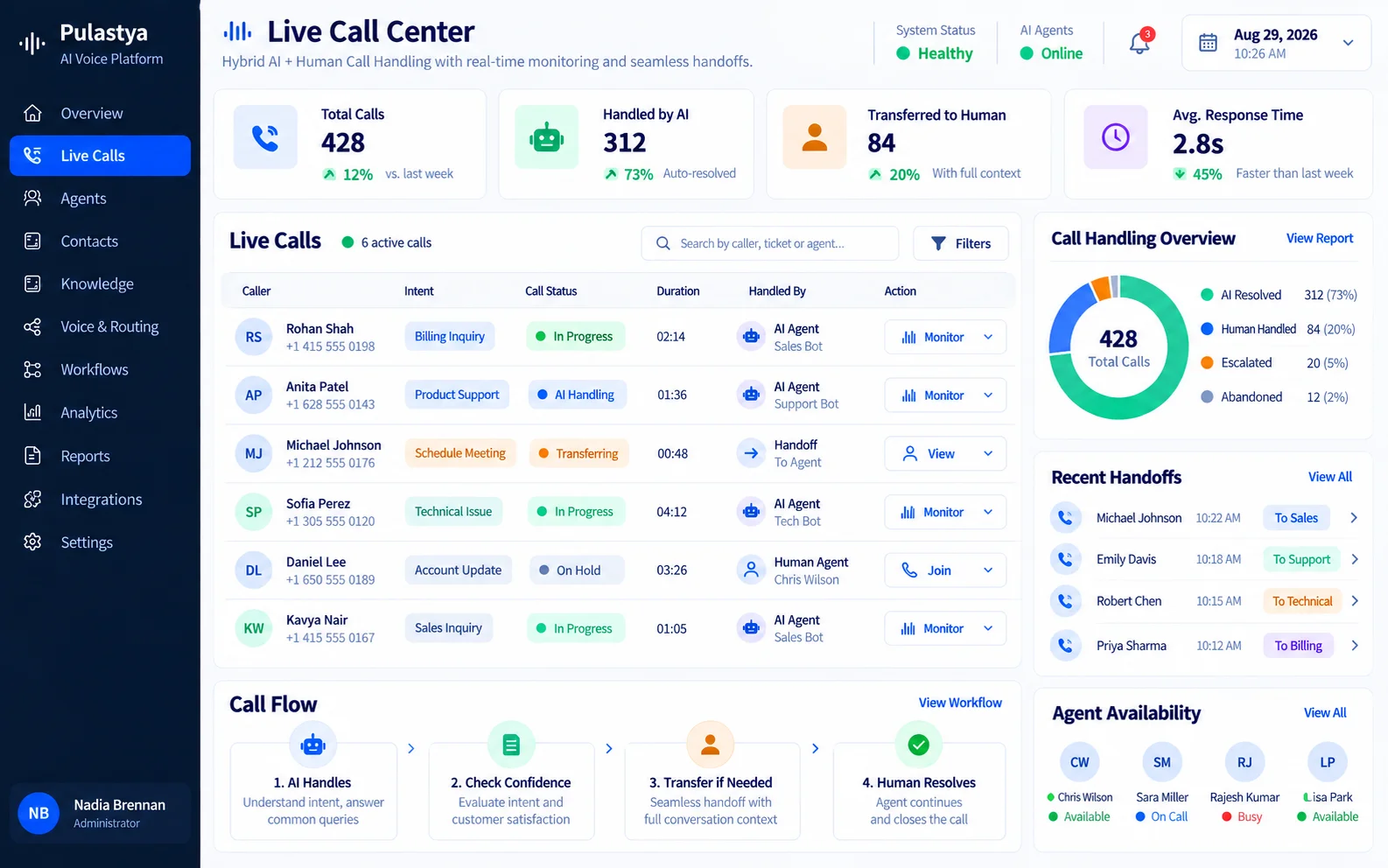
The routing logic should evaluate AI suitability, agent expertise, and compliance needs before choosing among three paths: the AI handles the call, a warm transfer in which the AI briefs the receiving agent or confirms availability before connecting the caller, or a cold transfer that sends the live call straight to an agent queue.
In both transfer types, pass the interaction transcript and state so agents inherit the caller record without repeat verification.
Escalation rules must be explicit and deterministic. Author rules that escalate on timeouts, repeated failed intents, or explicit customer requests for an agent.
Provide agents with a summary card showing AI actions taken, confidence scores, and suggested next steps. Warm-transfer briefings should include the last two AI-generated prompts and the last caller utterance so the receiving agent does not need to re-establish context; on a cold transfer, the same card should appear on the agent desktop at pickup.
Design for multiple escalation tiers: frontline agents for routine exceptions, specialized teams for regulated decisions, and a rapid-response ops center for systemic automation errors. Implement service-level objectives per tier and instrument route-to-agent latency. Use predictive routing to match agent skills with escalation type, reducing handle time and minimizing the need for downstream re-routing.
- Capture authentication and case context before AI attempts resolution to avoid redundant verification.
- Escalate on repeated failed intent matches or on explicit ask for a human.
- Provide agents with an AI summary card including confidence and recent actions.
- Implement tiered escalation routes with SLOs per tier and skills-based matching.
- Log full transcripts and metadata to enable post-call audits and training.
Clear escalation rules and context preservation make transfers efficient and defensible.
Hybrid routing
How a Hybrid Call Moves Between the AI Agent and People
- Capture context earlyChannel, customer profile, authentication state and active case numbers
- Check the request against AI scopeAI acts only on validated intents and above set confidence thresholds
- Apply escalation rulesTimeouts, repeated failed intents, a request for a person, regulated actions
- Choose the path and attach contextSummary card: AI actions taken, confidence scores, suggested next step
Possible outcomes
- AI resolves the callRoutine, in-scope request completed and logged with its transcript
- Warm transfer to an agentAI briefs the agent or confirms availability, then connects the caller
- Cold transfer to a tier queueLive call goes to a skills-matched queue; the card appears at pickup
Every path carries the same context forward; the transfer type only changes whether the agent is briefed before the caller joins.
AI Voice Handling: Limits, Intents, and Transparency
Set explicit limits on what the voice AI will do and expose those limits to the customer early. For example, announce that the system can handle status inquiries, password resets, and appointment bookings but cannot accept financial authorizations. Doing so reduces expectation mismatch and lowers failed handoffs. Internally, enforce allowable actions via policy checks rather than trusting NLU output alone.
Intent design should prioritize precision over recall for voice. Select a concise set of intents that map to high-volume, low-variance tasks and optimize ASR and NLU for those. Use slot-filling only for necessary structured fields and validate critical inputs with confirmation steps.
Maintain an intent deprecation schedule and versioned intent models to prevent drift and to keep human teams aligned with current AI capabilities.
Transparency matters for legal and UX reasons. Log and make available the transcript, timestamps, and decision rationale for every AI action so compliance teams can reconstruct any outcome. Communicate to customers when they are interacting with AI and provide a clear path to speak with a human. That clarity improves trust and reduces escalations tied to misattributed accountability.
- Publish AI capability boundaries to customers at the start of the call.
- Limit intents to high-confidence, high-volume tasks and optimize ASR for those utterances.
- Confirm critical information with explicit user acknowledgement.
- Version and deprecate intents through controlled releases and stakeholder reviews.
- Retain full transcripts and decision rationale for compliance and audit.
Precision, explicit limits, and transparency keep voice AI safe and user-friendly.
Staffing and Skills: Blending Agents and AI
Staffing for hybrid operations requires new roles and retraining. Agents need skills in supervising AI, validating suggested responses, and handling exceptions quickly.
Train staff to interpret AI confidence signals, use AI-generated summaries, and to correct model outputs in ways that feed back into supervised learning datasets. Create role distinctions between AI supervisors, escalation specialists, and standard agents to align career paths.
Plan staffing using scenario-based forecasting. Example scenario: a mid-size insurer introduces hybrid intake for claims triage. During the pilot, it staffs a reduced daytime agent roster because AI handles simple inquiries.
It keeps a staffed escalation rotation for complex claims and assigns operations support for model and workflow updates. The scenario highlights that hybrid staffing reduces peak load but requires dedicated cross-functional coverage for model lifecycle tasks.
Recruit and retain talent that understands both customer empathy and model limitations. Create on-call rotations for AI incidents and embed a small ML operations team inside the contact center to manage model retraining, labeling, and deployment windows. Offer incentives for agents who contribute high-quality labeled corrections and reward rapid detection of AI drift to keep models aligned with live behavior.
- Define new roles: AI supervisor, escalation specialist, and ML ops embedded in contact center.
- Use scenario-based forecasting tied to pilot metrics to size hybrid staffing needs.
- Establish an on-call rotation for AI incidents and rapid rollback procedures.
- Include model maintenance tasks in agent schedules to support continuous learning.
- Incentivize agent feedback and label contributions to improve model quality.
Hybrid staffing reduces workload but requires explicit new roles and continuous retraining.
Monitoring, Quality, and Compliance Controls
Robust monitoring is nonnegotiable. Track containment rates, escalation latency, customer satisfaction by route, and a small set of safety metrics tied to regulatory risk. Implement sampling and automated quality scoring for AI-handled calls and reserve human audits for high-impact or borderline cases. Correlate quality metrics with model versions so you can detect regressions quickly after releases.
Quality assurance must combine automated checks and human review. Use rule-based detectors for forbidden actions, sensitive data exposure, and anomalous decision patterns. Supplement those with periodic human audits that inspect transcripts for tone, accuracy, and adherence to policy. Feed audit findings into retraining cycles and change control boards so fixes are prioritized by risk and customer impact.
Compliance requires audit trails and role-based access to sensitive records. Log every automated decision with metadata: model version, confidence scores, and upstream context. Maintain retention and redaction policies aligned to regulations.
Build controls that block AI from executing any irreversible or reportable action without explicit human authorization, and require manual signoff for any change to those controls.
- Instrument containment, escalation latency, and customer satisfaction by routing path.
- Use automated detectors for forbidden actions and sensitive data leakage.
- Perform periodic human audits and correlate findings with model versions.
- Enforce human authorization for irreversible or regulated actions.
- Maintain auditable logs with model metadata and confidence scores.
Combine automated detectors with human audits to maintain quality and regulatory compliance.
Technology Stack and Integration Patterns
Architect the stack for modularity and fail-safe behavior. Separate ASR, NLU, dialog management, and action execution into replaceable components with clear APIs.
Place a routing layer in front that can switch between AI and agent modes without dropping context. Ensure the session state store is resilient and replicated so transfers, warm or cold, do not suffer from missing context under load.
Integration patterns should prioritize synchronous context handoff and asynchronous learning feedback. Use event streams to capture every interaction for downstream analytics and model training.
Implement a transactions log for any action that changes customer records so rollbacks and audits are possible. Design connectors to core systems with retry policies and circuit breakers to protect the AI layer from downstream failures.
Choose vendor or build decisions based on control, latency, and data governance needs. Where latency or sensitivity is high, prefer in-house or private cloud models that you can version and audit. For noncritical tasks, vendor-managed models accelerate time to value.
Regardless of choice, enforce encryption at rest and in transit and maintain a data retention policy that supports compliance and model retraining needs. Teams that decide to build or customize can bring in AI development services for the routing layer, core-system connectors, and audit logging.
- Modular stack: distinct ASR, NLU, dialog, and action execution components with clear APIs.
- Use a session store that survives failover so handoff context stays consistent in warm and cold transfers.
- Capture event streams for analytics and supervised learning pipelines.
- Implement circuit breakers and retries on connectors to core systems.
- Choose vendor vs. in-house based on latency, sensitivity, and governance requirements.
A modular, resilient stack with event streams enables safe integration and continuous learning.
Deploy, Measure, and Iterate: Metrics That Matter
Successful deployments are iterative and measure both efficiency and safety. Track containment, transfer rate, average handle time for escalations, customer satisfaction, and post-call compliance findings. Use control groups when rolling out changes so you can measure causal impact on both cost and quality. Set clear success thresholds and require a rollback plan as part of every release checklist.
Operationalize a continuous improvement loop: deploy a narrow automation change, monitor real-time metrics and audit samples, retrain models using corrected data, and redeploy with phased ramping. Maintain a change log tied to model versions and route configurations to trace any KPI swings to specific releases.
Prioritize metrics that reflect customer and regulatory risk. For example, combined tracking of escalation latency and satisfaction identifies bottlenecks that harm experience, while audit failure rate flags compliance gaps. Review these metrics weekly during initial rollout and graduate to monthly reviews once stability is proven. Use the metric trends to inform staffing, intent expansion, and lifecycle decisions.
- Use control groups and phased ramps to measure causal impact of automation changes.
- Track containment, transfer rate, escalation handle time, satisfaction, and audit failures.
- Maintain a change log mapping KPI changes to model versions and route adjustments.
- Close the loop: audit, correct, retrain, and redeploy with phased rollouts.
- Tie staffing and roadmap decisions directly to metric trends and risk signals.
Iterative deployment with control groups and clear metrics ensures safe, measurable gains.
Support centers are a common place to introduce hybrid staffing. The guide to an AI voice agent for customer support covers which support calls to automate and how escalation keeps people in control of complex cases.
For calls that arrive outside staffed hours, see after-hours call handling; for supporting the person who takes over the call, see AI agent assist for human call agents.
Conclusion
Hybrid AI and human call handling works best when automation and human expertise operate as one coordinated service model. AI can address routine inquiries, capture customer context, and route requests efficiently, while human agents manage exceptions, sensitive decisions, and conversations that require judgment. Clear escalation rules, context-preserving handoffs, and defined operating boundaries help enterprises improve efficiency without losing accountability or customer trust.
A successful deployment depends on more than a capable AI voice agent. Organizations also need trained teams, secure integrations, quality monitoring, compliance controls, and measurable performance targets. Starting with predictable call types, reviewing real interaction data, and expanding automation gradually makes it easier to develop a resilient hybrid call handling approach that balances operational performance with a dependable customer experience.
Frequently Asked Questions
Inventory call types and prioritize high-volume, low-variance intents for an initial pilot. Define handoff rules, confidence thresholds, and rollback criteria before any production routing change. Train staff on supervision tasks and set up basic monitoring and audit workflows to catch early failures.
Treat confidence scores as one signal among several. Use them to route low-confidence interactions to humans, but also include context checks, recent audit outcomes, and customer profile risk. Never allow confidence alone to approve regulated or irreversible actions.
Identify all decision points that trigger legal obligations and require human authorization for those actions. Maintain auditable logs, record consent when necessary, and provide explicit disclosure that a call involves AI. Regular human audits should validate compliance.
Introduce roles for AI supervision and embed ML ops within the contact center. Retrain agents to validate AI outputs, label corrections, and manage escalations. Establish on-call rotations for AI incidents and allocate time for model maintenance tasks.
Measure containment, transfer rate, escalation handle time, customer satisfaction, and audit failure rate. Use control groups for new automation and require clear success thresholds and rollback plans. Correlate metric shifts with model versions and route changes to ensure accountability.