AI agent assist pairs real-time AI with human call agents to increase accuracy, speed, and consistency on voice interactions.
It surfaces context, suggested responses, knowledge snippets, and prioritized actions while the human controls tone, escalation, and final decisions. The hybrid model preserves human judgment while reducing cognitive load and time-to-resolution in high-volume contact centers.
- Hybrid control Keep humans in control: AI should suggest, not replace, with easy override and clear provenance for every recommendation.
- Latency and privacy first Design for sub-second suggestions, encrypted streaming, role-based data access, and configurable retention to meet compliance mandates.
- Measured rollout Pilot on narrow queues, track CSAT and handle time, iterate on prompts and knowledge retrieval before broad deployment.
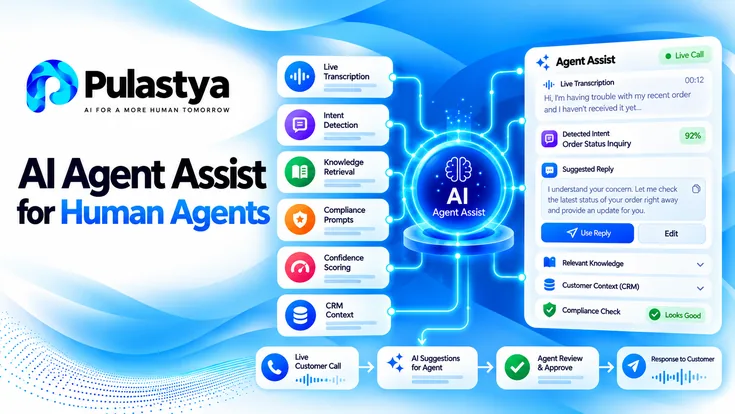
AI agent assist operates as a live co-pilot inside agent desktops and telephony middleware. It listens to call audio and the agent's actions, transcribes speech, classifies intents, pulls relevant knowledge, and proposes next-best actions in a side panel or whisper channel.
The system must meet strict latency and privacy requirements to avoid disrupting the live conversation and to maintain agent trust.
Enterprises adopt agent assist to standardize answers, reduce wrap-up time, and onboard new agents faster. Success requires tight integration with CRM records, routing, compliance controls, and escalation paths.
Design choices include streaming versus batch processing, on-prem versus cloud model hosting, and continuous evaluation metrics that keep the assistant aligned with evolving product, policy, and legal requirements.
How AI Agent Assist Works in Live Voice Support
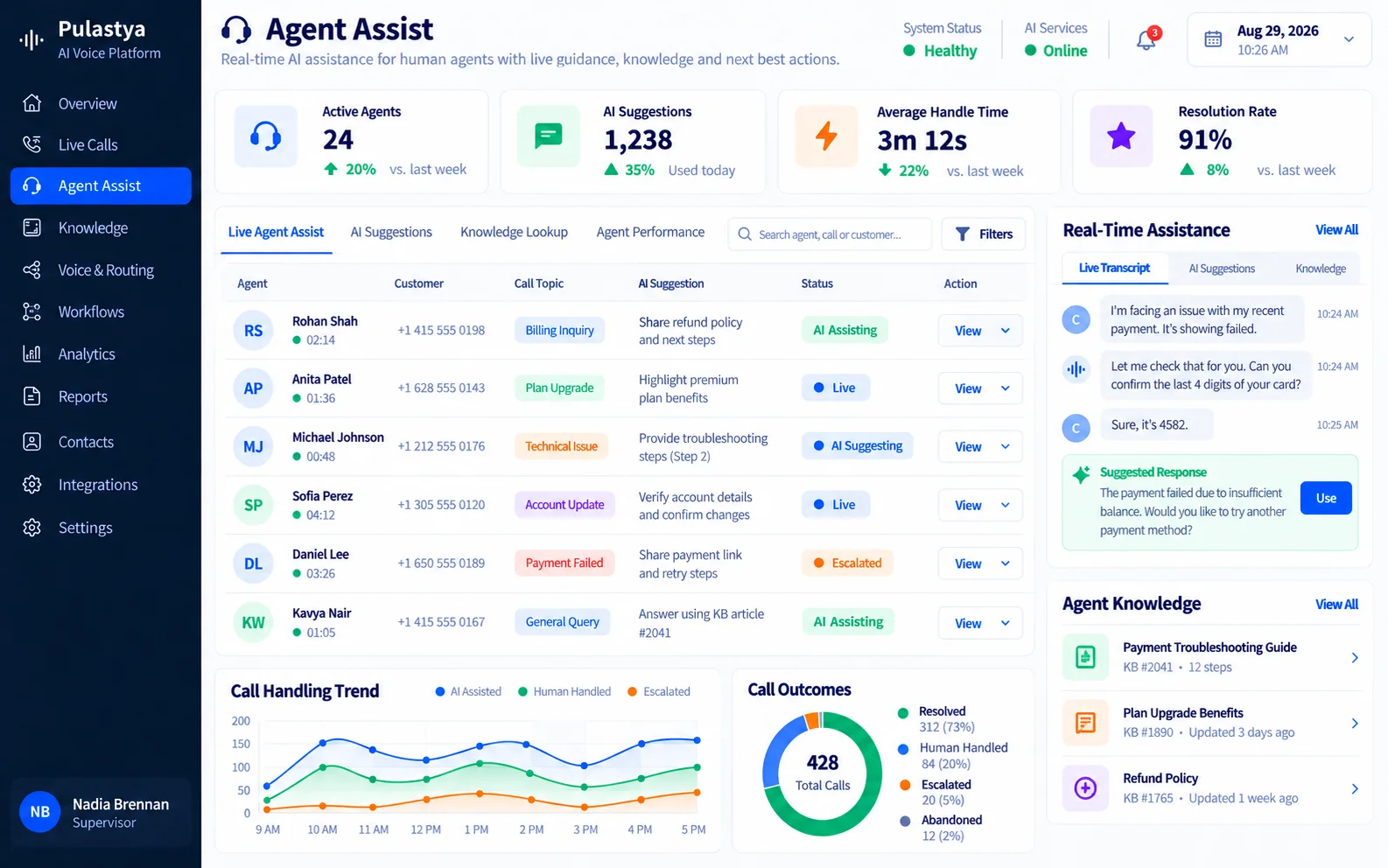
A live agent assist pipeline processes call audio and agent context in streaming stages: capture, speech-to-text, intent classification, knowledge retrieval, and response generation.
Capture forks call audio from SIP or cloud telephony, for example through SIPREC or a media streaming API, and sends low-latency audio frames to the speech service. Transcripts must be accurate enough to feed retrieval and classification, because recognition errors can steer retrieval toward the wrong policy and produce incorrect suggestions.
The assist UI presents results through whisper channels, inline suggested replies, knowledge cards, and checklist actions. In telephony, a whisper is audio that only the agent hears; agent assist usually delivers the same idea as brief private text in the agent desktop, so nothing reaches the caller.
Knowledge cards show source links and confidence scores so agents can verify recommendations before committing to a response.
Operationally, teams implement fallback and confidence gating: if model confidence is low, the system highlights uncertainty and prompts the agent to follow existing scripts or elevate to a supervisor. Logging and explainability are required for audit and training; every suggestion should carry metadata including source document, retrieval timestamp, and confidence band to support post-call review and compliance.
- Use streaming STT tuned to industry vocabularies for accurate transcripts.
- Surface provenance for each knowledge card and suggested reply.
- Provide whisper-only suggestions separate from customer audio.
- Enforce confidence thresholds to trigger human-only handling or escalation.
Design the assist to make decisions reversible and auditable.
Live agent assist pipeline
How Agent Assist Turns Live Call Audio Into Suggestions a Human Controls
- Fork call audio to the assistTelephony streams low-latency frames; the caller hears nothing new
- Transcribe and classify intentStreaming speech-to-text tuned to domain vocabulary feeds intent models
- Retrieve knowledge and account contextPolicy excerpts, ticket history and account status from CRM and knowledge base
- Suggest with source and confidencePrivate card in the agent desktop; low confidence is flagged, not hidden
- Agent accepts, edits or declinesThe human decides what the caller hears; decisions are logged for review
Possible outcomes
- After the callSummary, fields and disposition codes are prefilled for agent approval
Every suggestion carries its source and confidence, and nothing reaches the caller until the human agent chooses to use it.
What Parts of the Agent Workflow Benefit Most
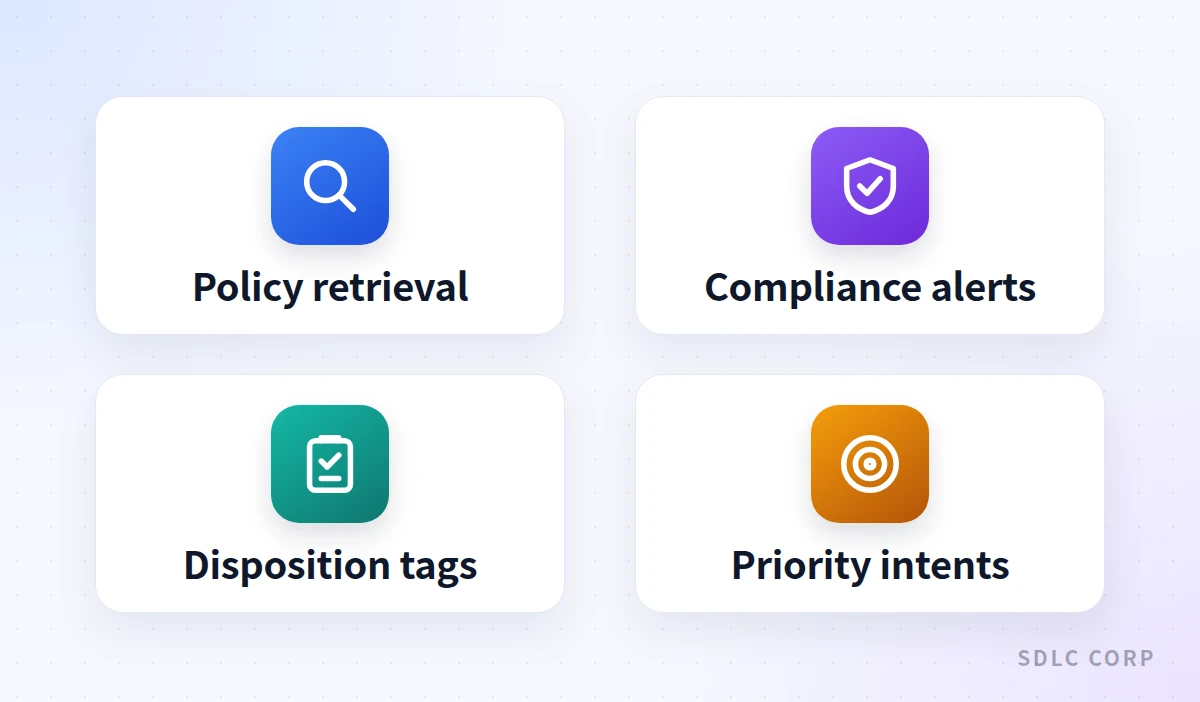
Knowledge retrieval and scripted guidance yield immediate gains in consistency for billing, refunds, and standard support requests. Agents spend less time searching multiple systems when a consolidated retrieval layer returns policy excerpts, relevant ticket history, and recommended micro-scripts. Prioritizing these routine tasks produces faster wins and easier measurement in pilots.
Realtime compliance checks are another high-value area; the assist can flag statements or actions that require specific disclosures, hold for consent, or avoid prohibited phrases. Embedding compliance logic into the assist reduces downstream risk and simplifies supervisor reviews, but the assist must always include explicit agent controls to correct false positives.
After-call summarization and tagging reduce wrap-up time and improve downstream routing. The assist can auto-fill structured fields, propose disposition codes, and extract follow-up tasks. Accurate auto-tagging enables better analytics and faster handoffs to collections, legal, or field service teams while preserving agent oversight for complex cases.
- Automate retrieval of policy snippets, past tickets, and account status.
- Provide compliance reminders for regulated conversations.
- Auto-suggest disposition codes and follow-up tasks after calls.
- Prioritize high-volume, repeatable call types for pilot deployments.
Start with routine workflows where accuracy is easy to validate.
Implementation Architecture and Integration Patterns
Architectures vary from cloud-native streaming with managed ML APIs to hybrid deployments that keep sensitive processing on-prem. Key components include audio ingestion, low-latency STT, a retrieval layer that indexes CRM and knowledge bases, an orchestration layer for routing suggestions, and the agent UI. Choose patterns that align with data residency and network constraints.
Integration points include CTI platforms, CRM APIs, KM systems, and identity access management. Implement event-driven connectors that fetch the latest account context on call start, and push suggested actions back to the desktop. Use idempotent APIs so retried calls or reconnections do not create duplicate actions or inconsistent state.
For scaling, shard retrieval indices by product line or geography to reduce query latency and tailor suggested content. Implement a monitoring stack that tracks suggestion latency, model confidence distributions, and agent acceptance rates. These metrics feed automated alerts and guardrails to prevent system-wide regressions and allow targeted retraining.
- Integrate with CTI for call metadata and secure audio capture.
- Index CRM and knowledge bases with near-real-time sync.
- Use event-driven connectors for predictable, replayable state.
- Shard retrieval by domain to keep query latency low at scale.
Choose an architecture that balances latency, control, and compliance requirements.
Operational Tradeoffs: Latency, Privacy, and Agent Trust
Latency dictates how helpful suggestions will be; sub-second or low-single-second latencies are required for whisper suggestions to remain relevant. Achieving this requires co-located services, efficient audio codecs, and tuned STT models. When low latency cannot be met, prioritize post-call summarization and deferred actions instead of real-time scripting to avoid negative agent experiences.
Privacy and data governance influence hosting choices and data retention. Redact or tokenize PII in transcripts before storage or indexing, restrict storage of sensitive audio, and apply role-based access to logs and annotations. Compliance teams will require data retention policies, on-demand data deletion, and audit trails that demonstrate how AI contributed to any agent action.
Agent trust is built through transparency, control, and visible corrections. Track acceptance rates and capture a one-click reason for declined suggestions to feed model improvement loops. Provide agents with training that explains common failure modes and how to spot inaccurate recommendations, and ensure supervisors have tools for spot-checking and coaching using assist logs.
- Prioritize latency budgets aligned to whisper or side-panel use cases.
- Apply PII redaction and short retention windows for sensitive data.
- Collect agent feedback to improve suggestion relevance iteratively.
- Keep a human override for all AI-suggested actions to preserve trust.
Trade latency against scope; reduce real-time features if compliance or network limits require it.
Example: Handling a High-Volume Billing Dispute Queue
Imagine a mid-market utility company with a sudden spike in billing disputes after a rate change. The agent assist is configured for the dispute queue: it pulls the account ledger, recent meter reads, and the rate change notice, then highlights line items that changed.
During the call, the assist provides agents with a two-line explanation and suggested corrective actions based on customer account status.
An agent receives a whisper suggesting a possible prorated credit when the account shows an overcharge pattern. The agent reviews the source citation and accepts the suggestion, then reads a short approved script variation. After the call, the assist auto-populates the billing adjustment form and tags the ticket for reconciliation, shrinking wrap-up steps and preventing form errors.
Rollout focused first on this queue to limit scope and validate accuracy. Supervisors audited suggestions for a pilot cohort and logged edge cases into the knowledge base. The staged approach preserved agent discretion on complex accounts while proving the workflow before expanding assist coverage to other queues such as cancellations or payment arrangements.
- Configure retrieval indexes with rate notices and recent billing history.
- Allowlist approved script variations for use with whisper suggestions.
- Auto-fill adjustment forms and disposition codes on agent acceptance.
- Pilot on one queue, audit suggestions, then expand incrementally.
Piloting on a single, measurable queue lets teams validate benefits and catch failure modes early.
Measuring ROI and Scaling: KPIs and Rollout Plan
Define KPIs that map to business outcomes: average handle time, first-call resolution, agent occupancy, error rate on disposition coding, and CSAT. Monitor acceptance rate of suggestions and correlation with improved KPIs. Establish control groups during pilots to measure causal impact rather than relying solely on before/after trends.
Design a phased rollout: discovery and data readiness, narrow pilot on selected queues, iterate on prompts and knowledge retrieval, then staged expansion by workload and geography. Each phase should include retraining windows for retrieval models, an updated governance checklist, and documented rollback procedures in case of a regression.
For enterprise-grade scaling, invest in continuous model monitoring, automated retraining pipelines, and a centralized knowledge operations team to curate sources and handle feedback.
- Use A/B tests and control cohorts to measure true impact on handle time and CSAT.
- Phase rollout: pilot, iterate, scale by queue and region.
- Maintain a knowledge ops team for curated sources and feedback loops.
- Implement monitoring and rollback procedures for model regressions.
Tie success metrics directly to operational KPIs and use staged rollouts to control risk.
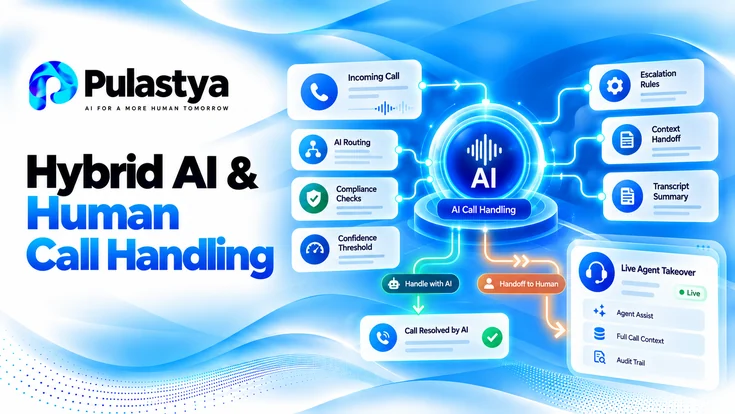
For transfers on calls the AI places itself, see AI-to-human transfer in outbound campaigns; for the signals that show a caller needs a person, see how AI voice agents detect escalation needs.
Conclusion
AI agent assist helps human contact center agents deliver faster, more consistent support by providing real-time knowledge retrieval, relevant customer context, suggested responses, and workflow guidance. Rather than replacing human judgment, it supports agents during complex conversations while keeping final decisions, customer communication, and escalation under human control.
Successful implementation depends on accurate knowledge sources, reliable CRM and telephony integrations, privacy safeguards, and continuous performance evaluation. Organizations should begin with high-volume, repeatable support workflows, measure outcomes such as average handle time, first-call resolution, and customer satisfaction, and expand gradually based on validated results. This approach helps teams adopt AI agent assistance while maintaining service quality, compliance, and agent trust.
Frequently Asked Questions
Encrypt audio in transit, for example with TLS or SRTP, apply PII redaction before storage, and limit data retention according to policy. Use tokenized access controls and separate environments for model training versus production data. Maintain audit logs of who accessed transcripts and provide on-demand deletion to meet regulatory requests.
Target sub-second to low-single-second round-trip latency for whisper suggestions to remain contextually relevant. If network or processing constraints prevent this, prioritize side-panel suggestions or post-call summaries. Architect for graceful degradation so the agent experience remains consistent if real-time features temporarily fail.
Build trust through transparency, provenance, and control. Show source documents, confidence levels, and allow quick correction. Start with narrow, high-accuracy tasks and involve agents in prompt tuning. Track acceptance rates and require supervisors to review edge-case rejections to close the feedback loop.
Plan a single-queue pilot around three workstreams: data readiness, CTI integration, and initial model tuning, with duration set largely by how ready the knowledge sources and telephony access are. Full rollouts across multiple queues and geographies take considerably longer, depending on compliance needs, training data availability, and custom integrations with legacy systems.
Major cost drivers include model inference and streaming STT costs, integration engineering with telephony and CRM systems, knowledge indexing and data pipeline setup, and ongoing monitoring and retraining. Licensing, private hosting for compliance, and building a knowledge operations team also contribute to recurring operational expenses.