AI voice escalation detection identifies when an automated call should transfer to a human agent.
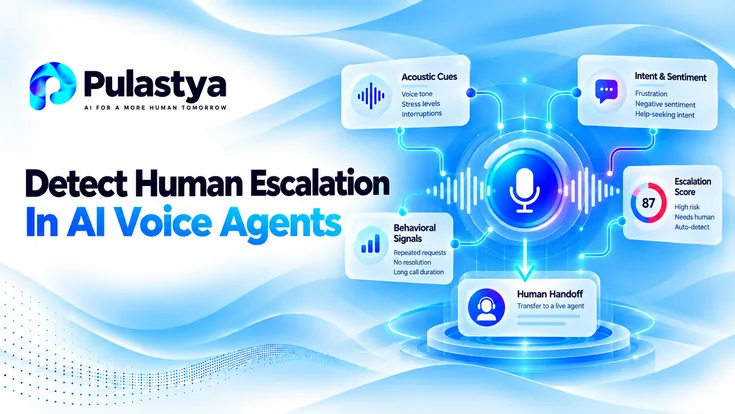
Successful systems combine acoustic cues, dialogue context, intent and sentiment signals, plus operational rules, to choose the right handoff moment that balances first-contact containment and customer satisfaction.
- Multi-signal detection Combine acoustic, semantic, and behavioral signals plus explicit requests to determine escalation need in real time.
- Hybrid decision logic Use rule-based thresholds with ML confidence scoring and contextual overrides to control transfer timing and priority.
- Operational controls Measure precision/recall, time-to-handoff, and post-handoff resolution to tune thresholds and routing for cost and CX.
Enterprises operate high-volume voice channels where mistimed escalations increase cost and missed escalations harm retention or compliance.
Modern AI voice agents must detect escalation needs in real time using layered signals: low-level audio features, speech-to-text intents, dialogue state, and explicit user requests. The architecture and decision policy determine whether escalation is automated, queued, or presented as an optional transfer with varying priority.
Reliable escalation detection depends on practical indicators of human escalation, sound decision logic, a clear view of the tradeoffs between accuracy and cost, and an implementable testing and monitoring approach. Operational controls such as thresholds, confidence scoring, and agent routing minimize false transfers while preserving service-level agreements and compliance.
How AI Voice Agents Detect Escalation Signals
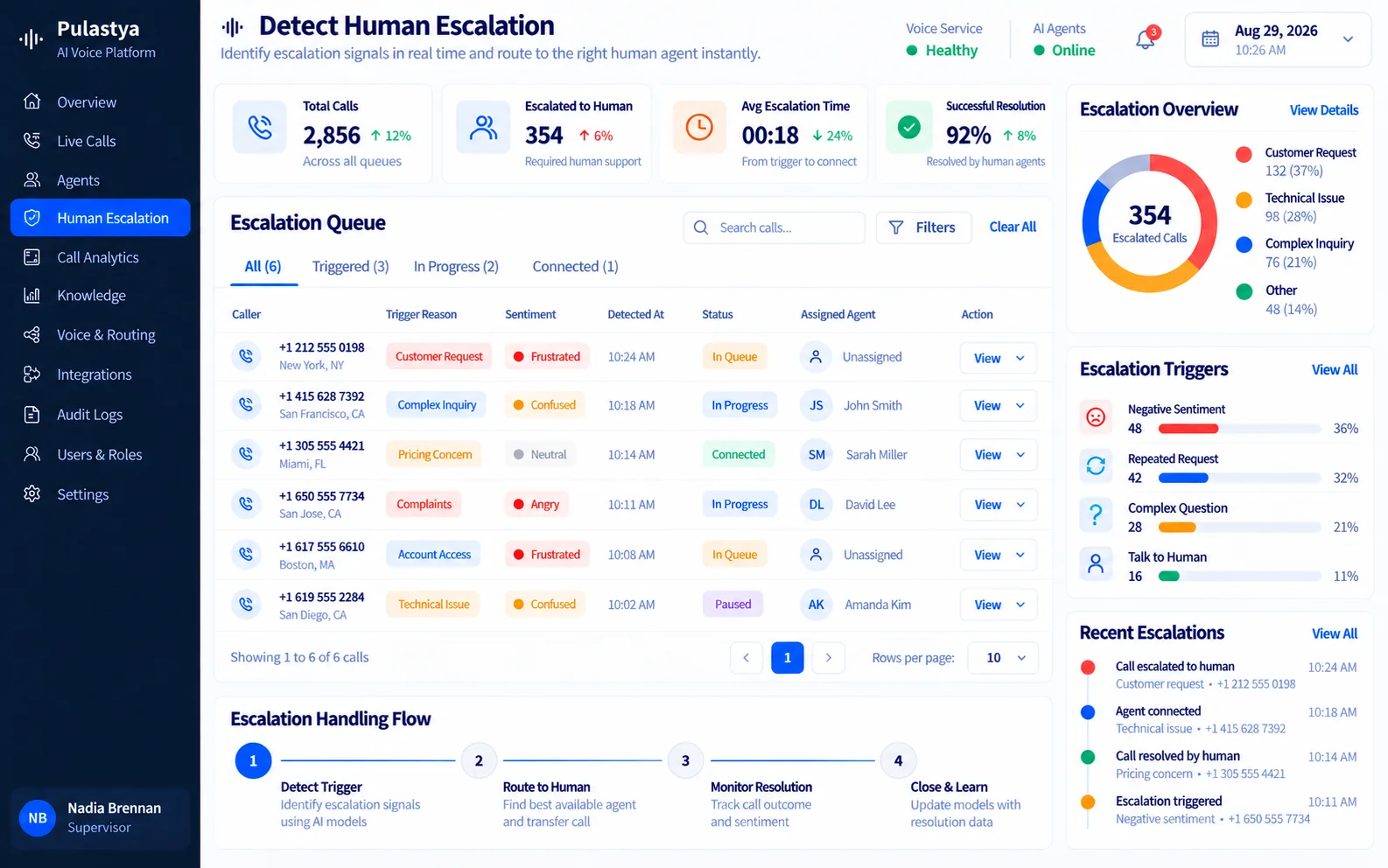
Real-time escalation detection starts by ingesting a live audio stream and producing synchronized outputs: VAD (voice activity detection), ASR transcripts, speaker turn boundaries, and prosody metrics. Those outputs feed higher-level models that classify intent, emotion, and dialogue acts.
The detection pipeline must keep latency low enough to avoid interrupting the conversation flow; actual processing delay varies with the deployed voice, model, network, and orchestration stack.
Detection combines explicit markers like 'I want to speak to a manager' with implicit markers such as repeated failed intents, rising vocal energy, or rapid turn-taking. Systems use sliding windows of recent turns and accumulate evidence. A single explicit request usually triggers immediate escalation, while implicit cues require aggregated confidence to avoid premature transfers.
Deployers should instrument the pipeline to attach a composite escalation score to each call. That score mixes normalized acoustic features, semantic confidence, and behavioral heuristics. Decision thresholds map score ranges to outcomes: immediate transfer, agent callback, supervised listen-in, or continued automation with de-escalation prompts.
- Ingest VAD, ASR, and prosody features within a subsecond processing budget for real-time decisions.
- Detect explicit transfer requests with intent classifiers trained on domain phrases and synonyms.
- Aggregate implicit signals over sliding windows to reduce false positives from single noisy signals.
- Produce a composite escalation score and map ranges to predefined routing outcomes.
Combine explicit and implicit signals with time-weighted evidence to make reliable escalation calls.
Which Acoustic Cues Indicate Rising Escalation
Acoustic cues are primary early indicators because they require no semantic understanding. Track pitch (fundamental frequency), intensity (energy), speaking rate, and spectral features; sudden pitch increases and higher energy often correlate with agitation. Also monitor voice tremor and spectral tilt changes that can signal stress. These features should be normalized per speaker to account for baseline differences.
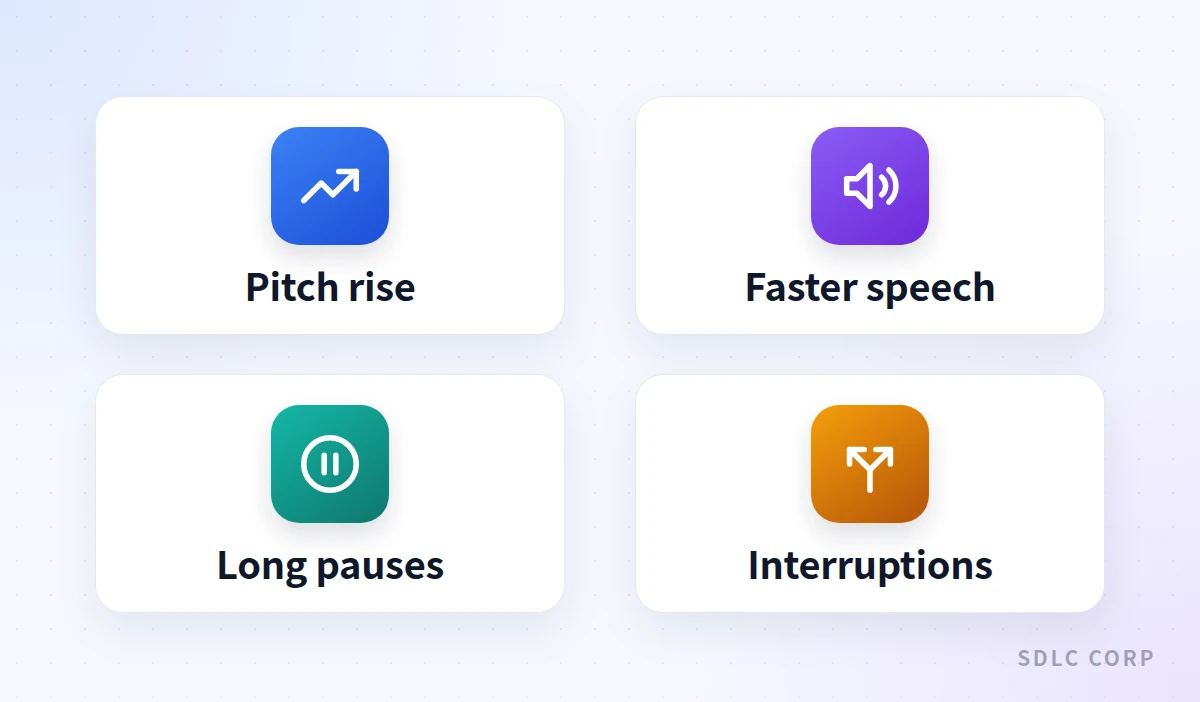
Pauses and overlapping speech are informative. Long or irregular silences after an agent response indicate confusion or dissatisfaction, while increased interruptions or overlapping speech suggest impatience or escalation. Filled pauses like 'uh' and 'um' or repeated backchannels can signal cognitive load or frustration when they occur frequently in short succession.
Acoustic models must be robust to channel noise and codec artifacts common in phone calls. Use noise-robust feature extraction and consider adaptive thresholds for mobile versus landline calls. Log feature distributions per channel type to allow threshold tuning and to prevent bias against certain customer segments.
- Monitor pitch and energy dynamics; sudden rises often correlate with agitation.
- Track speech rate acceleration and increased filler words as frustration signals.
- Detect long pauses after agent replies and frequent interruptions as escalation precursors.
- Normalize acoustic features per speaker and per channel to reduce false alarms.
Acoustic cues provide fast, language-independent escalation signals but need channel-aware normalization.
How Conversational Context and Semantics Reveal Escalation
Semantic signals come from ASR plus intent and entity extraction. Repeated failures to resolve an intent, contradictory statements, or repeating the same question after an automated answer are high-probability escalation indicators. Track intent confidence scores across turns and flag patterns: repeated low-confidence or repeated intent alternations within a short time window.
Dialogue acts such as complaint, complaint reinforcement, or escalation requests are classification targets. Train classifiers on labeled call data to recognize phrases and paraphrases across domains. Incorporate domain knowledge: contract or billing disputes require different escalation handling than simple password resets, so tie detected intents to priority policies.
Sentiment and emotion analysis on the transcript adds another layer. Sudden negative sentiment or a trending negative slope over multiple turns should raise the escalation score. Validate sentiment models on in-domain data because off-the-shelf sentiment systems often misclassify neutral problem statements as negative in service contexts.
- Flag repeated failed intents and low ASR confidence as semantic escalation signals.
- Classify dialogue acts like complaint, request escalation, or contradiction using in-domain training data.
- Link detected intents to domain-specific escalation policies and priority rules.
- Use sentiment trends across turns rather than single-turn labels to reduce noise.
Semantic patterns and dialogue acts give context that acoustic cues alone cannot provide.
Behavioral and Interaction Signals That Predict Handoff Needs
Behavioral signals include explicit requests to transfer, the number of agent interventions, rephrasing, and session abandonment attempts. Track escalation behaviors like asking for a supervisor, requesting a callback, or demanding charge reversals. These actions should immediately increase priority and may bypass normal queueing rules depending on policy.
Interaction metrics such as high frequency of agent clarifications, multiple consecutive agent prompts, or the customer repeatedly correcting the agent indicate the agent is failing to contain the call. Build heuristics that weight failure modes differently; for example, payment failures tied to compliance warrant higher priority than navigational confusion.
Also monitor external signals that impact escalation handling: customer value segments, open tickets linked to the account, or regulatory flags. Integrate CRM and compliance data into the escalation decision so routing considers both behavioral urgency and enterprise priorities rather than treating every escalation request equally.
- Treat explicit supervisor requests or repeated 'transfer me' phrases as immediate escalation triggers.
- Weight repeated clarifications, rephrasing, or corrections as high-priority escalation evidence.
- Integrate CRM flags, account value, and open tickets to set escalation routing priority.
- Escalate compliance-related failures with stricter rules and faster handoff paths.
Behavioral signals and enterprise context should influence both the decision to escalate and the routing priority.
Design Patterns for Escalation Decision Logic and Thresholds
Most production systems use a hybrid architecture: deterministic rules for explicit requests and high-risk cases, plus ML models that estimate escalation probability from implicit signals. Implement a decision engine that evaluates rules first, then applies ML-based scoring for ambiguous cases. This hybrid approach keeps critical handoffs deterministic while using ML to reduce unnecessary transfers.
Confidence thresholds must be tuned to business objectives. Use different thresholds for immediate transfer, soft-suggest transfer, and agent-assist modes. For example, a high threshold triggers warm transfer only when ML confidence and acoustic cues align; a lower threshold might trigger a screen-pop for agents to intervene if they have capacity.
Design for override and auditability. Include explainability metadata with each escalation decision: which signals contributed, their weights, and the final score. This supports human review, regulatory audits, and faster tuning cycles. Maintain rollback switches to revert to rules-only behavior if model performance degrades.
- Use deterministic rules for explicit or high-risk transfers and ML scoring for ambiguous cases.
- Define multiple thresholds that map to different actions: immediate transfer, suggest transfer, or agent assist.
- Attach explainability metadata to each decision to support audits and tuning.
- Provide emergency rollback switches to disable ML routing and revert to deterministic rules.
A hybrid rule-plus-ML decision engine balances safety, explainability, and containment goals.
Escalation decision
From Live Call Signals to an Escalation Decision
- Process the live audio streamVAD, ASR transcripts, turn boundaries and prosody metrics, kept in sync
- Extract signals in three layersAcoustic cues, intent and sentiment trends, behavioral patterns
- Apply deterministic rules firstExplicit requests for a person and high-risk or compliance cases escalate
- Score ambiguous cases over timeComposite score from sliding windows, with explainability metadata
- Map the score to an actionThresholds weigh urgency against live agent availability and skills
Possible outcomes
- Transfer nowWarm if an agent can be briefed in time; otherwise cold to a priority queue
- Offer a transfer or callbackSoft suggestion to the caller, or a screen pop so an agent can step in
- Continue automationUse de-escalation prompts and keep updating the score
Explicit and high-risk cases bypass scoring; only ambiguous calls rely on the composite score and agent capacity to set the outcome.
Operational Tradeoffs: False Positives, Handoff Timing, and SLA Impact
False positives increase handle time and cost by routing calls that automation could have resolved. False negatives harm customer experience and can create regulatory risk.
Tune thresholds based on cost of an unnecessary transfer relative to cost of a missed escalation. Use business metrics like transfer rate, containment rate, and cost per contact to quantify tradeoffs rather than relying solely on model accuracy.
Handoff timing affects outcomes. Early transfer interrupts automation gains; late transfer increases customer frustration. Implement graduated routing: soft prompts to customers offering transfer, automated callbacks, or immediate transfers based on combined urgency and agent availability.
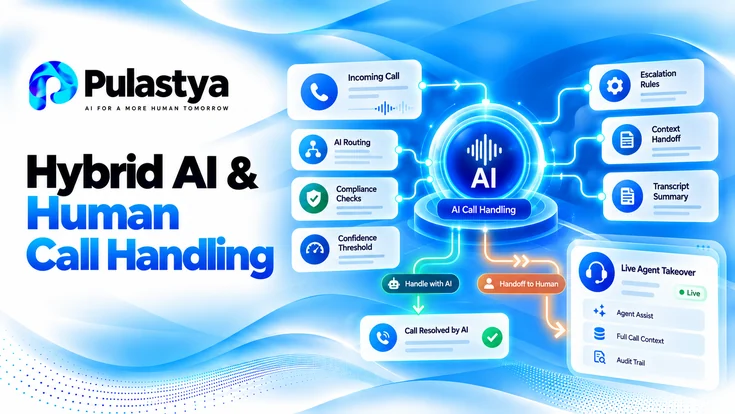
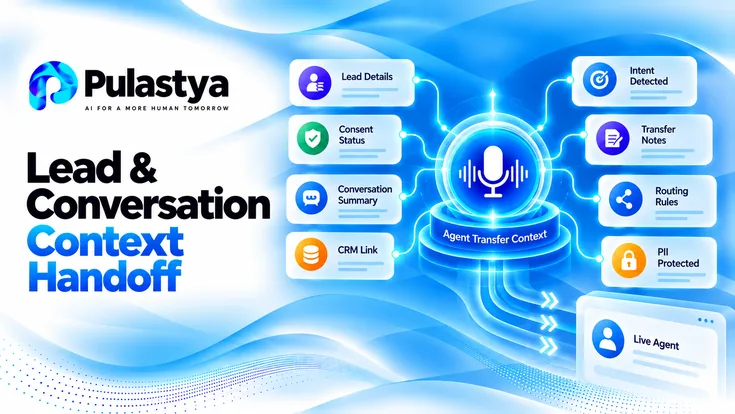
A warm transfer, in which the AI briefs an available agent or confirms availability before connecting the caller, suits urgent or sensitive escalations. When no qualified agent can take that consult in time, a cold transfer sends the live call to a priority queue, with the escalation context attached for the agent who answers.
Ensure SLA adherence by factoring predicted handling time and current queue states into the decision. Operationalize continuous monitoring and capacity-aware routing. Combine escalation scores with live agent availability and skill-based routing to ensure high-priority escalations reach qualified agents without excessive delay.
- Quantify false-positive cost versus false-negative cost using transfer and containment metrics.
- Use graduated handoff options (soft suggest, callback, warm or cold transfer) to balance timing tradeoffs.
- Factor agent availability and skill-based routing into escalation decisions to meet SLAs.
- Monitor transfer-to-resolution time to understand operational impact and tune priorities.
Tune thresholds with business metrics and make escalation decisions capacity-aware to meet SLAs.
Testing, Monitoring, and Continuous Improvement for Escalation Models
Testing should start with labeled replay datasets that mirror production call types. Create scenarios covering explicit requests, repeated failures, and acoustic edge cases. Use stratified sampling to ensure rare but critical cases are represented.
Evaluate models on precision at fixed recall rates relevant to business objectives, and run counterfactual tests to measure containment impact if escalation behavior changed.
In production, instrument real-time metrics: escalation rate, precision/recall on sampled human-reviewed calls, post-transfer resolution rate, average time-to-handoff, and customer satisfaction trends. Implement alerts for drift indicators such as sudden changes in ASR confidence, rising transfer rates, or degraded post-handoff resolution. Capture explainability traces to support rapid root-cause analysis.
Run controlled experiments to iterate: A/B test threshold settings, routing policies, and graduated handoff options. Use short-running experiments with clear success metrics tied to cost and CX. Maintain a prioritized backlog of failure modes discovered in monitoring and assign owners for labeling and model retraining so improvements feed the pipeline continuously.
- Validate models on stratified replay datasets that include rare high-risk scenarios.
- Monitor escalation and post-transfer resolution metrics in real time and set drift alerts.
- A/B test thresholds and handoff policies with clear cost and CX success metrics.
- Keep a labeled failure backlog and assign owners to close feedback loops with retraining.
Continuous testing, monitoring, and short A/B cycles turn escalation detection into a predictable operational capability.
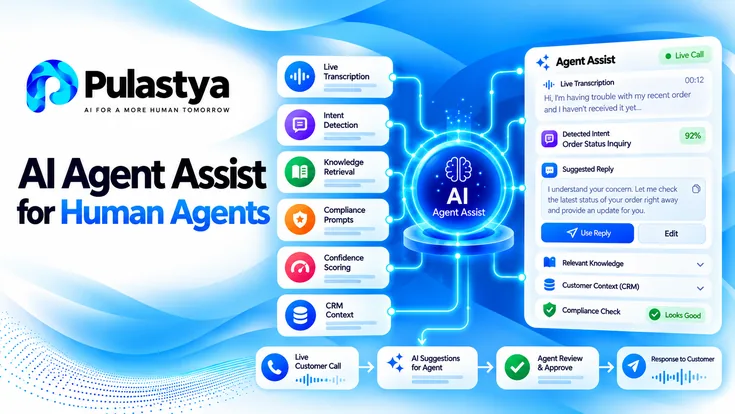
For supporting the person who takes over the call, see AI agent assist for human call agents; for transfers on calls the AI places itself, see AI-to-human transfer in outbound campaigns.
Conclusion
Effective AI voice escalation detection is not based on a single sentiment trigger. It combines acoustic changes, conversational context, repeated interaction failures, and explicit transfer requests to recognize when automation should hand off to a person. A hybrid decision engine keeps urgent or compliance-sensitive cases rule-based while using confidence scores to assess ambiguous calls and select the appropriate handoff option.
To make escalation reliable at scale, teams should test realistic call scenarios, tune thresholds against unnecessary transfers and missed escalations, and monitor handoff time, resolution rates, and customer outcomes. Capacity-aware routing and clear context for the receiving agent help make each transfer useful, while ongoing reviews and controlled experiments keep the policy aligned with service levels and customer expectations.
Frequently Asked Questions
Immediate triggers include explicit supervisor requests, safety or compliance keywords, payment failures tied to regulation, and repeated failed authentication attempts. These should bypass ML ambiguity and route directly to a human or a higher-priority queue.
Quantify costs for unnecessary transfers versus missed escalations using metrics like cost per contact, customer churn risk, and compliance exposure. Then tune thresholds to the business objective, using experiments to align statistical performance with operational impact.
Yes. Acoustic features like pitch, energy, pauses, and overlap are largely language-agnostic. But you must normalize per speaker and channel and combine acoustic cues with language-specific semantic signals for best results in multilingual deployments.
Combine the escalation score with enterprise context: customer value, open tickets, compliance flags, and required agent skillset. Priority routing should consider these factors plus current queue state and estimated handling time to meet SLAs.
Monitor key metrics in real time and review sampled human-annotated calls daily or weekly depending on volume. Run model performance audits monthly and retrain or retune when drift or degradations exceed thresholds defined by the business.