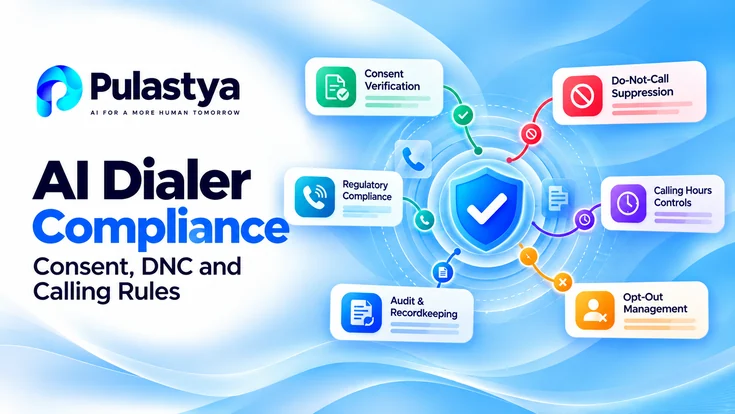
AI dialer compliance requires integrating consent capture, suppression lists, calling-window enforcement and opt-out handling into campaign workflows.
Enterprises must map consent type to use case, enforce national and internal do-not-call lists, log immutable evidence of consent and opt-outs, and run automated pre-launch checks to reduce regulatory and reputational risk.
- Foundational controls Persist consent with scope and timestamp, apply real-time suppression, and enforce campaign calling windows before dialing.
- Operational discipline Embed pre-launch rule validation, automated scrubs, and a documented escalation path for exceptions.
- Audit and retention Keep immutable logs, consent artifacts and call recordings with a retention policy aligned to risk and applicable law.
Consent must be tracked at the moment of capture and tied to campaign metadata. Map each phone number to a consent record that includes source, timestamp, scope, and any channel limits. Use enforcement at dial time so call attempts respect the consent scope and any campaign-level restrictions.
Calling-window controls and suppression are operational controls, not optional features. Implement rolling scrubs against internal and national DNC lists, enforce time-of-day and day-of-week windows at campaign runtime, and route exceptions through a documented approval and audit trail before any outbound attempt.
Important: Requirements vary by jurisdiction, call purpose, technology, and the relationship with the recipient. Verify applicable laws, maintain appropriate records, and obtain legal review before deploying automated outbound calling.
Consent, Suppression and Calling-Window Controls
Consent is not binary for outbound voice. Capture whether consent is express, implied, channel-limited or time-limited, and record the interaction that created it. Link consent metadata to the contact record and campaign ID so enforcement rules can check scope before dialing.
Suppression lists should operate at multiple layers: global corporate DNC, campaign-level exclusions, product-specific opt-outs, and temporary safety holds. Enforce suppression at queue entry and at dial time to prevent race conditions where a recent opt-out could be missed during bulk dialing.
Calling-window controls must reflect called-party local time as the authoritative dimension. Normalize timezones in your contact database and implement campaign windows that map to the contact's timezone. Prevent off-window attempts automatically and log any approved exceptions with a business justification.
Example scenario: a finance firm runs collections and marketing campaigns concurrently. Collections calls require different consent and calling windows than promotional outreach. Configure separate campaign templates with distinct suppression sources, consent checks and higher audit logging for collections so rules do not bleed across use cases.
- Store consent source, timestamp, scope, channel and supporting evidence artifacts for each phone number.
- Apply multi-layer suppression: national DNC, state DNC, corporate DNC, campaign exclusion, and recent opt-outs.
- Normalize contact timezone and enforce campaign windows using contact local time at dial decision.
- Run suppression and consent checks at both queue-enqueue and immediate pre-dial to avoid race conditions.
- Flag exception approvals with approver ID, reason, expiration and linked audit record.
Treat consent, suppression and calling windows as a single pre-dial decision to prevent operational gaps.
Opt-Outs, Do-Not-Call Handling and Recordkeeping
Opt-out handling must be immediate and enforceable across all outbound channels. Implement phone-based opt-outs via agent actions, in-call IVR keypress or explicit voice agent acknowledgement. Propagate opt-outs to the central suppression store synchronously to prevent any subsequent attempts.
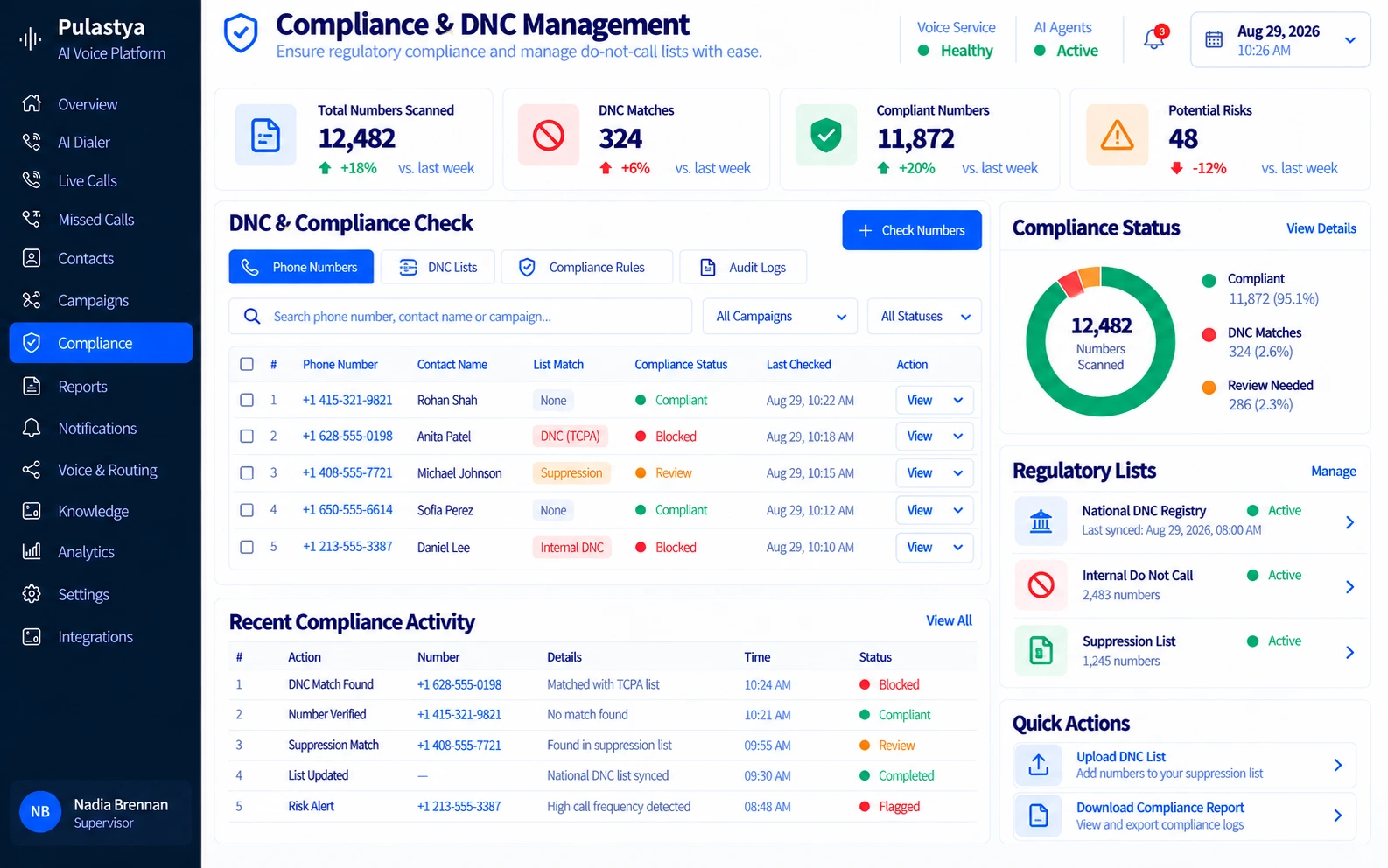
Do-not-call compliance requires scrubbing against official national and applicable sub-national lists. Schedule regular automated downloads and integrate a pre-dial scrub that denies calls for any matched listing. Maintain versioned snapshots of the lists used for each campaign launch to support audits.
Recordkeeping must preserve an immutable trail: consent artifacts, opt-out events, suppression list snapshots, campaign configuration and dial logs. Store call recordings with metadata linking them to consent and opt-out records. Ensure retention schedules follow risk appetite and any applicable regulatory minimums.
Practical retention decision checklist: retain consent artifacts and call recordings for the longest applicable statute of limitations or corporate risk threshold, whichever is longer. Provide indexed search for regulatory requests and legal holds, and ensure backups are immutable and access-controlled.
- Immediate propagation of opt-out events to the unified suppression store with source and timestamp.
- Automated, versioned scrubs against national and relevant state/provincial DNC lists before campaign launch and pre-dial.
- Retention of consent artifacts, opt-out logs, campaign configs, dial metadata and recordings with indexed search.
- Immutable snapshots of suppression lists and the exact dataset used for each outbound batch to support audits.
- Access controls, encryption at rest and audit logs for all suppression and consent data accesses.
Make opt-out propagation synchronous and store versioned evidence to support any future compliance inquiries.
Before, during and after
How Compliance Checks Run From Launch Review to Audit Trail
- Map obligationsCalled-party jurisdiction and campaign purpose set consent, DNC and window rules
- Validate before launchCheck consent coverage, suppression sync, timezone mapping and DNC scrub; block gaps
- Record sign-offCampaign owner, compliance reviewer and legal approver approve the rules
- Check at queue entry and pre-dialConsent scope, suppression and window in contact local time; block on any failure
- Enforce opt-outs at onceOpt-outs reach the central suppression store synchronously and stop further attempts
- Keep the audit trailConsent artifacts, opt-outs, list snapshots, configs, dial logs and approved exceptions
Checks repeat at launch, at queue entry and just before dialing, and every decision leaves evidence an auditor can trace later.
Why Requirements Vary by Jurisdiction and Use Case
Regulatory differences arise from the called party location, the caller location, the content of the call and the nature of consent. Telemarketing rules are typically stricter than informational or transactional communications, and some jurisdictions treat AI-generated voice differently or add disclosure requirements.
Cross-border campaigns increase complexity: local do-not-call registries, data residency rules and differing definitions of consent require mapping regulatory obligations by locale. Maintain a compliance matrix that lists obligations by country and state and link it to campaign templates to prevent incorrect rule application.
Use-case variation matters: debt collection, telemarketing, appointment reminders and fraud alerts each carry different expectations for permissible contact hours, necessary disclosures and permissible technologies. Design campaign profiles that encode these variations instead of reusing a single rule set.
AI voice agents raise additional considerations. Treat voice synthesis and autonomous agent behaviors as capabilities that require explicit disclosure and additional monitoring. Require supervised failover to human agents for sensitive interactions or where local rules limit AI use.
- Called-party jurisdiction determines which DNC registry and calling windows apply.
- Campaign purpose (marketing, collections, transactional) changes consent thresholds and disclosure needs.
- Local rules may require disclosure of AI use or prohibit automated voice without prior express consent.
- Data residency and cross-border transfer rules can constrain where call records and consent artifacts are stored.
- When in doubt, apply the most restrictive rule to reduce regulatory risk and customer harm.
Map obligations by called-party jurisdiction and campaign purpose, then apply the most restrictive rule at decision time.
Building a Compliance Review Process Around Campaign Rules
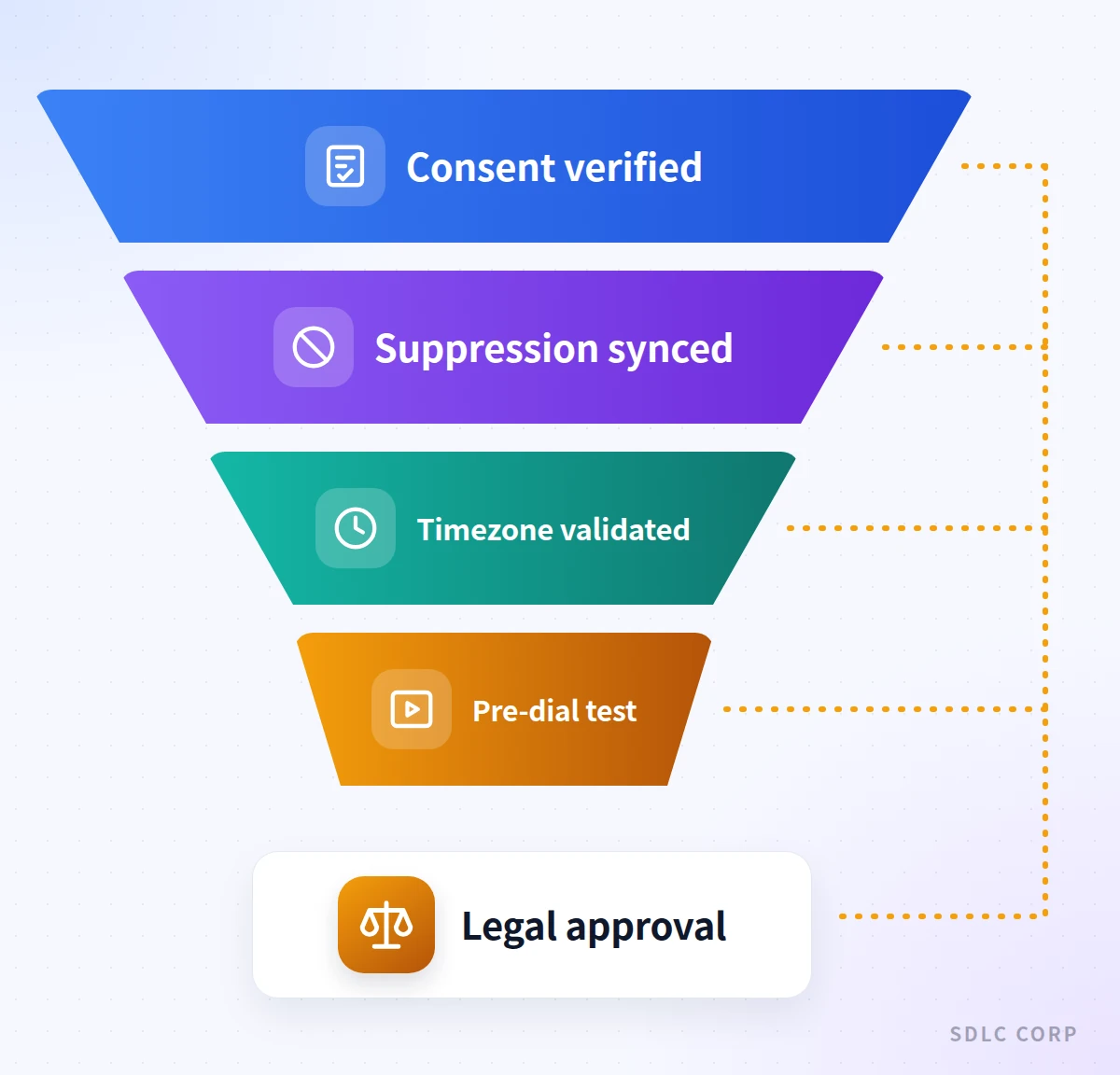
Design governance with clear roles: campaign owner, compliance reviewer, legal approver and operations engineer. Require documented sign-off on consent sources, suppression sources, calling windows and exception approvals before any campaign launches. Capture approvals as immutable artifacts linked to the campaign record.
Integrate automated pre-launch validations that check consent coverage, suppression synchronization, timezone normalization and DNC scrubbing. Block the launch where gaps exist and require documented remediation. Maintain a dashboard that tracks rule violations and overrides by user and campaign.
Run staged testing: sandbox runs with test numbers, limited pilot cohorts, and monitoring for misroutes or false positives. Evaluate AI-driven voice agents for compliance drift and misrecognition by sampling live calls and scoring against scripted acceptance criteria.
Create an exception workflow for business-critical outreach that documents justification, duration, approver identity and compensating controls. Limit exception scope and auto-expire approvals. Log every exception decision and review exceptions in monthly compliance reviews.
- Mandatory campaign checklist: consent source verified, suppression sync verified, timezone mapping validated, pre-dial rule test passed.
- Approval workflow capturing approver, timestamp, justification and linked artifacts before campaign activation.
- Sandbox pilot launches with monitoring thresholds for error rates and customer complaints before full-scale rollout.
- Automated dashboards showing rule failures, override counts and time-to-remediate for executive reporting.
- Tamper-evident evidence export for audits and legal holds including call recordings, consent records and suppression list versions.
Automate pre-launch checks and require documented approvals to make compliance a repeatable operational step.
Obligations that apply to AI voice agents on any call, such as AI disclosure and recording consent, are covered in AI voice agent compliance considerations.
Time-zone normalization and window enforcement are covered in more depth in campaign calling windows.
Compliance controls should be part of every tool evaluation. The guide to evaluating outbound AI calling software places consent, suppression and calling-window checks alongside the other capabilities buyers compare.
Conclusion
AI dialer compliance requires more than checking consent at campaign launch. Organizations need consistent controls for do-not-call suppression, permitted calling windows, opt-out handling and audit-ready records throughout the outbound calling lifecycle. Applying these checks before each call helps reduce preventable compliance risks and makes campaign operations more accountable.
A dependable compliance approach combines automated enforcement with documented approvals, appropriate human oversight and regular reviews of applicable requirements. By connecting campaign rules to consent evidence, suppression records and traceable decisions, enterprises can manage AI-powered outbound calling more responsibly while adapting to differing jurisdictions and use cases.
Frequently Asked Questions
Valid consent depends on jurisdiction and use case. Enterprises should capture express consent for telemarketing, recording source and timestamp, and the permitted channels. For ambiguous cases, apply the stricter consent interpretation and retain supporting artifacts that tie consent to the campaign and contact.
Opt-outs should be enforced immediately and propagated synchronously to the central suppression store. Implement pre-dial suppression checks and ensure any opt-out action blocks subsequent attempts within seconds to prevent accidental recontact and to produce a clear audit trail.
Keep consent artifacts with timestamps, call recordings, dial logs, suppression list snapshots, campaign configurations and approval artifacts. Index and protect these records, retain them according to regulatory or corporate risk timelines, and ensure exports are tamper-evident for regulator requests or legal proceedings.
Calling windows should use the called-party local time. Normalize contact timezone at data ingestion and enforce windows during pre-dial decisioning. Use caller local time only when explicitly required by policy, and document any deviations with approvals and compensating controls.
Map rules by called-party jurisdiction, consent definitions, and data residency requirements. Apply the most restrictive rule when multiple jurisdictions could apply. Maintain localized suppression handling or lawful transfer mechanisms for consent and call records and document the compliance rationale for multi-jurisdiction campaigns.