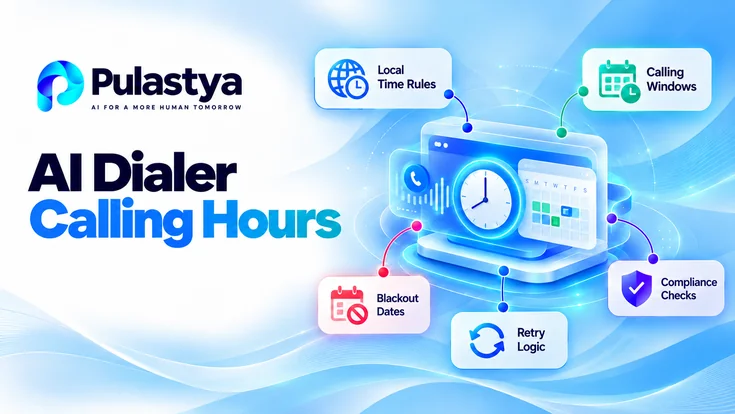
AI dialer calling hours define when automated outbound voice systems may place calls to contacts based on each contact's local time, legal constraints, and customer experience rules.
Proper local-time rules reduce regulatory risk, limit nuisance calls, improve answer rates, and keep campaign performance predictable across multiple time zones and jurisdictions.
- Local-time mapping Store reliable time-zone and preferred-calling-time attributes per contact and apply them at call decision time to avoid off-hour attempts.
- Clear blackout and closed windows Support recurring daily windows, single-day holidays, and ad hoc blackout ranges with priority rules to override campaign defaults.
- Retries respect schedules Retry logic must consider closed windows and escalate or defer attempts according to campaign SLA and compliance constraints.
Enterprises must build calling schedules that respect local time, national and state-level calling-hour restrictions, do-not-call rules, and customer-preference signals. An effective schedule maps contact time zone metadata to allowable call windows, blackout dates, and escalation rules so dialing aligns with legal and brand requirements.
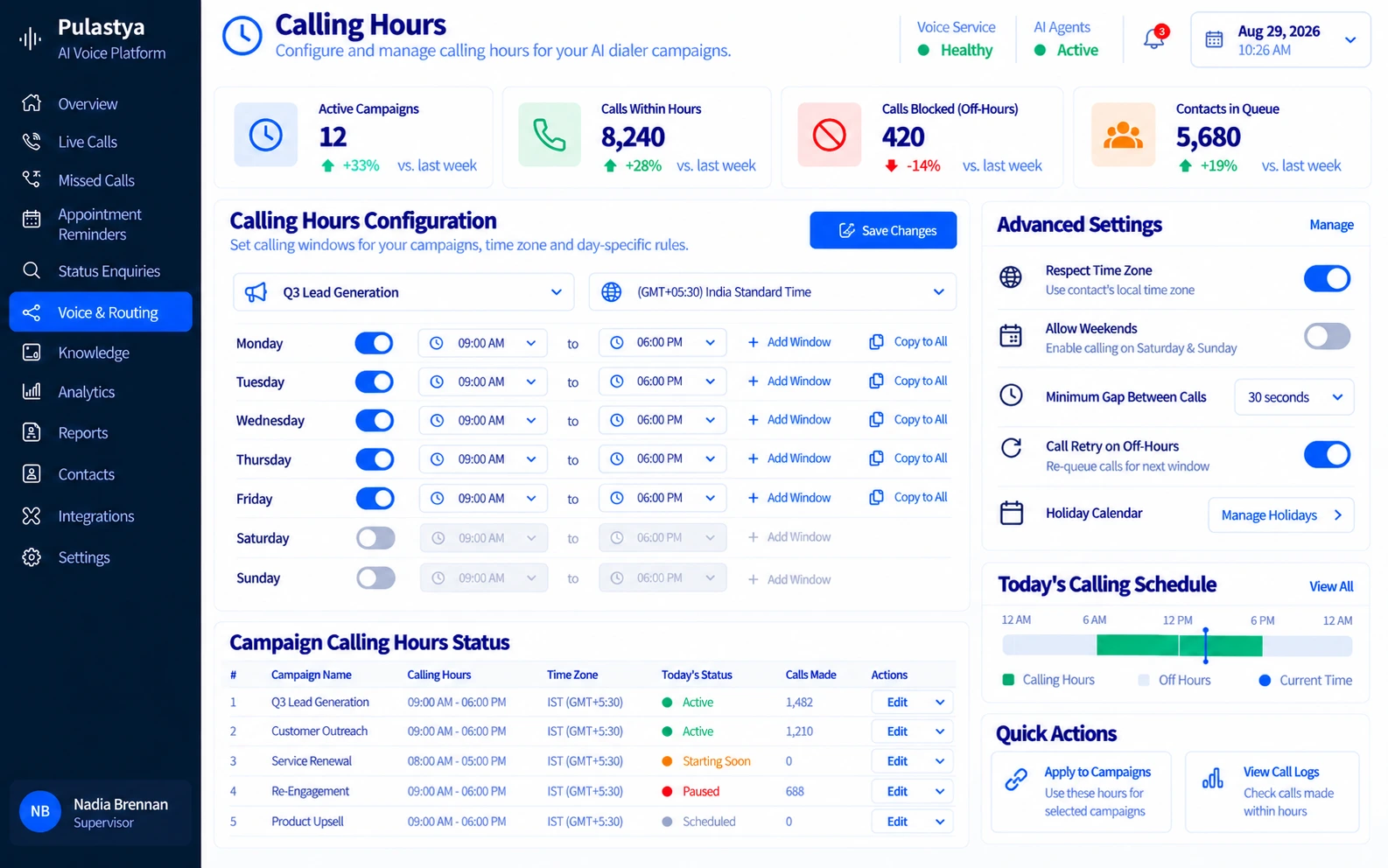
Operational designs should separate schedule logic from retry and campaign state machines. That separation makes it easier to audit rules, simulate outcomes, and change windows without pausing campaign logic or losing retry fidelity in long-running outbound programs.
Important: Requirements vary by jurisdiction, call purpose, technology, and the relationship with the recipient. Organizations should verify applicable laws, maintain appropriate records, and obtain legal review before deploying automated outbound calling.
Why Outbound Calling Hours Need Local-Time Rules
Contacts are distributed across multiple time zones and observe different legal restrictions and cultural norms. Dialing based on the system clock instead of a contact's local time will produce off-hour calls, regulatory risk, and poor answer-rate signals that distort campaign analytics.
Local-time rules reduce compliance exposure by preventing calls during prohibited hours under federal, state, or country laws. Design schedule enforcement to check both time zone and jurisdictional rules before placing any outbound call attempt.
Caller reputation and customer experience metrics suffer when calls occur at inconvenient hours. Respecting local-time windows preserves voicemail and answer quality, producing cleaner downstream data for lead scoring and agent handoffs.
Enterprise-grade systems need reliable time-zone resolution for each contact. Use contact-level country and postal-code metadata, fallback heuristics for missing data, and an administrative review workflow for unresolved time zones.
- Resolve time zone from contact attributes with a deterministic fallback procedure.
- Apply legal jurisdiction rules before campaign-level schedules to avoid violations.
- Surface time-zone conflicts in campaign validation and require manual resolution.
- Log decision timestamps and the resolved local time for auditability.
Enforce resolved contact local time at the final call decision to prevent off-hour attempts.
Building Schedules, Blackout Dates and Closed Windows
Schedule primitives should include daily windows, day-of-week patterns, date-range blackout periods, and recurring holidays. Each primitive needs a clear precedence so a global holiday can override campaign-specific hours when required.
Support closed-window semantics that either defer attempts until the next open window or mark the contact for retry with a specific backoff. Provide both soft closed windows for preference and hard closed windows for compliance.
Allow administrators to create tenant-wide blackout calendars that apply to all campaigns. Include multi-day maintenance ranges and emergency blackout toggles for rapid response to operational incidents.
Implement a schedule preview and validation UI that simulates dialing behavior for a sample contact set. The preview should display which attempts would be allowed, deferred, or blocked across a representative time span.
- Daily windows: local start and end times with optional pause intervals.
- Blackout dates: one-off and recurring date ranges with jurisdiction scope.
- Closed-window handling: defer, reschedule, or mark for manual follow-up.
- Schedule simulation: validate behavior across representative contacts before activation.
Make schedule setup auditable and testable before enabling campaigns in production.
Before each dial
The Calling-Hour Checks an AI Dialer Runs Before Placing a Call
| Rule | What is checked | Outcome if it fails |
|---|---|---|
| Time-zone resolution | Contact local time from country, postal code or area code fallback | Unresolved: flag for review and do not dial |
| Legal calling hours | Resolved local time against the permitted window for the jurisdiction | Hard block; attempt deferred to the next permitted time |
| Blackout calendar | Tenant-wide holidays, maintenance ranges and emergency blackouts | Blocked for every campaign until the blackout ends |
| Campaign schedule | Daily window and day-of-week pattern set for the campaign | Deferred to the next open window or marked for follow-up |
| Contact preference | Preferred calling times on the contact record | Soft window: shifts timing inside the legal limits |
| Retry timing | Next attempt computed in the contact's local time, not system time | Deferral logged with its reason in the contact history |
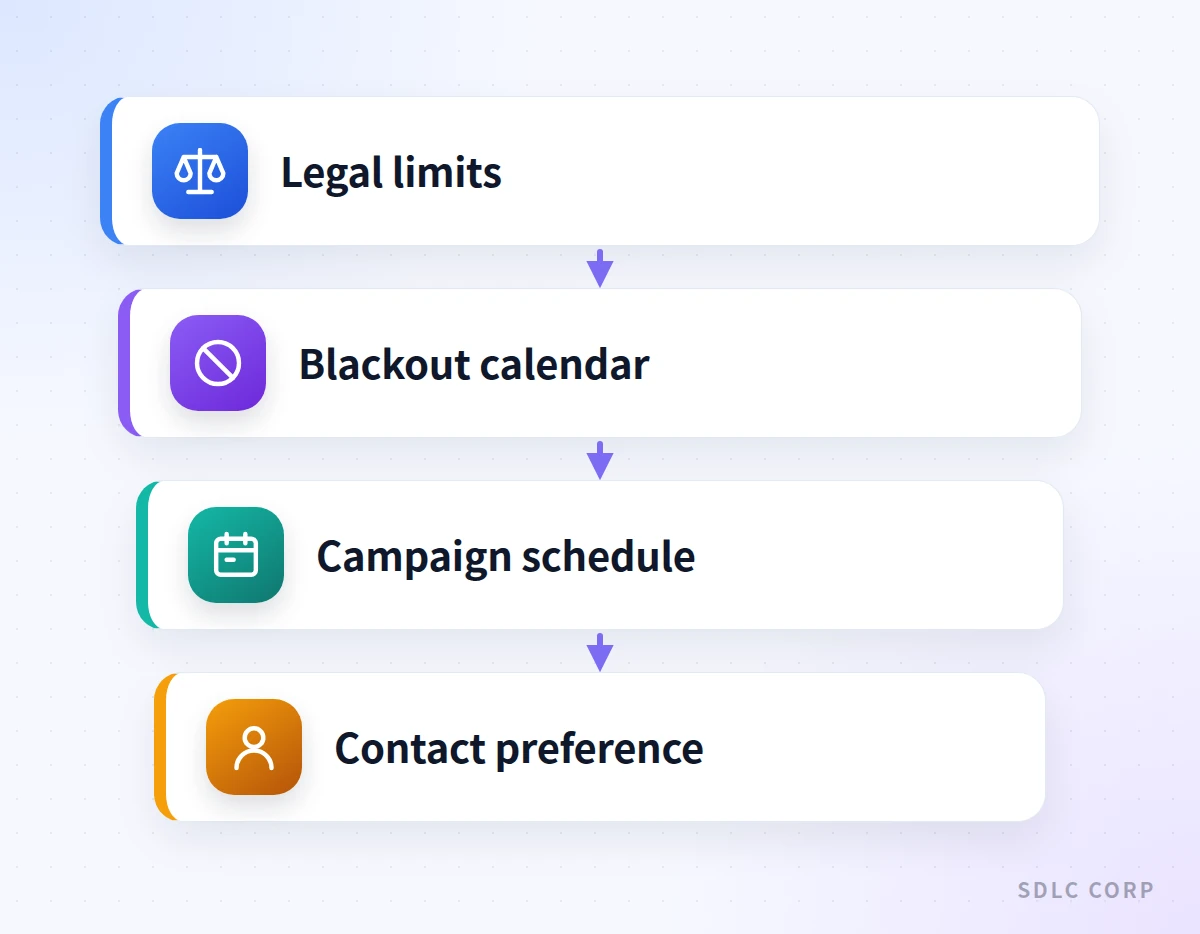
The checks run from most to least restrictive, so a campaign schedule or contact preference can narrow the calling window but never reopen hours a legal rule blocks.
How Calling Windows Affect Retries and Campaign Status
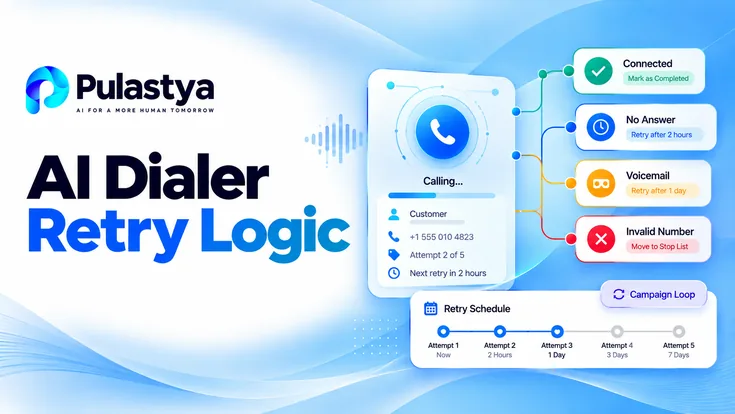
Retry logic should honor the same local-time and blackout rules used for initial attempts. When an attempt falls into a closed window, the system must record a deferred attempt and compute the next effective retry timestamp in the contact's local time.
Campaign status machines must distinguish between 'paused for schedule' and 'idle for capacity reasons.' That distinction prevents misinterpreting scheduling deferrals as underperforming campaigns when evaluating agent staffing.
Define clear retry policies: maximum attempts per contact, total retry span, per-day attempt caps, and allowable attempt windows. These parameters should be configurable per campaign and overridden only by legal blackouts.
Practical scenario: a campaign targets U.S. contacts across four time zones. The dialer should schedule attempts only within the permitted local-time window for the contact's jurisdiction, defer attempts that reach a closed window, and enforce the organization's approved attempt limits.
- Compute next retry in contact local time, not system time, and persist the decision reason.
- Differentiate schedule-based pause from agent-capacity pause in campaign dashboards.
- Cap daily attempts and total attempts with configurable campaign defaults.
- Chain deferrals over consecutive closed windows and surface counts in contact history.
Retry engines must be schedule-aware and persist the reason for each deferred attempt.
Separating Outbound Schedules From Inbound After-Hours Handling
Outbound calling windows and inbound after-hours routing serve different operational goals and should be managed independently. Outbound schedules control when automated attempts occur; inbound after-hours flows control how incoming calls are answered or routed.
Keep outbound schedule rules out of the inbound routing engine to avoid unintended interactions. Instead, publish standardized schedule state to a shared policy service that both outbound and inbound systems can reference if needed.
Where overlap is required, for example routing voicemails or call-backs, implement an explicit handoff contract. The contract should define allowable outbound actions triggered by inbound after-hours events and their permitted time frames.
Maintain separate audit trails for outbound scheduling decisions and inbound routing events. Correlate them in reporting where useful, but do not conflate decision logs because they have different compliance relevance and retention requirements.
- Publish outbound schedule state to a shared service rather than embedding it in inbound logic.
- Provide a clear handoff contract for cross-domain actions like call-back triggers.
- Keep separate logs and retention policies for outbound and inbound decision events.
- Define roles and runbooks that govern schedule and routing changes to avoid conflicts.
Treat outbound schedules and inbound after-hours routing as distinct policies with an explicit integration contract when needed.
Calling windows are one of several campaign-scope controls, alongside priority, retry budgets and live-agent destinations; see AI calling campaign setup.
How deferred attempts count toward attempt limits and when a lead should stop being retried is covered in outbound call retry rules.
Conclusion
AI dialer calling hours are an essential control for managing automated outbound campaigns responsibly. By applying contact-level time zones, legal calling restrictions, blackout dates, and customer preferences, businesses can reduce the risk of off-hour calls while creating more predictable campaign operations. Consistent scheduling rules also help teams maintain clear audit records and coordinate outreach across multiple regions.
A reliable calling-hours strategy should connect scheduling decisions with consent verification, retry management, campaign monitoring, and operational oversight. Organizations should regularly review jurisdiction-specific requirements, validate time-zone information, and test scheduling policies before deployment. This approach supports more responsible AI-powered outbound calling while maintaining flexibility as customer needs and regulations change.
Frequently Asked Questions
When contact time-zone data is missing, apply a deterministic fallback: use country-level defaults, infer from postal-code or area code where reliable, and flag unresolved records for manual review. Log the inference method and surface low-confidence flags to reduce off-hour risks.
Let the most restrictive authority win. Legal and jurisdictional limits come first and no other rule can widen them; tenant-wide blackout calendars apply next, then campaign schedules. Explicit contact preferences can override campaign defaults where allowed, but only to narrow or shift the window, never to reopen hours that a higher rule blocks.
Blackout windows should defer attempts without consuming retry budget when configured as compliance-driven hard blocks. If retries are limited per-day, define whether deferred attempts count against the cap once rescheduled. Document and surface the chosen behavior to campaign owners.
Yes. Design an emergency-blackout toggle that administrators can activate globally or by jurisdiction. When activated, it should pause outbound attempts immediately, log the action, and notify stakeholders. Treat such toggles as high-impact controls with restricted access and audit trails.
Version schedules to support auditability and rollback. Each schedule change should include metadata: author, effective date, scope, and a simulation snapshot showing expected behavior. Versioning reduces operational risk and speeds incident response during compliance reviews.