AI tools are becoming part of everyday enterprise operations, from customer support and analytics to software development, research, and workflow automation. But selecting an AI vendor requires more than comparing features, pricing, and implementation speed.
An AI vendor risk assessment helps enterprise buyers identify material privacy, security, model, legal, compliance, operational, and commercial risks before deployment.
What Is an AI Vendor Risk Assessment?
An AI vendor risk assessment is a structured review of the privacy, security, model, legal, operational, and commercial risks created by a third-party AI product. It helps enterprise buyers look beyond features and understand the real exposure created by adopting the platform.
The assessment should clarify whether the vendor can protect enterprise data, support the intended use case reliably, meet governance requirements, and provide a safe path to exit. The objective is not to find a zero-risk vendor, but to identify material risk before deployment. Enterprise teams can also use the NIST AI Risk Management Framework as a reference for structuring AI risk governance and assessment.
Why AI Vendor Assessment Goes Beyond Traditional Vendor Review
Traditional vendor assessments focus on cybersecurity, privacy, business continuity, and financial stability. AI systems add model behavior, training data, hallucinations, bias, prompt injection, external model dependencies, and rapidly changing capabilities.
Because these risks can change after procurement, enterprises need a review process that covers both the vendor organization and the AI system itself. This makes AI due diligence an extension of third-party risk management rather than a completely separate process.
Traditional Review
Review security, privacy, uptime, financial viability, contracts, compliance, business continuity, vendor stability, and operational controls.
AI-Enhanced Review
Review model provenance, training-data use, hallucinations, bias, AI-specific attacks, model changes, human oversight, and system controls.
Define the AI Use Case and Risk Level
Start with the business use case before reviewing vendor controls. The same AI product can be relatively low risk when summarizing public material but high risk when processing confidential data or influencing important decisions.
Document the users, data, integrations, decisions, and possible failure impact before procurement continues. This gives every later security, legal, and technical review a clear risk context. Organizations planning custom implementations can also explore our enterprise AI development services to align solution design with business requirements and risk controls.
- What business problem will the AI solve?
- Who will use the system?
- What data will enter the platform?
- Will sensitive or regulated data be processed?
- What decisions could the output influence?
- Can a human review important outputs?
- What happens if the AI is wrong?
- Which enterprise systems will it access?
Define Stakeholders, Ownership and Approval Responsibilities
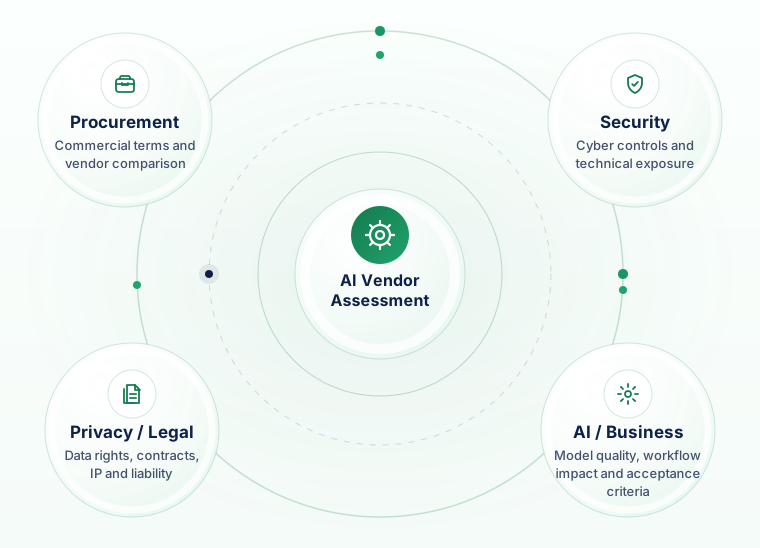
AI procurement should not be owned by a single team because the major risks span business, security, privacy, legal, compliance, engineering, and model performance. Cross-functional ownership reduces blind spots and makes approvals easier to defend later.
For lower-risk tools, some functions can play a lighter role. High-risk or regulated deployments should have clearly assigned decision owners and documented approval responsibilities before production use. Our AI consulting services can also help enterprises define governance, implementation priorities, and cross-functional AI decision frameworks.
Evaluate Data Privacy and AI Training Practices
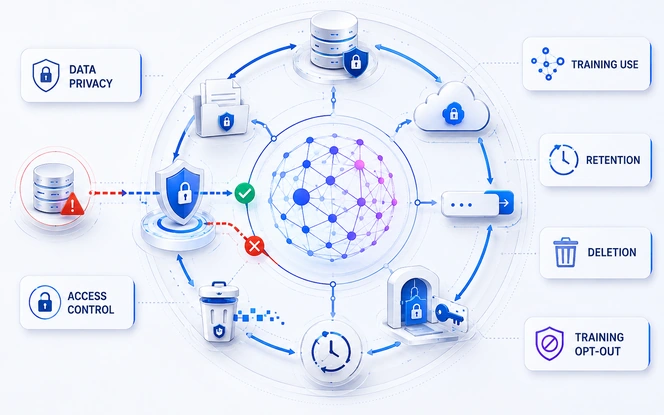
Data handling is one of the highest-priority areas in AI due diligence because prompts, files, logs, outputs, metadata, and connected-system data can all contain sensitive information. Buyers should map the complete data lifecycle, not just the visible prompt box.
The vendor should clearly explain collection, storage location, retention, deletion, human access, and whether enterprise content is used to train, fine-tune, evaluate, or improve models. Important restrictions should be supported by contract terms where appropriate. For additional privacy considerations, review the ICO guidance on AI and data protection.
What to verify
- Data categories collected
- Storage and processing regions
- Retention and backup handling
- Permanent deletion process
- Training or model-improvement use
- Enterprise opt-out controls
Assess Cybersecurity and AI-Specific Threats
AI vendors should meet the same security baseline expected from other enterprise software while also protecting the additional attack surface introduced by models, prompts, agents, plugins, and connected tools.
The review should cover identity, encryption, logging, vulnerability management, incident response, and AI-specific abuse scenarios. Systems that can take actions on behalf of users deserve especially strong permission boundaries and human controls. Enterprises building LLM-powered applications can use our generative AI development services to create secure, scalable solutions with appropriate model and data safeguards. Security teams can benchmark AI-specific threats against the OWASP GenAI LLM Top 10 2026.
Core Security Controls
SSO, MFA, RBAC, encryption, least privilege, API security, logging, secure development, vulnerability management, and incident response.
AI-Specific Threats
Prompt injection, indirect prompt injection, sensitive-data leakage, data poisoning, unsafe tool use, model manipulation, and excessive agent permissions.
- Review admin and security audit logs
- Check penetration testing evidence
- Validate incident notification process
- Restrict high-impact agent actions
- Apply least-privilege access
- Test unsafe prompt and tool scenarios
Review Model Provenance, Subprocessors and the AI Supply Chain
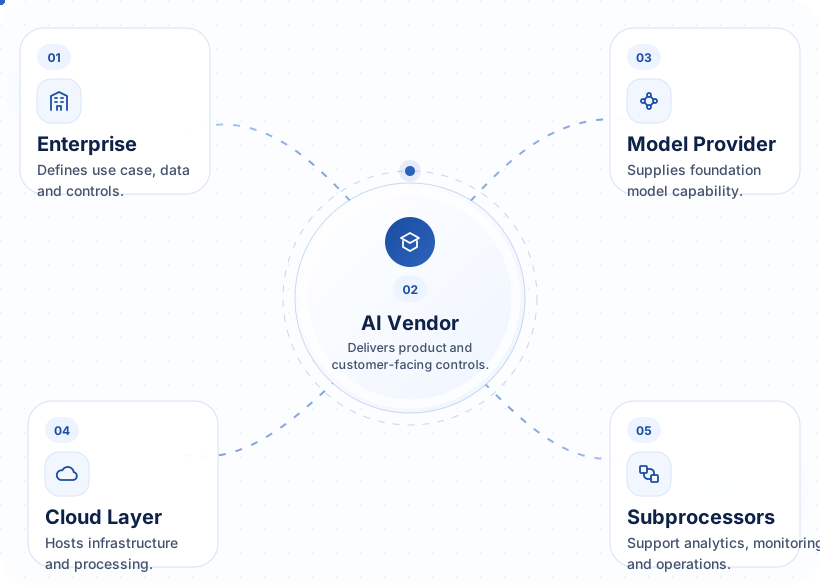
Many AI products are built on top of external foundation models, cloud infrastructure, vector databases, analytics systems, and other subprocessors. Enterprise buyers need visibility into these dependencies because the primary vendor may not control every part of the service.
The assessment should identify which parties receive data, which models power the product, how dependencies can change, and what happens when a critical provider becomes unavailable. Material changes should trigger review rather than happening silently.
Test Accuracy, Hallucinations, Bias and Reliability
A vendor demonstration is not enough to prove that an AI system will perform reliably in your environment. Enterprise buyers should test representative workflows, edge cases, domain-specific scenarios, and failure behavior using clearly defined acceptance criteria.
Testing should look beyond average accuracy and examine hallucinations, grounding, consistency, bias, human-review needs, latency, and behavior under difficult inputs. The acceptable threshold depends on the consequences of a wrong answer.
Accuracy & Hallucinations
Test factual quality, grounding, citations, consistency, uncertainty handling, and incorrect-output frequency.
Bias & Fairness
For high-impact use cases, test whether outcomes differ unfairly across groups, scenarios, regions, or languages.
Performance & Resilience
Measure latency, concurrency, throughput, long-input behavior, API limits, failure rates, and recovery.
Review Compliance, Intellectual Property and Contractual Protections
Technical controls need to be connected to the legal and regulatory requirements that apply to the enterprise use case. A broad statement that a product is “compliant” should never replace a review of scope, evidence, and responsibility. Organizations operating in or serving the European market should review the European Commission’s EU AI Act regulatory framework for applicable risk and compliance obligations.
Contracts should also clarify ownership of enterprise inputs and generated outputs, model-training rights, confidentiality, liability, indemnification, subprocessor obligations, termination, export, and deletion. These terms often determine how much risk the enterprise ultimately inherits.
| Area | What to Verify |
|---|---|
| Governance | Applicable frameworks, internal AI policy, auditability and responsibility. |
| Regulation | EU AI Act, GDPR, industry rules and jurisdiction-specific obligations where relevant. |
| IP Rights | Ownership of inputs, outputs, uploaded files, prompts and generated content. |
| Contract | Training rights, confidentiality, liability, indemnification, termination and deletion. |
Evaluate Integration, Business Continuity and Exit Risk
AI platforms often connect to CRM, ERP, knowledge bases, databases, communication tools, cloud storage, and internal APIs. Every integration expands both the value of the platform and the consequences of a security, availability, or permission failure.
Buyers should also understand what happens when the AI vendor or its underlying model becomes unavailable. A practical exit and continuity plan reduces lock-in and protects business operations during outages, renewals, or vendor changes. For organizations connecting models with existing enterprise platforms, our AI ML Implementation can help embed AI into web applications, CRM, ERP, mobile platforms, and other business systems.
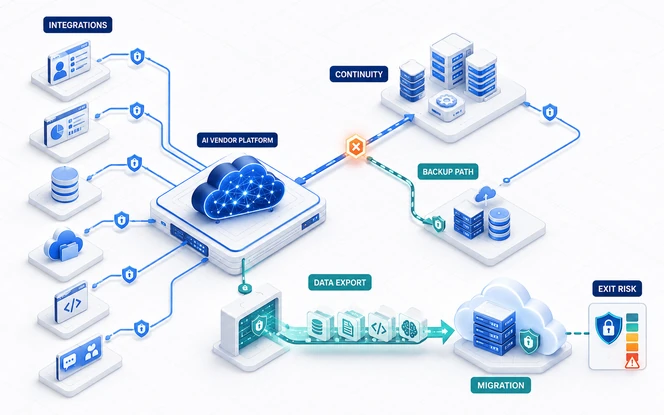
Key checks
- API authentication and permission scopes
- Connector and webhook security
- Monitoring and failure handling
- Availability and recovery objectives
- Fallback options during outages
- Data, prompt and configuration export
- Migration support and standard formats
- Support for alternative models or providers
Review Pricing, Commercial Risk and Total Cost of Ownership
AI pricing can become more complex than a standard SaaS subscription because costs may depend on users, tokens, API calls, premium models, storage, compute usage, integrations, support, and overage charges.
Enterprise buyers should estimate total cost using realistic production volumes rather than pilot usage. Commercial review should also cover minimum commitments, price increases, renewal terms, support levels, and the cost of migration if the vendor relationship ends.
Subscription & Usage
User or platform fees, tokens, API calls, premium-model usage and related consumption charges.
Implementation & Support
Integration, storage, technical support, change management and ongoing operational effort.
Migration & Switching
Data export, migration assistance, reimplementation work and the cost of changing providers.
Review Vendor Evidence and Run a Controlled Proof of Concept
Once the vendor has submitted its questionnaire and supporting documentation, review the evidence rather than relying on claims at face value. Confirm that certifications, policies, security documentation, data practices, and contractual commitments are current, relevant to the product being evaluated, and sufficient for the intended use case.
A controlled proof of concept should validate the vendor against realistic workflows, edge cases, security controls, model quality, latency, cost, and operational requirements. Use consistent scenarios and predefined pass/fail criteria so competing vendors can be evaluated on the same basis.
Evidence to Review
Review submitted SOC 2 or ISO reports, DPA, subprocessor disclosures, security architecture, data-use and retention policies, incident-response documentation, model documentation, BCP/DR evidence, and SLA commitments.
POC Objective
Validate the vendor’s claims using representative but protected data, predefined pass/fail criteria, realistic workflows, edge cases, and adversarial scenarios. Document limitations and unresolved risks before approval.
Score the Vendor, Identify Red Flags and Make the Decision
A structured scoring model makes vendor comparison more consistent and provides an audit trail for the final procurement decision. However, a high total score should never hide a critical failure in data rights, security, compliance, or mandatory enterprise controls.
Use weighted categories for normal comparison, then apply mandatory gates for non-negotiable requirements. The final outcome should clearly state whether the vendor is approved, conditionally approved, escalated, or rejected.
| Risk Category | Suggested Weight |
|---|---|
| Data Privacy & Governance | 20% |
| Cybersecurity | 15% |
| AI & Model Risk | 15% |
| Compliance & Governance | 15% |
| Legal, IP & Contract | 10% |
| Reliability & Performance | 10% |
| Integration & Operations | 5% |
| Vendor & Commercial Risk | 5% |
| Exit & Portability | 5% |
Critical Red Flags
Unclear training use, weak security evidence, unknown dependencies, poor deletion, excessive data rights, or no practical portability.
Mandatory Controls
Required residency, security controls, regulatory obligations, ownership terms, or prohibited training use should act as hard gates.
Final AI Vendor Risk Checklist and Ongoing Monitoring
Use the final checklist to confirm that the most important diligence activities are complete before production approval. This provides a simple final control point after the deeper technical, legal, operational, and commercial reviews.
Approval should also establish how the vendor will be monitored after deployment. Significant model changes, subprocessors, security incidents, data-use changes, new integrations, or higher-risk use cases should trigger reassessment rather than waiting for the next annual review.
Use Case & Data
- Risk tier assigned
- Data lifecycle mapped
- Training use confirmed
- Retention and deletion verified
Security & Model
- Security evidence reviewed
- AI-specific threats assessed
- Accuracy and hallucinations tested
- Model dependencies documented
Legal & Operations
- Compliance claims validated
- IP and contract terms reviewed
- Continuity and fallback tested
- Exit and portability confirmed
Approval
- Weighted score completed
- Mandatory controls passed
- Residual risks documented
- Mitigation owners assigned
Conclusion
AI vendor selection should be treated as an ongoing risk-management decision, not a one-time procurement exercise. A strong assessment brings together use-case risk, data privacy, cybersecurity, model behavior, compliance, legal terms, operational resilience, commercial exposure, and exit readiness before production approval.
The most defensible approach is to require evidence, test the vendor against realistic enterprise scenarios, document residual risk, assign mitigation owners, and continue monitoring after deployment. This helps organizations adopt valuable AI capabilities without losing visibility or control as the vendor, model, integrations, and regulatory environment evolve.
FAQs
What Is The Purpose Of An AI Vendor Risk Assessment?
+
To determine whether the privacy, security, model, legal, operational, and commercial risks of a third-party AI provider are acceptable for a specific enterprise use case.
Is SOC 2 Enough To Approve An AI Vendor?
+
No. It can support security assurance, but buyers still need to assess model behavior, enterprise-data use, AI dependencies, hallucinations, governance, IP rights, and the intended deployment.
How Often Should AI Vendors Be Reassessed?
+
Use periodic reviews based on risk plus event-based reassessment after major model changes, incidents, new subprocessors, changed data practices, new autonomous capabilities, or higher-risk use cases.
What Are The Biggest AI Vendor Red Flags?
+
Unclear customer-data use, weak security evidence, unknown AI dependencies, poor deletion or export capabilities, unacceptable contractual rights, and no process for communicating material AI changes.