AI vendors can look similar in a demo, while the real production risk sits underneath the interface: model providers, data paths, access controls, model changes, incident handling, and service limits.
A practical AI RFP checklist turns those hidden dependencies into evidence-backed questions. As a result, procurement, security, legal, data, and technical teams can compare vendors against one shared standard.
Key Takeaways
- Define the AI use case and mandatory requirements first.
- Review models, providers, RAG, agents, and dependencies.
- Verify security, data, governance, and compliance controls.
- Set measurable performance and SLA targets.
- Compare vendors using evidence and a consistent scorecard.
- Confirm pricing, ownership, data export, and exit terms.
What Is an AI RFP?
An AI RFP, or artificial intelligence request for proposal, is a procurement document that defines what an organization needs from an AI solution and asks shortlisted vendors to respond in a consistent format.
It covers the business use case, technical architecture, security, data handling, governance, performance, service levels, implementation, pricing, and vendor responsibilities. In addition, a strong AI RFP asks vendors to support important claims with evidence so teams can compare risk, fit, and cost before selection.
Business and Use Case
First, define the problem, intended users, expected outcomes, decision impact, and measurable success criteria.
Model and Architecture
Next, identify models, providers, RAG components, agents, integrations, hosting, dependencies, and change controls.
Security and Data
Then, set requirements for access, encryption, data residency, training use, retention, deletion, and AI-specific threats.
Governance and Vendor Fit
Finally, define oversight, auditability, compliance, SLAs, evidence, vendor experience, commercial terms, and exit requirements.
Why an AI RFP Matters
AI systems can change as models, providers, data sources, or agent permissions change. Therefore, the RFP should evaluate how the proposed service will operate in production, not only how it performs in a sales demo.
Why AI RFPs Need a Different Evaluation Approach
Traditional software RFPs usually evaluate stable functionality. AI adds probabilistic output, model and provider dependencies, retrieval layers, agent permissions, and model changes that can alter behavior after deployment.
Therefore, an enterprise AI RFP should test how the service behaves in production, who controls each dependency, and what evidence supports the vendor's claims.
Multiple Dependencies
An AI product may depend on foundation models, embedding models, vector databases, cloud AI APIs, and external tools. Each dependency can affect security, data handling, performance, and cost.
Variable AI Output
AI output behaves differently from fixed software logic. For example, similar prompts can produce different responses. Therefore, buyers need clear measures for output quality, monitoring, and human oversight.
What to Define Before Sending an AI RFP
Before issuing the RFP, agree on the business use case, intended users, decision impact, data classes, deployment boundaries, integrations, and measurable success criteria.
Separate non-negotiable controls from scored preferences. As a result, this makes an AI RFP template easier to answer, compare, and approve across procurement, legal, security, data, and technical teams.
Use Case and Users
Define the business goal, intended users, workflows, and decisions the AI may influence.
Data and Controls
Identify the data involved, its sensitivity, and the security, privacy, and governance controls that are mandatory.
Environment and Success
Confirm deployment, integrations, expected scale, performance targets, budget, and success measures.
Separate Mandatory and Preferred Requirements
A required data-processing region may be non-negotiable, while an optional analytics feature may receive a weighted score. As a result, this distinction makes vendor comparison more consistent.
Technical and Model Requirements
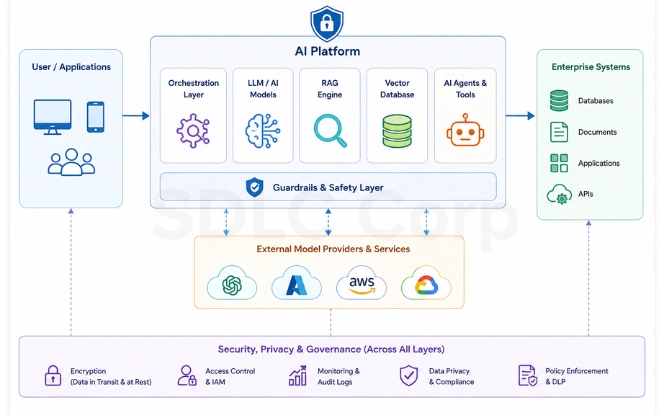
First, ask for an architecture view that shows the models, providers, retrieval components, agents, external services, and infrastructure involved in the production path.
Next, the response should identify model versions, routing or fallback logic, RAG and vector-store dependencies, tool permissions, and the process used to test and communicate material model changes.
Models and Providers
First, identify model providers, versions, and major third-party dependencies.
Retrieval and Customization
Next, explain fine-tuning, RAG, embeddings, vector databases, and customer-specific configuration.
Agents and External Services
Finally, list AI APIs, connected tools, and the actions each agent is permitted to take.
RAG Access Controls
For RAG systems, access controls should follow the permissions of the source system. Moreover, a user should not receive content through AI retrieval if that user cannot access the original document.
AI Agent Permissions
AI agents need stronger controls when they can take actions. For example, reading a record creates less risk than modifying data, sending messages, or approving a transaction.
Model Changes
Model changes also need review. Vendors should explain how they test new versions and whether customers receive notice before significant updates reach production.
Security Controls for an AI RFP
AI security requirements should cover standard enterprise controls and AI-specific attack paths. Consequently, the review needs to consider identity, tenant isolation, data exposure, prompt injection, model behavior, and connected tools.
Therefore, require evidence for SSO, MFA, RBAC, encryption, secrets management, vulnerability handling, incident notification, AI-specific testing, and restrictions on agent actions.
Identity and Infrastructure Security
The platform should support access controls that match the enterprise environment. For example, these may include SSO, MFA, role-based access, and least-privilege administration.
Encryption should protect data at rest and in transit. Depending on the use case, buyers may also need tenant isolation, key management, secrets management, and private connectivity.
Privileged vendor access needs clear controls as well. Similarly, administrative actions should be restricted, recorded, and reviewable.
AI-Specific Security Risks
Generative AI introduces attack paths such as prompt injection, sensitive-data leakage, malicious retrieved content, unsafe output, and unauthorized tool actions. Therefore, testing should cover the exact model, retrieval, and agent configuration being proposed.
Focus the AI-specific review on prompt injection, sensitive-data leakage, malicious content, unsafe output, third-party weaknesses, and unauthorized agent or tool actions.
Security Operations
Finally, security operations also matter after deployment. In practice, vendors should explain how they manage vulnerabilities, apply patches, investigate incidents, and notify affected customers.
Data Handling, Residency, and Ownership
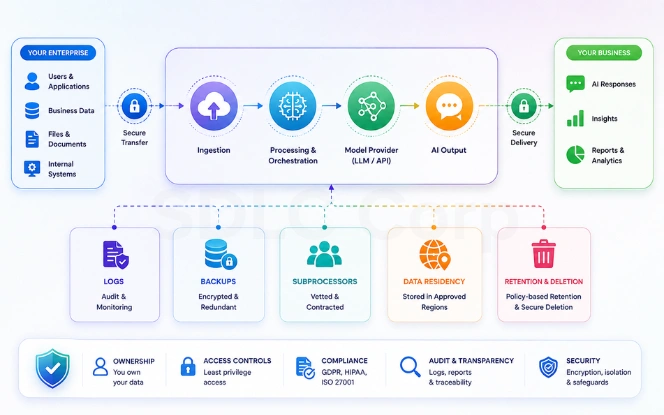
First, trace customer data from input to deletion. In addition, that includes prompts, uploads, retrieved content, generated outputs, telemetry, logs, backups, model providers, and subprocessors.
Next, confirm training use, residency, human access, retention, export, deletion, and ownership separately. Therefore, a hosting region alone does not describe the complete AI data path.
Customer Data and Model Training
One of the most important questions is whether customer data contributes to model training or improvement.
Ask explicitly whether prompts, uploaded files, retrieved documents, generated outputs, or usage telemetry are used to train or improve any model.
The answer should cover both the vendor's models and third-party providers.
If customer content is used for improvement, buyers should know whether they can opt out. Human access to prompts or outputs should also be clearly defined.
Data Residency and Third Parties
Similarly, storage and processing locations should both be disclosed. A platform may host its main database in one region while routing AI requests through another.
In addition, vendors should identify subprocessors and external AI providers that receive customer information.
Backups need the same level of clarity. However, their location and retention period can affect privacy, contractual, and regulatory obligations.
Retention, Deletion, and Ownership
Next, retention rules should cover prompts, files, outputs, logs, and backups. Deletion procedures should also explain when copies disappear from secondary systems.
Finally, contract terms should clarify ownership of customer inputs, generated outputs, configurations, embeddings, and other customer-specific assets.
Exit terms should state how data is returned and when the vendor deletes remaining copies.
AI Governance and Risk Management
AI governance requirements should show how risk is controlled across the system lifecycle, from model approval and release through monitoring, incident review, and retirement.
In addition, look for named owners, model inventory and classification, change approvals, human override, safety testing, monitoring records, and an auditable history of important model or policy changes.
First, define AI risk ownership, system inventory, risk classification, model approval, and change management.
Next, set the required level of human oversight, escalation, bias review, and safety testing for the use case.
Finally, confirm monitoring, incident review, audit records, and evidence needed to investigate important AI events.
Human Oversight
Human oversight should reflect the risk of the use case. As a result, AI that influences important decisions may require approvals or manual override.
Controlled Model Changes
Significant model updates can affect accuracy, safety, latency, and cost. Moreover, changes should follow a controlled testing and release process.
Auditability
Audit records should provide enough information to investigate important events. For example, useful records may include model versions, policy decisions, administrative changes, and AI-agent actions.
AI Standards, Assurance, and Regulatory Fit
Frameworks and assurance reports are useful only when their scope matches the service being evaluated. Consequently, certification names alone do not prove that the relevant AI controls are operating effectively.
Therefore, map applicable frameworks, security assurance, privacy obligations, and sector rules to specific controls, responsible owners, and evidence the enterprise can review.
AI Risk and Governance Frameworks
Where relevant, vendors can explain how their AI risk program aligns with recognized approaches such as the NIST AI Risk Management Framework or ISO/IEC 42001.
Security Assurance
For example, buyers may request applicable security certifications or assurance reports, such as ISO/IEC 27001 certification or SOC 2 reports, and verify the scope that covers the service.
Generative AI Security Guidance
Similarly, for generative AI and agentic systems, buyers can ask how the vendor uses current OWASP GenAI security guidance in threat modeling, testing, and control design.
Regulatory and Sector Requirements
Privacy and AI, consumer, financial, healthcare, or other sector rules may apply depending on the data, geography, users, and decisions involved. Vendors should identify relevant obligations and their control responsibilities.
Request Evidence, Not Just Compliance Claims
Finally, ask for the scope, issuing or auditing body, relevant entity, reporting period, material exceptions, and supporting documentation. Meanwhile, a certification or report should clearly relate to the service being evaluated.
Performance, Reliability, and SLAs
AI SLA requirements should convert terms such as fast, accurate, and enterprise-ready into measurable production commitments.
First, use task-specific quality metrics and defined test conditions. Also capture availability, latency percentiles, capacity, support response, recovery expectations, and remedies for repeated failures.
| Area | What to Define |
|---|---|
| Availability | Uptime target and exclusions |
| Latency | Response target or percentile |
| Quality | Task-specific accuracy measure |
| Capacity | Usage, throughput, or concurrency |
| Support | Response by incident severity |
| Recovery | Escalation and corrective action |
| Remedies | Action after repeated failures |
Use Metrics That Match the AI Task
For example, a classification model may need precision and recall targets. Similarly, a RAG assistant may need retrieval quality and groundedness measures.
Validate Performance Claims
Performance claims need context. In practice, a vendor should explain the test dataset, conditions, and calculation method behind reported results.
Define Support and Remedies
In addition, support terms need clear severity levels. Critical outages and confirmed security incidents should not follow the same process as minor product issues.
Repeated SLA failures should trigger defined remedies. Therefore, these may include service credits, corrective plans, escalation, or termination rights.
Deployment, Integration, and Scalability
First, confirm that the platform can operate inside the target enterprise environment at the expected workload. However, a successful pilot does not automatically prove production readiness.
Next, evaluate deployment options, identity, private connectivity, enterprise integrations, observability, agent permissions, quotas, scaling behavior, and what happens when capacity or dependencies fail.
Deployment Options
For example, SaaS, private cloud, VPC, on-premises, and hybrid environments may be considered based on data, security, and infrastructure needs.
Enterprise Integration
In addition, integration requirements may include CRM, ERP, identity platforms, document repositories, data warehouses, and monitoring tools.
AI Agent Integration Permissions
AI agents need additional review because integrations can allow them to take actions. As a result, buyers should know what each connection can access and how those permissions are limited.
Production Capacity
Next, production capacity should cover concurrent users, request rates, token limits, API limits, regional capacity, and peak-load behavior.
The vendor should also explain what happens when the platform reaches a limit. Moreover, requests may be rejected, queued, slowed, or rerouted.
How to Evaluate AI Vendors
An AI vendor evaluation checklist should assess both the product and the organization that will support it in production.
Next, weight relevant deployments, implementation capability, security maturity, support quality, customer references, product roadmap, external dependencies, and business continuity rather than relying on the demo alone.
Relevant Experience
First, review similar AI deployments, implementation experience, and customer references.
Delivery and Support
Next, assess integration capability, security expertise, technical support, and issue resolution.
Long-Term Fit
Finally, review the product roadmap, major technology dependencies, business continuity, and future flexibility.
Validate Vendor Experience
Customer references can reveal how the vendor performs after the sale. For example, ask about implementation quality, support responsiveness, product limitations, and problem resolution.
Review External Dependencies
Strong AI vendor due diligence should also identify major external dependencies. Consequently, heavy reliance on one cloud or model provider can affect availability, pricing, and future flexibility.
AI Vendor Evaluation Scorecard
First, use a common scorecard only after mandatory requirements have been checked. As a result, this prevents a strong commercial or feature score from hiding a failed security, data, or governance condition.
AI vendor evaluation criteria should reflect the risk of the use case. Similarly, regulated or high-impact deployments may need heavier weighting for security, data protection, governance, and operational evidence.
- Security20%
- Data and Privacy20%
- AI Governance15%
- Technical Capability15%
- Performance and SLAs10%
- Integration and Scalability10%
- Vendor Capability5%
- Commercial Terms5%
These percentages are examples. In practice, a regulated use case may place more weight on security and governance.
Download the AI RFP Vendor Evaluation Scorecard
Use the workbook to record mandatory gates, evaluation weights, vendor scores, evidence links, risk notes, and final weighted results.
Download ScorecardMandatory conditions should remain separate from weighted criteria. In addition, a vendor that fails a non-negotiable data or security requirement may not qualify, even with a high overall score.
Pricing, Contract Terms, and Exit Planning
Model expected production cost using realistic volumes rather than entry pricing. Therefore, AI spend can change with users, tokens, model choice, API calls, storage, infrastructure, and support.
Next, compare the full operating scenario, then review data and output rights, liability, third-party dependencies, export formats, migration support, deletion timing, and termination charges before signing.
Platform fees, user licenses, tokens, models, and API calls.
Implementation, migration, storage, and infrastructure costs.
Support tiers, optional capabilities, and premium features.
Contract Terms
In addition, contract terms should clarify customer data, generated outputs, confidentiality, intellectual property, and third-party model use.
Exit Planning
Finally, exit planning matters because AI platforms may accumulate prompts, workflows, embeddings, configurations, and other assets.
Buyers should confirm what can be exported, the available formats, migration support, deletion timelines, and termination charges.
Evidence to Request from AI Vendors
Material claims should be supported with current evidence tied to the exact service, environment, and entity being evaluated.
First, prioritize scoped audit reports, architecture and data-flow diagrams, model documentation, subprocessor details, penetration-test summaries, governance records, performance tests, SLA history, and relevant references.
Security Proof
For example, audit reports, relevant certifications, and penetration-test summaries.
Architecture and Data Proof
In addition, architecture diagrams, data-flow diagrams, model documentation, and subprocessor information.
Operational Proof
Finally, governance records, incident procedures, performance tests, SLA reports, and customer references.
Check the Test Context
Technical claims also need context. However, a reported performance result should include the test method, dataset, and conditions.
Questions to Ask AI Vendors in an RFP
Vendor responses become easier to compare when every supplier answers the same direct questions in the same format.
Therefore, for each material requirement, request the answer, supporting evidence, known limitation, responsible owner, and any commercial or technical dependency that could change the final decision.
- Which AI models, model providers, APIs, and major third-party components are used?
- Will prompts, files, retrieved content, outputs, or usage data be used to train or improve any model?
- Where is customer data stored, processed, backed up, and accessed, and which subprocessors receive it?
- How do you test and reduce prompt injection, data leakage, malicious content, and unauthorized agent actions?
- How are model changes tested, approved, monitored, and communicated before production use?
- Which quality, latency, availability, capacity, and support targets can you commit to?
- Which logs, audit records, governance controls, and assurance evidence are available?
- What data and customer-specific assets can be exported at termination, and when are remaining copies deleted?
Ask Vendors to Answer in a Consistent Format
For each material requirement, request a direct response, supporting evidence, known limitations, responsible party, and any commercial dependency. As a result, this makes scoring and risk review more consistent across vendors.
AI RFP Red Flags to Watch For
Treat gaps in model ownership, data location, security testing, auditability, SLA commitments, change control, deletion, or exit planning as risk signals rather than documentation issues.
One gap may be remediable. Moreover, several unresolved gaps should reduce the vendor score, trigger stronger contract controls, or remove the vendor from consideration.
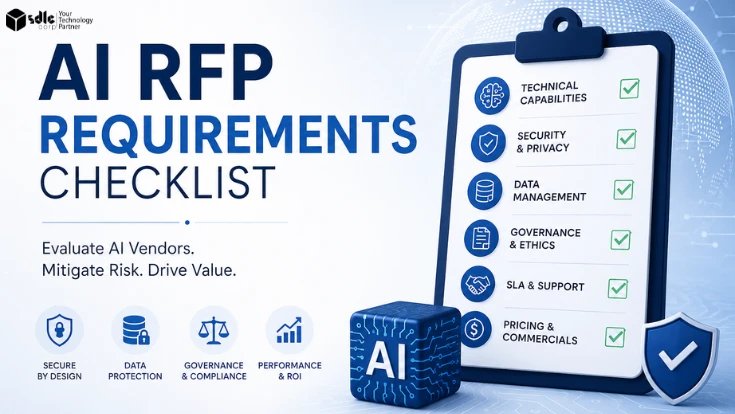
AI RFP Requirements Checklist
Finally, use the AI RFP requirements checklist as a decision gate before vendor selection, not as another summary of the proposal.
Any material item that remains unverified should become a documented risk, contractual condition, remediation action, or disqualifier before approval.
Security and Data
0/3 verifiedGovernance and AI
0/3 verifiedPerformance and Technical Fit
0/3 verifiedVendor and Commercial Review
0/3 verifiedFinal Thoughts
Ultimately, the strongest AI RFPs make vendors prove how the service will operate in production, not simply describe features.
Therefore, keep mandatory controls separate from weighted criteria, request evidence for material claims, and confirm a practical exit path before vendor selection.
Build the Right Requirements Before You Choose an AI Vendor
SDLC Corp can help enterprises define AI architecture, security controls, data flows, governance, integrations, evaluation criteria, and production requirements before moving from vendor review to implementation.
Discuss Your AI RequirementsProof of Concept and Total Cost Comparison
Test the shortlist before scoring it
Vendor answers converge on paper. A short proof of concept is what separates them. Keep it narrow: one or two real use cases, your own documents or records, the acceptance metrics already agreed in the requirements, and the same dataset for every vendor. Define in advance who provides the data, who can see it, how it is deleted afterwards, and what counts as a pass.
Scope a proof of concept in weeks rather than months. A knowledge assistant over an existing corpus usually needs two to four weeks of vendor effort; a workflow or agent use case touching several systems runs longer because integration, not the model, sets the pace. Anything under a week generally tests a demo environment rather than your problem.
Compare total cost, not licence price
Build the same cost model for every shortlisted vendor across a realistic three-year horizon:
- Platform or licence fees, including tiering as volume grows.
- Model and inference usage, with an estimate at expected and peak load.
- Implementation and integration effort, including your own team's time.
- Data preparation and knowledge maintenance, which is recurring rather than one-off.
- Evaluation, monitoring and support tooling.
- Internal operations: review queues, incident handling and governance overhead.
- Exit cost: export, re-platforming and parallel running during a switch.
Score consistently
Weight the scoring before the demos, not after, so a strong presentation cannot move the criteria. Keep mandatory requirements as pass or fail, score preferred requirements on a fixed scale, and record the evidence behind each score. Where two vendors are close, the deciding factors are usually delivery capability and exit terms rather than model quality.
FAQs
What should an AI RFP include?
An AI RFP should cover the use case, technical architecture, security, data handling, governance, performance, SLAs, deployment, vendor capability, pricing, and exit terms.
How is an AI RFP different from a standard software RFP?
AI RFPs need extra checks around model providers, training-data use, model changes, output quality, human oversight, and AI-specific security threats.
What AI security requirements should an RFP include?
The RFP should cover identity controls, encryption, tenant isolation, privileged access, vulnerability management, incident response, prompt injection, data exposure, and AI-agent permissions.
How should enterprises evaluate AI vendors?
Start with mandatory requirements. Then use weighted criteria for security, data, governance, technical capability, SLAs, integrations, vendor experience, and commercial terms.
What SLA metrics should be included in an AI RFP?
Useful measures include availability, latency, throughput, error rate, task success, accuracy, and retrieval quality. For example, the final metrics should match the actual AI use case.
What evidence should an AI vendor provide?
Useful evidence includes security audit reports, architecture diagrams, data-flow documentation, model information, testing results, SLA records, incident procedures, and customer references.