
In reality, AI data loss prevention starts well before someone pastes confidential data into ChatGPT. Sensitive information can also enter through file uploads, retrieval, model outputs, agents, and external APIs.
That makes AI data loss prevention a data-flow problem rather than prompt filtering. Overall, this guide covers the leak paths, enterprise architecture, RAG and agent controls, evaluation, and testing.
AI DLP in 60 Seconds
AI data loss prevention is the use of policies and technical controls to discover, classify, inspect, and protect sensitive information as it enters, moves through, or leaves generative AI and LLM applications.
In practice, AI DLP may cover prompts, file uploads, images, retrieved enterprise data, model interactions, outputs, agents, tool calls, APIs, and downstream systems. However, no single control automatically sees every AI data path.
However, coverage depends on the architecture, integration, identity model, traffic path, supported modalities, and enforcement point.
What Is AI Data Loss Prevention?
Essentially, AI DLP extends data-protection controls into AI-specific workflows. Meanwhile, traditional DLP continues to protect established channels such as email, endpoints, file transfers, and cloud applications.
AI-aware controls then address conversational, retrieval, multimodal, agentic, and model-related data flows.
| Technology | Primary role | What it does not automatically solve |
|---|---|---|
| AI DLP | Protect sensitive data moving through AI workflows | Does not replace authorization or governance |
| AI guardrails | Control model inputs, outputs, and behavior | May not govern every enterprise data path |
| AI gateway or proxy | Centralize AI traffic and policy enforcement | Cannot automatically control bypassed or internal application flows |
| DSPM for AI | Discover AI activity, data exposure, and risk | Does not necessarily provide inline enforcement |
| IAM | Authenticate and authorize users, applications, and actions | Does not inspect all content for sensitive data |
| Application controls | Enforce RAG, agent, tool, and business-logic permissions | Do not automatically protect employee use of external AI |
The practical question is not simply whether a platform supports AI. It is which AI data paths it can actually see and control.
Why Generative AI Creates New Data-Loss Risks
In contrast, generative AI introduces multiple data paths that may not exist in a conventional file-transfer workflow. Sensitive information can appear in:
- Prompts and conversations
- File and document uploads
- Images, screenshots, and scanned documents
- RAG retrieval results
- Vector databases
- Model outputs
- AI-agent context
- Tool arguments and tool results
- External APIs and downstream applications
- Shadow AI applications
Authorization Is Not the Same as Inspection
Notably, RAG creates an important distinction. DLP determines whether sensitive information is handled appropriately. By contrast, authorization determines whether the user should receive the information at all.
Unauthorized content should not reach the model simply because an output filter exists.
Agents Add Actions, Not Just Content
In addition, agents can access information and perform actions. Least privilege, tool restrictions, destination controls, downstream authorization, approval workflows, and activity logging are therefore required alongside content inspection. The OWASP Top 10 for LLM Applications makes the same point about excessive agency.
Typically, AI security inspection capabilities vary by modality, integration, file type, and file size.
Evidence Behind the AI DLP Risk
Shadow AI is a measurable data-protection issue. In Microsoft and LinkedIn's 2024 Work Trend Index, 78% of surveyed AI users said they brought their own AI tools to work. This figure describes AI users in the survey, not all employees.
In IBM's 2025 Cost of a Data Breach research of 600 organizations that experienced breaches, one in five reported a breach due to shadow AI. Organizations with high levels of shadow AI had average breach costs $670,000 higher than those with low or no shadow AI. These are study findings, not a forecast for any individual organization.
Documented incident: OpenAI's March 2023 incident report describes a bug that let some users see other users' chat-history titles and could expose payment-related information for 1.2% of active ChatGPT Plus subscribers during a nine-hour window. This provider-side disclosure shows why vendor assurance and incident response belong alongside controls on prompts and outputs.
The Enterprise AI DLP Data-Flow Model
In practice, a workable architecture follows data as it moves from the user through prompts or file uploads into an AI application or gateway, where identity and data-protection controls can be applied.
The data may then pass through RAG or retrieval systems and authorization checks before reaching the model. After the model generates a response, data may continue through AI agents, tools, APIs, and downstream systems, with logging and governance providing evidence throughout.
Therefore, place controls where they can actually observe and influence the data flow they are intended to protect.
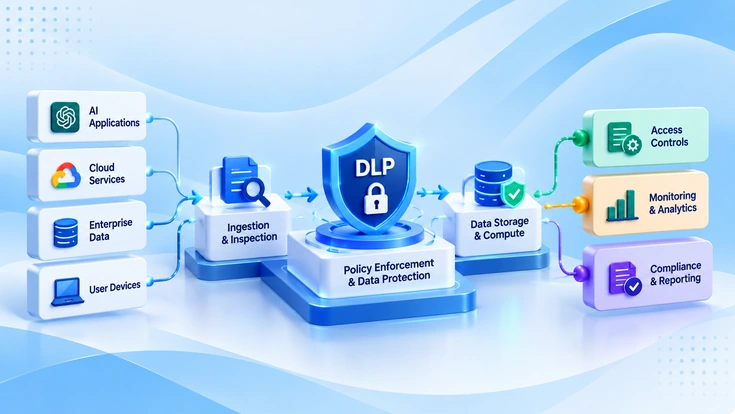
A browser control cannot automatically govern server-side RAG retrieval. An AI gateway cannot automatically enforce vector-database permissions. Likewise, an output filter cannot undo every consequence of sensitive data already being sent to an external provider.
| AI layer | Typical risk | Appropriate control |
|---|---|---|
| Prompt and file | PII, source code, confidential documents | Classification, inspection, masking, blocking |
| Retrieval and vector DB | Unauthorized enterprise data | Authorization, metadata filtering, tenant isolation |
| Model boundary | Sensitive data sent to an external provider | Approved-provider and data-flow policies |
| Output | Confidential information disclosed | Output inspection and response policy |
| Agent and tool | Unauthorized access or action | Least privilege, tool restrictions, approvals |
| API and destination | External data transfer | Destination controls and downstream authorization |
| Evidence layer | Sensitive prompts or outputs exposed in logs | Protected logging, access control, retention policies |
AI DLP for RAG and AI Agents
First, for RAG applications, security should begin before retrieval. Specifically, enterprise documents need appropriate permissions, classifications, tenant boundaries, and retrieval-time authorization.
Above all, the LLM should not become the final access-control decision maker.
Useful RAG Controls
- Document-level permissions
- Retrieval-time authorization
- Metadata filtering
- Vector-store isolation
- Data classification
- Sensitive-data filtering
- Output validation
- Monitoring and audit logs
Agents Need Content and Action Protection
For AI agents, the focus expands from content protection to content and action protection. Furthermore, agents with excessive functionality, permissions, or autonomy can create confidentiality, integrity, and availability risks.
Where supported, evaluate MCP and other tool-connected AI architectures using the same principles: identity, tool permissions, data access, destination restrictions, approval, monitoring, and evidence.
Prompt-Injection Exfiltration and Sensitive-Information Disclosure
An attacker can hide instructions in a retrieved document, web page, email, or tool result. If an AI application treats that untrusted content as instructions, an agent may reveal protected context in its answer or send it through an outbound tool call. OWASP's prompt-injection guidance describes exfiltration paths, while its sensitive-information disclosure guidance covers exposure through model output.
- Keep retrieved and other external content separate from trusted instructions.
- Enforce retrieval authorization and least-privilege tool and destination permissions.
- Inspect sensitive outputs and outbound tool payloads; require approval for high-risk sends.
- Test prompt-injection and disclosure paths with synthetic secrets and record the control decision.
How AI DLP Works
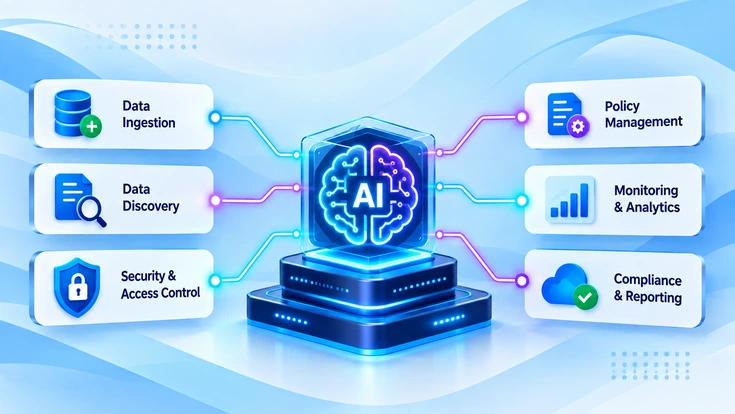
Typically, AI DLP starts by identifying AI applications, models, agents, APIs, RAG systems, and connected data sources. It then classifies sensitive information using existing enterprise data labels where possible.
Next, controls inspect prompts, files, images, retrieved context, model outputs, API requests, agent actions, and tool arguments to identify potential data-loss risks.
Depending on the sensitivity of the information and the organization's policies, the system may allow the activity, warn or coach the user, redact or mask sensitive data, block the action, or escalate the event for investigation.
Finally, continuous monitoring and audit logging provide the evidence needed to investigate incidents, measure control effectiveness, and improve policies over time.
Protect AI security logs as well. Indeed, they may themselves contain sensitive prompts, files, or model outputs.
AI DLP Coverage Reality Check
Even so, a vendor saying it supports ChatGPT or another AI application is not proof of complete coverage. Before selecting a solution, verify:
- Browser versus native-client coverage
- API versus web-interface coverage
- Traffic routing and TLS inspection
- File types and file-size limits
- Image and OCR support
- Streaming behavior
- RAG retrieval visibility
- Identity integration
- Bypass scenarios
- Licensing requirements
- Evidence and logging
- Failure behavior
Notably, AI security controls do not necessarily inspect every field involved in tool calling. For example, AWS Bedrock documents that certain guardrail filters do not evaluate model-generated tool-call arguments or tool results.
Therefore, test coverage against the organization's actual deployment path, not a vendor application list.
How to Evaluate an AI DLP Solution
In general, enterprise evaluation should focus on coverage, technical effectiveness, operational impact, and evidence. Ask vendors:
- Which AI clients, applications, APIs, and deployment models are covered?
- Which content types can be inspected: prompts, files, outputs, images, OCR content, and tool calls?
- Do policies support identity, data sensitivity, destination, and risk as conditions?
- Can the platform integrate with IAM, SIEM, existing DLP, and governance systems?
- Which traffic bypasses the enforcement point?
- How is content handled when it exceeds inspection limits?
- How much latency does inline inspection introduce?
- Where does traffic go if the security service becomes unavailable?
- Which data does the platform retain, and for how long?
- What evidence can investigators retrieve?
Do not evaluate feature counts alone. Instead, evaluate whether the product can protect the data paths that matter to the business.
How to Test AI DLP Before Deployment
For that reason, a proof of concept should use synthetic data and test real workflows rather than relying on a vendor demonstration.
Detect, warn, block, or redact synthetic PII.
Test documents, copy and paste, drag and drop, different clients, and large files.
Test screenshots, scanned PDFs, spreadsheets, and images.
Determine whether generated sensitive content is detected.
Specifically, verify that User A cannot retrieve User B's restricted dataset.
Attempt unauthorized tools, data sources, and actions.
Test approved, unapproved, and unknown destinations.
Determine whether cumulative multi-turn context is evaluated.
Additionally, test alternate browsers, clients, APIs, applications, file types, and network paths.
Measure legitimate business interactions incorrectly blocked.
Finally, verify user, application, data category, policy, action, destination, and timestamp are captured.
Ultimately, the objective is not to find the product with the most features. It is to determine which solution produces the required control outcomes across the same synthetic scenarios.
AI DLP Auditor Evidence
For an audit, retain evidence that shows which AI data paths were covered, which policy ran, and what action followed. A practical evidence packet includes:
- Scope and coverage: an inventory of AI applications, models, agents, clients, APIs, data sources, and documented blind spots.
- Policy history: approved data-classification rules, policy versions, owners, changes, and exception approvals.
- Control tests: dated synthetic-data results for prompts, uploads, retrieval, outputs, agent tools, bypass paths, and false positives.
- Access decisions: identity and RAG authorization checks, tool permissions, destination restrictions, and high-risk approvals.
- Event records: time, user or service identity, application, data category, policy, destination, allow/warn/redact/block action, and correlation ID.
- Response and review: investigated alerts, incidents, remediation, periodic coverage reviews, and evidence of closure.
Logs and test records can contain sensitive information. Restrict access, minimize or redact captured content, and apply the organization's retention rules.
AI DLP Implementation Roadmap
In practice, an implementation can follow these stages.
Discover
To begin, inventory AI applications, agents, models, APIs, users, and data sources.
Map
Document how data moves from user to AI application, model, retrieval system, tool, and destination.
Classify
Identify PII, regulated information, credentials, source code, intellectual property, and confidential business data, using the labels in your enterprise data governance framework.
Risk-rank
Consider data sensitivity, users, external exposure, agent autonomy, business impact, and regulatory requirements.
Define policies
Establish who can send what data to which AI system under which conditions.
Establish authorization
Confirm identity, RAG permissions, application access, agent permissions, and downstream authorization.
Enforce
Begin with monitoring and warnings before progressing to stronger controls where appropriate.
Integrate
Connect AI DLP with IAM, SIEM, existing DLP, classification, incident response, and AI governance.
Measure
Track coverage, detection quality, false positives, enforcement outcomes, investigation time, and business disruption.
Regulatory References for AI DLP
Where the GDPR applies, Article 5(1)(f) and Article 32 address integrity and confidentiality, risk-appropriate technical and organizational measures, and regular testing of security effectiveness. Map AI data flows and test results to those obligations.
For systems classified as high risk, Article 12 of the EU AI Act requires logging capabilities that support traceability. AI DLP events can contribute to the evidence trail, but do not by themselves establish AI Act compliance.
Requirements depend on the data, jurisdiction, AI-system classification, and the organization's role. Document that mapping before treating any control as compliance evidence.
AI DLP and AI Governance
In practice, AI DLP is one operational layer within a broader enterprise AI governance framework. Governance establishes ownership, risk classification, policies, oversight, and accountability. DLP provides the technical controls and evidence for protecting sensitive data.
Usefully, this distinction also prevents confusion with neighbouring topics. AI governance covers the broader lifecycle, AI policy management focuses on the policy lifecycle, AI usage monitoring provides activity visibility, AI compliance monitoring focuses on adherence and investigation, and AI DLP focuses on sensitive-data protection across AI data flows. The NIST AI Risk Management Framework is a useful reference for the governance layer.
How SDLC Corp Can Help With AI Data Loss Prevention
Overall, AI DLP should be implemented as part of an enterprise AI security and governance architecture. Organizations can use platforms such as Foresite to support visibility, governance, and control across their AI environment, while combining these capabilities with appropriate DLP, IAM, gateway, DSPM, and application-level controls where required.
Specifically, relevant areas include AI discovery and classification, risk and policy management, role-based access, approved-provider controls, data rules, tool permissions, RAG source permissions, monitoring, audit logs, and governance workflows.
Finally, organizations should validate which capabilities meet their specific AI data paths, and where additional DLP, IAM, gateway, DSPM, or application-level controls are required. Our AI consulting services can help map those paths before selection.
See Your AI Data Paths Before You Choose a Control
Together, discovery, classification, and policy mapping turn an unclear AI footprint into a scoped control plan with evidence behind each decision.
Conclusion
In summary, AI DLP is not simply about stopping employees from pasting confidential information into ChatGPT. It is about controlling how sensitive data moves across the complete AI application lifecycle, from prompts and file uploads to retrieval, model interactions, outputs, agents, APIs, and downstream systems.
Instead, an effective enterprise approach combines data discovery, classification, inspection, risk-based enforcement, monitoring, and auditability, while maintaining appropriate authorization at each stage.
Above all, the goal is not maximum blocking. It is controlled AI adoption with measurable visibility, appropriate enforcement, strong authorization, and defensible evidence.
Frequently Asked Questions
How is AI DLP different from traditional DLP?
AI DLP extends data-protection capabilities into AI-specific flows such as prompts, model responses, RAG retrieval, multimodal inputs, agents, and AI applications.
Does AI DLP replace traditional DLP?
No. Enterprises can extend existing DLP while adding AI-specific controls where traditional channels do not provide sufficient visibility.
Does AI DLP protect RAG applications?
It can contribute to RAG protection, but authorization, document permissions, retrieval filtering, vector controls, and output validation remain necessary.
Does AI DLP protect AI agents?
AI agent protection requires more than content inspection. Least privilege, tool restrictions, destination controls, downstream authorization, approval, logging, and monitoring are important.
How should organizations test AI DLP?
Use synthetic data and test prompts, uploads, multimodal inputs, outputs, RAG authorization, agent tools, destinations, bypass paths, false positives, and evidence collection.