AI voice agent implementation requires clear timelines, phased effort estimates, and realistic resource planning.
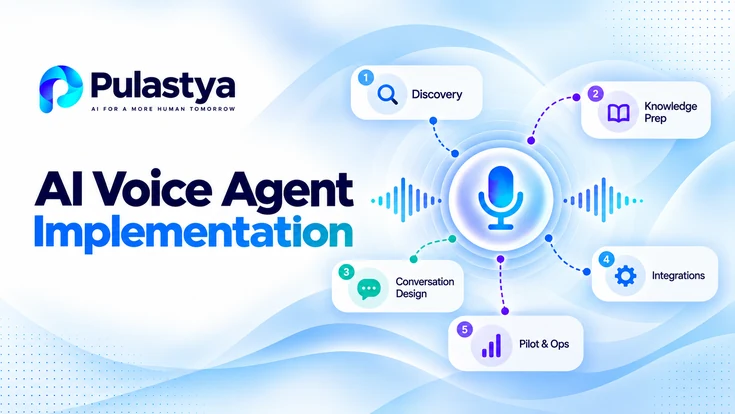
A phased rollout map separates discovery, knowledge preparation, conversation and prompt design, voice tuning, integrations, and operations, so buyers and technical stakeholders can align procurement, engineering, and compliance without sacrificing speed to value.
- Scope first Define call types, languages, escalation rules, and integrations before design or procurement.
- Knowledge and integrations drive effort Most work goes into approved content, prompt design, and tool integrations; labeled data and fine-tuning are optional.
- Ops and monitoring Plan for observability, prompt and content update cadence, and incident runbooks during the implementation phase.
Start by defining measurable business outcomes tied to voice interactions: containment rate, average handle time reduction, handoff accuracy, or revenue per call. For enterprise deployments that touch billing, CRM, or identity, scope decisions drive architecture and testing complexity.
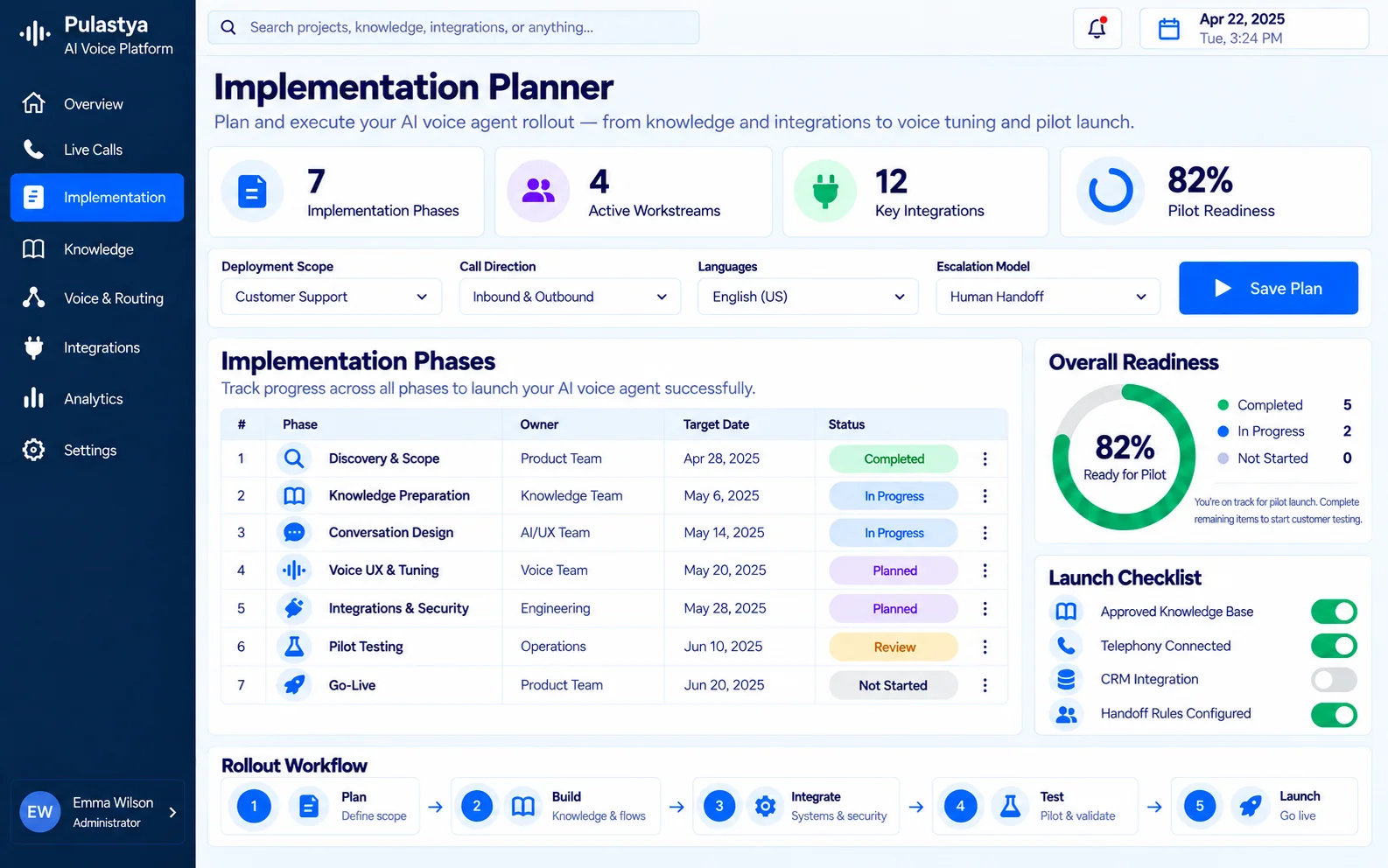
A concise scope prevents scope creep; enumerate the call types, call direction (inbound, outbound, or both), languages, and escalation paths before technical design begins so each phase has concrete deliverables and acceptance criteria.
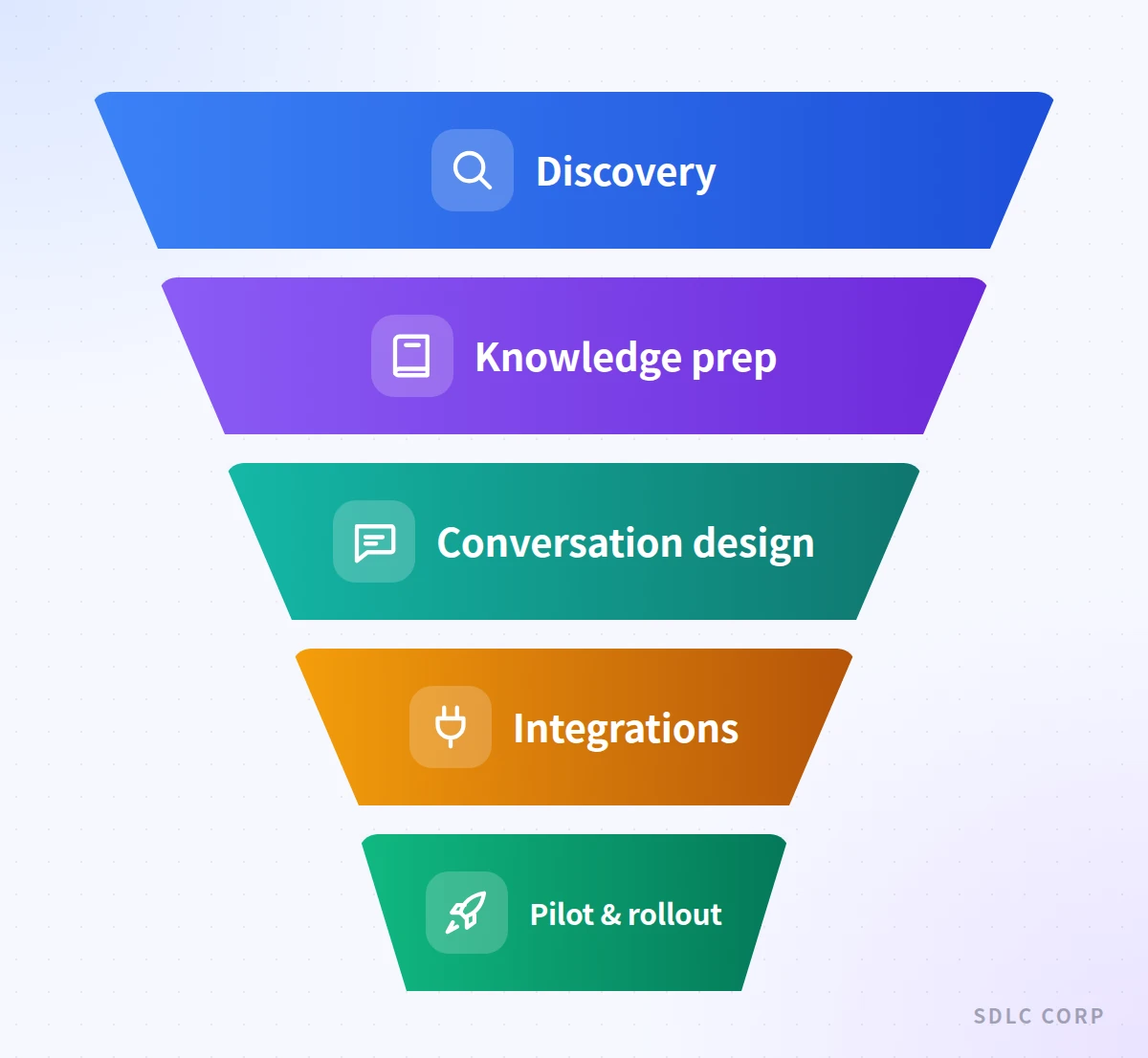
A dependable rollout runs in distinct phases: discovery, knowledge and data readiness, conversation and prompt design, voice UX and latency optimization, integrations and security, pilot deployment and monitoring, and production operations.
Assign owners for knowledge content, conversation design, platform engineering, and vendor management. Each phase has time and effort ranges tied to common enterprise patterns: new build from scratch, modernization of legacy IVR, or vendor-native extension work with prebuilt connectors.
Most modern voice agents do not start with model training. They combine hosted speech and language models with prompt design, retrieval (RAG) over approved content, and tool or API integrations; labeled data and fine-tuning come in only when evaluation shows a gap.
Phase 1: Discovery and Scope Validation
Discovery translates business goals into an actionable scope for the voice agent. Conduct stakeholder interviews across contact center operations, fraud, legal, and IT to identify top call intents, compliance constraints, and integration endpoints. Deliverables should include a prioritized intent list, data sources inventory, compliance checklist, and a risk register that maps technical unknowns to mitigation tasks.
Estimate effort via three archetypes: pilot scope (small intent set, single language, minimal integrations), enterprise modernization (multiple intents, CRM and billing integrations), or full production (multi-lingual, preauth, payments, and regulated data).
For a pilot expect two to six weeks of discovery with a cross-functional team. Modernization often requires four to eight weeks because of legacy interface discovery and security reviews.
Define success metrics up front and align acceptance criteria to them. Metrics include containment, fallback rate, and transfer accuracy; include SLO thresholds for latency and error budgets for production. A clear discovery phase closes ambiguity, reduces rework downstream, and enables realistic timeline commitments during procurement and vendor evaluation.
- Map top 10 call intents and volume distribution by intent.
- Confirm call direction for each use case: inbound, outbound, or both.
- Inventory integrations: CRM APIs, billing, identity providers, and logging.
- Document regulatory requirements for call recording and data residency.
- Identify stakeholders and assign phase owners for each workstream.
Discovery converts vague goals into a bounded implementation plan with measurable acceptance criteria.
Implementation phases
From Scope to Production, With Model Training as an Optional Branch
- Discovery and scopeCall types, inbound or outbound direction, escalation rules and success metrics
- Knowledge and evaluation setsApproved content, real-call test samples and a canonical field schema
- Prompt, retrieval and voice designSystem prompts, RAG over approved content, tools, fallbacks and latency
- Integrations and telephonyAPIs, inbound number routing or outbound triggers, security review
- Pilot on limited trafficRun evaluation sets and live calls; measure containment, transfers, latency
Possible outcomes
- Targets metRoll out in stages with runbooks, monitoring and content updates
- Gap remains after tuningIf prompts, content and tools cannot close it, add labeled data or fine-tuning
Model training sits on a side branch: most implementations reach the pilot with prompts, retrieval and integrations alone.
Phase 2: Knowledge Preparation, Data Extraction, and Canonicalization
Phase 2 assembles what the agent is allowed to know and use. Gather the approved content that answers the prioritized intents, such as FAQs, policies, pricing sheets, and service documents, and remove outdated or conflicting versions before they reach the retrieval index. Assign an owner to each source and define how updates are reviewed and reindexed.
Pull a representative sample of call recordings, transcripts, chat logs, and CRM notes for each prioritized intent. These samples become evaluation sets for testing prompts, retrieval, routing, and transfers, and they reveal the vocabulary, numbers, and edge cases callers actually use.
Establish a canonical schema for fields like customer ID, product type, and transaction amounts so tool calls and integration code reference consistent keys and formats. Normalize numbers, dates, and currencies to locale-aware formats, and document which system is the source of truth for each field the agent reads or writes.
Labeled training data is optional. Plan it only when evaluation shows a gap that prompt changes, better source content, or tool design cannot close, such as domain terms speech recognition keeps missing or a classification that must stay consistent at high volume.
When that case is proven, budget for labeling guidelines, two review passes with adjudication for ambiguous examples, and synthetic utterances for low-data intents, then confirm on the evaluation sets that fine-tuning actually closed the gap.
- Collect approved content for each intent and retire conflicting versions.
- Extract representative call samples by intent to build evaluation sets.
- Create a canonical field schema for tool calls and integrations.
- Add labeling or fine-tuning only when evaluation shows a gap other fixes cannot close.
Approved content, realistic evaluation sets, and standardized field formats reduce iteration cycles; labeled data is an exception, not a default.
Phase 3: Conversation Design and NLU Tuning
Conversation design translates intents into dialog flows, slot requirements, and fallback strategies. Map primary paths and recovery paths for each intent, including prompts, confirmations, and escalation. Use a modular approach: small reusable dialog components for authentication, payment, or address collection speed up design and maintenance across multiple intents and languages.
NLU tuning follows knowledge preparation. Start with a system prompt that sets the agent's role, scope, tone, and escalation rules, plus intent and entity definitions the model returns as structured output, with retrieval over approved content and tools for live lookups.
Run the evaluation sets after every revision and expect several tuning cycles before pilot-grade accuracy. Each cycle should include error analysis, prompt and retrieval adjustments, and intent merges or splits. Track confusion matrices and precision-recall by intent to decide where the next change, or in rare cases fine-tuning, will pay off.
Design for graceful failure and transparent escalation. Implement confidence thresholds, ask-back strategies, or short clarification questions instead of transferring at the first sign of uncertainty. Define acceptable fallback behavior and handoff metadata to ensure agents receive full context. Proper conversation design reduces agent load and improves containment without heavy model complexity.
- Design modular dialog components for reuse across intents.
- Set confidence thresholds and explicit handoff metadata for agents.
- Run staged NLU tuning cycles with error analysis dashboards.
- Document recovery paths and escalation criteria for each flow.
Good conversation design plus targeted NLU tuning yields faster containment and fewer agent escalations.
Phase 4: Voice UX, TTS, and Latency Optimization
Voice performance and perceived UX depend on latency, speech clarity, and natural turn-taking. Measure end-to-end latency budget including telephony gateway, ASR, NLU processing, and TTS synthesis. For production-grade systems aim for subsecond median processing excluding network jitter; prioritize streaming architectures to reduce perceived pause between customer speech and system response.
Select TTS voices and prosody settings consistent with brand and compliance. Run A/B tests with representative user samples for clarity and trust. When enabling multilingual capabilities, verify voice matching and localized prompts to avoid mixed-language dissonance that increases user confusion and agent transfers.
Plan for fallback ASR and network degradation strategies. Implement low-bandwidth codecs and an alternative prompt set for degraded conditions. Monitor MOS (Mean Opinion Score) and latency percentiles in production; introduce automated alerts for threshold breaches so operations can triage telephony or cloud issues quickly.
- Measure and budget end-to-end latency with streaming ASR and TTS.
- Run voice A/B tests for clarity and brand fit before production.
- Implement low-bandwidth fallbacks and alternate prompt sets.
- Monitor MOS and 95th-percentile latency in production dashboards.
Voice UX is as much about latency and reliability as it is about natural-sounding speech.
Phase 5: Integrations, Security, and Compliance
Integration complexity shapes schedule: direct API-based integrations are faster than screen-scrape or legacy middleware. Catalog required endpoints, authentication modes, rate limits, and SLA windows.
Securely store credentials and use least-privilege service accounts. For sensitive operations such as payments or identity verification, implement tokenization and avoid exposing raw PII to third-party services where possible.
Telephony integration differs by call direction. For inbound calls, the business number is routed to the agent, typically by buying a number on the platform, forwarding an existing number, or pointing an existing number's voice webhook or SIP trunk at the agent, with a tested failover route to a human line.
For outbound calls, the platform places calls from a contact list, a schedule, or an event trigger such as a CRM update or form submission. That path adds caller ID setup, consent records, calling-hour rules, do-not-call handling, and opt-out processing, which legal and compliance teams should approve before the first live call.
Security reviews and compliance checks must be baked into the timeline. Allocate time for penetration testing, data flow reviews, and privacy impact assessments.
For regulated interactions, document retention policies for recordings and transcripts, and ensure retention and deletion flows meet legal requirements. Schedule stakeholder sign-offs for audit trails and evidence packages early to prevent last-minute delays.
Operationally, create integration test harnesses and mock endpoints to parallelize frontend voice work with backend readiness. Where connectors touch billing, identity, or legacy systems, a partner providing AI development services can build and test them alongside the voice work.
Use feature flags and canary routes for progressive activation of integrations. This reduces risk during pilot rollout and enables rapid rollback if downstream systems behave unexpectedly under live voice traffic.
- Catalog API endpoints, auth modes, rate limits, and SLAs before dev.
- Configure inbound number routing, or outbound triggers with consent and calling-hour rules.
- Tokenize PII and restrict third-party access to raw data.
- Schedule pen testing and privacy reviews within the project timeline.
- Use mock endpoints and feature flags for safe integration testing.
Security, telephony, and integration complexity determine real-world timelines more than model work.
Phase 6: Pilot Deployment, Monitoring, and Iteration
Pilot deployment validates the end-to-end experience on a constrained traffic slice. Define pilot KPIs such as containment, transfer accuracy, average handle time, and customer satisfaction scores. Run the pilot on selected queues or customer cohorts and maintain a rapid feedback loop between voice ops, conversation design, and platform engineers to chase observed failures.
Implement full observability: call-level transcripts, intent confidence, latency metrics, handoff reasons, and agent feedback flags. Integrate dashboards and automated alerts for regression in containment or rising fallback rates.
Plan iteration after the pilot. Set a regular review of prompts and knowledge content driven by failure analysis, drift metrics, and new-intent capture, and retrain only where a fine-tuned model is in use.
Define roles for on-call triage, monthly analytics reviews, and quarterly roadmap sprints. The pilot phase is not a single cutover but the start of continuous improvement where measured changes deliver incremental containment and quality gains.
- Run pilots on limited queues with clearly defined KPIs and cohorts.
- Capture call-level telemetry and agent feedback for root-cause analysis.
- Use automated alerts for drops in containment or latency spikes.
- Define prompt, content, and drift review cadence after pilot.
A disciplined pilot with telemetry and short feedback loops accelerates safe production rollout.
Phase 7: Production Roll-Out, Ops Handoff, and Scaling
Production roll-out requires operational readiness: runbooks, on-call rotations, and playbooks for common failure modes. Transfer knowledge through structured runbook documents and shadowing sessions that cover incident response, rollback procedures, and how to interpret observability signals. Confirm capacity planning for peak concurrent calls and prepare autoscaling policies with clear thresholds.
Scaling introduces additional considerations: multi-region failover, load balancing across ASR/TTS clusters, and database partitioning for active conversations. Perform load tests that mirror peak traffic plus a headroom factor. Validate failover procedures under load and ensure session stickiness or state synchronization methods do not create customer-facing degradation during switchover.
Governance should include a continuous improvement loop tied to business KPIs. Schedule regular audits on data retention and model performance, and implement prioritized backlog items for conversational gaps and new intents. Ensure product owners have a clear mechanism to request changes that feed into prompt, knowledge content, and UX optimization cycles.
- Publish runbooks, incident playbooks, and escalations before cutover.
- Load-test end-to-end flows at peak plus buffer headroom.
- Implement multi-region failover with validated switchover procedures.
- Establish regular governance reviews tied to business KPIs.
Production readiness is operational discipline combined with validated capacity and governance.
Implementation planning is stronger when teams assess platform selection criteria, enterprise integration boundaries, and the production-readiness test plan.
Implementation effort depends heavily on the platform you choose. The comparison of voice agent platforms by buyer type shows which options suit business-team setup, developer builds or vendor-led rollouts.
Conclusion
Successful AI voice agent implementation depends on treating the rollout as a coordinated engineering and operations program, not just a model setup task. Begin with measurable call outcomes and a clear scope, then prepare approved knowledge, design reliable conversations, optimize voice latency, and secure telephony and business-system integrations. Validate each phase against realistic evaluation sets and agreed acceptance criteria before expanding live traffic.
A limited pilot should establish baselines for containment, transfer accuracy, response latency, and customer experience. Use the results to improve prompts, retrieval, and workflows, reserving labeled data or fine-tuning for proven gaps. Before scaling, assign owners for monitoring, privacy controls, incident response, content updates, and capacity planning. This phased approach helps teams manage delivery risk and maintain a dependable AI voice agent as business needs change.
Frequently Asked Questions
Implementation timelines vary with workflow scope, integration readiness, risk controls, testing depth, and the organization's approval process. Estimate each phase from verified dependencies rather than applying a generic duration. Discovery, knowledge preparation, and integrations usually consume a large portion of any timeline.
Core teams should include a product owner, conversation designer, knowledge or data engineer, integration engineer, telephony or cloud platform engineer, QA lead, and a security/compliance representative, plus a machine learning engineer if fine-tuning is in scope. For pilots add contact center SMEs and at least one agent reviewer for acceptance testing.
Usually not at the start. Most implementations use hosted models with prompt design, retrieval over approved content, and tool or API integrations. Build evaluation sets from real calls first, and add labeled data or fine-tuning only when testing shows a gap that prompt, content, or integration changes cannot close.
Essential monitoring includes intent confidence distributions, containment rate, fallback rate, end-to-end latency percentiles, call-level transcripts for triage, and business metrics like completion or conversion rates. Automated alerts and dashboards for these signals are critical for rapid remediation.
Manage compliance by documenting data flows, minimizing PII exposure, applying tokenization, and enforcing retention/deletion policies aligned with regulations. Include privacy reviews and pen tests in the timeline and ensure audit trails for recording and transcript access are available to compliance teams.