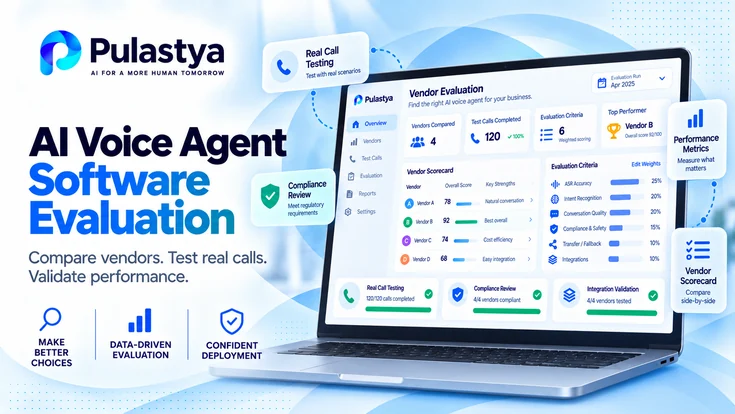
Enterprise buyers selecting AI voice agent software need a checklist that turns vendor demos into measurable decisions.
The criteria that matter most cover call direction and telephony fit, call quality, dialog control, transfer and fallback, integrations, compliance controls, billing model, and operational metrics. Use them to reduce risk and align procurement to business outcomes rather than vendor feature lists.
- Outcome-driven criteria Define acceptance metrics tied to business KPIs before contacting vendors.
- Real call validation Evaluate with recorded live calls, noisy channels, and accented speakers.
- Operational readiness Assess call direction, transfer and fallback, billing model, compliance controls, integration, and vendor SLAs as core evaluation items.
Start by mapping the business outcomes the voice agent must deliver: reduce average handle time, increase containment, collect required data, or route high-value calls to human agents.
Translate outcomes into acceptance criteria with measurable thresholds for recognition accuracy, intent completion, fallback rates, latency, and system availability. Frame each criterion as a pass fail or graded score to make vendor comparisons objective rather than subjective.
Prioritize evaluation scenarios by volume, complexity, and regulatory risk. Include live and simulated call traffic, accented speech, noisy channels, and multi-turn dialogs that require slot filling, confirmation, and escalation.
Require vendors to run the same test scripts against their baseline models and any custom models or domain tuning. Capture raw call recordings, transcripts, and evaluation logs for audit and long term model improvement.
Define Measurable Evaluation Criteria up Front
Begin evaluations with a concise requirements matrix that maps features to target metrics. For voice agents those metrics should include word error rate or domain-specific recognition accuracy, intent completion rate, average turn duration, fallback frequency, and end-to-end service latency under load.
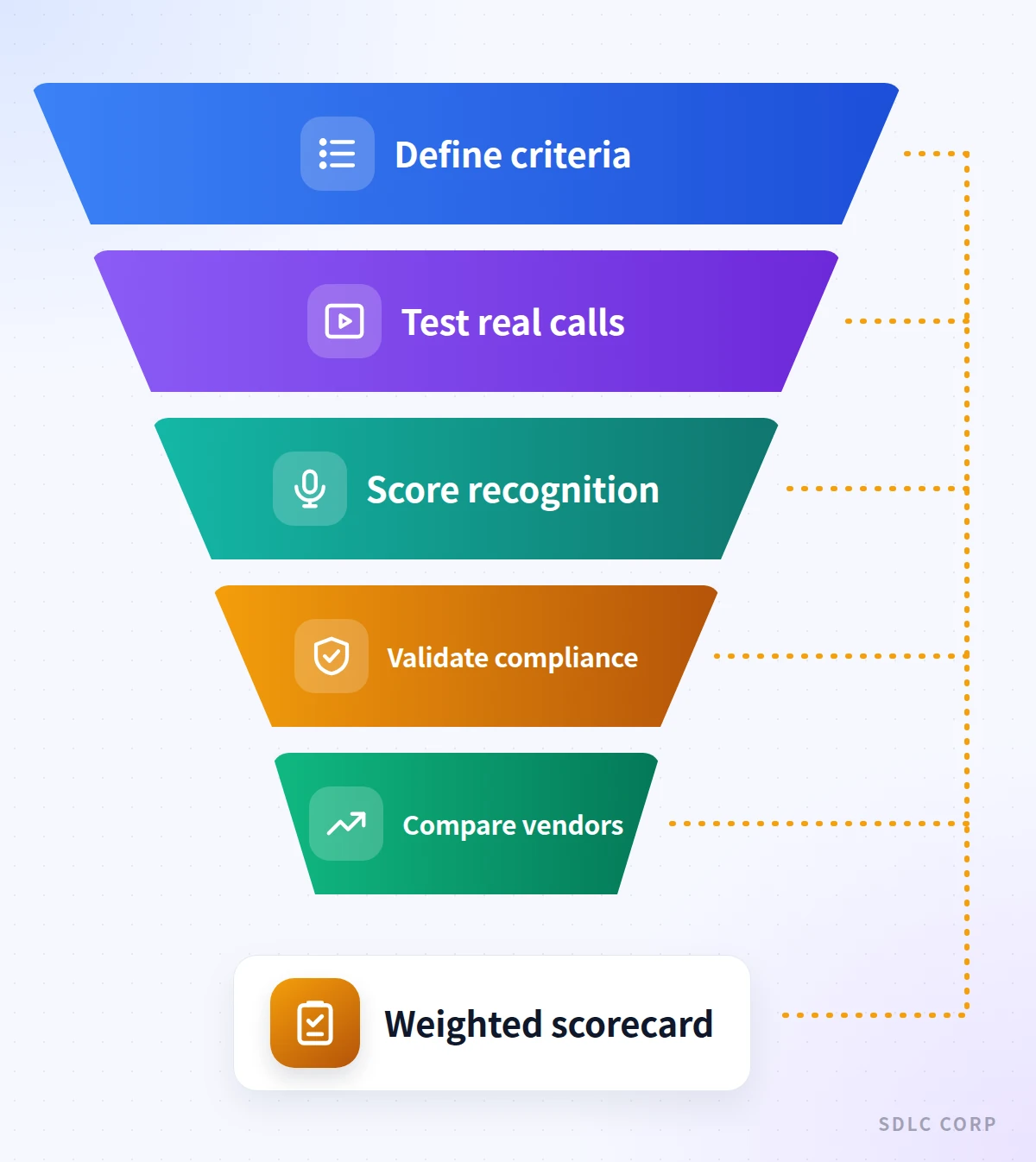
Assign target thresholds and weight each metric by business impact so scoring reflects priorities like containment or revenue capture.
Scope call direction before scoring anything else. Record whether the agent must answer inbound calls, place outbound calls, or both, and define the telephony path for each.
For inbound, confirm how calls reach the agent: a number bought through the platform, forwarding or porting an existing number, pointing an existing carrier number's webhook at the platform, or a SIP trunk from your phone system.
For outbound, confirm how calls are placed: single calls through an API, batches from a contact list, or triggers from a CRM or web form.
Outbound also brings caller ID setup, consent records, calling-hour limits, and do-not-call handling into scope. A vendor that demonstrates only one direction has not proven the other, so treat each required direction as a gating criterion.
Translate functional requirements into testable acceptance tests. Example tests include completing a representative qualification dialogue, measuring critical-field recognition in noisy audio, and validating response time under production-like traffic against thresholds chosen for the deployment.
Require vendors to provide evidence for each passing test: transcripts, timestamps, and system logs that map to the metric.
Include nonfunctional criteria and verification steps such as uptime during scheduled business hours, disaster recovery time objective, and mean time to repair.
Review vendor capacities to scale concurrent sessions and concurrent transcriptions. Make these nonfunctional items and the required call directions gating criteria for final selection rather than checkbox features so procurement teams account for operational continuity.
- Create a weighted scoring matrix mapping KPIs to numeric targets and score ranges.
- Score inbound and outbound separately, including the telephony path each one uses.
- Require vendor-supplied evidence: raw audio, raw transcripts, and evaluation logs for each test.
- Make latency and concurrency targets explicit for peak and off-peak scenarios.
- Score fallback and escalation behavior separately from raw recognition accuracy.
- Treat availability, DR, and maintenance windows as hard pass fail items.
Define measurable pass fail and graded criteria tied to concrete business KPIs before vendor engagement.
Evaluation criteria
What to Test for Each Criterion, the Evidence to Ask a Supplier for, and the Red Flags to Watch For
| Criterion | What to test | Evidence to ask for | Red flag |
|---|---|---|---|
| Call direction | Real inbound and outbound calls on the telephony path you will use in production | A recording of the live call plus the account showing the number and direction used | Required direction not shown live, or outbound lacks consent and calling-hour controls |
| Transfer and fallback | Cold and warm transfers, an unanswered destination and routing during an outage | Transcript and call summary handed to the receiving destination, and the configured failover route | Caller hears silence, or must repeat details after the transfer |
| Recognition and intent | Anonymized real calls with noise, accents, numbers and product names | Per-call results on your own audio sample, not an aggregate score supplied by the vendor | Accuracy proven only on scripted demo audio |
| Billing model | Monthly cost from your minutes, call lengths and model choices | An itemized invoice or usage export for the trial period, separating platform charges from provider usage | A headline rate that does not say which provider costs are included |
| Compliance controls | Disclosure prompts, recording settings, redaction and audit logs | The attestation or report itself, dated and in scope, rather than a statement that one exists | Certifications claimed with no attestation, or no BAA where HIPAA applies |
Score each criterion with a real test on your own calls, and treat a red flag as a gap to price or a reason to drop the vendor.
Test With Real Voice-Call Audio and Full Call Flows
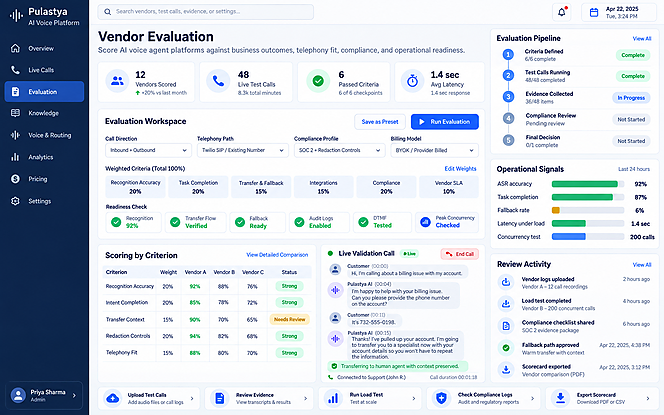
Synthetic demos mask real-world failure modes. Use recorded calls drawn from your contact center that reflect call lengths, accents, hold music, multi-party calls, and background noise. Convert those recordings into anonymized test sets and run them through vendor systems. Insist on the same scoring scripts across vendors to produce comparable results for intent extraction, slot filling, and dialog completion.
Include end-to-end call flows that cover authentication, data retrieval from backend systems, payment entry, and sensitive-data redaction. Test interruption handling, cold and warm transfers, and what happens when a transfer destination does not answer.
Validate that touch-tone (DTMF) detection and dual-tone voice interactions work reliably together. Real flows uncover integration gaps that do not appear in single-turn or scripted voice samples.
Run every test on the telephony path you will use in production, not a vendor demo line. If outbound calling is in scope, include outbound scenarios on that same path: a live answer, voicemail, the wrong person answering, and a request to stop calling.
Example: a mortgage lender needs to reduce manual intake for new applications. Create a test set with 1,000 anonymized mortgage inquiry calls including noisy background and varied income descriptions.
Run those through candidate voice agents, measure form completion without human handoff, and compare revenue-impacting error patterns. Use that scenario to calibrate vendor scoring toward measurable containment and correct data capture.
- Run anonymized recorded calls through each vendor to compare raw and normalized transcripts.
- Test multi-turn flows including authentication, data lookup, and payment capture end to end.
- Include noisy channels, accented speech, and background music to surface robustness issues.
- Validate mixed DTMF and speech inputs and confirm correct dual-mode handling.
- Test inbound and outbound scenarios on your production telephony path.
- Use a realistic scenario derived from high-volume call types to weight vendor scores.
Validate vendors using your anonymized real call recordings and full business call flows.
Assess Speech Recognition, LLM Intent, and Pronunciation Coverage
Separate ASR performance from downstream intent classification. Measure raw word and phrase recognition accuracy and then measure intent accuracy after normalization and entity extraction.
Some vendors report high ASR accuracy but still fail to extract critical fields like account numbers or custom product names. Build test cases for named entities, short numeric sequences, and domain-specific vocabulary to surface those gaps.
Check pronunciation and locale coverage. Evaluate performance on the accents and dialects common to your customer base and on nonstandard pronunciations of product names, place names, and acronyms. Require vendors to demonstrate how they support custom pronunciation dictionaries, phonetic tuning, or domain-specific lexicons and measure the incremental lift from such adaptations.
Consider the role of generative LLMs when used for intent resolution or response generation. Measure hallucination risk in factual responses and require guardrails for data access. For transactional tasks such as billing updates or order changes, insist that the system returns structured intents and confirmations rather than freeform LLM text that could produce ambiguous results.
- Measure ASR and post-processing intent accuracy separately to find downstream failures.
- Test named entities, account numbers, and product names with custom lexicons.
- Validate performance across locales and accented speakers representative of your callers.
- Require vendor documentation on phonetic dictionaries and domain tuning procedures.
- Assess LLM use for hallucination risk and require structured transactional outputs.
Evaluate ASR and downstream intent separately and validate pronunciation coverage for your caller base.
Verify Dialog Management, Interruptions, and Escalation Paths
Dialog management determines whether the agent closes tasks or generates churn. Test handling of interruptions, corrections, and mid-dialog context shifts. Run tests where callers change intent mid-call, provide partial answers, or correct previously given information. Measure how often the agent recovers without human handoff and quantify any negative loopbacks that cause repeated confirmations or circular prompts.
Inspect escalation logic and human-in-the-loop handoff. Confirm the agent marks contextual state for transfer, provides call summaries to agents, and preserves data integrity during transfer. Verify tone and textual prompts to ensure compliance language is preserved at escalation boundaries. For compliance-sensitive workflows, require hard stops before irreversible actions like refunds or charge reversals.
Evaluate transfer behavior by type. In a cold (blind) transfer, the live call goes to the destination without the agent first speaking with the receiver; in a warm transfer, the agent first reaches or briefs the receiver, or confirms availability, and then connects the caller.
Confirm which types are available on your plan and how context reaches the receiver in each case.
Then test fallback paths. Check what happens when no one answers a transfer, such as voicemail, a callback request, an alternate queue, or a return to the agent.
Ask how calls are routed if the voice agent service, a model provider, or a key integration is unavailable, and verify that callers reach a configured human line or message rather than silence.
Test session and context persistence across channels if omnichannel handoff is required. For example, a call that escalates to chat or SMS should carry conversation context, pending actions, and verification status. Measure data loss rates during channel handoff and set acceptable thresholds to avoid repeat verification and friction that increases average handle time.
- Test interruption recovery with callers changing intent mid-dialog and measure recovery rate.
- Require clean agent transfers with context summaries and preserved verification markers.
- Test cold and warm transfers, unanswered destinations, and routing during a platform outage.
- Set hard-stop rules for high-risk transactions and measure enforcement success.
- Evaluate omnichannel context persistence and quantify data loss during handoffs.
- Score dialog loops and repeated confirmations separately from task completion metrics.
Require robust interruption handling, context-preserving handoffs, and tested fallback routes as nonnegotiable features.
Validate Security, Privacy, and Compliance Controls
Treat security and data governance as core evaluation criteria. Confirm support for encryption in transit and at rest, tenant isolation, and role based access control to production logs and transcripts.
Review the vendor's incident response process, third-party audits, and any relevant certifications such as SOC 2 or ISO. Require transparency on where audio and model data are stored and how long it is retained.
Test compliance controls in the product, not only in contract documents. Check whether the agent can play required disclosures such as recording notices, whether recording and transcription can be limited by call type, and whether retention and deletion periods are configurable. Where HIPAA applies, confirm whether a business associate agreement is available and which plan tier it requires.
For outbound calling, confirm the controls for consent records, calling hours in the recipient's time zone, do-not-call suppression, and honoring opt-out requests during a call. Treat any control the platform lacks as work your team must build or a process it must run, and score it accordingly.
Evaluate redaction and data minimization features. Test whether PII can be redacted automatically from transcripts, whether DTMF-entered data bypasses transcription, and whether the system supports tokenization for backend storage.
For regulated industries, insist on proof that audio is isolated during training and that vendor policies prevent customer data from being used to train shared models without explicit consent.
Confirm compliance with applicable regulations such as HIPAA, PCI, or sector-specific rules. Ask for contract language supporting data residency, breach notification windows, and audit access. Require logging and immutable audit trails for transactions that change customer records and verify the vendor exposes the right telemetry for your compliance monitors and internal auditors.
- Require encryption, tenant isolation, RBAC, and documented incident response processes.
- Test automatic PII redaction, DTMF bypass, and tokenization for backend storage.
- Obtain evidence that customer audio is not used to train shared models without consent.
- Request certifications and compliance attestations relevant to your industry.
- Test disclosure prompts, recording settings, and outbound consent and calling-hour controls.
- Insist on immutable audit trails and exportable logs for internal compliance checks.
Make data governance, redaction, and compliant auditability gating criteria in procurement.
Assess Integration, Deployment Strategy, and Operational Metrics
Evaluate how the voice agent integrates with your telephony stack, contact center platform, CRM, and backend APIs. Confirm whether the vendor supports SIP, WebRTC, and common CCaaS platforms with sample connectors. Map required API calls for lookups, state changes, and confirmations and verify the existence of SDKs, webhook models, and message formats to avoid heavy custom middleware work.
Review deployment models and operational responsibilities. Determine whether the vendor offers managed cloud, virtual private cloud, or on-premise options and what parts remain your responsibility. Validate SLAs for uptime, latency, and support response times, and require run books for failover. Ask for load-testing evidence to understand how performance degrades at specific concurrency thresholds.
Plan for monitoring and observability. Confirm the vendor exposes call-level telemetry, error rates, per-intent metrics, and latency histograms to your monitoring tools. Build dashboards for business and engineering stakeholders that show containment, average handle time, fallback reasons, and human escalation patterns.
- Require connectors for SIP, WebRTC, and major CCaaS platforms and check sample integrations.
- Clarify deployment options: managed cloud, VPC, or on-premise and associated responsibilities.
- Obtain vendor SLAs for uptime, latency, and support and runbook access for failover.
- Request load-testing evidence that shows performance at target concurrency.
- Confirm exposure of call-level telemetry and ability to hook into your monitoring stack.
Make integration complexity, deployment model, and telemetry exposure part of the scoring matrix.
Evaluate Vendor Support, Roadmap, and Total Cost of Ownership
Assess the vendor's support model and the economics of production support. Clarify SLAs for incident triage, escalation paths, and access to engineering during go live. Evaluate whether the vendor provides a dedicated customer success team, runbooks, and onboarding QBRs. For projects with high uptime requirements, factor dedicated support resources and faster response promises into cost comparisons.
Review the product roadmap and release cadence against your critical features and compliance needs. Ask how frequently models are updated, how backward compatibility is maintained for dialog flows, and the vendor policy for deprecating features. Prioritize vendors that provide transparent roadmaps, clear change control, and a mechanism for urgent fixes tied to contractual commitments.
Identify the billing model before building the TCO. Bundled per-minute pricing folds platform and provider costs into one rate. Platform fee plus pass-through pricing adds provider usage to a per-minute platform fee.
With bring-your-own-keys (BYOK) provider billing, you connect provider accounts the platform supports and those providers bill you directly, which exposes provider usage but leaves your team managing the accounts, keys, and limits.
Pulastya AI, for example, charges no software fee above provider usage: customers connect their own supported telephony and AI-provider accounts, currently Twilio and OpenAI, and those providers bill the usage directly. Whatever the model, calculate cost from your own call volumes, call lengths, and model choices rather than a headline rate.
Calculate realistic total cost of ownership over a three year horizon. Include licensing, per-minute platform and provider fees, any model adaptation costs, integration and middleware expenses, and internal support headcount.
Apply a risk buffer for remediation work identified in pilot tests. Use the scoring matrix to convert functional gaps into estimated remediation costs and include those in the final procurement comparison.
- Validate SLAs for support, incident response, and access to engineering resources.
- Request a public or customer-facing roadmap and verify change control practices.
- Identify the billing model: bundled per-minute, platform fee plus pass-through, or BYOK provider billing.
- Estimate three year TCO including licensing, per-minute fees, customization, and internal support.
- Factor remediation costs and a risk buffer identified during pilot testing.
- Score vendors on transparency, responsiveness, and clear upgrade or deprecation policies.
Compare vendors on support SLAs, roadmap transparency, and realistic three year TCO.
A buyer assessment should connect the cost model with implementation effort and pre-production testing.
To apply these criteria to specific vendors, see how to evaluate the best AI voice agent platforms, which compares capabilities, pricing models and buyer fit.
Conclusion
Selecting AI voice agent software requires more than comparing feature lists or polished demos. Build a weighted evaluation scorecard around your business outcomes, then test each vendor using anonymized real calls on the inbound and outbound telephony paths you plan to deploy. Measure task completion, speech recognition, intent accuracy, latency, interruption recovery, human handoffs, and fallback behavior alongside security and compliance controls.
Before choosing a vendor, validate integrations, monitoring, concurrency, service-level agreements, and data governance in a production-like pilot. Compare total cost of ownership using your expected call volumes, provider charges, implementation effort, support needs, and potential remediation costs. Select the platform that meets your acceptance thresholds with verifiable evidence and a clear operational model, rather than relying on the lowest advertised rate.
Frequently Asked Questions
Weight task completion higher if the agent drives business outcomes such as form completion or payments. Recognition accuracy is important but secondary to whether the agent completes the required task. Use a weighted scoring matrix that assigns higher weight to completion, lower weight to raw ASR metrics, and separate scores for security and compliance controls.
Require explicit contract language if you do not want recordings used for shared model training. Ask for data handling policies that state whether customer audio is used to improve base models and require opt out or model training isolation. For regulated data, insist on a clause preventing any use without written consent.
Run a pilot that mirrors peak call types and volumes for at least two to four weeks. Include a representative sample of accents, noise conditions, and multi-turn dialogs. A pilot with several thousand calls will surface scalability and edge-case failures; smaller pilots can validate basic function but will miss concurrency and rare issues.
Test human handoff end to end. Verify the receiving agent sees a concise context summary, the verified identity markers, and any collected slots without data loss. Measure how often agents need to re-verify information and set thresholds for acceptable re-verification rates. Include these tests in your acceptance criteria.
Require call-level telemetry including intent classification rates, fallback frequency, per-intent latency, error codes, and handoff reasons. Expose aggregate KPIs like containment, average handle time, and escalation ratios. Ensure the vendor provides logs and metrics in formats compatible with your observability stack for real time alerts and historical analysis.