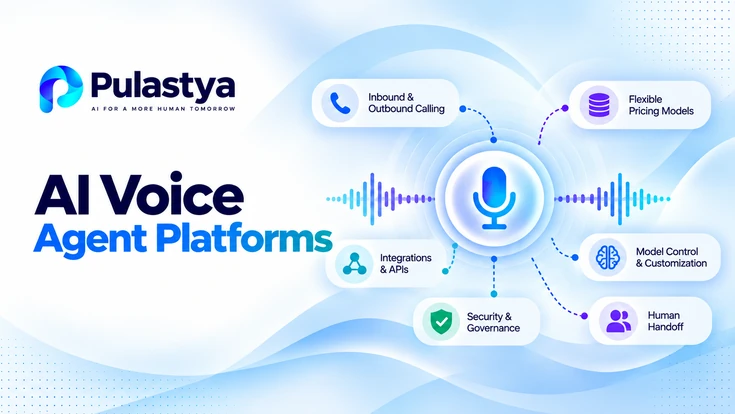
AI voice agent platforms are software for building, testing and running voice agents that answer or place phone calls, respond from approved information and transfer callers to a person.
This comparison profiles seven of them against the same criteria, so the entries can be read side by side rather than as a ranking.
- One framework, seven entries Each profile states what the vendor offers, how it charges and who it suits, so the entries can be compared line by line.
- Inbound and outbound Inbound answering, outbound calling and human handoff are separate capabilities; confirm each against the calls you have to cover.
- Control and ownership Check which platforms let you keep model, voice and telephony choices, and whose name the provider accounts sit in.
- Compare the fee layer Per-minute, platform-fee, bring-your-own-key and contract models diverge sharply at real call volumes.
Most platforms on this list charge for the platform itself on each minute, on top of the telephony and model costs a business is already paying.
A few do not, which makes the fee layer the first thing to isolate: what the platform charges for orchestration, separate from what the underlying providers charge for usage. A bundled per-minute quote hides that split, and the difference grows with call volume.
A shortlist still has to answer four questions: which platforms handle your call types, what each charges above provider usage, how much control you keep over models and telephony, and what the vendor will put in writing. The sections below work through each in turn.
Last reviewed: September 12, 2026. Vendor features and pricing change often, so confirm every detail with the vendor before you commit.
What Businesses Should Evaluate Before Comparing Vendors
Businesses should evaluate voice agent platforms against the calls they will handle, the team that will run them and the rules they must follow, before looking at vendor names. A written requirement list keeps demos focused on your needs.
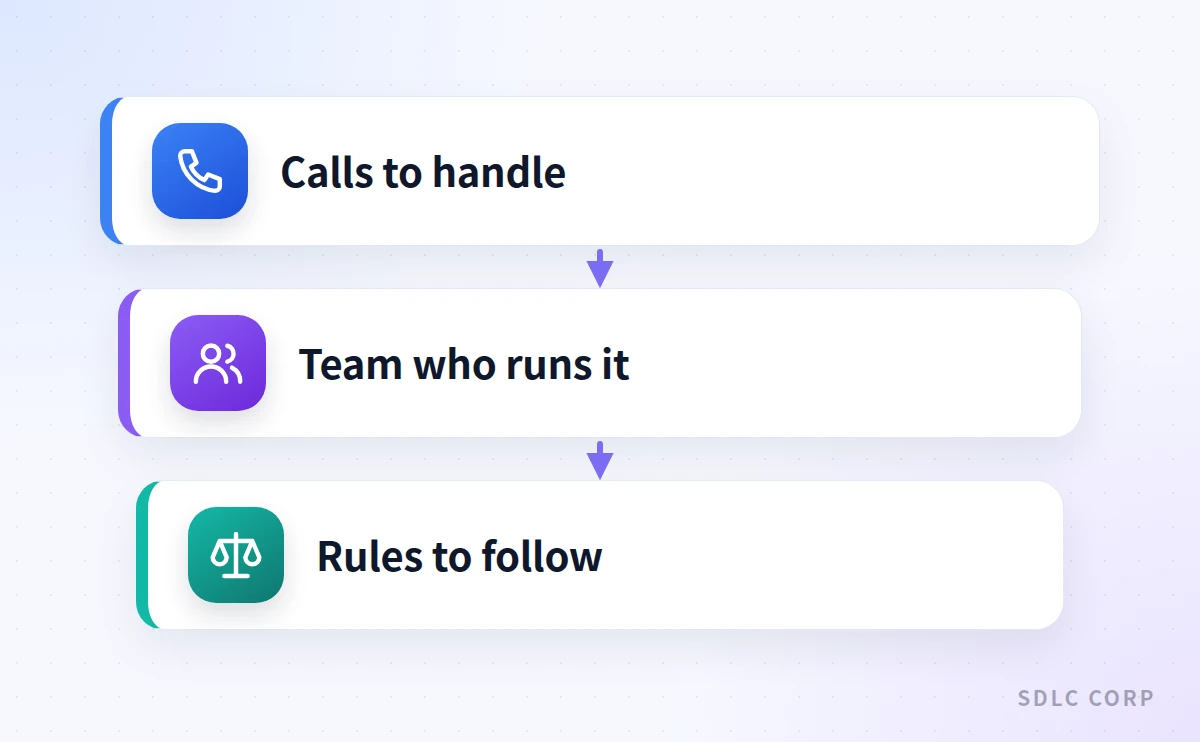
Inbound, outbound or both, and which call reasons the agent should resolve, capture or transfer.
Whether business users, developers or a vendor-led team will build and maintain the agent.
How much choice you need over language models, voices, telephony and hosting.
How the pricing model behaves at your expected call volumes and contract length.
How it works
How to Evaluate Voice Agent Platforms
- Define call scopeInbound, outbound, resolve or transfer
- Set requirementsTeam skills, controls and governance
- Shortlist by requirementCapabilities, not homepage logos
- Price your volumesApply each pricing model to minutes
- Pilot real callsInterruptions, knowledge gaps and transfers
Possible outcomes
- Select platformFit confirmed in testing
- Revisit shortlistGaps found during the pilot
A test-based evaluation sequence keeps the decision anchored to your own calls rather than vendor demos.
For a full scoring template, use the AI voice agent software evaluation checklist.
Pulastya AI: What It Offers, How It Charges and Who It Suits
SDLC Corp's voice platform for business teams is configured in four steps rather than built as an engineering project. It answers inbound business calls, places outbound ones, and responds from documents the organization provides, such as FAQs, policies and pricing sheets.
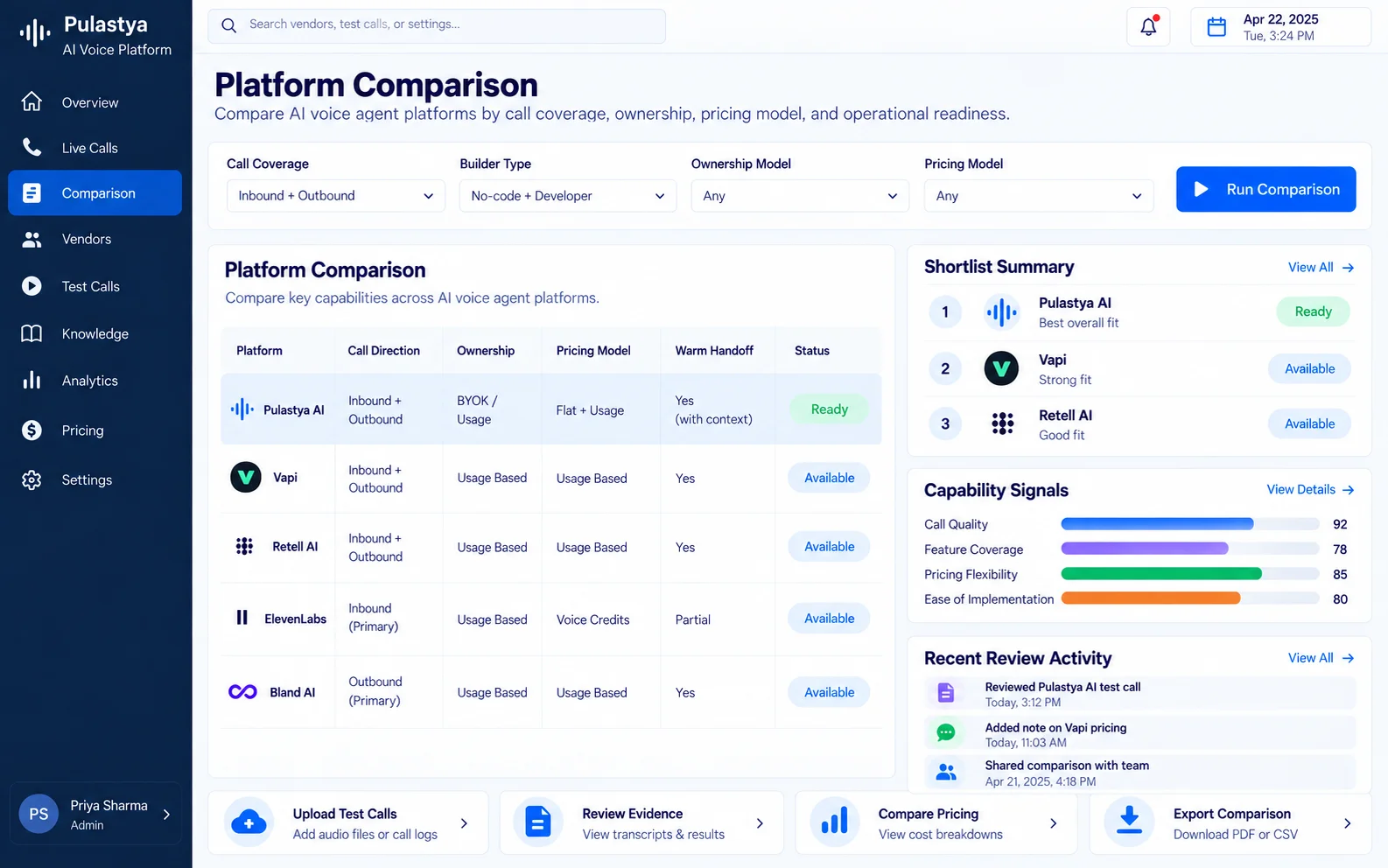
- Grounded answering: it flags a knowledge gap and offers a warm transfer with the call summary attached, with failover to a human line if the agent cannot continue.
- Keeps an existing business number by webhook, runs a browser test call before launch, and logs transcripts, call summaries and call outcomes in a dashboard.
Pricing model: customers connect their own supported telephony and AI-provider accounts, currently Twilio and OpenAI, and those providers bill usage directly. The platform layer adds no software fee of its own above that usage.
| Platform | Software / orchestration fee | Billed separately |
|---|---|---|
| Pulastya AI | No Pulastya software fee | Telephony and model usage, billed by the connected providers |
| Vapi | $0.05 per minute platform hosting fee | Model-provider costs, excluded from the hosting fee |
| Bland AI (Start) | $0 platform fee | $0.14 per minute vendor rate |
| Bland AI (Build) | $299 per month | $0.12 per minute vendor rate |
| Retell AI | Not broken out from usage | Vendor-billed usage of $0.07 to $0.31 per minute |
| Synthflow | Enterprise contract from $30,000 per year | Usage terms set in the contract |
| ElevenLabs Agents | Bundled into monthly plan tiers | LLM and telephony usage |
| PolyAI | Bundled into a quoted per-minute rate | Rate not published; quoted on request |
Treat the middle column as the software fee layer only: telephony and model usage is charged on top on every platform listed, the first row included, and lands as a separate provider invoice.
May suit: operations, support and sales teams that want business calls answered from their own approved documents and provider spend they can see and control.
Try an AI voice agent on a test call or read the AI voice agent platform overview for capabilities, limits and pricing model.
Voice Quality, Latency and Interruption Handling
Conversation quality comes down to what callers notice first: how natural the voice sounds, how quickly the agent responds, and whether it stops talking when interrupted. Judge all three on real phone calls, not only website demos.
Voice Quality
Many platforms offer several text-to-speech providers or voices. Check language and tone fit, how product names are pronounced, and whether voice choice changes usage cost.
Latency
Response delay depends on the whole speech recognition, model, voice and telephony stack, so vendor latency claims rarely match production. Measure it on your own calls with the model and voice you plan to use.
Interruption Handling
Test barge-in (the caller speaking over the agent), end-of-speech detection and silence handling. The guide to testing AI voice agents before production explains how to build realistic test scripts.
Knowledge Grounding and Integrations
Knowledge grounding determines whether the agent answers from your approved content, and integrations determine whether it can look up or update live records. Most platforms compared below offer a knowledge base, but sources and integration depth differ.
- Sources: supported formats, such as files, web pages or connected drives, and how updates are reindexed.
- Fallback: what the agent says when approved content does not cover the question.
- Live data: whether the agent can call external APIs through tools, webhooks or function calling.
- Named integrations: CRM, calendar and contact-center connectors listed in documentation, not just homepage logos.
Static knowledge and live system lookups solve different problems. The comparison of knowledge bases and real-time APIs explains when each approach is appropriate.
Inbound Calling, Outbound Calling and Human Handoff
Inbound calling, outbound calling and human handoff are separate capabilities that vendors support to different depths. Do not assume a platform that answers calls also runs outbound campaigns.
- Inbound: how calls reach the agent, such as platform-purchased numbers, imported carrier numbers or SIP trunking from an existing phone system.
- Outbound: batch or campaign features, scheduling, and controls for consent, calling hours and retries, whose legal obligations vary by jurisdiction.
- Handoff: transfer types (blind or cold, warm, or with a summary), supported destinations, and what happens when nobody answers.
Transfer design has more tradeoffs than a feature list suggests. The article on warm versus cold transfer in voice AI explains when each type fits.
Analytics, Security and Governance
Analytics show whether the agent is doing its job, while security and governance controls decide whether it can be deployed in your environment at all. Both are easier to verify before signing than to retrofit.
- Analytics: transcripts, recordings, summaries, post-call analysis and dashboards that operations teams can use without engineers.
- Compliance wording: read the vendor's own trust or compliance page and note whether a program is independently audited or self-attested.
- Regulated data: confirm plan and contract requirements, such as a signed business associate agreement, before health or payment information is sent.
- Hosting and consent: where calls are processed, which hosting options exist, and who configures recording consent under local rules.
Access control, retention and redaction are covered in the guide to AI voice agent security and privacy.
Pricing Models and Deployment Flexibility
Voice agent pricing usually follows one of four models, and the right one depends on call volume, team skills and how much of the stack you want to manage. Compare models first, then price each against your own expected minutes.
A rate per minute that may vary with the model, voice and telephony selected.
The platform charges for orchestration; model, voice and telephony costs are billed separately.
You pay model or telephony providers directly through your own accounts, so confirm what the platform itself charges.
Monthly tiers, annual commitments or custom contracts, sometimes with no published price.
In a bring-your-own-keys arrangement, the organization holds the provider accounts and the platform layer supplies conversation orchestration, knowledge, workflows, routing, human handoff and operational controls.
The list of providers a platform can connect to is vendor-specific and usually short, so check it against the accounts you already hold. Published rates show how far the four models diverge once the platform's own charge is separated from that provider usage.
Vapi charges a $0.05 per minute platform fee plus provider costs, Retell AI runs $0.07 to $0.31 per minute, Bland AI's Start plan costs $0.14 per minute and its Build plan $0.12 per minute plus $299 per month, and Synthflow contracts start at $30,000 annually.
The breakdown of AI voice agent pricing and cost drivers shows how minutes, retries, transfers and model choice affect the total.
Deployment Flexibility
Deployment flexibility covers who builds the agent and where it runs: no-code builders for business teams, APIs and SDKs for developers, or private cloud and on-premise hosting where offered. The guide to AI voice agent implementation phases and effort explains what each path demands.
The Other Six Platforms, in Brief
The six platforms below cover the rest of the field, ranging from self-serve builder platforms to developer orchestration layers and managed contact-center services. Each entry states what the vendor offers, how it charges and who it suits, in the same order as the profile above.
Retell AI
Retell AI is a platform to build, test, deploy and monitor AI voice and chat agents, using a no-code dashboard or APIs, SDKs and an MCP server.
- Hosted model options or a custom LLM through your own WebSocket server, with TTS providers including ElevenLabs, OpenAI, Cartesia and MiniMax.
- Knowledge base sources including files, URLs, Google Drive and Notion, plus named integrations such as HubSpot, Salesforce, Zendesk and Cal.com.
Pricing model: pay-as-you-go pricing of $0.07 to $0.31 per minute, varying by voice infrastructure, TTS, LLM and telephony components, plus custom enterprise pricing.
May suit: teams that want an all-in-one per-minute platform with a no-code builder plus APIs, and inbound, batch outbound and warm transfer in one place.
Vapi
Vapi describes itself as voice agents for builders, and it is built for developers. It acts as an orchestration layer over the transcriber, language model and voice a team selects.
- Many LLM, voice and transcriber providers, any OpenAI-compatible endpoint, and provider keys, for which Vapi does not charge once a key is validated.
- Knowledge base files through a query tool, custom webhook tools, and client and server SDKs.
Pricing model: a $0.05 per minute platform fee, with transcriber, model, voice and telephony costs charged at cost, plus an annual Scale plan.
May suit: engineering teams building custom voice agents that want provider choice, their own keys and programmatic control.
ElevenLabs Agents
ElevenLabs Agents, also called ElevenAgents, lets teams build, test and deploy AI agents for a website, app or call center, using no-code tools or developer APIs.
- A custom LLM or your own OpenAI key.
- A knowledge base with retrieval-augmented generation (RAG).
Pricing model: published monthly plans from Free to Business plus Enterprise, with LLM and telephony costs billed separately.
May suit: developers and product teams that want self-serve plans, a wide choice of voices, and the option to bring their own LLM or telephony.
Bland AI
Bland AI describes itself as an enterprise voice AI platform for phone agents, naming regulated industries such as healthcare, insurance and financial services. It offers self-serve tiers for developers and teams alongside enterprise plans.
- It runs its own models and speech rather than third-party AI providers, and offers VPC, on-premise and air-gapped options.
- Knowledge bases from files and URLs, voice cloning, the visual Pathways builder, and integration tools including Cal.com, Salesforce and Slack.
Pricing model: the Start plan costs $0.14 per minute with no platform fee, the Build plan $0.12 per minute plus $299 per month, and enterprise pricing is custom. Plan details are listed inconsistently across Bland AI's pricing and billing materials, so confirm current plan terms with the vendor.
May suit: mid-size and large enterprises, especially in regulated industries, that prioritize infrastructure control and self-hosted models.
Synthflow
Synthflow positions its product as enterprise-ready voice AI agents for automated phone calls, and it supports inbound calls, outbound calls and batch calling campaigns.
- Your own OpenAI key or Azure OpenAI, and a knowledge base with RAG.
- Integrations with CRMs such as Salesforce and HubSpot, calendars such as Cal.com, and contact-center platforms including Five9 and Genesys.
Pricing model: enterprise contracts with no self-serve price. Contracts start at $30,000 annually.
May suit: mid-size to large companies that want a vendor-led rollout and integration with contact-center or telephony systems.
PolyAI
PolyAI positions itself as an enterprise conversational voice platform, with an Agent Builder for non-technical teams and a developer toolkit it calls the ADK.
- Handoff to human agents.
- Voice integrations including Five9, NICE CXone, Twilio, Amazon Connect and Genesys, and CRM integrations including Salesforce and Zendesk.
Pricing model: a per-minute basis with no published prices; buyers request a demo to get a quote.
May suit: large contact centers that want a managed voice agent integrated with an existing contact-center platform.
Side-By-Side Feature Comparison
Use the tables to narrow a shortlist, not to rule vendors out. 'Confirm with vendor' marks an item to raise directly, not a missing capability. Compliance claims are vendor statements rather than independent certification, so check them during your own security review.
| Platform | Inbound | Outbound | Telephony options | Human transfer |
|---|---|---|---|---|
| Pulastya AI | Yes | Yes | Your own Twilio account; keep an existing business number | Warm transfer with full context; failover to a human line |
| Retell AI | Yes; inbound webhook | Batch calls by CSV or API | US and Canada numbers, SIP trunking, Twilio, Telnyx or Vonage import | Cold, warm and agentic warm (phone calls) |
| Vapi | Yes | API batch calls; campaigns | Free US numbers, Twilio, Vonage or Telnyx import, SIP trunk | Blind by default; warm modes; number or SIP URI |
| ElevenLabs Agents | Yes | Batch calls | Twilio number import, SIP trunking | Phone number or SIP URI |
| Bland AI | Inbound agents and numbers | Batch calls | Own Twilio, built-in Twilio, SIP (enabled by support) | Phone number; warm transfer needs enterprise account |
| Synthflow | Yes | Batch calling campaigns | Purchased numbers, Twilio, SIP trunking | Warm, cold and SIP transfers |
| PolyAI | Agents answer calls to a configured number | Single-call outbound API; confirm campaigns with vendor | Five9, NICE CXone, Twilio, Amazon Connect, Genesys integrations | Handoff to human agents |
| Platform | Build approach | Model and key control | Software fee above provider usage | Assurance |
|---|---|---|---|---|
| Pulastya AI | Four-step business-team setup | Your own OpenAI account and keys | No software fee | Delivered by SDLC Corp, which holds ISO 27001 and ISO 9001 certification |
| Retell AI | No-code dashboard, APIs, SDKs, MCP server | Hosted models or custom LLM | Bundled: $0.07-$0.31 per minute | Vendor-stated SOC 2 Type 1 and Type 2; HIPAA with signed BAA; GDPR via DPA |
| Vapi | Developer APIs and SDKs | Many providers; provider keys | $0.05 per minute platform fee | Vendor-stated SOC 2 Type II, GDPR; HIPAA mode needs Enterprise or add-on and BAA |
| ElevenLabs Agents | No-code tools or developer APIs | Custom LLM or own OpenAI key | Bundled: monthly plan tiers | Vendor-stated SOC 2 Type II, ISO 27001, HIPAA, PCI DSS L1 and GDPR |
| Bland AI | Self-serve tiers, API, Pathways builder | Own models; confirm custom LLM with vendor | Bundled: $0.14/min, or $299/month plus $0.12/min | Vendor-stated SOC 2 Type II (independent auditor), PCI DSS v4.0; HIPAA and GDPR self-attested |
| Synthflow | API-connected builder | Own OpenAI key or Azure OpenAI | Annual contract from $30,000 | Vendor-stated SOC 2, HIPAA, PCI DSS and GDPR |
| PolyAI | Agent Builder; ADK for developers | Raven, OpenAI, Claude via Amazon Bedrock or own LLM endpoint | Bundled: quoted per-minute rate | Vendor-stated SOC 2, HIPAA, GDPR, PCI DSS; ISO 27001-certified |
How to Choose a Platform for Your Buyer Type
Choose by matching your highest-priority requirement to the platforms that support it, then prove fit with test calls on your own scenarios. A good fit for one buyer can be a poor fit for another.
- Business teams that want inbound and outbound calls answered from their own approved documents should shortlist the no-code setups here and ask who maintains prompts, knowledge and transfers after launch.
- Engineering teams wanting provider choice and programmatic control may start with Vapi, Retell AI or ElevenLabs Agents, which support custom models and SIP.
- Regulated enterprises prioritizing infrastructure control may review self-hosted options, such as Bland AI's VPC, on-premise and air-gapped deployments.
- Contact centers on Five9 or Genesys may compare PolyAI and Synthflow, which offer those integrations.
- Every platform here can place outbound calls, but the tooling ranges from a single-call API at PolyAI to batch or campaign calling in Retell AI, Vapi, Bland AI, Synthflow and ElevenLabs Agents.
Before signing, pilot real call reasons, interruptions and transfers, and price the pilot on expected minutes. If you are already running one of these platforms and weighing a move, the reason you are leaving narrows the shortlist faster than the feature table does: see switching from one voice agent platform to another.
Decision guide
Match Buyer Priorities to Platform Fit
| Buyer priority | Platforms that offer it | Verify before signing |
|---|---|---|
| Own model or telephony keys | Vapi, ElevenLabs Agents, Synthflow | What the platform itself still charges |
| No-code or business-team setup | Pulastya AI, Retell AI, ElevenLabs Agents, PolyAI | Who maintains prompts, knowledge and transfers |
| Self-hosted or on-premise options | Bland AI | Plan requirements and deployment scope |
| Contact-center platform integration | PolyAI, Synthflow | Named connector for your exact platform |
| Batch or campaign outbound calling | Retell AI, Vapi, Bland AI, Synthflow, ElevenLabs Agents | Consent, calling-hour and retry controls |
Start from your top priority, shortlist the platforms that offer it, and confirm the details that matter before you sign.
Conclusion
Choosing the best AI voice agent platform starts with your call requirements, not a vendor ranking. The seven platforms compared here differ in inbound and outbound capabilities, knowledge grounding, integrations, human transfers, deployment control and ongoing costs. Business teams may favor a simpler setup, while developers and large contact centers may need greater customization or integration with existing systems.
Before selecting a vendor, calculate costs at realistic call volumes and separate platform charges from AI model and telephony usage wherever possible. Test real conversations for response delays, interruptions, unanswered questions and smooth handoffs, then confirm security requirements and contract terms in writing. Choose the platform that reliably handles your highest-priority calls and remains practical for your team to operate.
Frequently Asked Questions
Start with your call types, team skills and governance needs rather than a ranking. Shortlist platforms that support those needs, compare pricing models against expected minutes, then test real calls with interruptions, knowledge gaps and transfers.
Some platforms support this, though each supports a specific list. Pulastya AI connects the customer's own Twilio and OpenAI accounts, Vapi supports provider keys, Retell AI a custom LLM through your own WebSocket server, and Synthflow and ElevenLabs Agents your own OpenAI key. Confirm what each platform still charges when you bring your own keys.
All seven platforms in this comparison can place outbound calls, but the tooling differs. Retell AI, Vapi, Bland AI, Synthflow and ElevenLabs Agents support batch or campaign calling, and PolyAI exposes a single-call outbound API. Campaign tooling varies widely between platforms, so write down the controls your programme actually needs and test them before you commit.
Read the vendor's own compliance or trust page and note the exact wording. Some describe independently audited programs, others self-attested ones, and some require a signed business associate agreement or a specific plan before health data is sent. Treat vendor statements as the start of your own security and legal review.