Warm and cold transfer describe two opposing call-handling models that shape caller experience, agent efficiency, and technical integration in voice AI systems.
Choosing the right transfer model affects how context, consent, and data flow between automated systems and live agents. Each model carries distinct operational and implementation requirements for enterprise deployments.
- Customer experience Warm transfers brief the receiver before the caller joins, which reduces repetition; cold transfers skip that consult, so the receiver may ask the caller to repeat details unless the AI passes structured data into the next agent workflow.
- Operational cost Cold transfers minimize orchestration overhead and lower platform complexity, while warm transfers often raise agent time and integration costs but can boost resolution rates.
- Technical scope Warm transfers require presence checks, a consult leg, session handoff APIs, and consent capture; cold transfers focus on robust routing rules and metadata persistence so the receiving desktop can show context on pickup.
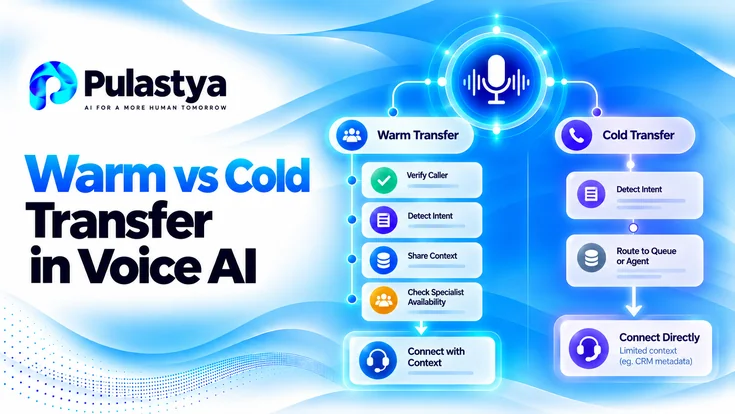
Define the transfer model early. In a warm (consult) transfer, the AI agent or a human intermediary first reaches the receiver, briefs them or confirms they are available, and then connects the caller. In a cold (blind) transfer, the live call is sent to the destination without that prior consult.
Neither model drops the call, and a cold transfer can still pass context out-of-band as a screen pop or CRM note. For voice AI deployments, the distinction determines whether the receiving agent is briefed before pickup, whether the AI agent stays on the line during the consult, and how long the overall contact takes.
Focus on tradeoffs you can measure: average handle time, first-contact resolution, customer effort, and platform complexity. These tradeoffs apply to an enterprise contact center architecture with voice AI front-end, CRM integration, and supervised agent teams. Key design decisions include failover behavior, privacy-preserving transcription handoffs, and real-world escalation paths.
What Is a Warm Transfer and When to Use It?
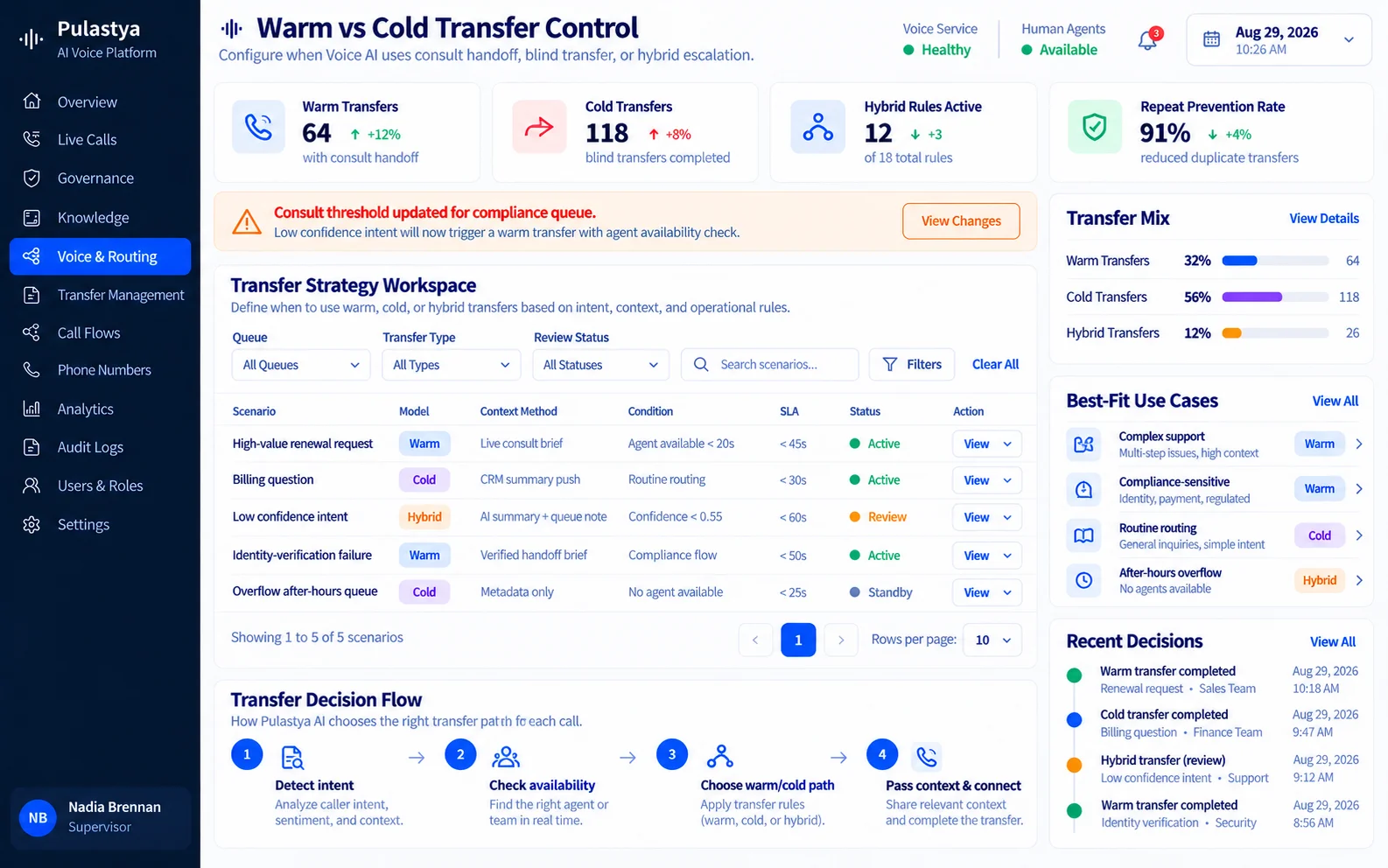
A warm transfer routes a caller to another party after a live or automated intermediary reaches the receiver and shares context or confirms availability. In voice AI, the handoff can be agent-to-agent, AI-to-agent, or AI-assisted agent briefing. Use warm transfers for high-complexity issues where the next agent benefits from an explicit summary, active consent, or stateful session continuation.
Operational indicators for warm transfer include high-value customers, multi-step transactions, or regulated interactions that require a human to verify identity or collect signatures.
Warm transfers reduce repeat explanation and support cross-sell opportunities because the receiving agent is briefed before the caller joins, rather than picking up with only the data that reached their desktop. That briefing must be explicit and auditable in enterprise systems.
Tradeoffs to evaluate: warm transfers lengthen active contact time and demand stronger integration between voice AI, agent desktops, and CRMs. Plan for agent availability windows and fallback routing rules to prevent long hold times. Implement warm transfer selectively for high-impact queues rather than universally to control labor costs and latency.
- Preserves conversational context and reduces customer repetition
- Requires agent availability checks and real-time session bridging
- Useful for high-value accounts, complex escalations, and compliance-sensitive calls
- Increases average handle time and platform orchestration requirements
Warm transfers improve resolution at the cost of more complex routing and longer active sessions.
What Is a Cold Transfer and Where It Fits
A cold transfer, also called a blind transfer, sends the live call to another queue or number without an intermediary briefing or confirmation. The call is not dropped and the caller does not redial.
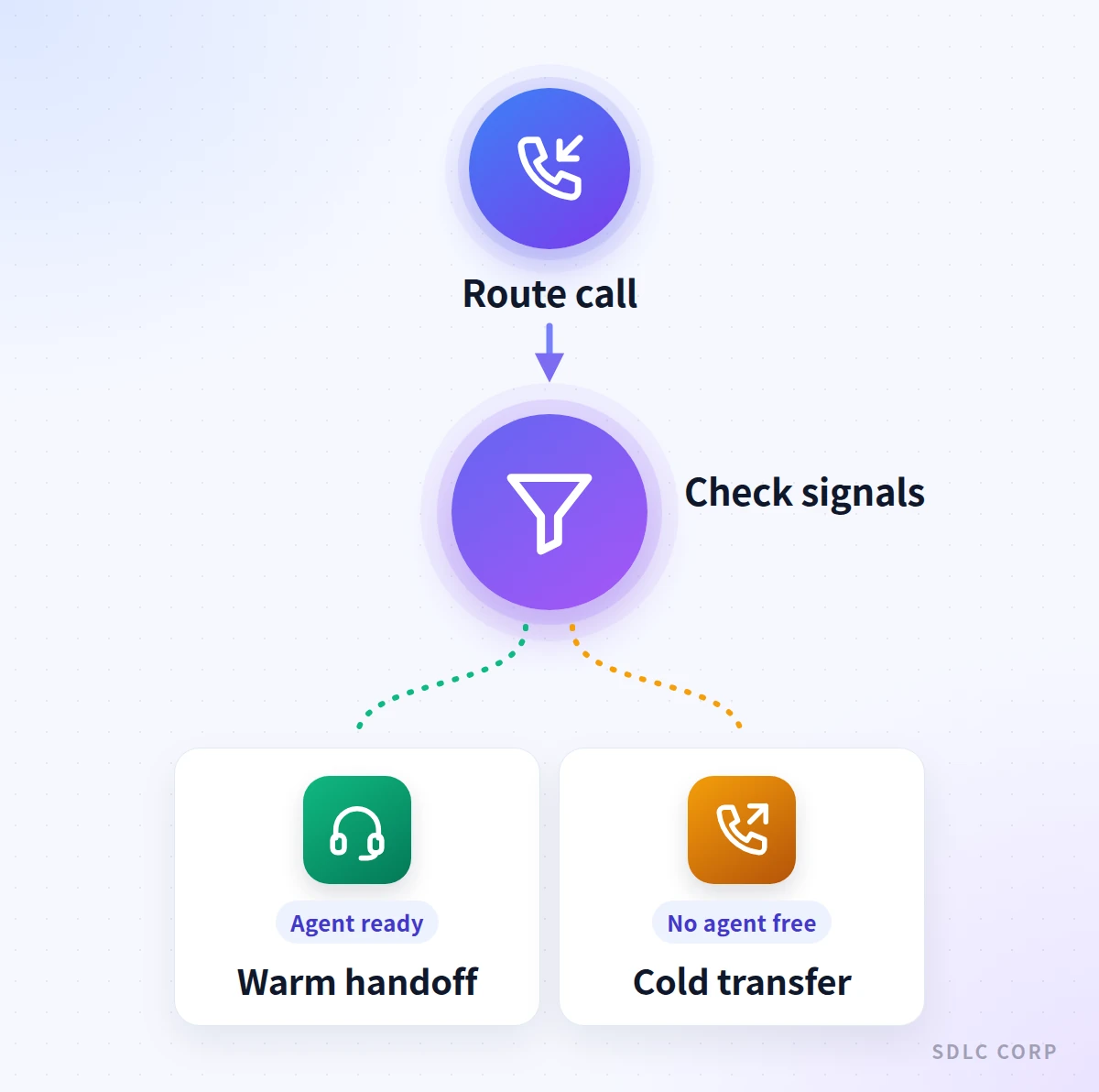
In voice AI flows, this often means the AI routes the call using DNIS or routing rules and ends its active involvement. Use cold transfers when speed, throughput, and low integration overhead matter more than a live briefing.
Cold transfers reduce orchestration demands because they avoid a consult leg and agent-to-agent negotiation. They are appropriate for simple routing decisions, basic verification transfers, or when the receiving system can fetch structured data asynchronously from a shared CRM. Cold transfer is also the preferred fallback when no agent is immediately available for a warm handoff.
The main risk is that the receiver was not briefed and may ask the caller to repeat information, which is more likely when metadata is not persisted or injected into the receiving agent's desktop.
Mitigate that risk by ensuring the voice AI logs structured summaries, pushes key fields to the CRM, and signals expected call reasons to the routing engine so receiving agents get a preview.
- Minimal orchestration; faster routing and higher throughput
- Best for straightforward routing and large-volume queues
- Receiver starts unbriefed and may ask callers to repeat details if no context is passed
- Lower implementation complexity compared with warm transfers
Cold transfers optimize throughput but demand robust metadata persistence to avoid poor customer experience.
Transfer models
Warm vs Cold Transfer: The Difference Is the Consult
| Aspect | Warm (consult) transfer | Cold (blind) transfer |
|---|---|---|
| Before the caller is connected | AI reaches the receiver, briefs them or confirms availability | Live call goes straight to the queue or number with no consult |
| Is the call dropped? | No; the caller waits on hold during the consult | No; the live call is sent on and the caller does not redial |
| Context for the receiver | Summary delivered before pickup, spoken or on screen | Can arrive out-of-band as a screen pop or CRM note |
| Main risk | Longer contact time and hold while the consult runs | Unbriefed receiver may ask the caller to repeat details |
| Best fit | Complex, high-value or compliance-sensitive calls | Simple routing, high-volume queues, fallback when no agent is free |
Both models keep the call live; what changes is whether the receiver is briefed before the caller is connected.
Technical Architecture Required for Warm Transfers
Implementing warm transfers requires session continuity, real-time APIs, and a way to surface AI-generated summaries to live agents. Typical architecture includes a voice platform that supports call conferencing or on-hold bridging, a context store for transcripts and intent labels, and an agent desktop that accepts pre-call briefings via API.
The voice AI must also support transcript redaction and selective data sharing for privacy.
Key integration points include session-handoff endpoints, authenticated metadata channels to the agent desktop, and real-time presence checks so the AI or intermediary can confirm agent readiness. Design the workflow to allow an automated summary to be played or displayed and to support supervised escalation where an agent can join the conversation while the AI remains connected for fallback.
Operational safeguards matter: ensure deterministic timeout behavior if the receiving agent fails to answer, and capture consent before passing sensitive data. Also provide audit logs for every handoff event, including timestamps, which fields were shared, and the identity of the receiving agent to meet enterprise compliance needs.
- Real-time session bridging or conferencing capability in the voice platform
- Context store with structured intent, entities, and redacted transcripts
- Agent desktop integration to receive summaries and jump into calls
- Presence checks, timeouts, and audit logging for handoff events
Warm transfers need coordinated session APIs, context persistence, and strict operational safeguards.
Technical Implementation for Cold Transfers
Cold transfer implementation centers on reliable routing and metadata persistence rather than a live consult. The voice AI should extract and store structured fields-case ID, intent, priority-then trigger a routing decision that places the caller into the appropriate queue or forwards the call to a dial string.
The receiving system retrieves the stored metadata via API or CRM sync, allowing post-transfer context without a live briefing.
Design the metadata schema carefully: include routing reason codes, confidence scores for intent detection, and a minimum set of customer identifiers. When the receiving agent picks up, their desktop should query the context store to present pre-filled fields and a short AI-generated summary. This compensates for the lack of a warm brief while keeping implementation overhead manageable.
Operational resilience is simpler: cold transfers rely on routing engine reliability and CRM consistency. Implement retry logic for metadata persistence, idempotent APIs for context retrieval, and monitoring that correlates call IDs to CRM records to detect missing or incomplete context handoffs quickly.
- Focus on structured metadata capture and reliable routing rules
- Store case IDs, intent labels, and confidence scores for post-transfer retrieval
- Agent desktop queries the context store on pickup to populate fields
- Simpler runtime orchestration but requires robust persistence and monitoring
Cold transfers trade the live consult for simpler runtime and stronger metadata design.
Hybrid and Escalation Strategies That Combine Both Models
Hybrid strategies apply warm transfer selectively and use cold transfer for routine routing. Implement rules that switch a call from the cold default to a warm transfer when the AI detects low confidence, repeated user frustration, or regulatory triggers.
For example, use a fast cold route for routine requests to reduce wait time, but if the caller asks for a human after failed attempts or sentiment drops, use a warm transfer so the receiver is briefed before picking up.
A common hybrid approach keeps the AI on the line while it checks whether an agent in the target queue can take a consult within a threshold; if one can, the AI briefs that agent and bridges the caller.
If no agent is available in time, it falls back to a cold transfer into the queue while persisting a detailed summary for the agent who picks up. This gives you best-effort human continuity without holding resources indefinitely.
Operationalize hybrid flows with clear SLAs and escalation thresholds. Track metrics for each pathway-time-to-bridge, successful warm handoffs, and recontact rates-to refine rules. Use A/B testing to measure customer satisfaction and operational cost impact before scaling hybrid rules cross-queue.
- Selective warm handoffs for low-confidence or high-value calls
- Fallback to cold transfer when agent not available within SLA threshold
- AI stays on the line while it checks agent availability for a consult
- Monitor metrics and run experiments to tune escalation thresholds
Hybrids deliver flexibility: warm up only when needed, cold when speed and capacity matter.
Security, Compliance, and Data Handling for Transfers
Both transfer types must meet the same regulatory and security constraints, but warm transfers raise additional concerns because they often transmit or display sensitive data live.
Implement consent capture at the start of the call and again before sharing any PII or payment data in a handoff. Apply role-based access controls on the agent desktop and redact or tokenize sensitive fields before sending them over any bridge.
Retain minimal necessary context: store only what agents need to resolve the issue and log full audit trails of who accessed which fields. In both models, encrypt bridged call traffic end to end and protect transcripts at rest with enterprise key management. Cold transfers must also secure the metadata store and use authenticated APIs for retrieval by agent desktops.
Design for cross-border compliance if calls cross international boundaries. Enforce localized data residency rules for transcripts and personal data, and implement a policy for purging temporary handoff data after a defined retention window. Include legal review in your handoff design phase to avoid costly noncompliance issues.
- Capture consent before sharing PII or payment details during handoffs
- Encrypt bridging traffic and protect transcripts at rest using KMS
- Tokenize sensitive fields and apply role-based access on agent desktops
- Follow data residency and retention requirements for cross-border calls
Treat handoffs as data flows and apply the same controls you use for stored records.
Implementation Checklist and Cost Considerations
Start with a prioritized pilot: pick two queues with differing complexity (one high-touch, one high-volume) and implement both warm and cold flows. Measure handle time, transfers per call, repeat contacts, and NPS or CSAT changes. Use those pilot results to model labor and platform costs before a wider rollout. Ensure your CI/CD and monitoring pipelines capture handoff events for analysis.
Budget for agent desktop changes, API throughput, and increased storage for context. Warm transfer pilots will reveal additional staffing needs for consult periods; cold transfer pilots will show metadata storage and retrieval costs. Factor in development time for session APIs, redaction/tokenization services, and SLA-driven routing rules when building financial models.
If you need development partners for runtime integration, look for vendors with experience delivering secure session handoffs and CRM integration at enterprise scale.
- Pilot with one high-touch and one high-volume queue to compare outcomes
- Track handle time, repeat contacts, CSAT, and transfer success rates
- Include development, storage, and desktop integration in cost models
- Use a phased rollout with monitoring and rollback paths to control risk
Pilot early, measure the right operational KPIs, and budget for desktop and API integration overhead.
For the warm transfer sequence step by step, see how warm transfer works; for transfers on calls the AI places itself, see AI-to-human transfer in outbound campaigns.
Conclusion
Choosing between warm and cold transfers in voice AI depends on call complexity, customer expectations, agent availability, and how much context a human agent needs. Warm transfers allow a prior consultation and support more coordinated escalations, while cold transfers simplify routing for routine or high-volume interactions. Either approach can provide an effective customer experience when the underlying routing, CRM integration, and information sharing are designed carefully.
For enterprise teams, a hybrid transfer strategy can balance speed with continuity. Define measurable escalation rules, preserve relevant conversation context, protect sensitive customer information, and monitor transfer outcomes. The goal is not to apply one model to every call, but to choose the appropriate handoff for each interaction and continuously improve it using operational data.
Frequently Asked Questions
Warm transfers often reduce repetition and can improve satisfaction for complex issues, but they are not universally better. They increase active contact time and may raise wait time if agents are busy. Use warm transfers selectively for cases where preserved context materially reduces follow-up or escalation.
Yes. By persisting structured metadata, confidence scores, and a short AI-generated summary in the CRM or context store, the receiving agent sees the same core information as a warm brief. The difference is that no one confirms the agent is ready or briefs them live before the caller joins; therefore, metadata accuracy and timeliness become critical.
Common triggers include low intent-detection confidence, multiple failed attempts to resolve, negative sentiment indicators, explicit customer request for a human, or regulatory requirements. Implement measurable thresholds and test them in pilot runs to calibrate false positives.
Log every handoff with call IDs, timestamps, identities of agents involved, fields shared, and consent records. Retain redacted transcripts and a secure record of what data was disclosed. Make these logs searchable and exportable for legal and compliance reviews.
Track average handle time, first-contact resolution, transfer rate per contact, repeat contact rate, and post-call customer satisfaction. Combine those with cost-per-contact and agent occupancy to model the operational impact and choose the transfer model that delivers the required business outcomes.