A warm transfer in AI voice agents means the automated agent first reaches the receiving person or endpoint, briefs them on the call or confirms they are available, and only then connects the caller.
For enterprise buyers, a reliable warm transfer reduces repeat explanations, limits lost context, and preserves business logic across systems during a live voice session.
- Preserve session state Always transfer transcripts, intent, and verification tokens so the receiving endpoint can pick up immediately without reauthenticating the caller.
- Design observable handoffs Log transfer decisions, success and failure events, and latency metrics to enable SLA tracking and fast troubleshooting.
- Plan fallbacks Implement clear fallback routes and caller messaging to handle unavailable agents, failed bridges, or compliance redaction requirements.
A robust warm transfer strategy must cover three domains: call media bridging, conversational context handoff, and routing logic that reflects service policies. Media bridging holds the caller and joins them to the receiver without audible gaps; context handoff delivers intents, recent transcripts, and verification data to the receiver before the caller joins.
Routing logic determines destination, priority, and fallback behavior when the preferred agent is unavailable or declines the consult. Designing these components as discrete, observable services simplifies iteration and compliance controls.
Enterprises treat warm transfer as part of incident flows and SLAs rather than a UI flourish. Implementation choices-SIP versus WebRTC, push of CRM context versus server-side joins, and synchronous versus asynchronous confirmation-drive operational tradeoffs.
Practical call flows, well-defined data elements to pass, orchestration patterns, quality and latency guardrails, and security controls make warm transfer reliable at scale.
What a Warm Transfer Actually Does in AI Voice Systems
A warm transfer, also called a consult or attended transfer, is a live handoff in which the transferring party reaches the receiver before the caller is connected.
The AI voice agent keeps the caller on the line, contacts a human agent or another service, and briefs the receiver or confirms availability; only after the receiver accepts does it connect the caller.
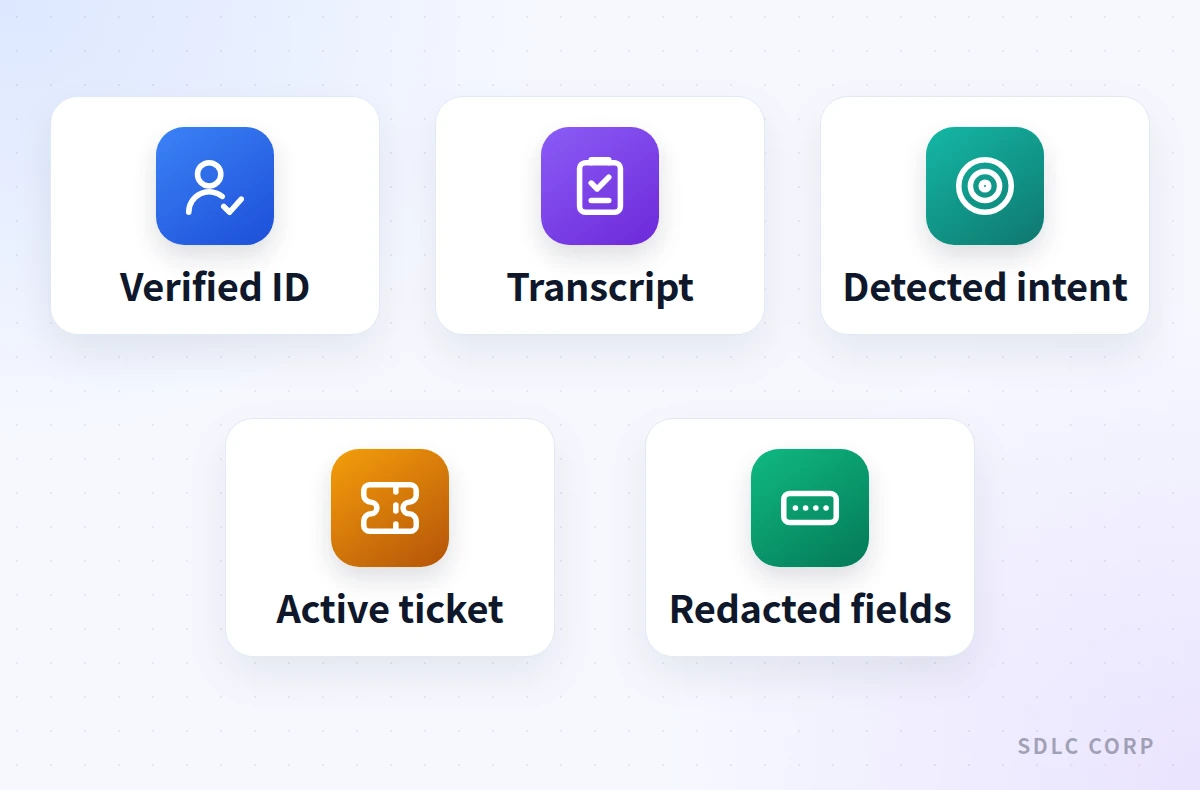
The briefing is what makes the handoff warm. It typically carries the recent transcript, detected intent, entity values, and verification state, so the receiver starts the conversation already informed and the caller does not have to repeat information.
Practically that requires three capabilities: a transport layer that can hold, join, or bridge media streams, a context transport mechanism to send structured session state, and an orchestration policy that decides destination, priority, and fallback. These capabilities can be implemented as separate microservices to simplify scaling and security boundaries.
Designing them independently lets teams test media reliability, verify data mappings to CRM records, and update routing logic without touching audio code.
A warm transfer differs from a cold transfer, also called a blind transfer, in one step: the consult. In a cold transfer the live call is sent straight to the destination without the transferring party first speaking with the receiver.
The call is not dropped and the caller does not redial. Context can still travel out-of-band as a screen pop or CRM note when the systems support it, but the receiver has not been briefed and may ask the caller to repeat details.
Warm transfer also differs from ongoing conferencing, where multiple parties stay on the call together; a warm transfer may briefly use a three-way connection for the introduction and then release the AI agent. For enterprise deployments the guiding metric is customer effort: measured by number of repeated statements, reauthentication steps, and elapsed human-agent time required to reach resolution.
- Brief the receiver or confirm availability before connecting the caller.
- Preserve last N utterances and detected intent so the receiving agent has immediate context.
- Carry verification state to avoid redundant security questions during transfer.
- Bridge audio so the caller does not hear reconnection prompts or hold tones beyond policy.
- Log a transfer event with unique session id for tracing and post-call analytics.
Warm transfer reduces customer friction because the receiver is briefed and ready before the caller is connected.
Core Architecture and Call Flow Components
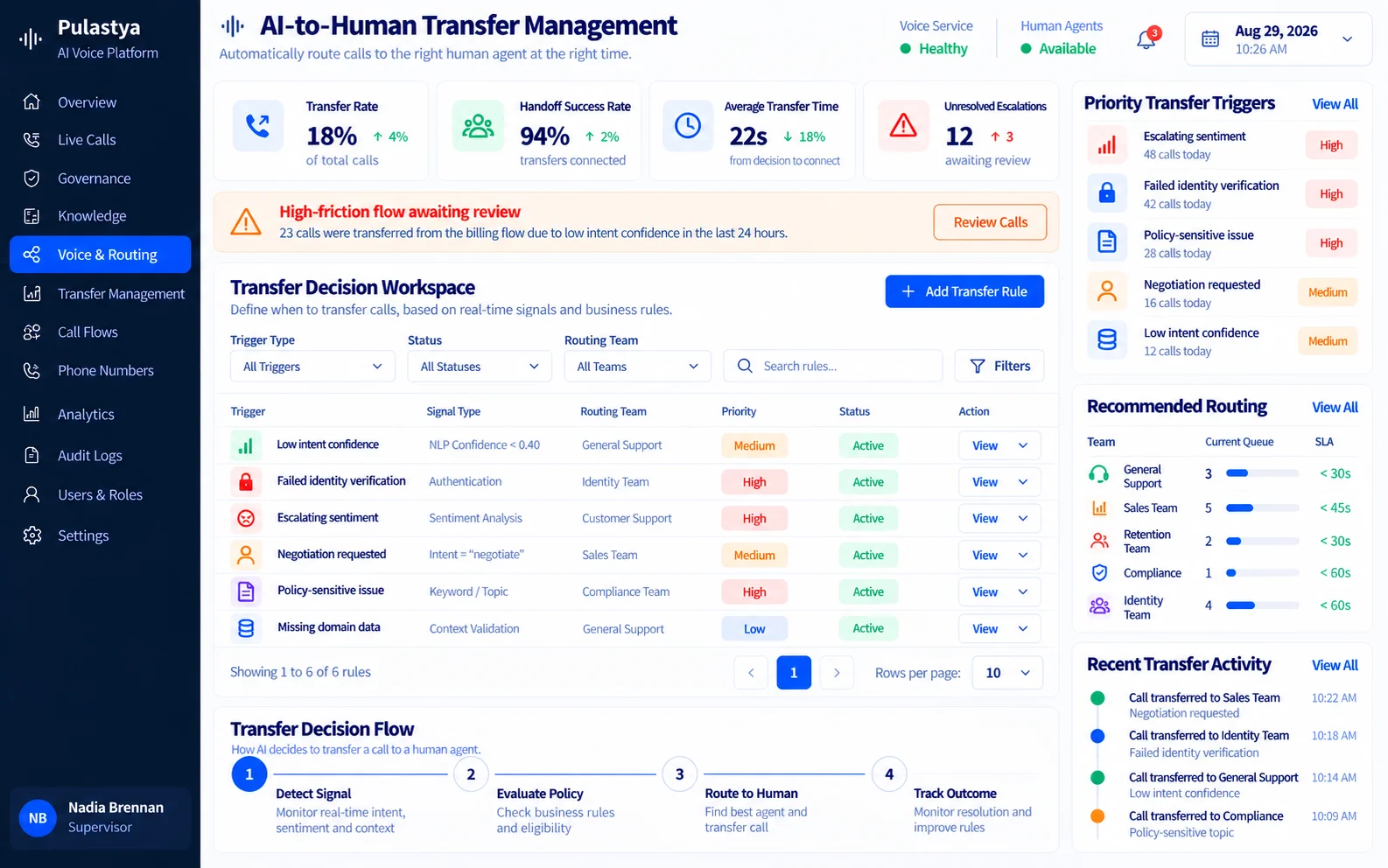
Implement warm transfer as an interaction between a media plane, a context plane, and an orchestration layer. The media plane manages audio streams via SIP, WebRTC, or native telephony carriers and supports joining, holding, or bridging calls.
The context plane stores ephemeral conversation state, transcripts, intent, and metadata and exposes APIs for read and write during the handoff. The orchestration layer executes routing policy and coordinates the two planes through idempotent control messages.
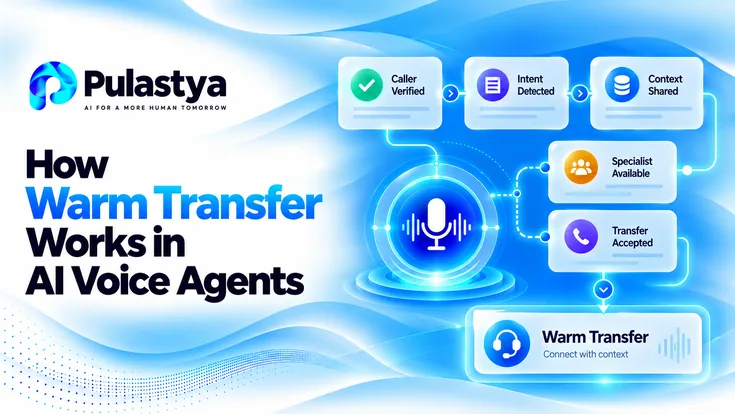
In a typical call flow the voice agent first collects identification and resolves the account. If a transfer is required, the orchestrator chooses a destination, serializes the context, and tells the caller they are being connected.
The media plane places the caller on hold while a separate leg reaches the receiver, who gets the briefing as a spoken summary, a desktop screen pop, or both.
Once the receiver accepts, the media plane bridges the caller to the receiver, and the orchestrator releases the AI leg and any intermediary resources and updates call status in the CRM and monitoring logs.
If the receiver declines or does not answer, the orchestrator returns to the caller and applies the fallback policy, such as another agent, a queue, or a callback.
Design for failure modes: missing context, destination timeout, and media negotiation failure. Implement transactional handoff steps with compensating actions so that partial failures do not leave the caller in indefinite hold or expose inconsistent records. Store transfer state with a unique id and expire it predictably; a single id simplifies troubleshooting, reconciles billing events, and supports later audits.
- Media plane: supports hold, conference, and bridge operations with clear timeouts.
- Context plane: provides secure APIs for session read/write and short-term retention.
- Orchestrator: central decision engine for destination selection, retries, and fallbacks.
- Observability: emit transfer-start, transfer-success, transfer-failure, and latency metrics.
Separate media, context, and orchestration services to contain failure domains and simplify scaling.
Warm transfer sequence
Consult First, Connect Second: How a Warm Transfer Runs
- Decide to transfer and pick a destinationPolicy selects the human or service by skill, language and availability
- Tell the caller and place them on holdSay who they will reach and why; keep hold audio within policy limits
- Reach the receiver on a separate legThe AI agent contacts the receiver while the caller stays on the line
- Brief the receiverSpoken summary or screen pop: verified identity, intent, recent transcript
Possible outcomes
- Receiver acceptsBridge the caller, release the AI leg, log the transfer event
- Declined or no answerReturn to the caller with another agent, a queue or a callback
Notice that the receiver is reached and briefed before the caller is connected; that consult step is what makes the transfer warm.
What Context to Pass and How to Format It
Pass the minimal context that enables the receiving endpoint to continue work without reasking: verified caller id, recent transcript snippets, current intent and confidence, resolved entities, and any active tasks or tickets. Avoid over-sharing raw audio or full-call transcripts unless the recipient needs them; reduce data movement and lower compliance burden.
Use a session model with versioning so receivers can detect if they hold an outdated view of the conversation.
Choose structured transports: JSON payloads over HTTPS for the context plane, and short-lived tokens for authorizing access. Map contextual fields to CRM or agent desktop fields to avoid manual copy-paste and to make agent UI actionable. Include a canonical session id and event timestamps so traces across telephony logs, context stores, and CRM updates can be correlated during post-incident review.
Address data minimization and redaction at the source. Implement rules to redact or replace payment or personally identifying fields before they leave the voice agent process unless the destination is explicitly authorized. Maintain audit trails for any redaction decisions and record the redaction policy version in the transfer metadata to support compliance and forensic review.
- Include verified identifier, current intent, and the last 2-3 utterances for context.
- Use versioned JSON session objects and a canonical session id for correlation.
- Encrypt context in transit and use short-lived tokens for authorization.
- Redact or mask sensitive entities unless the recipient is authorized to view them.
Structured, versioned session objects make handoffs predictable and easy to reconcile.
Latency and Voice Experience Tradeoffs
Call experience degrades quickly if the transfer adds perceptible silence, repeated prompts, or reauthentication. Prioritize sub-second audio continuity and provide clear, human-friendly messaging during unavoidable wait periods, including the consult itself.
Where an agent must confirm context, design succinct confirmation prompts that assume the context rather than require full repetition, for example, a single confirm question rather than replaying the full transcript.
Tolerate small context gaps by including confidence scores and a short transcript snippet; the receiving agent or human can decide whether to probe further.
Optimize media negotiation by preferring the caller's current transport (WebRTC or PSTN) and using carrier or session-level bridging rather than forcing a codec re-negotiation. Monitor perceived quality metrics and use them to adjust routing decisions dynamically.
Tradeoffs include the added seconds of a consult and fuller context versus faster direct transfers, where the receiver starts without a briefing and may need to confirm details with the caller.
Choose the tradeoff based on risk profile: high-risk verification or billing changes require stricter context guarantees and a consult before connecting, while informational escalations can accept lighter transfers for speed.
- Keep audio continuity instead of forcing caller reconnects to reduce perceived effort.
- Use short, confirmatory prompts that assume context rather than replay dialogue.
- Prefer in-band bridging to reduce codec negotiation and minimize delays.
- Instrument perceived quality and use it as a routing factor.
Balance transfer latency against the need for context fidelity based on the business risk of the interaction.
Orchestration Patterns and a Practical Scenario
Orchestration patterns include direct transfer, consult-then-join, and staged escalation. Direct transfer is a cold (blind) transfer: the live call goes straight to the destination without a prior consult, and any context arrives out-of-band, for example as a screen pop.
Consult-then-join is the warm pattern: it dials the destination, presents the context to the recipient, and only joins the caller after the recipient accepts. Staged escalation attempts tiered human responses before moving to higher-level specialists. Each pattern maps to different user expectations and SLA priorities.
Example scenario: an enterprise software customer calls an automated agent for license reconfiguration. The agent verifies the account and detects a complex entitlement mismatch. Using a consult-then-join pattern, the orchestrator sends the session id, last three utterances, and entitlement details to a Tier 2 specialist.
The specialist reviews the context, accepts, and the orchestrator bridges the caller to the specialist; the specialist begins the session already aware of the verification and the problem statement.
Apply routing policy rules: prefer local-language specialists, enforce maximum hold times, and require explicit acceptance for consult-then-join to avoid forced transfers. Implement quotas and concurrency limits to prevent overloading high-skill agents with simultaneous consults.
Where necessary, automatically create a ticket and provide the ticket id to the receiving agent in the handoff metadata so they can update the record during the call.
- Direct (cold) transfer: lowest latency; the receiver is not briefed, so context must arrive out-of-band.
- Consult-then-join (warm): confirms recipient readiness and context review before the caller joins.
- Staged escalation: tiered approach with automated fallback and ticket creation.
- Routing rules: language, skill, SLAs, and concurrency limits drive destination choice.
Choose an orchestration pattern that matches caller expectations and the destination's readiness to handle complex context.
Security, Compliance, Testing, and Observability
Secure transfers require end-to-end considerations: encrypted media, authenticated context APIs, short-lived tokens, and role-based access for any human or system receiving context. Implement token exchange patterns so the receiving endpoint obtains only the necessary privileges for the transfer duration.
Record minimal logs that allow troubleshooting without exposing raw sensitive data; where high-fidelity logs are required, store them in a hardened, auditable vault with access controls.
Design compliance workflows for data subject requests and retention policies. For transfers that touch payment or other regulated data, implement in-line redaction or replace sensitive values with references that only authorized systems can resolve.
Include consent indicators in the transfer metadata when a caller explicitly agrees to share context with a human agent or third party, and honor that consent during subsequent processing and storage.
Operationalize observability: emit structured events for transfer start, accept, failure, and metrics for handoff latency and hold durations. Run regular chaos or resilience tests that simulate destination timeouts, media failures, and malformed context objects.
Maintain a regression test suite that exercises both happy-path warm transfers and failure modes such as a declined consult, and include a drill to validate agent desktop mapping and CRM consistency after transfers.
- Encrypt media and context in transit and require short-lived authorization tokens.
- Mask or redact regulated fields before transfer unless recipient cleared for access.
- Emit structured transfer events for monitoring, tracing, and SLA calculation.
- Execute resilience tests for destination timeouts and context serialization failures.
Treat warm transfer as a security and compliance boundary with enforced tokens, redaction, and audit trails.
Warm transfer is often where business deployments earn or lose caller trust. It is a core design decision for an agent answering the main business line and for an AI voice agent handling support calls, where the receiving person needs context immediately.
For choosing between the two transfer types, see warm vs cold transfer; for transfers on calls the AI places itself, see AI-to-human transfer in outbound campaigns.
Conclusion
Warm transfer in AI voice agents helps enterprises connect callers with the right human support while preserving relevant conversation context. A reliable handoff combines recipient availability, secure context sharing, controlled call bridging, and clear fallback routing. When these components work together, businesses can reduce unnecessary repetition, improve call continuity, and make escalations more efficient.
For successful implementation, organizations should prioritize secure context handling, transfer reliability, measurable performance, and a consistent caller experience. Testing different escalation scenarios and monitoring handoff outcomes can help teams refine their transfer policies over time. With the right architecture and safeguards, warm transfers can become a dependable part of enterprise AI voice operations.
Frequently Asked Questions
A warm transfer adds a consult step: the AI agent or human first reaches the receiver, briefs them or confirms they are available, and then connects the caller. A cold (blind) transfer sends the live call straight to the destination without that consult. Neither drops the call, and a cold transfer can still pass context out-of-band, but the receiver starts unbriefed and may ask the caller to repeat details.
Essential fields include a canonical session id, verified caller identifier, recent transcript snippets, detected intent with confidence, resolved entities, and any active ticket id. Keep transfers minimal and redact sensitive elements unless the recipient is explicitly authorized to access them.
Implement clear fallbacks: announce expected wait times to the caller, queue or offer callback options, and route to alternate agents if primary destinations fail. Log failure reasons with unique session ids for post-incident analysis and trigger automated ticket creation when appropriate.
Use a combination of synthetic load tests that exercise orchestration and media bridging under peak concurrency, chaos tests that simulate destination timeouts and partial context loss, and manual agent desktop validation to ensure CRM mappings and UI context appear as expected.
Tell the caller who they are being connected to and why, and set a short expectation for the wait while the receiver is briefed. Keep hold audio within policy limits. If the receiver declines or does not answer, return to the caller with a clear option such as another agent, a queue, or a scheduled callback instead of leaving them on hold.