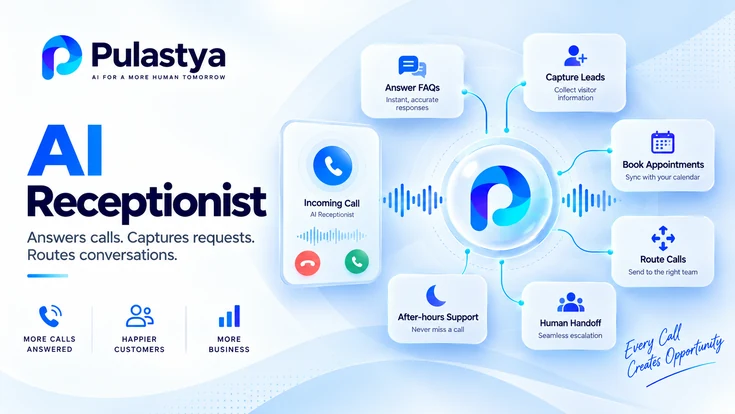
An AI receptionist is software that answers incoming business phone calls, works out what the caller needs, answers from approved business information, captures appointment or lead requests, and transfers the call to a person when required.
It suits businesses that miss calls during busy periods or after hours, or spend front-desk time on the same questions. It also suits trade and field businesses whose team is out on jobs, where the phone goes unanswered for structural rather than careless reasons.
- Answers and routes It answers routine questions, captures requests and sends other calls to the right person or team.
- Grounded answers It should answer from approved business information and say when it does not know.
- Clear handoff rules Sensitive, urgent or uncertain calls go to people, with a summary of what the caller already said.
The practical outcome is that more calls get a consistent answer, routine requests are handled without waiting, and complex calls reach the right person with context already captured.
An AI receptionist is not a voicemail box or a fixed phone menu. Callers speak naturally, the system identifies the request, and it follows rules the business has approved. Good deployments resolve what is safe to resolve and hand off everything else.
What an AI Receptionist Does on a Business Call
An AI receptionist does the job of the desk by the door, on the phone side only: it picks up, says who the business is, answers what the desk is supposed to know, writes down anything it cannot answer, and puts people through to colleagues.
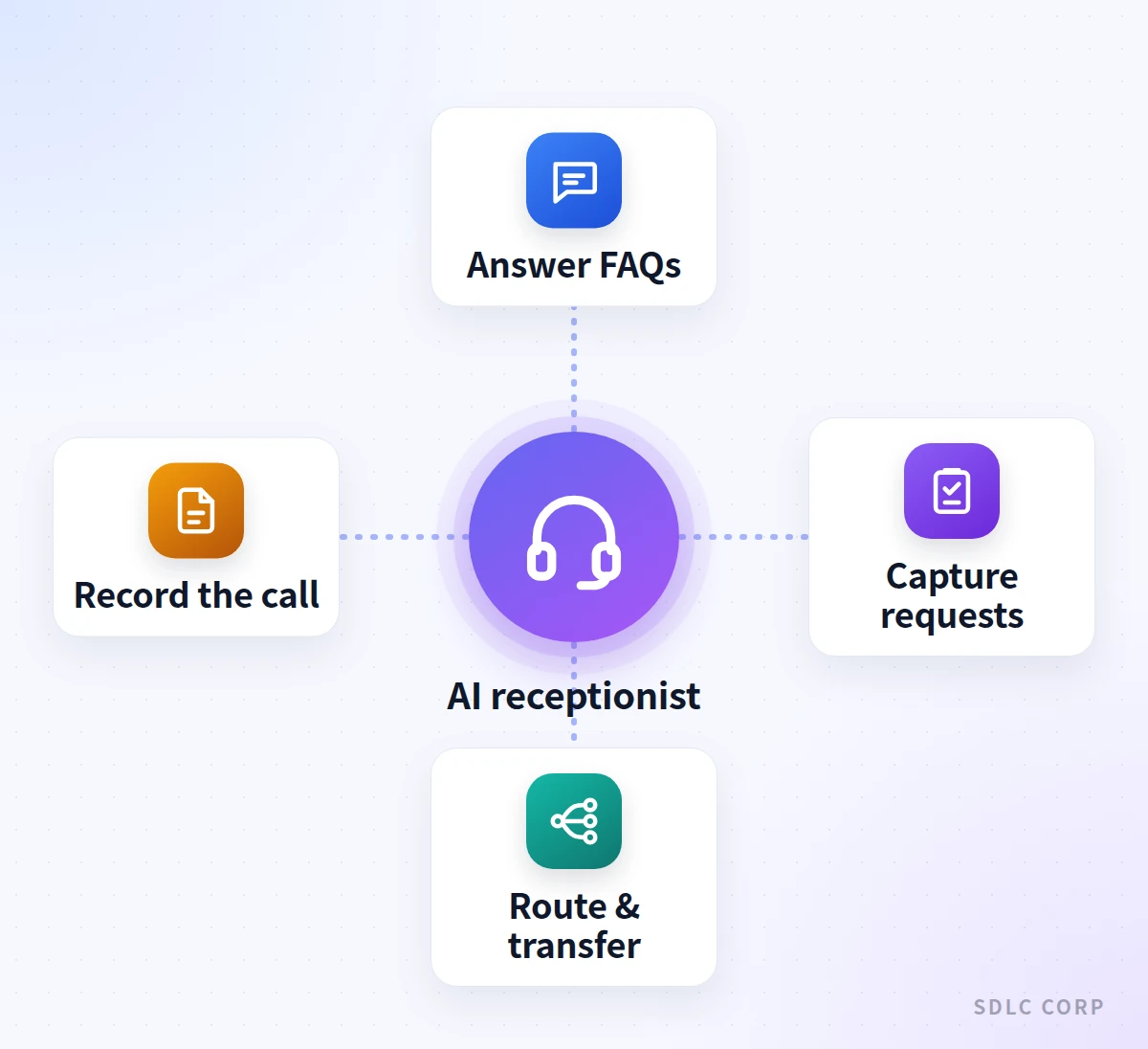
The difference from a person on that desk is that it never has only one line free.
Under the hood it is a specialized voice agent. If you want the underlying building blocks, the guide to how an AI voice agent works explains speech recognition, language understanding and response generation. For buyers, the more useful question is which parts of the desk job the software should hold.
The desk answers on the first ring, including the calls that arrive while the previous one is still going.
Opening hours, the address and parking, which services the business offers, what to bring, and any published prices.
Name, reason for calling, best number and best time, written the same way every time so nobody has to ring back to ask.
Reach the colleague or team the caller asked for, or say plainly when that person is next available.
| Option | What happens to a routine question | Where it falls short |
|---|---|---|
| Voicemail | Caller leaves a message and waits for a callback | No answer in the moment and messages vary in quality |
| Phone menu (IVR) | Caller presses keys to find the right path | Callers must self-classify and often pick the wrong option |
| Human answering service | An operator answers from a script | Depth is limited by the script and staffing |
| AI receptionist | Answered from approved information or captured for follow-up | Needs good source content and clear handoff rules |
How an AI Receptionist Handles an Inbound Call
The desk runs the same short script on every call. Writing it down is what lets a manager answer the caller who rings back asking why they were put through to the wrong person, or why nobody has returned their message.
The general shape of an automated call, from ring to recorded outcome, belongs with inbound AI voice agents. What follows is the desk version of it, which differs mainly in the second step.
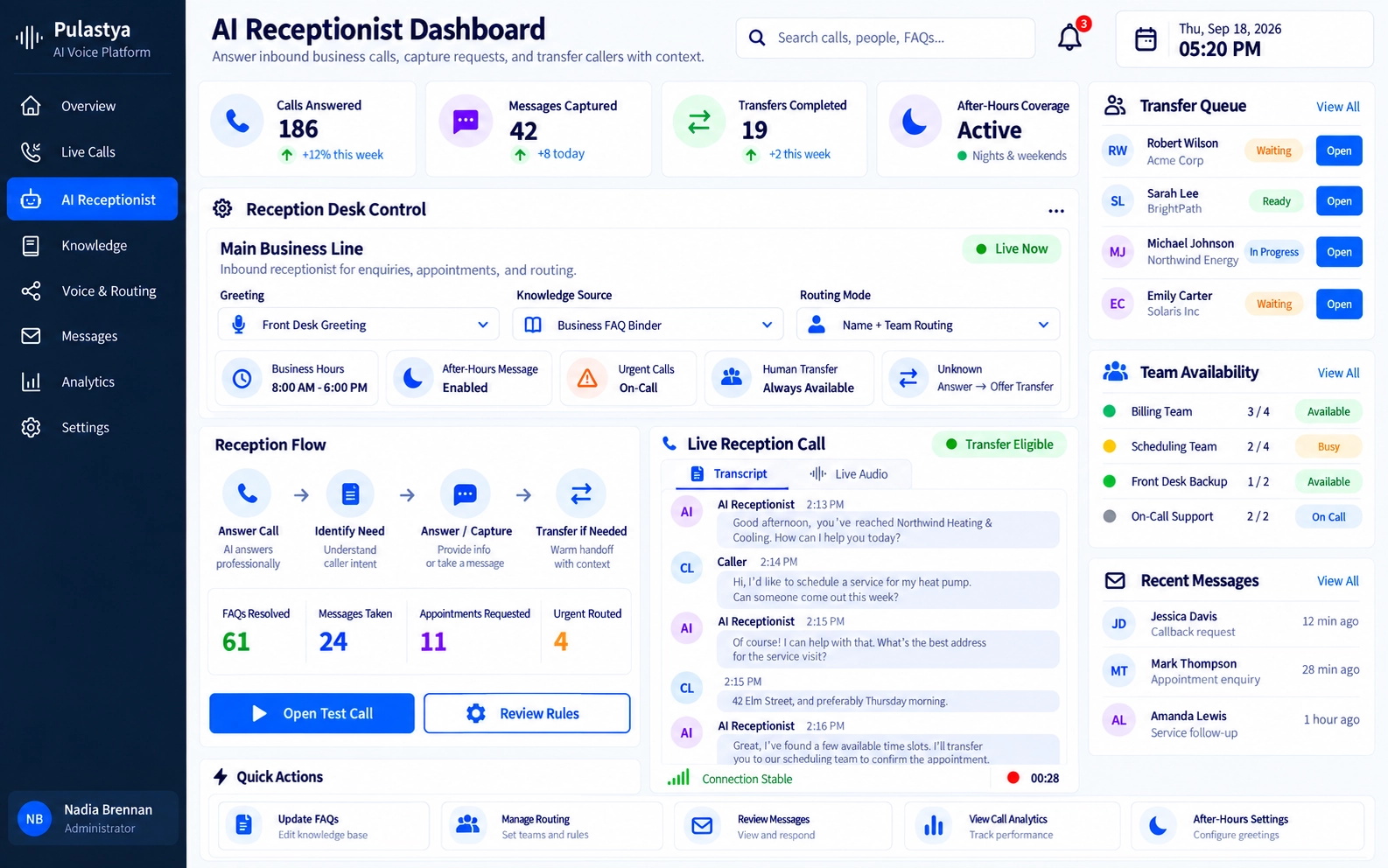
- Pick upThe published number rings through to the desk, which opens with the wording the business wrote for it.
- Work out who or what they wantA question the desk can answer, a colleague asked for by name, or a message for somebody who is out.
- Look it up in the desk's own answersThe approved hours, address, services and prices the business keeps for the desk to quote from.
- Answer, write it down, or put them throughSay the answer, take the message and lead details, or reach the colleague the caller named.
- Say what happens nextTell the caller who will contact them and roughly when, then file the transcript and summary.
The second step is where a desk differs from a menu. Subject-based menus assume the caller knows which department owns their question. A desk gets asked for people by name at least as often, and has to handle a caller who only knows that they spoke to a woman in accounts last Tuesday.
Recognizing a name is a different problem from recognizing a subject, and the techniques behind both are set out in automating call intake and routing. For a desk, the useful preparation is a current list of who is reachable and what each person is known for.
Answering FAQs From Approved Business Knowledge
A good receptionist keeps a binder at the desk. Everything in it was checked by somebody, and nothing a caller hears was made up on the spot. An AI receptionist needs the same binder in software form: the FAQs, service descriptions, policies and published prices the business has signed off.
Somebody has to keep that binder current. Hours shift with the season, services are added, prices are revised. The guide to what goes into a voice agent knowledge base covers how to organize those sources so the desk keeps quoting the current version.
- One agreed answer per question a caller actually asks, phrased the way a person would say it on the phone.
- Keep the things that never change, like the address, apart from the things that change every few months.
- Decide in advance what the desk says about a question the binder does not cover.
- Read the transcripts for questions that came up and were not in there, then add the page.
The binder is also what makes a mistake fixable. When a caller is quoted the wrong closing time, you find the page it came from and change it, and every call after that is right. That is the whole benefit of answering from sources rather than from recall.
A desk that answers from general model knowledge has no page to change. The test is simple. When somebody reports a wrong answer, does it lead you to a line you can edit, or only to a prompt you can reword and hope?
The binder needs an edge as well as contents. Hours, prices and policies are exactly the facts a caller writes on the back of an envelope and then acts on, so the desk has to be willing to say it does not have that one and offer to put the caller through instead.
Pulastya, the SDLC Corp voice platform for inbound and outbound business calls, works that way: the desk quotes from the FAQs, policies and pricing the organization uploads, and where it does not have enough context it says so and offers a transfer rather than filling the gap.
Appointment Requests, Lead Capture and Messages
A lot of what crosses a desk is not a question at all. It is somebody who wants something written down and passed on. The value of a desk here is uniformity: every message reaches its recipient in the same shape, so nobody has to ring the caller back to ask a basic thing that was never noted.
Messages and Callbacks
A message is worth more than a voicemail because it is already sorted. A voicemail is two minutes of audio somebody has to listen to; a message is four lines a colleague can read while walking between rooms and act on without listening to anything.
- Who rang, spelled out, and the number to use rather than the one they rang from.
- Who they wanted, and whether anybody else will do.
- What it is about, in the caller's own words, not summarized into nothing.
- When they can take a call back, and whether this is the second or third time they have rung.
New Enquiries and Leads
A first-time caller who is considering buying something is the most valuable call the desk takes and the easiest one to waste. The desk should find out who they are, what they are trying to do, and how soon, then pass that to whoever sells.
What it must not do is negotiate. A desk that quotes a discount, promises a lead time or implies terms creates something the business has to honor or explain away later. Capture, confirm the details back, and hand over.
Appointment Requests
A desk with access to the diary can offer a slot outright. A desk without it takes the preferred times and says honestly that somebody will confirm. Both patterns, and the reasons to choose one, are in AI appointment scheduling.
Routing Callers to the Right Person or Team
A desk spends less of its day choosing between departments than finding one specific person. Callers ask for somebody by name, by job title, or by the conversation they had last week, and the desk has to know who stands in when that person is out.
So the thing to prepare is not a decision tree. It is a current list of people, which is a smaller document and a more perishable one, because it goes wrong every time somebody changes role or goes on leave.
- Each name the desk should recognize, including the shortened versions callers actually use.
- The number that reaches that name, and the second person who covers it.
- What the desk says when neither of them is free: take a message, or offer a time.
- The names whose direct numbers the desk must never read out to a caller.
Sending calls by subject instead of by name is a larger design job, and intelligent call routing covers it. A desk is usually better off starting with the name list and adding subject rules only where transcripts show callers arriving with no name at all.
However the desk decides, put the caller through with what they already said attached, so the colleague opens with the reason for the call rather than a fresh greeting. How warm transfer works in AI voice agents covers the mechanics and the tradeoffs.
After-Hours and Overflow Coverage
Most businesses that want a desk cannot justify a person sitting at one all day. The desk is empty at lunch, empty from five, empty on Saturday, and busy exactly when the one person on it is already on another call. Those four gaps are usually the whole reason for buying anything.
The desk job narrows when the building is empty. Almost nobody is there to be put through to, so the value moves entirely to answering what the binder covers and taking messages the morning shift can act on without ringing back.
- Say the office is shut and when somebody will be in touch, without inventing a response time nobody agreed.
- Keep answering the binder questions: hours, address, what the business does. Those do not need staff.
- Take the message in full, because there is nobody to fill in the gaps at seven in the morning.
- Send genuinely urgent calls to whoever is on call, or say the correct next step and mean it.
Overflow during the working day is a different case worth planning separately. There, people are available, so the desk should still be reaching them, and a queue of callers told to ring back at a moment when staff are actually present is a failure rather than coverage.
The rules behind all of this, including time-of-day detection, holiday calendars and urgent exceptions, are set out in after-hours call handling with AI voice agents.
Example Receptionist Conversation
The example below, set at a heating and cooling service company, shows a routine question, a request that is captured rather than confirmed, and a clean transfer.
Example scenario
Good afternoon, you have reached the heating and cooling service team. How can I help?
Do you service heat pumps, and can someone come out this week? Mine is making a grinding noise.
Yes, we service heat pumps. I can take a service request so the scheduling team can offer you a time. What is the service address?
It is 42 Elm Street. Mornings are best.
Thanks. I have 42 Elm Street, heat pump making a grinding noise, mornings preferred. Is this the best number to reach you?
Yes. Actually, can I also ask about a billing charge from last month?
Billing is a separate team here, so let me put you through to them. I will pass on the visit details you just gave me, so none of that needs saying twice.
Notice what the receptionist did not do. It did not guess at what was wrong with the unit, promise an arrival time, or comment on the charge. It answered what approved content covers, captured the request, and transferred the account question.
When an AI Receptionist Should Not Resolve a Call
A desk that tries to be helpful about the wrong things does real damage. Write the boundaries down before launch, because the alternative is learning them from the first caller who was told something the business then has to retract.
- Anything that sounds like an emergency. Follow the written policy and do not try to judge how serious it is.
- Callers who want an account changed. Identity checks belong on a channel built for them, not on an open phone line.
- Anyone ringing to say a supplier's bank details have changed, which is a well-known way in for fraud.
- Questions about whether a named person is in the building today, which a desk should not confirm to a stranger.
- Callers who are angry, or who have already rung once about the same thing and got nowhere.
- Anyone who simply asks for a person. That request is always granted, with no persuasion attempt.
A desk is the outward face of a business and it is also its softest edge. Keep confirmations of identity, whereabouts and payment details off the automated line entirely, and write those refusals into the rules before launch rather than adding them after somebody has been talked into something.
Integrations and Setup Considerations
Most of what makes a desk work is not technical, and the setup questions worth arguing about are ownership questions. Somebody has to write the greeting, somebody has to keep the binder current, and somebody has to read the messages the desk takes overnight.
- Who writes the opening line, and who is allowed to change it later.
- Who owns each document in the binder, and how often they are expected to look at it.
- Where messages and lead details land: an inbox, a shared list, or a system somebody already checks.
- Who reads them first thing, and who covers that when they are away.
- Who reviews transcripts, because without a named reader nobody ever does it.
Name those owners before the number goes live. A desk with an unread message inbox is worse than no desk, because callers were told somebody would be in touch and have gone away believing it.
Records deserve one deliberate decision rather than a default. Transcripts and summaries are the only evidence you will have when a caller disputes what the desk told them, so decide where they live and who may read them while you are still choosing, not afterwards.
Decision guide
Resolve, Capture or Transfer
| Call type | Default action | Why |
|---|---|---|
| Hours, location, services | Resolve | Covered by approved content |
| Appointment request | Capture or book | Booking depends on scheduling access |
| New enquiry | Capture and route | Sales or service team follows up |
| Billing dispute or complaint | Transfer | Needs human judgment |
| Emergency or safety issue | Follow emergency policy | AI must not assess urgency alone |
Deciding the default action for each call type before launch keeps the AI receptionist inside safe, predictable boundaries.
How to Launch an AI Receptionist Without Surprises
A desk earns trust by being narrow and honest rather than broad and confident. Start with the handful of things callers ring about every single day, and let the rest reach a person while you watch what actually arrives.
- Ask whoever answers the phone nowThe person on the desk already knows the five things people ring about. Write their list down first.
- Mark each one answer, write down, or put throughOne default per item, plus the exceptions, agreed with the people who will receive the results.
- Fill the binderWrite each answer the way a colleague would say it on the phone, and put a name against every document.
- Ring your own deskInterrupt it, mumble an address, ask for somebody by a nickname, and ask to speak to a human.
- Read the messages it tookWeekly, look for questions with no binder page, colleagues reached in error, and messages too thin to act on.
The fourth step is the one people skip, and it is the cheapest. Hearing the desk speak your business name, in the voice it will actually use, settles arguments that a configuration review can run for a fortnight without resolving.
If you want to see these patterns in a working system, the AI receptionist platform from SDLC Corp is built around approved-content grounding, explicit transfer rules and call summaries. To look at the call dashboard and routing settings before you commit, book a guided walkthrough of the platform.
Conclusion
An AI receptionist works best as a reliable first point of contact, not a replacement for every human conversation. It can answer routine questions from approved business information, capture messages and appointment requests, handle after-hours calls, and route callers to the right person. The key is knowing which requests it can resolve safely and which need a human response.
Start with the calls your team receives most often, then define clear rules for answering, capturing, and transferring each type. Keep business information up to date, test the receptionist with realistic calls, and assign people to review messages and follow up. With those basics in place, the AI receptionist can reduce missed calls and ease front-desk workload while keeping callers informed about what happens next.
Frequently Asked Questions
Yes, and reaching a named colleague is the part of the desk job worth setting up carefully. Give it the names callers actually use, the number behind each one, and a second person who covers that name. Somebody who simply asks for a human should always get one, without being talked out of it first.
A desk with access to the diary can offer a slot outright. A desk without it takes the preferred times and the reason for the visit, then says plainly that somebody will confirm. The second pattern is honest and still useful, as long as the confirmation genuinely happens.
Yes, and the empty desk is the usual reason to buy one. The job narrows though, because there is nobody in the building to reach. What matters overnight is answering the questions the binder covers and taking messages complete enough that the morning shift never has to ring back for a detail.
It should not, and the way to prevent it is to give it a fixed set of approved answers and a defined thing to say about anything else. Test that directly: ask it something you know is not written down anywhere, and listen for whether it admits it or produces a plausible closing time.