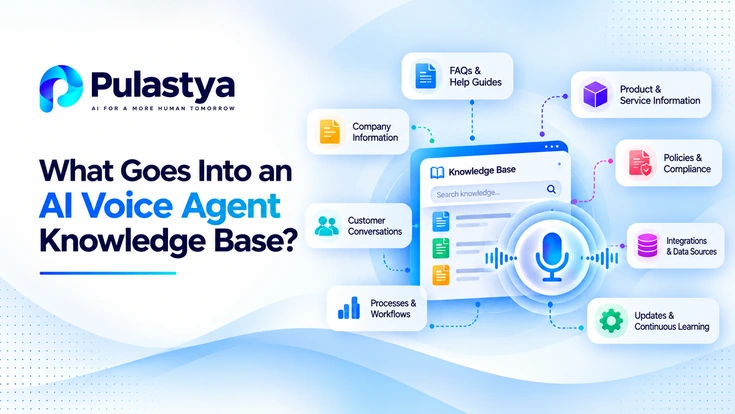
An AI voice agent knowledge base is the structured set of content, data, and metadata that a conversational voice system uses to answer callers, decide when to escalate, and complete tasks.
For enterprises that replace script-driven IVR with generative or retrieval-augmented voice agents, the knowledge base largely determines answer accuracy, handoff quality, and regulatory safety.
- Canonical sources first Prioritize authoritative internal sources like policy documents, pricing sheets, and product specs over scraped web content; mark provenance for every response.
- Context management is essential Store session-level state and slot history to support multi-turn flows and reduce ambiguous follow-ups during voice interactions.
- Governance by design Implement role-based editing, automated content validation, and redaction rules to keep the voice agent compliant and auditable.
Designing a knowledge base for AI voice agents demands practical decisions about source selection, indexing, context windows, and conversational state. Stakeholders must balance coverage against latency and cost, decide which sources are canonical, and define how turn-level context is preserved across long interactions.
These operational choices directly affect call containment, average handle time, and customer satisfaction.
Engineering, product, and compliance teams need six elements to build and maintain a reliable knowledge base: ingestion pipelines, vector and metadata models, conversational wiring, governance guardrails, testing strategies, and deployment patterns. The central tradeoffs are when to favor precision over recall, and when to use deterministic retrieval versus generative synthesis for spoken answers.
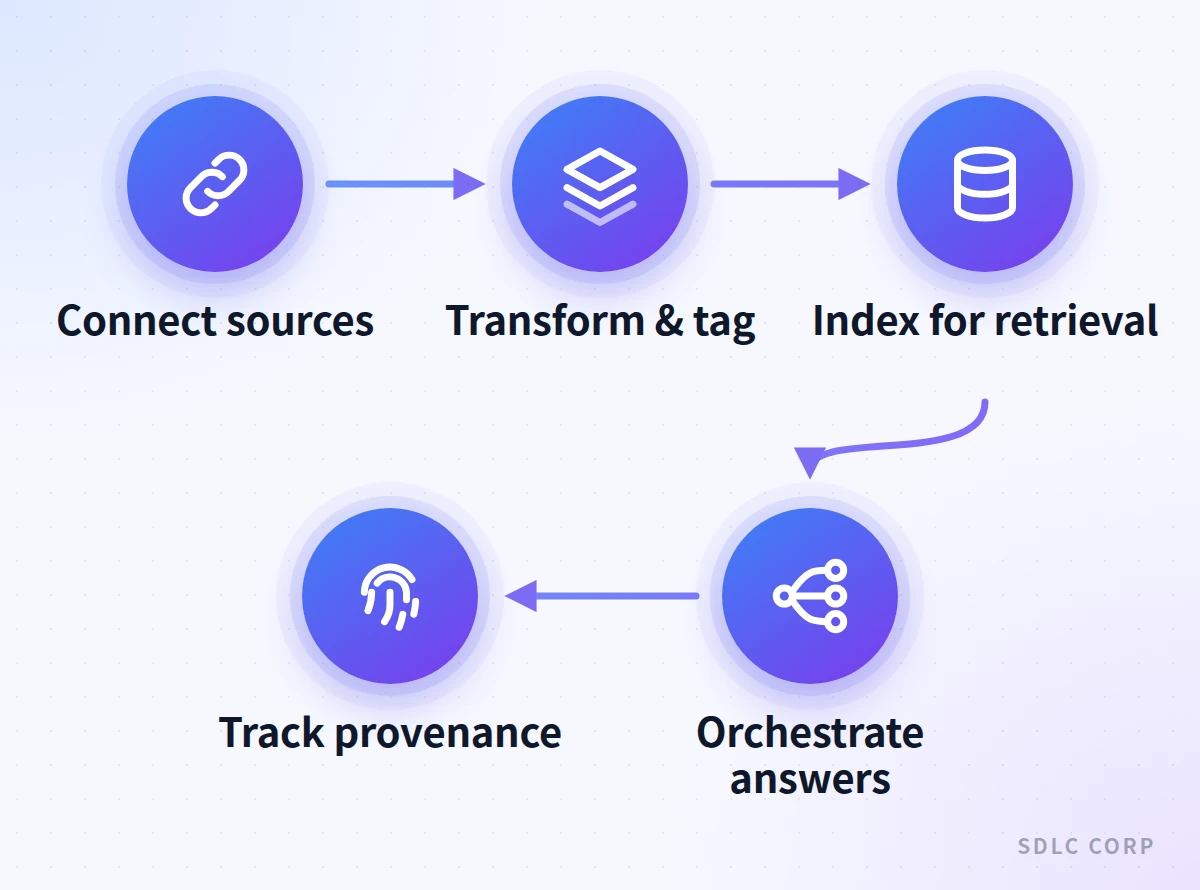
Core Components of an AI Voice Agent Knowledge Base
A knowledge base for voice agents is not a single database; it is a pipeline that transforms source documents into retrieval-ready fragments enriched with metadata.
Core components include connectors that ingest content from CMS, product catalogs, policy repositories, and approved reference fields from business systems; a transformation layer that segments, normalizes, and tags content; an index service for fast retrieval; and an orchestration layer that maps retrieved items to spoken responses.
Each component requires clear SLAs: ingestion frequency, indexing latency, and query response time. For customer-facing voice, sub-second retrieval for prioritized intents is essential to avoid perceptible pauses. Decide which content needs synchronous retrieval during the call versus asynchronous lookups that can prompt a callback or chat follow-up.
Make provenance and ranking first-class fields. Every fragment should carry a source ID, version, last-reviewed timestamp, and reviewer or quality score. At query time the retriever adds a relevance score for each match. Together these fields drive both runtime heuristics that choose whether to synthesize an answer and post-call analytics that surface stale or low-quality sources for remediation.
- Connectors: CMS, product catalog, legal policies, approved reference fields.
- Transform: segmentation, canonicalization, entity tagging.
- Index: vector store plus keyword index for hybrid retrieval.
- Orchestration: routing rules, confidence thresholds, fallbacks.
- Provenance: source ID, version, reviewer, timestamp.
Treat the knowledge base as a pipeline, not a file dump.
Knowledge pipeline
How a Source Document Becomes a Grounded Spoken Answer
- Select sourcesMark canonical and secondary sources, each with an owner and update process
- Ingest and validateExtract text, redact PII, and check formatting in staging before indexing
- Chunk and add metadataSplit into fragments tagged with source ID, version, review date, and scope
- Retrieve and rerankFilter by metadata, run vector plus keyword search, then apply business rules
- Compose a grounded answerSpeak a reply built only from retrieved fragments and log their source IDs
Possible outcomes
- Strong matchAnswer concisely and offer detail on request
- Low confidenceAsk a clarifying question before answering
- No approved sourceSay so and offer a person or a callback
Notice that metadata added at ingestion is what lets retrieval filter, rerank, and trace every spoken answer to its source.
Source Selection and Ingestion Pipelines
Source selection should follow a governance checklist: authority, update frequency, legal constraints, and change control. Operationally, mark sources as canonical or secondary. Canonical sources drive final answers; secondary sources can supplement context but must not override canonical facts. Use automated checks to detect schema drift or removal of required fields in upstream systems.
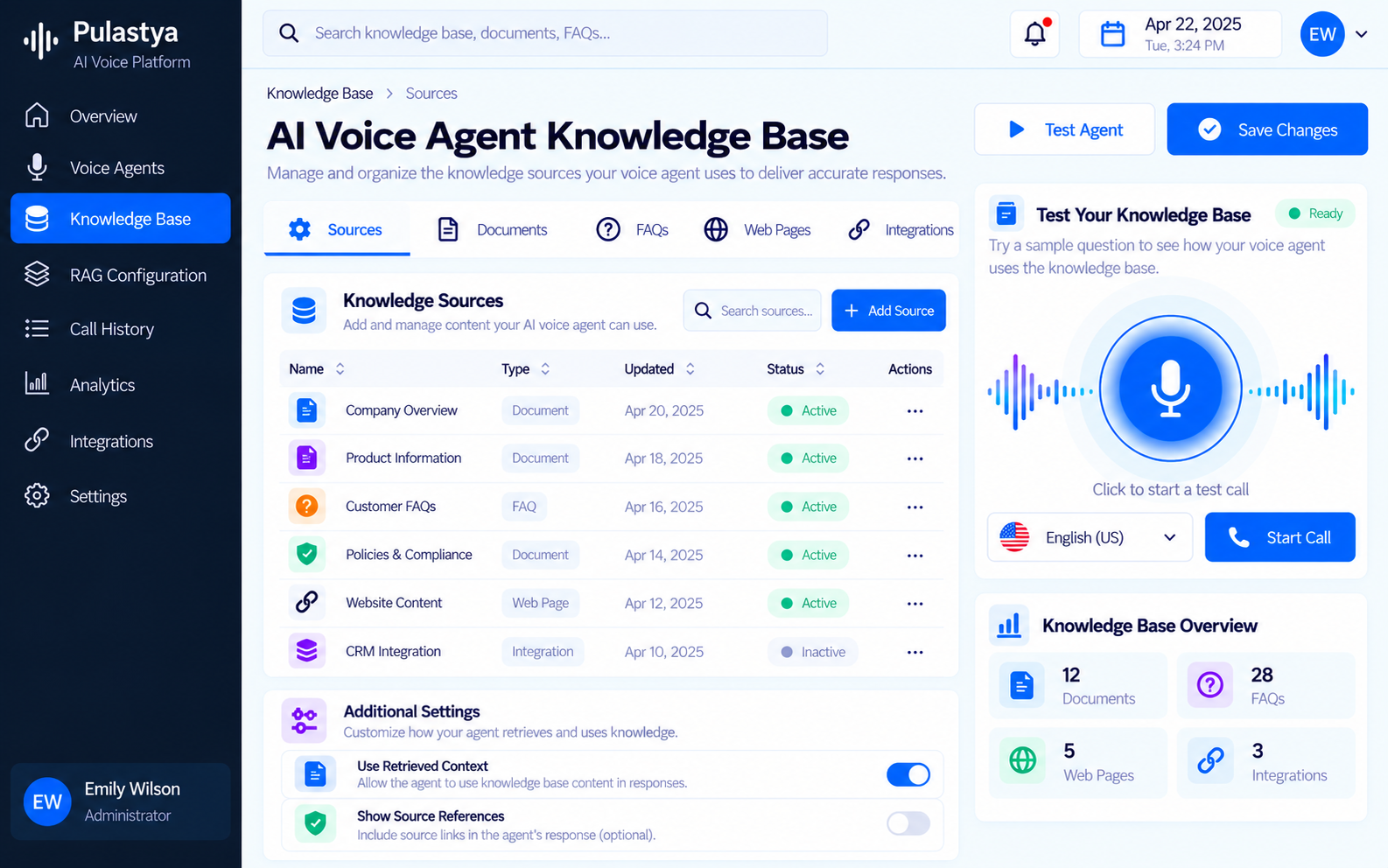
Ingestion pipelines should include content normalization steps: text extraction from PDFs, HTML sanitization, table flattening, and key-value extraction from system records. Implement incremental ingestion with change logs and content hashes so reindexing only touches changed fragments. Maintain a staging area where content is validated for formatting and redaction before it becomes queryable.
Consider a tiered refresh strategy. Data that changes by the minute or belongs to one caller, such as product availability or account balances, should not be copied into the knowledge base; fetch it from the system of record through a real-time API lookup during the call.
Slower-moving content such as pricing sheets can be re-indexed whenever the source changes, and stable content such as HR policies on a scheduled cadence. Document retention and archival rules so obsolete fragments are retired rather than causing incorrect answers.
- Canonical vs secondary source policy and tagging.
- Incremental ingestion using change logs and content hashes.
- Normalization: OCR cleanup, HTML stripping, table parsing.
- Staging validation: redaction, schema checks, reviewer sign-off.
- Tiered refresh: live API lookups, change-triggered and scheduled re-indexing, archival.
Automate ingestion checks to catch missing or malformed content early.
Data Modeling and Retrieval Strategies
Design a hybrid retrieval architecture combining vector similarity with keyword filters. Vectors capture semantic similarity while keyword filters and metadata constraints enforce strict matches for regulated fields. For example, use metadata to limit retrieval to a specific product line or region before applying vector similarity so the agent does not return irrelevant general content during a regional call.
Fragment design matters: make fragments conversational-ready by including a short summary sentence, canonical answer, and associated excerpt. Store multiple granularities, such as short FAQ responses for quick answers and long-form source excerpts for explanation, so the runtime can choose concise spoken replies or detailed follow-ups when appropriate.
Establish reranking and confidence logic. After initial retrieval, rerank candidates with business rules that weigh exact matches, recency, and reviewer scores, then pass only the top fragments to the answer generator.
For low-confidence cases, design deterministic escalation paths: ask clarifying questions, offer to connect to an agent, or schedule a callback. Track which reranking decisions lead to escalations to refine thresholds.
- Hybrid retrieval: vectors plus metadata filters for strict matches.
- Fragments: short summary, canonical answer, long excerpt.
- Store multiple granularities for concise or detailed replies.
- Reranking rules: recency, reviewer score, metadata match.
- Deterministic fallbacks: clarify, escalate, or schedule callback.
Combine semantic similarity with strict metadata filters for reliable retrieval.
Conversational Design and Context Management
Voice requires different conversational design than chat. Spoken turns are costlier and slower, so design prompts and clarifying questions that minimize back-and-forth. Use slot-filling where possible to collect missing information in a single follow-up. For complicated intents, present a short option set and confirm choices before executing back-end actions to reduce error rates.
Maintain session state across turns using a compact key-value session record that captures slots, recent answer IDs, and escalation flags. Persist critical context to a short-lived store so the agent can reference earlier parts of the call even after a brief silence, and expire or redact sensitive fields according to compliance rules when the call ends.
Use persona and tone controls mapped to response templates that vary by caller segment and channel. For account-sensitive responses, require an authentication confirmation step before sharing or taking action. Test response brevity against comprehension in live-call pilots to avoid clipped replies that create confusion.
- Design short prompts to reduce turn count and handle time.
- Slot-filling strategies to capture multiple fields in one prompt.
- Session record: slot values, last answer ID, escalation flag.
- Tone templates by caller segment and regulatory context.
- Auth gating for account or PII-sensitive actions.
Optimize voice flows to reduce turns while preserving clarity.
Governance, Security, and Compliance for Voice Content
Governance must be baked into content workflows. Implement role-based access control for editing and publishing fragments, require a reviewer sign-off for policy content, and maintain an immutable audit trail that records which version of a fragment produced a given spoken response. For regulated industries, store the exact wording delivered to the caller along with provenance and timestamps.
Security controls include encryption at rest for the index, tokenized access for runtime queries, and short-lived credentials for connectors. Apply field-level redaction before content enters the knowledge base for any PII or sensitive account fields.
Conduct regular penetration tests on ingestion endpoints and runtime query layers to ensure attackers cannot inject malicious fragments that the voice agent might read aloud.
Compliance needs explicit handling for recording consent, data retention, and right-to-be-forgotten requests. Implement procedures to remove or quarantine fragments when a removal request arrives, and ensure that archived transcripts reference the fragment versions used so compliance teams can reconstruct what was said and why.
- RBAC and reviewer sign-off for policy and legal content.
- Immutable audit logs linking fragment versions to calls.
- Encryption at rest, tokenized queries, short-lived credentials.
- Field-level redaction for PII before indexing.
- Procedures for removal, quarantine, and transcript reconstruction.
Make auditability and redaction first-class, not optional.
Operational Metrics, Testing, and Continuous Improvement
Define a compact metrics set that ties knowledge base quality to business outcomes: containment rate, mean time to resolution for automated calls, escalation rate by intent, and false-answer incidents requiring remediation. Instrument the runtime to tag which fragment or source was used for each spoken answer so analysts can correlate content quality with caller outcomes.
Testing requires both synthetic and live evaluation. Synthetic tests include regression suites that validate deterministic answers for critical intents and adversarial tests that introduce noisy transcripts and paraphrases. For live evaluation, run A/B pilots with human oversight, collect caller feedback signals, and monitor for rising escalation or repeat-call patterns that indicate knowledge gaps.
Establish a continuous improvement loop: prioritize fragments by business impact and error frequency, route high-impact issues to subject-matter experts for rewrite, and automate reindexing and redeployment.
- Metrics: containment, escalation, mean resolution time, false-answer incidents.
- Instrument answers with fragment IDs for root-cause analysis.
- Synthetic regression tests for critical deterministic intents.
- A/B pilots with human oversight and caller feedback collection.
- Prioritize fixes by impact and automate reindexing workflows.
Measure what drives callers away or toward self-service and act fast.
Deployment Patterns and Integration Architectures
Choose deployment patterns that match risk tolerance. For high-risk or regulated use cases, prefer a hybrid model where sensitive queries stay on-prem or in a private cloud vector store while less sensitive content uses managed vector services.
For rapid iteration, use managed services with strict network controls and define an escape hatch that routes calls to human agents when latency or confidence thresholds are breached.
Integration should follow a microservice contract approach: a retrieval service that returns ranked fragments, a synthesis service that composes spoken text, and a runtime that handles audio I/O and telephony. Standardize API contracts and error codes so downstream systems like CRM or order management can reliably interpret outcomes and acknowledgments from the voice agent.
Plan for versioned releases and blue-green rollouts of knowledge base updates. Maintain a staging replica of the index to validate new content against regression tests before promotion. When deploying region-specific knowledge, isolate regional indexes to meet data residency rules and to avoid accidental cross-region leakage of content.
- Hybrid deployments: private vector stores for sensitive data.
- Microservice contracts: retrieval, synthesis, runtime separation.
- Blue-green index rollouts with staging validation.
- Regional indexes for data residency and isolation.
- Escape hatch routing for low-confidence or high-latency cases.
Match deployment topology to regulatory and latency requirements.
A small, well-owned knowledge base is often the first milestone for an AI agent on the front desk, which answers hours, services and policy questions before handing other calls to staff.
For review cadence and stale-answer detection, see keeping an AI voice knowledge base accurate; for deciding when an answer needs live data, see knowledge base vs real-time API.
Conclusion
A reliable AI voice agent knowledge base is more than a collection of indexed documents. It combines authoritative sources, well-structured fragments, current metadata, and retrieval rules that keep spoken answers grounded. Hybrid search, conversational context, and real-time API lookups serve different purposes. Together, they help the agent answer routine questions accurately, recognize uncertainty, and route sensitive or complex requests to the right person.
Start with a focused set of high-volume caller needs and clearly owned content. Validate each ingestion step, protect personal information, and track the sources behind every response. Then measure answer quality, retrieval speed, escalation rates, and repeat calls while refining content through regular reviews and regression tests. This ongoing discipline makes the knowledge base a dependable foundation for enterprise voice support as coverage and complexity grow.
Frequently Asked Questions
Prioritize sources with official authority, controlled updates, and clear ownership, such as policy documents, approved product specs, and pricing sheets. Look up caller-specific records at call time instead of indexing them. Tag each source with an authority label so lower-authority content cannot override canonical facts during retrieval.
Store source ID, version, last-reviewed timestamp, author or reviewer, region or product tags, and a reviewer or quality score. These fields enable filtering, provenance checks, and reranking without expensive lookups during runtime.
Use dual-granularity fragments: a brief spoken answer for immediate clarity and a longer excerpt accessible on demand or via follow-up. For regulated disclosures, require the agent to offer to send the full text via SMS or email and log the disclosure attempt for audit purposes.
Combine synthetic regression tests for deterministic intents with adversarial paraphrase testing and limited live A/B pilots. Instrument production calls to tag fragment IDs so analysts can quickly find and fix fragments that generate false or confusing answers.
Redact or tokenize PII before indexing; keep any needed identifiers in a separate, access-controlled data store referenced by non-sensitive keys. Enforce short retention, audit access, and require authentication before the agent uses or speaks account-specific information.