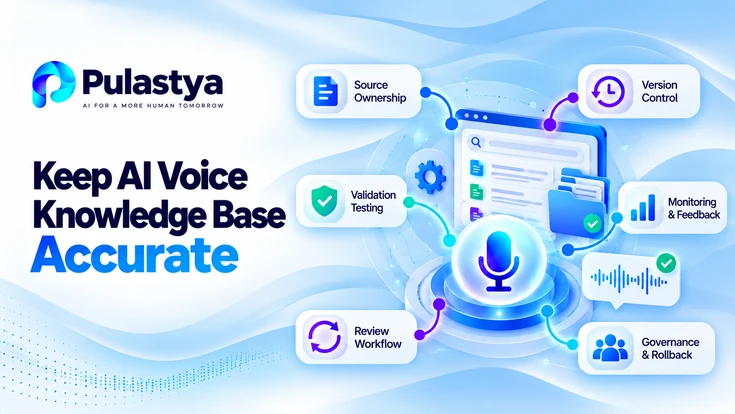
Accurate voice knowledge bases are critical to enterprise conversational systems. Accuracy depends on content freshness, clear source ownership, rigorous version control, and repeatable review cycles that tie every spoken answer back to an approved, current source.
A sound approach prioritizes governance, automation, and measurable gates so teams reduce regressions, speed updates, and keep spoken responses reliable under live call conditions.
- Measure what matters Track answer accuracy against approved sources, stale-answer signals, and end-to-end task success to prioritize fixes.
- Version everything Keep source documents, prompts, and retrieval settings in version control with owners, review-by dates, and immutable releases.
- Automate validation Use stage gates, synthetic voice tests, and telemetry checks to catch regressions early.
Define what accuracy means for your voice knowledge base before you change anything. Establish concrete success metrics such as answer correctness against the approved source, the share of answers drawn from a current document version, and the rate of stale or disputed answers, measured on live calls and controlled tests.
Tie those metrics to business outcomes like containment rate, average handle time improvement, or reduced transfers so accuracy work shows operational impact and budget justification.
Treat freshness and versioning as operational controls, not ad hoc tasks. Implement a release cadence with feature branches for content and prompt changes, mandatory peer review, and automated validation pipelines that run synthetic voice tests.
Include rollback plan templates and time-to-rollback targets. These controls reduce exposure to bad updates and make audit trails usable for compliance or postmortem analysis.
Set Precise Accuracy Objectives and KPIs
Translate business needs into measurable voice knowledge base objectives. For example, set an objective to reduce transfer-to-agent rate for billing inquiries by a fixed target and define the target metric: percentage of sessions where the AI resolved the inquiry without escalation.
Break down objectives into measurement layers: retrieval quality (did the agent find the right passage), answer accuracy (did the spoken answer match the source), and business outcome mapping for full-session success.
Choose KPIs that are actionable. Retrieval hit rate and answer accuracy on a test question set are necessary but not sufficient; add end-to-end metrics like task completion rate and time to resolution.
Instrument call flows to capture whether a spoken response triggered the correct back-end action or handoff. Establish baseline values from historical call logs before making changes so you can quantify improvements and regressions.
Assign ownership for each KPI. Designate an analytics owner responsible for reporting, a product owner for prioritizing fixes, and an engineering owner for implementing changes. Implement weekly dashboards and a monthly review cadence that ties metric trends to specific releases.
Give every source document a named owner as well, so a report of an outdated answer reaches someone who can correct the source. Clear ownership speeds decision making when tradeoffs appear between answer coverage and answer precision.
- Map KPIs to clear business outcomes like containment and handle time.
- Capture retrieval, answer accuracy, and end-to-end task success metrics.
- Establish baselines from production call logs before changes.
- Assign KPI owners and a named owner for every source document.
- Schedule recurring KPI reviews with release readiness checks.
Make KPIs actionable and owned to prioritize accuracy work.
Design a Robust Review and Versioning Lifecycle
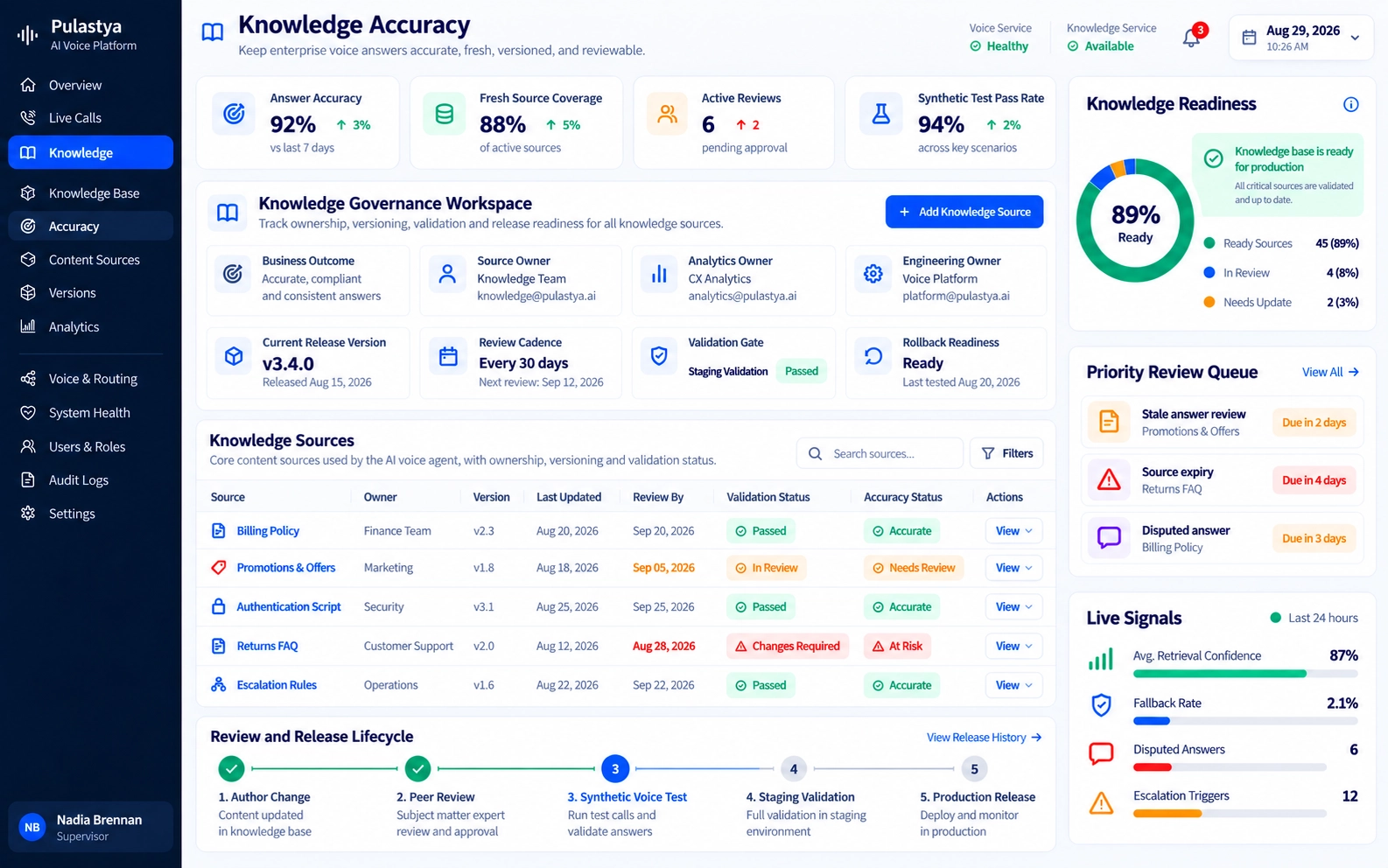
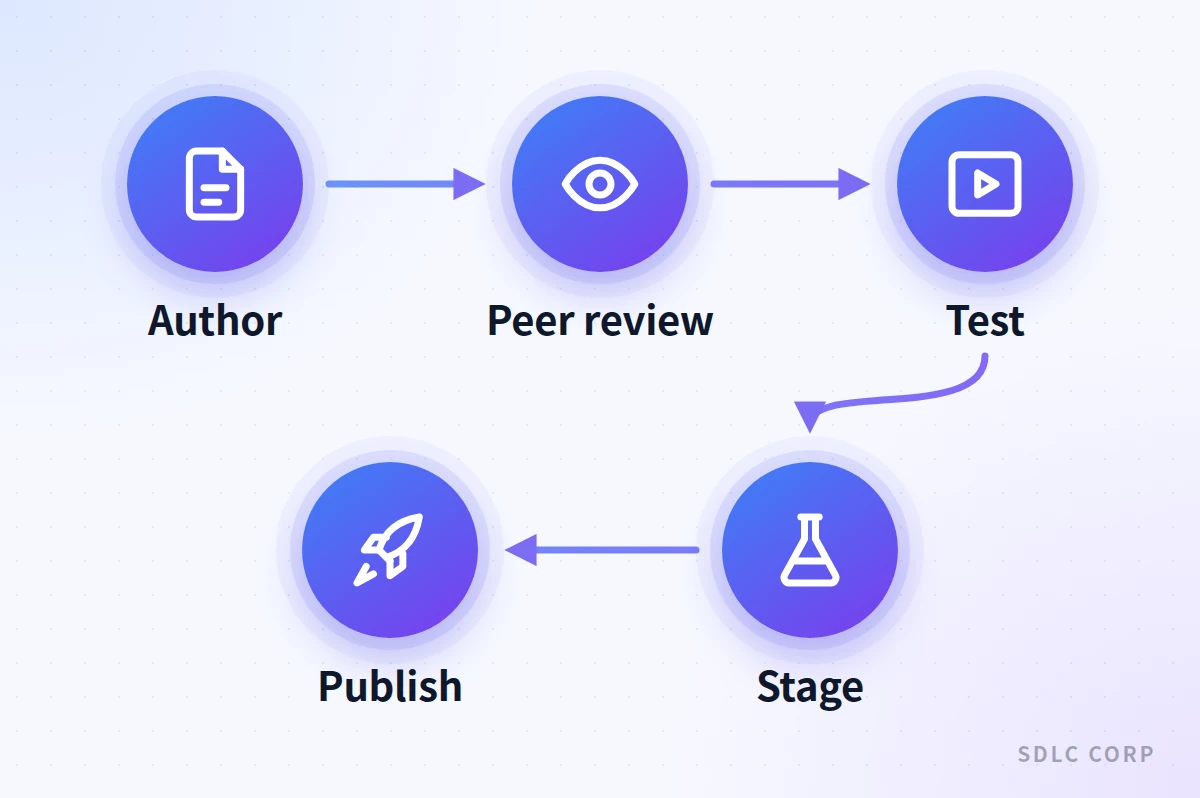
Create a formal lifecycle that covers authoring, peer review, testing, staging, and production for knowledge content and voice prompts. Use branching workflows in your CMS or repository so each change carries a single source of truth and a review history.
Require at least one peer reviewer plus the owner of the source document, and add a conversation design review when a change alters how the agent asks questions or routes callers.
Embed version metadata in every content artifact: author, owner, effective date, review-by date, change summary, linked ticket, and impact assessment. Use semantic versioning for knowledge releases that make behavioral changes to voice responses. Maintain a changelog that is machine-readable to enable automated rollback based on release tags when a new knowledge version introduces regression in live telemetry.
Enforce mandatory staging validation. Before a release, run a synthetic voice test suite and a smoke test across prioritized intents. Gate releases on predefined acceptance criteria that include no drop in answer accuracy for critical questions and no decline in task completion for key flows.
Document roll-forward and roll-back processes and rehearse them as part of release drills to reduce time to remediate.
- Author changes in feature branches with linked change tickets.
- Require peer and source-owner review before publishing.
- Apply semantic versioning and machine-readable changelogs.
- Include owner and review-by dates for traceability and expiry.
- Gate staging releases with synthetic voice and smoke tests.
Versioned releases with mandatory reviews prevent accidental regressions.
Use Source Control and CI for Knowledge Content
Treat knowledge content like code. Store scripts, prompts, interaction maps, and source documents in a repository with commit history.
Use a CI pipeline that validates content formatting, runs static analysis for missing mandatory fields, flags content past its review-by date, and verifies that changes do not conflict with restricted phrases or regulatory constraints. This approach improves traceability and enables automated quality checks before deployment.
Integrate content repositories with the indexing pipeline so the retrieval index is rebuilt from the same committed documents. Ensure your CI produces immutable build artifacts containing the content snapshot, index version, and prompt version.
Keep these artifacts linked to release tags so any production answer can be reproduced, tested, or rolled back. This reproducibility is essential for incident investigations and regulatory audits.
Automate regression checks for prompts and mapping tables. CI jobs should replay a saved set of real caller questions against the new content to detect answers that changed unexpectedly. For larger enterprises, enforce policy-as-code rules during CI to flag forbidden responses or compliance violations before any human hears them in production.
- Store all prompts, interaction maps, and source documents in repos.
- Run CI checks for formatting, mandatory fields, expiry, and policy rules.
- Produce immutable build artifacts linked to release tags.
- Rebuild the retrieval index from each committed content snapshot.
- Replay saved caller questions to detect changed answers automatically.
Source control plus CI makes content changes auditable and reproducible.
Automate Validation With Synthetic Voice Tests
Synthetic voice testing simulates real calls to validate the full voice path. Build a library of test scenarios that include varied accents, background noise, and phrasing diversity for each critical intent. Run these tests in CI against staged content and configuration to measure whether the agent hears the question correctly, retrieves the right answer, and completes the expected action.
Flag regressions against historical baselines before release approvals.
Create deterministic tests for core business flows and probabilistic tests for coverage. Deterministic tests validate critical success paths like authentication or payment confirmation where failure is costly.
Probabilistic tests use randomized utterances and noise profiles to estimate system robustness. Combine both sets into nightly runs and gate releases on deterministic success plus acceptable probabilistic trend behavior.
Integrate synthetic tests with the text-to-speech and speech-to-text stacks used in production to catch integration issues. Capture audio-level logs and transcripts from synthetic runs to compare against expected intents and actions.
Use automated metrics from these runs to generate pre-release reports that summarize risk areas and recommended mitigations for the release owner. For a broader test plan, see testing AI voice agents before production.
- Build deterministic tests for high-risk flows like payments and auth.
- Use probabilistic tests for broader utterance and noise coverage.
- Run synthetic voice tests in CI against staged artifacts.
- Compare transcripts and actions to expected outcomes automatically.
- Gate releases when deterministic tests fail or probabilistic drift exceeds thresholds.
Synthetic voice tests catch integration and regression issues before production.
Operational Monitoring and Feedback Loops
Operational telemetry is the primary signal for accuracy in production. Monitor real-time metrics such as retrieval confidence, "no answer found" and fallback rates, and customer escalation triggers. Capture structured call outcomes and link them back to the knowledge artifact version and model version to isolate when regressions start.
Watch for stale-answer signals as well: callers who contradict an answer, ask for a person right after it, or call back about the same topic. Use alerting thresholds for sudden drops in success metrics so teams can react within defined SLAs.
Harvest human-in-the-loop feedback from quality specialists and agents. Route sampled calls with low retrieval confidence or disputed answers to reviewers and capture their corrections as content tickets assigned to the source owner.
Send confirmed corrections through the normal content review gate so fixes improve answers while preserving reviewability. Ensure reviewers document why a change was made to build institutional knowledge.
Close the loop by prioritizing fixes based on signal strength and business impact. Use a triage matrix that combines frequency, severity, and cost to customer to schedule hotfixes, patch releases, or long-term rewrites. Maintain a backlog with linked telemetry evidence so product managers and engineers can justify resource allocation and measure the effect of remediation after deployment.
- Link telemetry to content and model versions for root cause analysis.
- Alert on sudden falls in retrieval confidence or spikes in fallbacks.
- Route low-confidence and disputed answers to reviewers.
- Turn reviewer corrections into content tickets for source owners.
- Prioritize fixes by frequency, severity, and business impact.
Operational telemetry plus human review creates a repeatable improvement cycle.
Stale-answer detection
Which Signal Triggers Which Review, and Who Owns It
| Signal | Review action | Owner |
|---|---|---|
| A source document passes its review-by date | Flag or withdraw the content until its owner approves it again | Source document owner |
| Pricing or policy changes in the system of record | Update the document, re-index it, and replay affected test questions | Content author, with source owner sign-off |
| Callers dispute an answer or ask for a person right after it | Review sampled calls and open a content ticket with the call evidence | QA specialist |
| Fallback or no-answer rate rises for one topic | Check for missing or outdated content before touching any model | Analytics owner |
| Transfers spike after a knowledge release | Roll back to the prior tagged release and run a postmortem | Accuracy steward |
Every signal leads to a content action with a named owner; model retraining is not the first response to a stale answer.
Manage Voice-Specific Data and NLU Model Changes
Keep knowledge updates and NLU model changes on separate tracks. A stale or wrong answer is a content problem: correct the source document, re-index it, and re-test. Updating knowledge does not require retraining a model.
Retraining an intent or speech model addresses a different failure, such as callers being routed to the wrong topic or domain terms being misheard.
When the two interact, for example a new product line that needs both new content and a new intent, version the model with the content release it was tested against and include model hyperparameters in the release artifact.
When you do retrain intent or speech models, standardize dataset curation for voice. Include diverse audio samples, regional accents, and expected noise conditions. Tag samples with metadata such as source channel, device type, and transcription confidence. Use stratified sampling to ensure less common utterances are present during training and validation.
Maintain a test holdout that mirrors live-production distributions to prevent optimistic validation.
Plan model updates with a canary deployment strategy. Roll new NLU models to a small percent of traffic and monitor accuracy, fallback, and completion metrics linked to that cohort. If canary telemetry meets acceptance thresholds, progressively increase traffic. Document rollback triggers and keep previous model artifacts readily deployable for immediate rollback if the canary shows degradation.
- Fix stale answers in content; retrain models only for recognition or routing errors.
- Curate diverse audio datasets with metadata tags for robust training.
- Keep a production-like holdout test set separate from training data.
- Deploy models via canary rollouts and monitor cohort-specific metrics.
- Prepare rollback artifacts and clear rollback criteria in advance.
Separating content fixes from model retraining, and versioning both, prevents unpredictable behavior.
Governance, Roles, and an Example Remediation Scenario
Define governance with clear role definitions: content authors, source document owners, NLU engineers, QA specialists, analytics owners, and an accuracy steward who signs off on releases. Create an escalation path for high-severity issues so business stakeholders can pause releases.
Maintain a policy catalog that specifies allowed response templates and regulated language. Governance ensures that speed of updates does not come at the cost of compliance or customer trust. The approval workflow itself is covered in knowledge governance for AI voice agents.
Set a review-by date on every source, with shorter cycles for pricing, promotions, and policy content, and flag or withdraw content that passes its date without review. Document review SLAs and maintain an approvals dashboard that shows pending reviews, reviewers assigned, and time elapsed.
Tie release windows to staffed monitoring periods to ensure teams can observe the initial production impact. Conduct quarterly audits of content changes and model updates to confirm adherence to the lifecycle and to surface systemic process improvements.
Example scenario: A weekend release introduced a new billing-response template that increased transfer rates. The alerting system detected a sharp rise in transfers for billing questions on Monday morning. The on-call accuracy steward invoked the rollback playbook, reverted to the previous tagged release, and created a corrective ticket.
The postmortem showed the content edit removed a disambiguating question. The fix restored that question in the template, re-indexed the updated content, and added a targeted synthetic test to prevent recurrence; no model retraining was needed.
- Define roles: content author, source owner, NLU engineer, QA, analytics owner, accuracy steward.
- Maintain an approvals dashboard and review SLAs for release gating.
- Schedule release windows with staffed monitoring to observe initial impact.
- Run quarterly audits of lifecycle adherence and postmortem trends.
- Keep rollback playbooks and tagged artifacts ready for immediate recovery.
Clear governance and rehearsed rollback plans shorten incident resolution windows.
For what the knowledge base should contain, see what goes into an AI voice agent knowledge base; for deciding when an answer needs live data, see knowledge base vs real-time API.
Conclusion
Keeping an AI voice knowledge base accurate is an ongoing governance and release discipline, not a one-time content cleanup. Set measurable accuracy targets, assign a named owner and review-by date to each source, and link approved documents, prompts, and retrieval indexes to versioned releases. Peer review, continuous integration checks, and synthetic voice tests help catch outdated information and unexpected answer changes before they reach callers.
After each release, track disputed answers, fallback rates, transfers, and task completion against your baseline. Route confirmed content issues to source owners, update and re-index stale knowledge, and reserve model retraining for speech-recognition or intent-routing failures. Clear escalation paths, documented approvals, and tested rollback procedures keep spoken answers current, trustworthy, and auditable as business information changes.
Frequently Asked Questions
Set the cadence by how quickly each source changes. Review pricing, promotions, and policy content whenever the system of record changes and on a short fixed cycle, while stable how-to content can follow a longer one. Give every document an owner and a review-by date, and flag or withdraw content that passes that date unreviewed.
At minimum, run deterministic tests for critical flows like authentication, payments, and legal disclaimers plus a representative probabilistic suite that covers common phrasings, accents, and noise profiles. Gate releases on deterministic success and acceptable probabilistic trend behavior.
Check where the failure happened. If the agent understood the question but gave an outdated or wrong answer, fix the source content and re-index it. If callers are routed to the wrong topic across varied phrasings, or key terms are misheard, review the intent or speech model. Use frequency and severity to assign hotfix, patch, or roadmap priority.
Maintain immutable, tagged production artifacts and an automated rollback job that restores prior model and content versions. Use canary deployments for safer rollouts and have a documented rollback SLA measured in minutes to limit customer exposure.
Assign an accuracy steward to own metrics and release signoff, with named owners for each source document and delegated ownership for analytics, content, and engineering tasks. This single-point accountability speeds decisions and ensures that KPIs map directly to operational actions.