Selecting between a knowledge base and a real-time API is a core architecture decision for enterprise AI voice agents. The choice determines response accuracy, compliance surface, integration complexity, and operational cost.
Clear criteria, deployment patterns, and a practical scenario help technical and product teams decide and implement the right mix for customer-facing voice automation.
- Determinism vs Freshness Knowledge bases deliver approved, reviewable answers and auditability; real-time APIs deliver freshness and actionability.
- Operational Cost and Complexity Real-time integrations raise failure modes and monitoring needs; knowledge bases simplify runtime operations but increase content governance work.
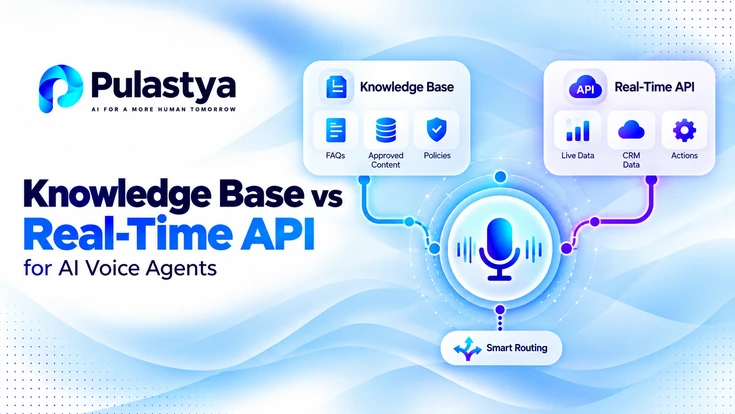
- Hybrid is often optimal Combine both: use a knowledge base for policy and fallback, real-time API for personalized data and commands, and a selection layer to route queries.
Knowledge bases provide curated, versioned content that voice agents can retrieve and cite. The content is fixed and reviewable, although an LLM that rephrases retrieved text can still vary its wording, so regulated passages should be read verbatim. Knowledge bases are appropriate when answers are stable, regulatory requirements demand audit trails, or latency must be predictable.
Real-time APIs fetch live data and execute actions, enabling transactions, personalization, and updates that a static knowledge store cannot deliver. Both approaches affect dialog design, error handling strategies, and monitoring requirements in different ways.
Enterprise teams commonly face hybrid needs: some intents require fresh account or inventory data, others must reference approved policy text or training scripts. The decision should be driven by source ownership, expected update frequency, SLA for response time, and how safety and logging will be enforced.
When to Choose a Knowledge Base for Voice Answers
Choose a knowledge base when the primary requirement is repeatable, auditable responses rather than live state. Examples include regulatory disclosures, product manuals, approved troubleshooting procedures, and scripted legal language.
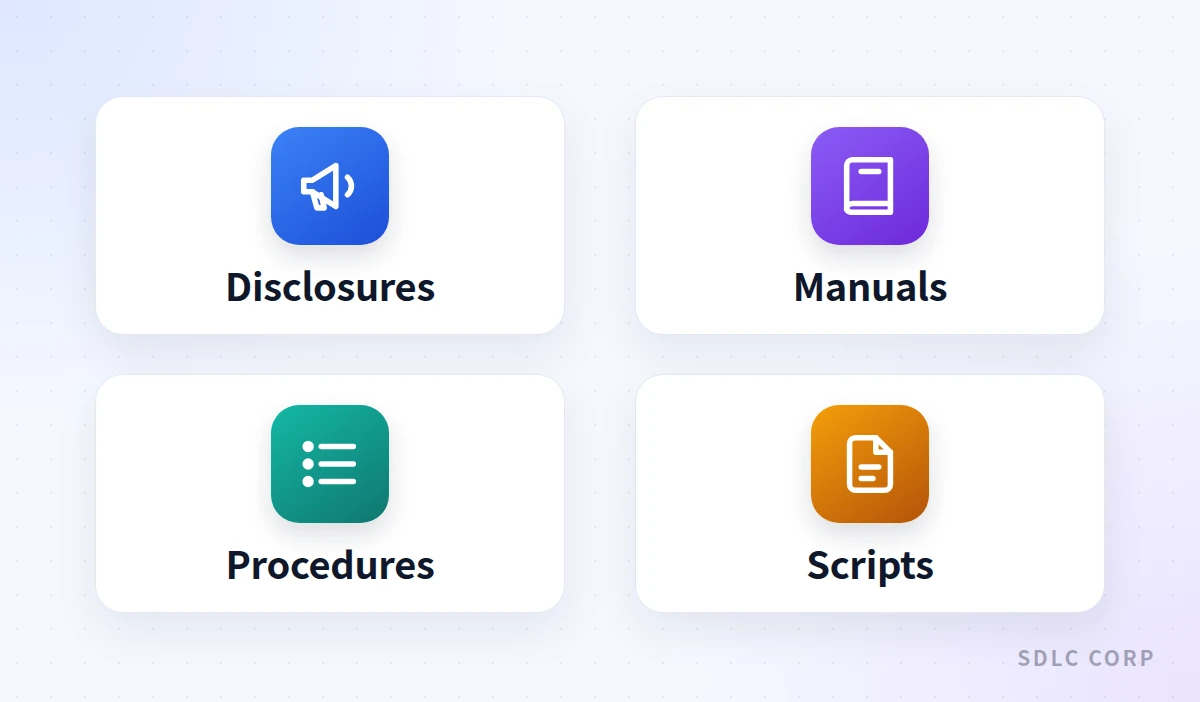
A curated store enables version control, content review workflows, and deterministic mapping from intent to content, which simplifies verification and reduces hallucination risk in LLM-backed voice agents.
Operationally, knowledge bases reduce runtime integration dependencies: fewer external calls mean fewer transient failures and predictable latency. They support content owners with role-based editing, staged releases, and rollback. For agents that must produce verbatim policy text or label-sensitive phrasing, storing canonical responses enforces consistency and eases compliance audits and training for support staff.
Tradeoffs include content staleness and the governance overhead of keeping information current. If the underlying facts change frequently, the knowledge base becomes a blocking update pipeline. Plan content owners, edit cadence, and automation for syncing canonical records from authoritative systems to prevent outdated or contradictory agent responses.
- Best for stable, approved text: policies, manuals, scripted dialogs.
- Supports versioning, editorial workflows, and audit trails.
- Reduces runtime points of failure and offers predictable latency.
- Requires content governance to avoid stale answers and contradictions.
Use a knowledge base when deterministic, auditable replies matter more than live state.
When to Choose a Real-Time API for Voice Actions and Data
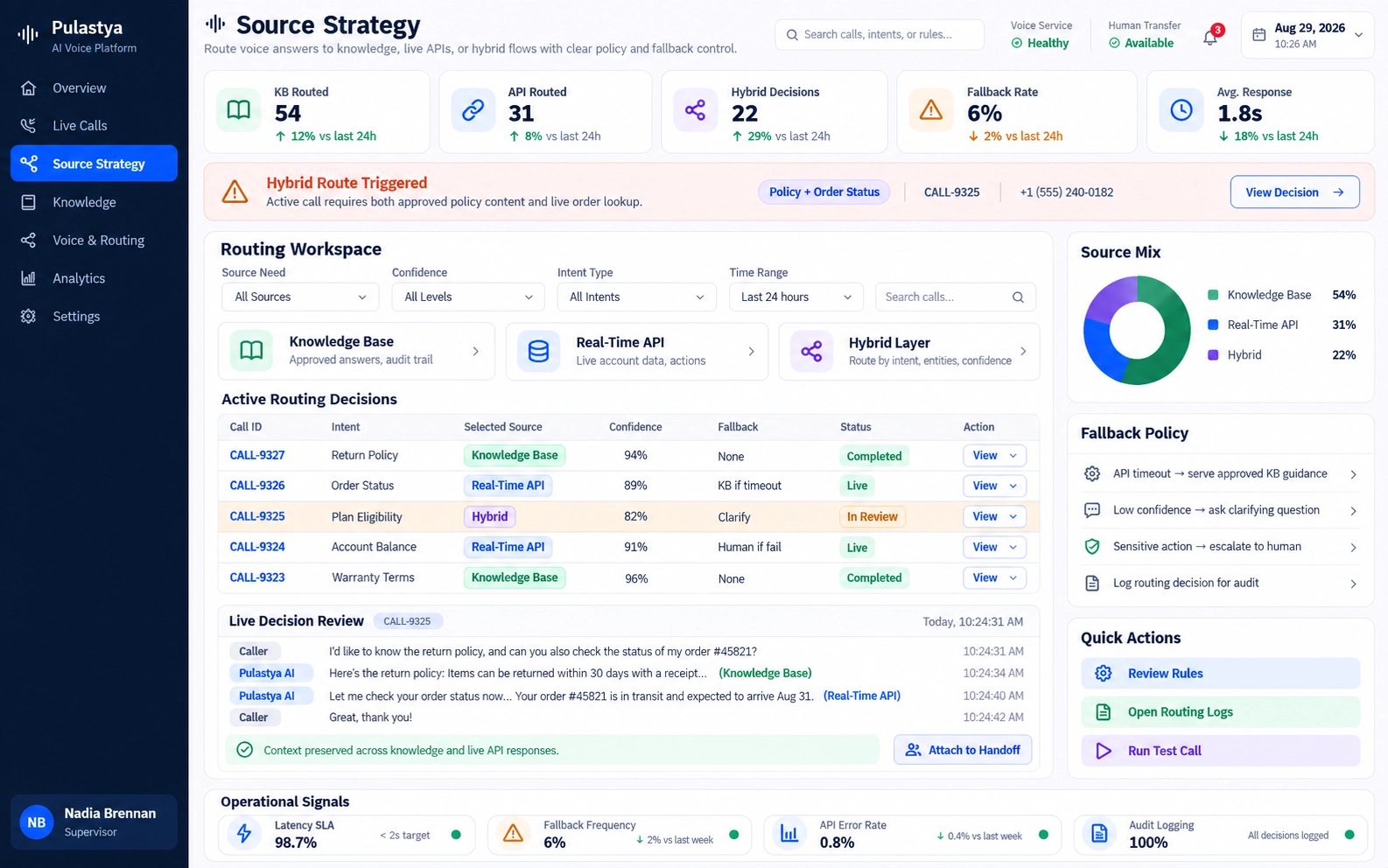
Real-time APIs are essential when the voice agent must act on current state or execute transactions: retrieving account balances, checking inventory, booking appointments, or applying promotions. These integrations give the agent up-to-date context required for safe, correct decisions and enable two-way interactions that change backend state in response to user intent.
Designing for real-time calls forces teams to manage latency, retry behavior, and partial failures. For enterprise-grade voice agents, instrument every API call with correlation IDs, timeout budgets, and explicit fallback paths.
Implement idempotency keys for mutations so a retry after a timeout does not book, charge, or cancel twice; a caller cannot easily spot or undo a duplicate action in the middle of a call.
Real-time connectivity increases surface area for outages and security controls. It also complicates testing because responses depend on external system state. Create mock services, contract tests, and staged feature flags to validate behavior before routing production traffic to live APIs. For timeout budgets and fallback patterns in detail, see real-time APIs for AI voice agents.
- Required when responses depend on live customer or inventory state.
- Mandates robust timeout, retry, and idempotency strategies.
- Needs monitoring of third-party SLAs and end-to-end latency.
- Adds security demands: scoped credentials, least privilege, and encryption in transit.
Choose real-time APIs when current state or transactional capability is nonnegotiable.
Source decision
Knowledge Base or Real-Time API: What Each Source Is Built For
| Aspect | Knowledge base | Real-time API |
|---|---|---|
| Best for | Stable, approved content such as policies, manuals, and FAQs | Live or caller-specific data and actions such as balances or bookings |
| Freshness | As current as the last reviewed publish | Current at the moment of the call |
| Latency | Predictable; no wait on backend systems | Adds network, authentication, and backend time |
| Main failure mode | Stale or contradictory content | Timeouts, outages, and partial failures |
| Controls to plan | Owners, review cadence, versioning, rollback | Timeout budgets, fallbacks, idempotency, scoped credentials |
| Audit evidence | Content version behind each spoken answer | Correlation IDs linking utterance, request, and reply |
Notice that each source fails differently, which is why hybrid agents route by intent and need a fallback for API failures.
When and How to Implement a Hybrid Source-Selection Layer
A source-selection layer routes queries to a knowledge base, a real-time API, a clarifying question, or a human based on intent, confidence, and context. Implement this layer as a lightweight decision service that evaluates rules and dynamic signals: intent classification, entity presence, recency needs, and user permissions. This isolates routing logic from dialog code and lets teams evolve sources independently.
Build decision rules that are explicit and observable. Example pattern: for intents flagged as 'policy' return knowledge base content; for intents with account or session entities call real-time APIs; if confidence is low, ask a clarifying question or escalate to a live agent. Any generated reply should stay constrained to retrieved or returned data.
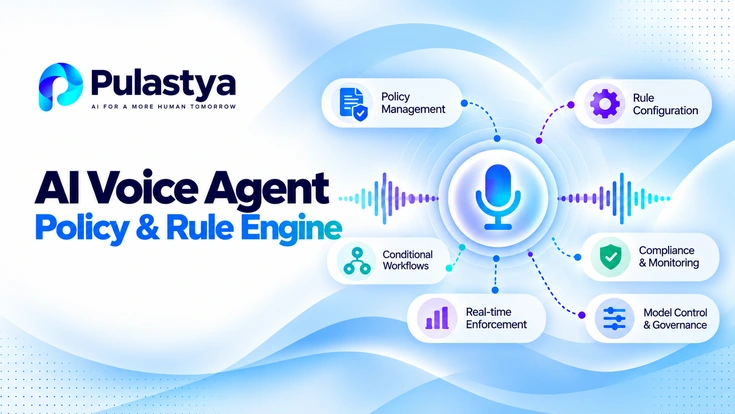
Store routing rules in a configuration service under change control so non-developers can adjust behaviors without redeploying code.
Operational benefits include graceful degradation and clearer failure modes. If an API fails, the layer can return general knowledge-base guidance, a cached value clearly described as last known where policy allows, or an apology script, and route for human escalation. Maintain metrics for misrouted calls, fallback frequency, and user satisfaction to iteratively tune rules and thresholds.
- Use a decision service to map intents to source types at runtime.
- Evaluate signals like intent type, entity recency, and confidence score.
- Provide cached or scripted fallbacks when real-time calls fail.
- Make routing rules configurable to allow rapid policy changes.
A configurable selection layer reduces coupling and enables safe hybrid operation.
Latency, Cost, and Reliability Tradeoffs
Latency targets for voice agents are strict: users expect short pauses and immediate reassurance. Knowledge-base lookups are often faster and more predictable because they do not wait on backend systems of record, but large indexes or vector search can introduce variability.
Real-time APIs add network latency, authentication overhead, and backend processing time. Set an SLO for end-to-end response time and budget per-call latency to decide which source is acceptable for each intent.
Costs scale differently: knowledge bases impose content management and storage costs plus occasional compute for vector search; real-time APIs incur per-call processing and potential third-party fees and maintenance overhead. Calculate cost per successful interaction under expected call volumes, and plan caching or batching strategies for high-frequency queries to control operating expense.
Reliability modeling must account for cascading failures. Design for graceful degradation: prioritize critical intents for guaranteed route availability, use retries with backoffs, and limit user-visible retries to preserve experience. Invest in synthetic monitoring for latency and error rates and include circuit breakers to protect the voice agent during downstream outages.
- Set SLOs for end-to-end voice response times and per-call budgets.
- Model cost per interaction including storage, compute, and API fees.
- Use caching, batching, or TTL strategies to reduce live-call volume.
- Implement circuit breakers and synthetic checks to detect cascading failures.
Balance latency and cost by assigning strict SLOs and caching high-volume lookups.
Design Patterns for Dialogs, Slot-Filling, and Error Handling
Design dialogs so the agent clarifies data needs before making real-time calls. Use pre-checks to verify required entities are present and validated, then call the API only once the user intent is confirmed.
For knowledge-base responses, retrieve and confirm canonical phrasing, then present it with minimal rephrasing to avoid drift. These patterns reduce unnecessary downstream traffic and improve predictability in spoken exchanges.
Implement progressive disclosure for long knowledge-base texts: summarize first, offer to expand on sections, and log user choices for analytics. For slot-filling tied to real-time actions, add a spoken confirmation step that repeats critical fields before executing a command. For spoken confirmations, use explicit language of actionability, such as 'I will schedule this appointment for 2 p.m.; should I proceed?'.
Example scenario: a telecom voice agent determines whether to offer a plan change. The agent first queries the knowledge base for approved offer scripts and eligibility rules, then fetches live account usage via real-time API to decide the specific promotion.
If the API times out, the agent falls back to a scripted apology and sets a callback task for a human agent, ensuring compliance and avoiding incorrect commitments.
- Clarify and validate entities before calling real-time APIs to avoid wasted calls.
- Summarize long knowledge responses and offer optional expansion on request.
- Confirm critical fields with the user before executing actions tied to APIs.
- Fallback to scripted responses and human escalation when live data is unavailable.
Structure dialogs to validate inputs first, then call the most appropriate source to minimize errors.
Security, Privacy, and Compliance Considerations
Security posture differs between knowledge bases and real-time APIs. Knowledge stores must control write access, protect version history, and sanitize content that could leak sensitive data. Real-time APIs require fine-grained API keys, short-lived tokens, and strict authorization checks because they often expose customer-specific data and can trigger state changes. Apply least-privilege for both types of access.
Privacy obligations drive retention and logging decisions. For knowledge-base answers that contain no PII, long-term logging is often acceptable. For real-time transactions, mask PII in logs, use tokenization for identifiers, and maintain clear retention policies aligned with regulatory requirements. Ensure consent flows in the voice UX if recording or persisting customer audio or personal identifiers.
Compliance workflows must be auditable. Maintain tamper-evident logs correlating user utterances, selected source, API calls, and the exact response delivered. This traceability supports dispute resolution and regulatory reviews. Perform regular audits of routing rules, content updates, and access rights to detect drift or unauthorized changes.
- Enforce least-privilege access for content editing and API credentials.
- Mask or tokenize PII in logs and limit retention for real-time transactions.
- Keep tamper-evident traces linking utterance, routing decision, API call, and reply.
- Audit routing rules and editor permissions regularly for compliance assurance.
Treat source selection as part of your compliance surface and log it end-to-end.
How to Evaluate, Monitor, and Roll Out Voice Source Strategies
Evaluate source strategies with measurable experiments. Split traffic by intent and route a controlled percentage to knowledge-base-only or API-only flows to collect comparative metrics: resolution rate, mean time to resolve, conversation duration, and escalation rate.
Use quality sampling to review transcripts for correctness and compliance. Measurement drives decisions about permanent routing changes and optimization.
Monitoring must capture both system metrics and user-centric KPIs. Track per-intent latency, fallback frequency, API error rate, and user abandonment in real time. Implement escalation alerts for rising fallback rates or degraded API SLAs. Tag telemetry with routing decisions so you can attribute behavioral changes to changes in source selection or content updates.
For rollout, use feature flags and phased releases. Start with low-risk intents and expand coverage as confidence grows. Include a rollback plan that can switch traffic back to knowledge-base responses if an API regression occurs.
- Run A/B or canary tests by routing small traffic slices to different source strategies.
- Instrument routing, latency, and fallback KPIs and correlate with user satisfaction.
- Use feature flags and phased rollouts with clear rollback paths.
- Ensure telemetry links routing decisions with downstream API performance for root cause analysis.
Measure impact with experiments, monitor end-to-end telemetry, and roll out incrementally with clear rollback controls.
E-commerce support is a clear example of this split: return policies come from approved content, while order status needs a live system. The guide to AI voice agents for e-commerce calls works through both.
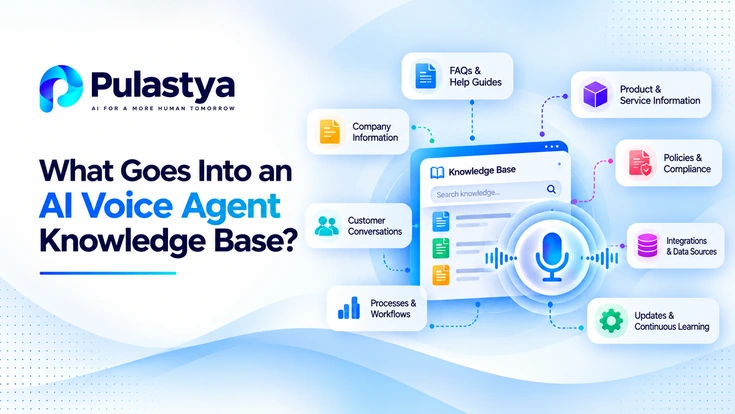
For what the knowledge base should contain, see what goes into an AI voice agent knowledge base; for review cadence and stale-answer detection, see keeping an AI voice knowledge base accurate.
Frequently Asked Questions
Yes for use cases where answers are stable, nontransactional, and must be audited. But purely knowledge-based agents cannot perform live transactions or return personalized state. For scenarios requiring actions or current account data, integrate real-time APIs or accept limited functionality.
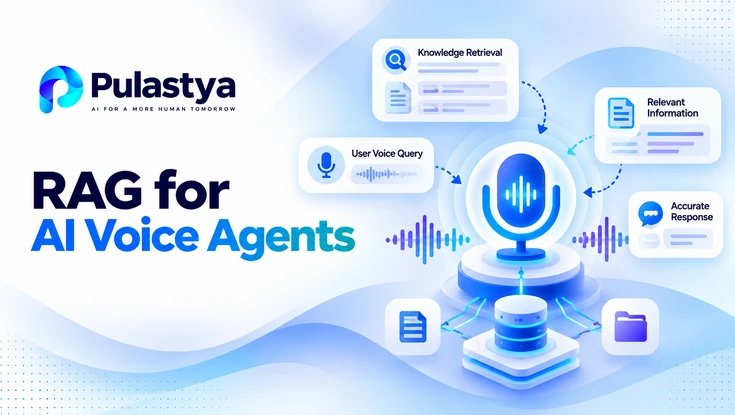
Use retrieval-augmented generation: instruct the LLM to answer only from retrieved knowledge-base snippets, have it say it does not know when nothing relevant is retrieved, and check outputs before they are spoken. Read canonical text verbatim for regulated content and log the retrieval IDs for auditability.
Common fallbacks include cached knowledge-base responses, scripted apologies with callback scheduling, escalation to human agents, or soft-failing with limited read-only information. Choose fallbacks that preserve compliance and avoid unauthorized commitments.
Use contract tests, mock services for APIs, and shadow traffic to validate routing without impacting users. Run synthetic calls and human reviews on sampled transcripts. Gradually enable routing via feature flags and monitor for increased fallbacks or errors.
Prioritize per-intent resolution rate, end-to-end latency, fallback frequency, API error rates, and user abandonment. Correlate these with routing decisions and content changes to quickly identify regressions and tune rules.