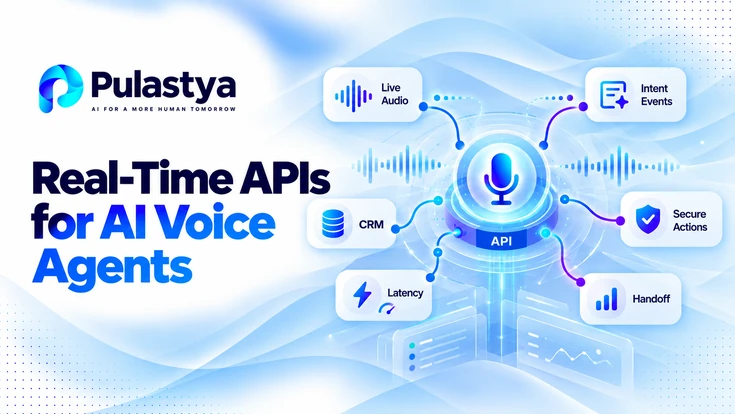
Real-time APIs are the connective tissue that turns speech into action for enterprise voice agents. They deliver low-latency audio streams, live intent signals, and secured action channels so agents can read live data, execute transactions, and maintain conversational continuity across systems and users.
- Live audio and events Treat audio streams and intent events as first-class supported payloads with defined codecs, chunk sizes, and event schemas.
- Action safety and audit Separate 'suggest' and 'execute' channels and require multi-step authorization for high-impact actions with full provenance.
- Operational SLOs Design latency budgets for audio round-trip, STT/intent processing, and back-end action execution; monitor each independently.
Enterprises deploying AI voice agents need a clear specification for live data and action access. Real-time APIs define the semantics, performance targets, and security boundaries for streaming audio, streaming intents, and command execution.
Concrete API contracts avoid ad hoc integrations that break under load, make auditability tractable, and let engineering teams build components that scale independently.
The practical implementation choices for voice-call workflows are low-latency audio transport, instant transcription and intent events, safe action channels into back-end systems, and operational controls like latency budgets and SLOs.
These choices fall to technical stakeholders and architects who must integrate voice agents with CRMs, ticketing systems, order platforms, and internal automation while preserving control and auditability.
Why Real-Time APIs Matter for AI Voice Agents
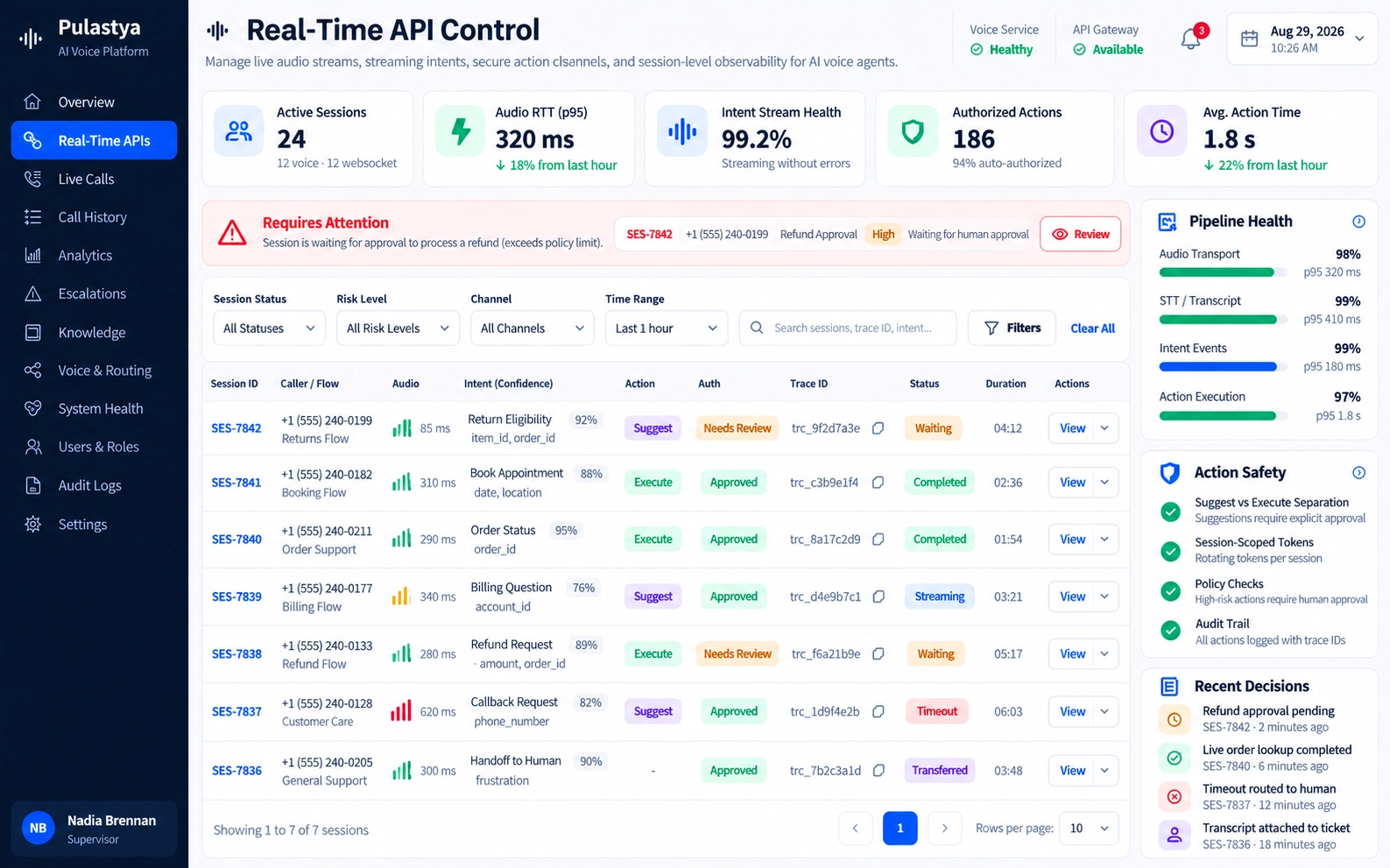
Voice agents are judged on responsiveness, accuracy, and the ability to act. Real-time APIs formalize the contract between streaming components: audio capture, speech-to-text, intent extraction, and action execution. An explicit API reduces integration drift, documents quality expectations, and lets product and security teams accept or reject capabilities based on measurable SLAs and access rules.
Without a real-time API layer, teams stitch custom sockets or webhooks that vary by vendor and break on scale. A standardized API lets engineering teams swap STT or NLU components, deploy edge gateways for latency reduction, and enforce consistent authentication and encryption across all live sessions without reauthoring every integration point.
For compliance and auditing, real-time APIs make it possible to record structured events tied to a session ID and a user identity. This event stream supports dispute resolution, regulatory reporting, and downstream analytics without requiring post-hoc log matching. That structure also simplifies incident response when agents take incorrect actions.
- Defines precise latency and reliability expectations for audio and events
- Allows component substitution while keeping contracts stable
- Enables session-scoped audit trails and provenance
- Reduces integration complexity and vendor lock-in
A formal real-time API turns transient voice interactions into managed, auditable sessions.
Core Capabilities: Audio Streaming, Streaming Intents, and Actions
A production-ready real-time API must support bidirectional audio streaming with compatible codecs, chunk framing, and optional packet-level sequencing for jitter handling. The API should include a lightweight control channel for start/stop, mute, and low-resource device signals, and should allow clients to request partial transcripts as they become available to avoid wait-state handoffs.
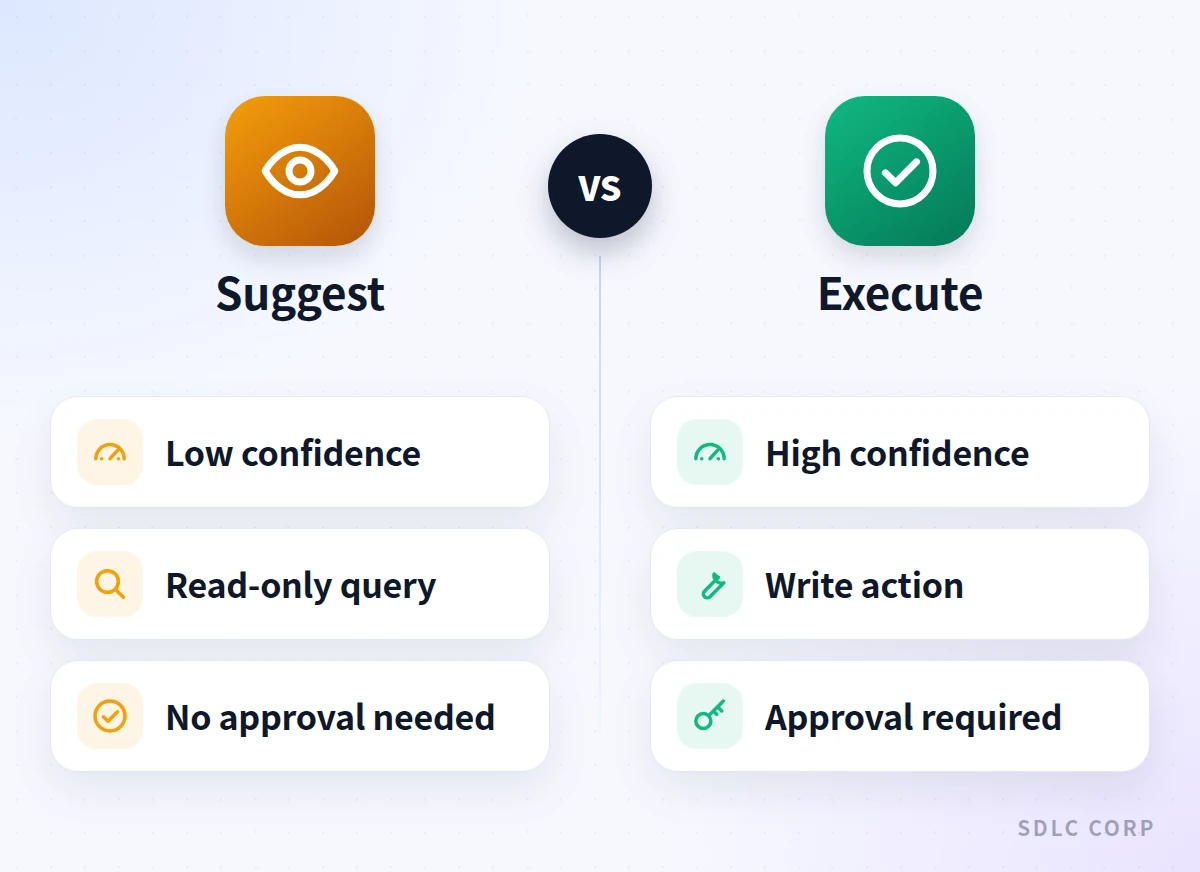
Streaming intent events are as important as raw transcripts. APIs should emit structured intent signals with confidence scores, entity spans, and timestamps in near real time to support progressive UX updates and partial automation. Design the event schema to separate high-confidence 'execute' intents from tentative 'suggest' intents and to carry metadata for authorization and audit.
Action channels require clearly defined safety semantics. Provide distinct endpoints for exploratory queries, read-only requests, and write actions. High-impact actions should require an additional signed approval or a short-lived grant token. Embed trace identifiers that link audio chunks, intent events, and action requests for forensic analysis.
- Bidirectional audio with codecs and sequencing to minimize jitter
- Partial transcription events to reduce perceived latency
- Real-time intent events with confidence and entity spans
- Separated channels for suggest vs execute with explicit authorization
Treat intent streams as first-class signals with clear execute semantics and provenance.
Architecture Patterns for Reliability and Scale
Scale and reliability start with where processing happens. Push jitter-sensitive functions like echo cancellation and basic VAD to the client or edge gateway; keep STT, NLU, and business logic in regionally scaled services.
Use WebRTC or persistent WebSocket connections when low latency matters (telephony platforms commonly stream call audio over WebSockets), and fall back to chunked HTTP for less time-sensitive use cases to broaden compatibility.
Design for graceful degradation. Implement local fallback heuristics when cloud services are unavailable: cached responses, simplified grammar models, or a clear message before transferring the caller to a person. Partition conversational state so a failure in one region does not erase cross-session context; replicate session metadata asynchronously to secondary regions for fast failover.
Adopt streaming-friendly message brokers and back-pressure controls between STT and NLU components. Use autoscaling groups with predictable warm pools to avoid cold-start latency for ML inference. Instrument request paths with trace IDs and measure per-component latency so you can attribute SLA violations to infrastructure, model inference, or network issues.
- Prefer WebRTC or persistent WebSocket connections for lowest perceived latency
- Edge gateways offload jitter-sensitive audio processing
- Asynchronous replication of session state for regional failover
- Autoscaled inference with warm-pool instances to avoid cold starts
Architect for progressive degradation and measurable component-level latency.
Data Access and Action Control: Live Context, Personalization, and Safety
Live context is the differentiator for enterprise voice agents. Real-time APIs must provide a secure, low-latency path to fetch user profile data, recent transactions, and session-scoped variables so responses can be personalized without large prefetch windows. Use fine-grained access tokens scoped by session and by data type, and require explicit claims for PII retrieval.
Action control requires policy enforcement across streaming pipelines. Maintain an authorization layer that evaluates intent attributes, confidence thresholds, user role, and business rules before allowing an action. Log each decision point with justification and binding evidence (transcript segment, intent confidence) so reviewers can reconstruct the decision chain.
Safety controls also need rate limits and manual overrides. For operations with financial or legal impact, require a two-step flow: the voice agent proposes the action and the back end issues a short-lived approval token after policy checks and fraud screening. This pattern reduces accidental execution while preserving conversational flow.
Every live lookup also needs a timeout budget that fits a natural conversational pause. While the request runs, the agent can say a short holding phrase.
If the budget expires or the back end returns an error, the agent should not guess or reuse an old value as if it were current: it tells the caller the information is not available right now and offers a callback or a transfer.
Retry write actions only with an idempotency key so a slow response does not cause a duplicate refund or booking.
- Session-scoped tokens for low-latency data reads with minimal exposure
- Policy evaluation that binds intent to user role and confidence
- Evidence-backed decision logs linking transcript to action
- Two-step approval flows for high-risk operations
- Timeout budgets with a spoken fallback instead of a guessed answer
Secure live data access with session-scoped tokens and evidence-backed policies.
Live lookup on a call
How a Voice Agent Calls a Live System Without Guessing
- Receive the intent eventIntent, entities, and confidence arrive with a trace ID for the session
- Authorize the requestSession-scoped token plus policy checks on role, confidence, and action risk
- Call within a timeout budgetSay a short holding phrase while the back end responds
- Validate the resultCheck the response schema; writes need an idempotency key or approval token
- Respond and logSpeak the value or confirm the action and record the evidence chain
Possible outcomes
- Result in timeAnswer or complete the action
- Timeout or errorSay it is unavailable; offer a callback or transfer
- Policy check failsHand off to a person with the case context
Notice that a timeout leads to an honest fallback, never to a guessed or stale value presented as current.
Integrations With Enterprise Systems: CRMs, Ticketing, and IoT
Enterprise voice agents become valuable when they access canonical systems of record. Design connectors that use the real-time API to translate streamed intents into canonical operations: create or update CRM records, attach audio snippets to tickets, trigger fulfillment, or query inventory. Keep integration adapters stateless and idempotent to tolerate retries and partial failures.
For complex integrations, implement a middleware layer that maps intent events to internal APIs and enforces orchestration and compensating transactions. That layer should expose a consistent event schema for downstream systems and support synchronous and asynchronous action paths.
IoT and physical-world actions require extra safeguards. Maintain an action gating service that simulates or audits actuator requests, imposes safe ranges, and requires operator confirmation for irreversible steps. Use durable receipts and reconciliation jobs to ensure the real-time action had the intended effect and surface any discrepancies to human operators.
- Stateless, idempotent adapters for CRM and ticketing integrations
- Middleware orchestration that supports sync and async action flows
- Action gating and simulation for IoT or hardware-affecting commands
- Durable receipts and reconciliation for post-action verification
Map voice intents to canonical enterprise operations through idempotent, auditable adapters.
Operational Practices: Monitoring, SLOs, and Latency Budgets
Define SLOs for each stage of the voice pipeline: audio transport, STT latency, NLU inference, and action execution. Turn those SLOs into measurable metrics with clear alert thresholds.
For example, track 95th-percentile round-trip time from spoken word to suggested intent and 99th-percentile time-to-execute for low-risk actions. Use those metrics to prioritize optimizations and to communicate operational readiness to stakeholders.
Implement observability that correlates audio chunks, intent events, and actions through trace IDs. Capture sample transcripts, model confidence scores, and raw latency histograms to support incident analysis. Build synthetic test calls that validate the entire path and run them continuously from representative edge locations to detect regressions before users do.
Operational readiness also requires runbooks and escalation paths for partial failures: muted audio, transcription drift, or back-end timeouts. Maintain automatic fallback modes, such as queuing actions for human review or routing callers to human agents. Regularly review audit logs to detect policy bypass attempts and tune policy thresholds to minimize false positives.
- SLOs per pipeline stage with clear alert thresholds
- Trace IDs linking audio to intent and resulting action
- Continuous synthetic calls from edge locations for regression detection
- Runbooks for failover, human handoff, and policy escalations
Operationalize voice pipelines with stage-level SLOs and end-to-end synthetic testing.
Deployment Scenario: An Example Retail Returns Voice Agent
Imagine a retail voice agent handling returns over a phone call. The agent accepts an audio stream, emits partial transcripts and intent events, and looks up recent orders via a session-scoped token.
If the intent matches a return and confidence surpasses a threshold, the agent proposes the return details while checking inventory and return window in real time to determine eligibility.
For a refund above a threshold, the system uses a two-step action flow: the agent suggests the refund amount and posts a pending return to the ticketing system; a fraud module runs checks and, on pass, issues a short-lived approval token that the voice agent uses to finalize the refund.
All steps carry trace IDs and store the exact transcript segment and confidence that led to the approval.
If the order falls outside the return window, a lookup times out, or fraud checks fail, the system routes the customer to a human specialist with a pre-populated case that includes audio highlights and the decision rationale. This workflow preserves low-latency handling for routine returns, enforces safety controls for high-risk actions, and keeps full audit trails for downstream reconciliation.
- Session token to fetch order and eligibility in subsecond windows
- Two-step refund approval with fraud screening and short-lived tokens
- Pre-populated handoff to human agent with audio evidence and rationale
- Traceable audit trail linking transcript to refund execution
A well-architected real-time API turns a voice call into a low-friction, auditable enterprise transaction.
Appointment booking is a common reason to connect a voice agent to a live system. The guide to AI appointment scheduling compares live availability lookup with capturing requests for staff to confirm.
For deciding when an answer needs live data, see knowledge base vs real-time API.
Conclusion
Real-time APIs give enterprise AI voice agents a dependable path from live speech to verified business actions. Bidirectional audio, partial transcripts, structured intent events, and separate suggest and execute channels help agents respond quickly without giving up control. Session-scoped tokens, approval checks, idempotent writes, and linked audit trails protect sensitive data and reduce the risk of unintended transactions.
For a successful rollout, start with one defined workflow, such as order inquiries, appointment booking, or retail returns. Set measurable latency targets for each pipeline stage, then test timeouts, policy failures, and transfers to human agents before scaling. Stable API contracts and ongoing SLO monitoring make it easier to expand voice automation while maintaining reliable responses, safe actions, and clear accountability.
Frequently Asked Questions
Set separate latency objectives for audio transport, speech and intent processing, and authorized action execution. Measure each stage under production-like load and choose thresholds that fit the call experience and risk level. Use percentile SLAs and track 95th and 99th percentiles to capture tail behavior.
Use session-scoped, short-lived tokens with least-privilege scopes for data reads. Require step-up authorization for PII or write actions, log every access with transcript references, and apply encryption in transit and at rest for session artifacts.
Expose confidence scores and treat low-confidence signals as suggestions, not commands. Design the API to carry provisional intents and require either explicit user confirmation or additional validation steps before executing high-impact operations.
Keep handoffs fast and context-rich: include session ID, audio excerpts, suggested intents, and the decision rationale. Provide an escalation token that human agents can use to take control of the session without losing continuity or requiring the customer to repeat information.