Data Platforms
First, we move legacy warehouses and data lakes to cloud platforms such as Snowflake and Databricks. Pipelines, schemas and reports then move across in tested waves.

Data & AI Modernization
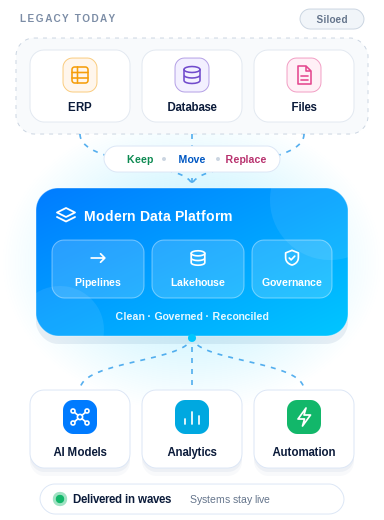
SDLC Corp’s enterprise data and AI modernization services upgrade the data platforms, core applications and governance that AI depends on. First, we assess the warehouses, ERP and pipelines you run today. Then we decide what to keep, move or replace. Finally, we deliver the change in waves, so reporting and operations keep running.
Our 400+ AI specialists are part of SDLC Corp's 1,200+ engineering team. Together, they have completed 300+ AI deployments and 120+ enterprise AI integrations.
Trusted by Fortune Global 500 leaders, governments & top universities across 30+ countries
Powered by leading cloud & AI platforms
Recognized by leading industry reviewers
Awards & industry recognition
2026 Clutch Global Award winner for Oracle services, recognizing Oracle consulting, integration and modernization work.
Services
Our enterprise data and AI modernization services cover the layers that hold AI back the most. Each of the 6 services can also run as a separate project or as part of one program.
First, we move legacy warehouses and data lakes to cloud platforms such as Snowflake and Databricks. Pipelines, schemas and reports then move across in tested waves.
We replace brittle batch jobs and point-to-point links with pipelines orchestrated in tools such as Apache Airflow. In this way, ERP, CRM and document data reach one governed layer.
Most operational data starts in ERP and line-of-business systems. Therefore, we modernize them alongside the data platform so both share clean, timely records.
We assign data owners, define data contracts and track lineage. In addition, quality rules cover accuracy, completeness and timeliness, in line with the ISO 8000 data quality series.
We set up model deployment pipelines, registries, monitoring and evaluation on AWS, Azure or Google Cloud. As a result, every new AI use case reuses the same production path.
We map AI controls to the NIST AI Risk Management Framework. Accordingly, each AI system gets risk tiers, human review and audit evidence.
Industries
Source systems and compliance rules differ across the 4 sectors below. So the target architecture changes with the industry.
Finance
Core banking, payments and risk data often sit on separate legacy platforms. We consolidate them into governed pipelines, so fraud models and regulatory reports draw on the same trusted records.
Banking Software DevelopmentHealth
Clinical, billing and operational data must move under strict privacy rules such as HIPAA and GDPR. We modernize these platforms with role-based access and lineage, so analytics and AI use only approved data.
Healthcare Software DevelopmentSupply Chain
Shipment, fleet and warehouse data often arrive as documents and spreadsheets. We therefore connect ERP, tracking and document data into one layer for planning and AI automation.
Logistics Software DevelopmentIndustrial
Plant systems, ERP and quality records rarely share definitions. We bring them onto one platform, so forecasting and quality AI run on consistent production data.
Manufacturing Software DevelopmentHow We Deliver
Every program follows the same 6 steps. However, the size of each wave depends on what the maturity assessment finds.
First, inventory systems, data flows, reports and active AI projects. Then score each workload on value, risk and effort.
Rank workloads by value and dependency. We also cut unused reports and duplicate pipelines before anything moves.
Next, define the target architecture, platform choice such as Snowflake or Databricks, governance model and team roles.
Migrate and rebuild one wave at a time. Old and new platforms run in parallel until users confirm the numbers match.
After migration, turn ownership, quality checks, lineage and access rules into controls that run every day, in line with ISO 8000.
Once a wave is stable, extend proven patterns to more business units. After that, monitor cost, reliability and model performance.
Related Case Studies
Three SDLC Corp programs where a stronger data and application foundation let AI work at scale.
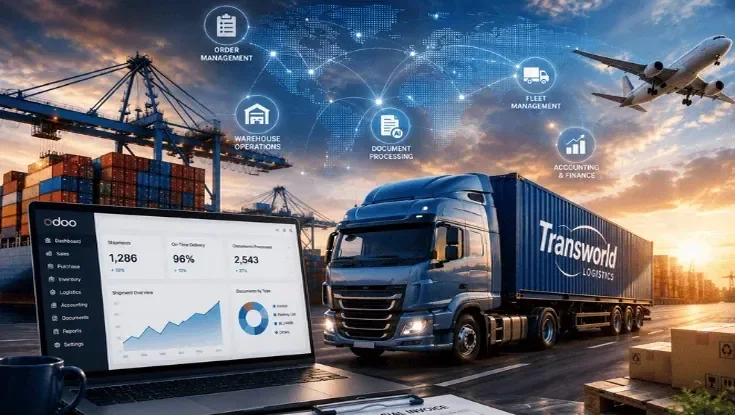
View All AI Case StudiesTransworld Logistics moved fleet, warehouse, accounting and orders onto one Odoo ERP. In addition, AI now extracts shipment-document data and validates it before ERP entry.
Hercules Industries could not import Phocas sales data without damaging CRM records. Therefore, we built two-key matching, field rules and a reusable import framework.

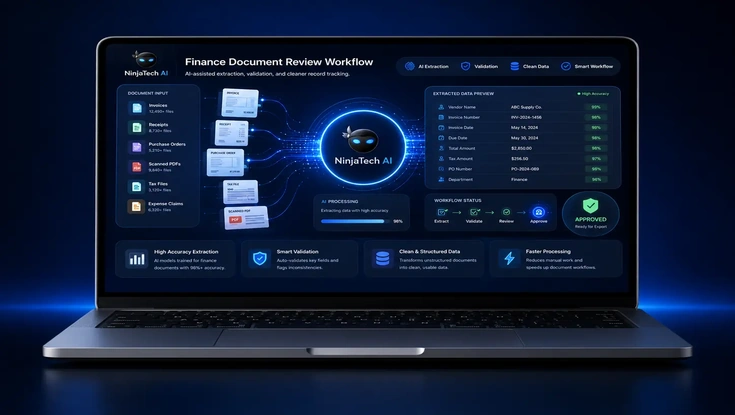
Data AI Ninja extracts fields from invoices, receipts and scanned PDFs. It scores each field and sends low-confidence values to a reviewer before export.
Why SDLC Corp
The SDLC Corp team that plans your modernization also engineers it. As a result, the roadmap and the delivery stay aligned.
We plan data platforms, applications and AI together. Each wave therefore prepares the ground for the next AI use case.
Beyond data platforms, we also modernize ERP and line-of-business systems, where most operational data starts.
Legacy and modern platforms run side by side until users sign off each wave. Meanwhile, reporting and operations keep working.
Ownership, lineage and access controls ship inside each wave. In addition, our Trust Center sets out the security practices behind every engagement.
Cost and Timeline
Each stage below shows a planning range and a typical timeline. Then our assessment turns them into a fixed, phased estimate, and our modernization cost guide explains what drives each figure.
| Stage | Planning range | Timeline | What you get |
|---|---|---|---|
| Constrained Pilot | $75,000 to $250,000 | 8 to 16 weeks | Current-state assessment, target architecture and one validated wave on a priority workload. |
| Foundation and First Production Wave | $250,000 to $1.2 million | 4 to 9 months | Modern data platform, governed pipelines, quality controls and a first AI use case in production. |
| Scaled Multi-Domain Program | $1.2 million to $5 million+ | 9 to 24+ months | More waves across business units, with MLOps, AI governance and a run playbook. |
Testimonials
Watch founders and CEOs talk about building with SDLC Corp. Then read verified Clutch and GoodFirms reviews from ERP, data and AI modernization clients.
Eric Leist
CEO, Edgerton Strategies

Doug Schmidt
CEO, Roofaid USA

Reyzal Razmi
All Star Influencers

"The team had strong technical knowledge, especially around ERP workflows, AI development, chatbot functionality, and overall system architecture."
"I was impressed with their proactive risk management."
"What impressed me most was their methodical approach. Instead of immediately jumping into development, they spent time understanding our entire quote-to-cash workflow."
They approached our Salesforce discovery with real technical depth, uncovered structural gaps others missed, and delivered a solution that worked exactly as promised.
SDLC CORP built a mobile application that met our strategic requirements with strong technical execution. The solution performs reliably and has become an important operational asset.
From planning to post-launch, SDLC Corp guided us every step of the way. Their support makes them more than a vendor. They're a trusted partner.
The SDLC Corp team scaled our platform with impressive technical expertise, ensuring it's secure, robust, and ready for future growth.
See what founders, CEOs and operations leaders say about working with SDLC Corp, or tell us about the system you need to modernize.
Specialist Services
Larger programs draw on dedicated SDLC Corp teams. Each of the 6 teams also works as a standalone service.
Pipelines, warehouses, lakehouses and migrations for analytics and AI.
Data Engineering ServicesModel deployment, registries, feature stores and production monitoring.
MLOps ServicesConnect AI to ERP, CRM, APIs and daily workflows.
AI Integration and Implementation ServicesAI applications and shared AI capabilities built on the modern foundation.
Enterprise AI Development ServicesPolicies, risk tiers, human oversight and audit evidence for enterprise AI.
AI Governance Consulting ServicesApplication rewrites, replatforming and phased cutover for aging software.
Legacy Software Modernization ServicesResources
Practical guides for planning, sequencing and measuring a modernization program.
Explore All Articles
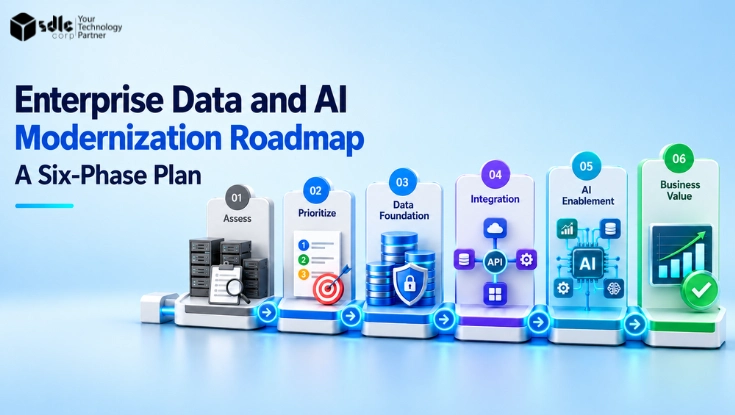
Build a 6-phase roadmap covering architecture, data, governance, operating model and production readiness.
Read Article
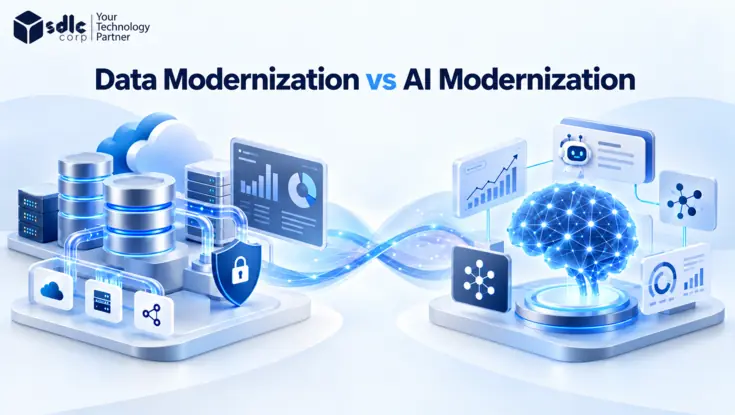
How the two programs differ, where they overlap and which one to sequence first.
Read Article
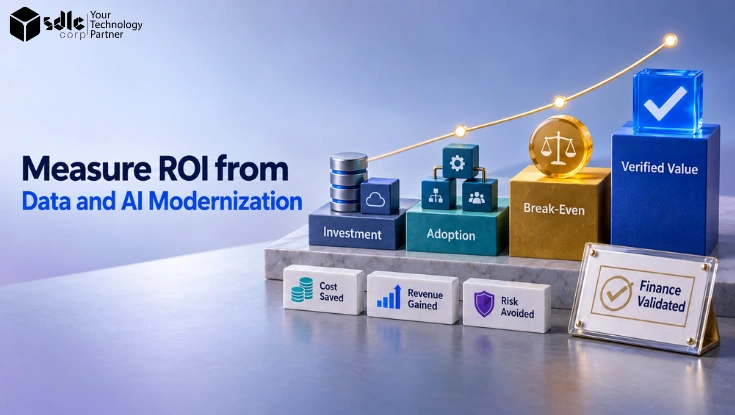
Evaluate modernization investments using business outcomes, operational improvement and long-term platform value.
Read ArticleGet Started
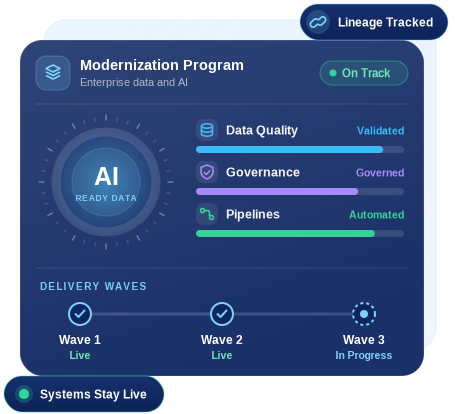
Get a clear plan for what to keep, move or replace. Then modernize in phased waves while reporting and operations keep running.
FAQ
Common questions on scope, timelines, cost, legacy systems and governance in a modernization program.
Enterprise data and AI modernization services upgrade the data platforms, core applications, pipelines and governance an organization needs to run AI in production. The work covers assessment, platform migration, integration, data quality, MLOps and AI governance. Unlike a single migration project, it changes how data is owned, moved and controlled. As a result, analytics and AI teams build on one shared foundation instead of rebuilding it for each use case.
Data migration moves data from one system to another, for example from an on-premises warehouse to Snowflake. Data modernization goes further, because it also redesigns the architecture, pipelines, governance and operating model around the data. On its own, a migration often carries old technical debt onto a new platform. For that reason, we treat migration as one step inside a modernization program, not the goal.
Above all, start with the constraint that blocks your most valuable AI or analytics use cases. For some organizations that is fragmented data. For others, it is an aging ERP, missing governance or unclear ownership. Next, our Current-State Assessment scores each workload on value, risk and effort. As a result, the first wave can target high-value workloads with few dependencies.
In general, program length depends on the number of workloads in scope, data volumes and how much code converts automatically. For example, a single warehouse or pipeline wave is much shorter than a full estate program. As a guide, a constrained pilot takes 8 to 16 weeks, while a scaled program takes 9 to 24 months or more. Either way, the full program runs as a series of waves, and the assessment sets the length of each wave. In most programs, priority workloads go live well before the final wave.
Overall, cost depends on 5 factors. Specifically, these are workloads in scope, source systems, manual conversion effort, governance work and the length of the parallel run. Notably, cutting unused reports and pipelines during the assessment is often the biggest saving. As a guide, a constrained pilot costs $75,000 to $250,000, while a scaled multi-domain program can exceed $1.2 million. We share a phased estimate once the assessment is complete.
No. Each legacy system gets one of 5 paths: retain, integrate, replatform, refactor or replace. The choice depends on its business value, running cost and fit with the target architecture. In fact, many stable systems stay in place and connect to the new platform through APIs or change data capture.
We run old and new platforms in parallel for each wave. Users compare results until the numbers match, and only then does the legacy workload switch off. Then cutover happens one workload at a time, with a rollback plan for each. As a result, reporting, month-end close and daily operations keep running throughout the program.
We work across Snowflake, Databricks, Google BigQuery, Amazon Redshift and Azure Synapse, on AWS, Microsoft Azure and Google Cloud. In addition, we use tools such as dbt, Apache Airflow, Apache Spark and Apache Kafka for pipelines and orchestration. The platform choice follows your workloads, existing investments and regulatory needs rather than a fixed preference.
AI-ready data is accurate, governed, current and consistently defined. Modernization therefore builds those properties into the platform. Quality checks run in every pipeline in line with ISO 8000, lineage shows where each field came from, and access rules apply automatically. MLOps then adds deployment, monitoring and evaluation. Consequently, a new AI use case can reach production without a fresh round of data preparation.
Governance is part of each wave rather than an add-on at the end. First, we define data owners, AI risk tiers, human review points and audit evidence. Then we map them to standards such as ISO/IEC 42001. In practice, risk and compliance teams can then approve new AI systems faster, because the controls already exist.
Yes. The target architecture can be cloud (AWS, Azure or Google Cloud), on-premises or hybrid, depending on data residency, security and existing infrastructure. For example, many enterprises keep sensitive systems on-premises and move analytics and AI workloads to the cloud. In either case, the same governance and quality controls apply across both environments.
Choose enterprise data and AI modernization services from a partner that can both plan and engineer the change. Ask how they decide migration scope, how they prove data parity before cutover, and whether governance ships inside the program. Also check that they can modernize ERP and core applications, not only data platforms. Finally, ask for case studies with measured before-and-after results, such as Transworld Logistics cutting document turnaround from 48 hours to 4.