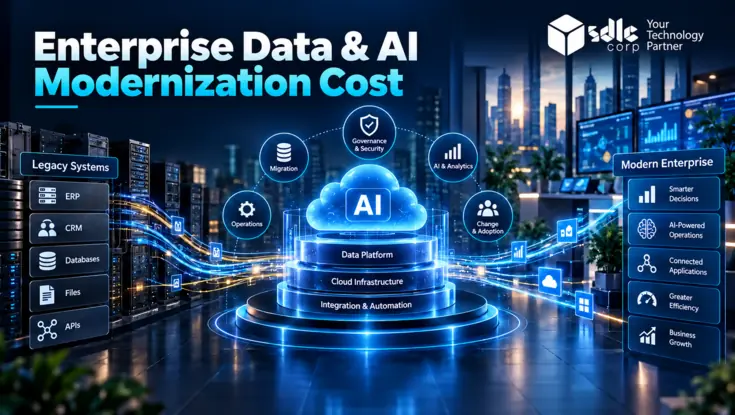
Enterprise data and AI modernization cost should be estimated as a portfolio of workstreams, run costs, and risk allowances. It should not be reduced to one public benchmark or one generic per user multiplier.
- Separate assessment, build, migration, control, and run costs.
- Keep infrastructure and model inference spend distinct from delivery labour.
- Label scenario bands and multipliers as illustrative assumptions.
- Use phased outcomes to contain risk instead of pretending the entire programme can be priced precisely on day one.
Treat every range as directional. Actual cost depends on estate complexity, integration burden, data quality, regulatory controls, and use case scope.
Use A Scenario Based Planning Worksheet Before Requesting Funding
This worksheet is a directional planning aid, not a commercial quote or guarantee. It makes scope assumptions visible before sponsors compare funding options.
The three rows distinguish a constrained pilot, an expected foundation program, and a resilient scaled program. Each scenario keeps one time delivery work separate from recurring operations.
Use the worksheet below to record clear assumptions, cite supporting evidence, and list non monetary estimate drivers that change effort or risk. Populate the same grid for each scenario so reviewers can compare assumptions side by side.
| Planning dimension | Assumptions | Evidence | Estimate drivers |
|---|---|---|---|
| Constrained pilot | One priority use case, one or two data domains, limited integrations, an existing cloud foundation, and explicitly excluded enterprise-wide remediation. | Named business owner, use case brief, source inventory, sample data profile, interface list, security classification, and measurable pilot acceptance criteria. | Domain count, source count, integration complexity, data quality exceptions, environments, user cohort, test cycles, and support hours. |
| Expected foundation program | Reusable platform controls plus the first production wave; several domains; necessary migration, integration, governance, training, and operational handover. | Validated architecture, workload disposition, dependency map, quality baseline, control matrix, delivery backlog, supplier estimates, and agreed service levels. | Workload volume, interface count, migration patterns, remediation backlog, control evidence, team mix, release waves, and steady-state consumption. |
| Resilient scaled program | Multiple business domains and production use cases with resilience, rollback, dual running, adoption support, continuity planning, and operating capacity. | Portfolio roadmap, tested recovery objectives, capacity forecast, operating model, adoption baseline, audit requirements, benefit owners, and exit plan. | Program duration, parallel workstreams, regional controls, peak throughput, retention, availability, vendor dependencies, adoption effort, and contingency exposure. |
Populate every cell with evidence that a reviewer can inspect. Replace vague labels such as “complex integration” with counts, patterns, owners, and known constraints.
Compare assumptions across the three scenarios before comparing totals. Approve the smallest scenario that can create credible evidence for the next funding decision.
- Keep one time implementation work separate from recurring platform and support costs.
- Record dependencies that could change the estimate, including data quality remediation and supplier controls.
- Review the model when the scope, architecture, risk tier, or adoption plan changes materially.
Budget Planning Method
Build enterprise data and AI modernization cost from workstreams and operating components, not one headline figure. Start with assessment and target state design.
Then estimate platform foundations, migration, integration, governance, security, use case delivery, change enablement, and recurring run costs after go live.
This approach makes trade offs visible. Teams can see which spend is unavoidable foundation work, which spend scales with the number of use cases, and which spend is a policy choice about control depth, resilience, or speed.
- Use cost buckets that map to real teams and vendors.
- Separate one time implementation work from recurring operations.
- Track dependencies that shift cost between phases rather than removing it.
- Show the assumptions behind each bucket explicitly.
Build A Defensible Bottom Up Estimate
A defensible estimate starts with a work breakdown structure that connects deliverables to people, technology, suppliers, and time. Every cost should have an identifiable reason for existing.
Begin with discovery outputs: an application inventory, data domain map, interface catalogue, control requirements, target architecture, migration disposition, and release plan. These artifacts turn uncertainty into countable work.
Estimate Labor By Role And Activity
Map each work package to roles such as architect, data engineer, platform engineer, security specialist, product owner, tester, change lead, and service operator.
Estimate effort in person-days or person-weeks before applying internal rates or supplier prices. This keeps productivity assumptions visible and makes comparisons easier when the delivery model changes.
Do not assume every role remains fully allocated throughout the program. Architecture and security may peak early, while testing, adoption, and operations increase closer to release.
Estimate Technology By Environment And Consumption
Separate development, test, staging, disaster recovery, and production environments. Then model storage, compute, network, orchestration, observability, security tooling, licenses, and model consumption for each environment.
Use workload measurements where available. Daily data volume, retention, query concurrency, model calls, token usage, and peak processing windows provide stronger evidence than generic platform percentages.
Estimate Migration By Repeatable Pattern
Group workloads into migration patterns instead of estimating every system independently. Common patterns include rehost, replatform, refactor, retire, retain, and replace.
Create a reference estimate for each pattern, then adjust it for source condition, data sensitivity, interface coupling, test effort, and cutover risk. Record exceptions rather than burying them in averages.
Add Risk Without Double Counting
Maintain a risk register with probability, impact, owner, mitigation, trigger, and financial exposure. Contingency should cover identified uncertainty, while management reserve addresses genuinely unknown work.
Keep both amounts separate from the delivery baseline. This prevents teams from using contingency to fund features that were known but omitted during planning.
Finally, reconcile the bottom-up estimate against the scenario band. A large variance is a prompt to inspect assumptions, not a reason to force the detailed model into the benchmark.
Why Fixed Public Estimates Are Often Misleading
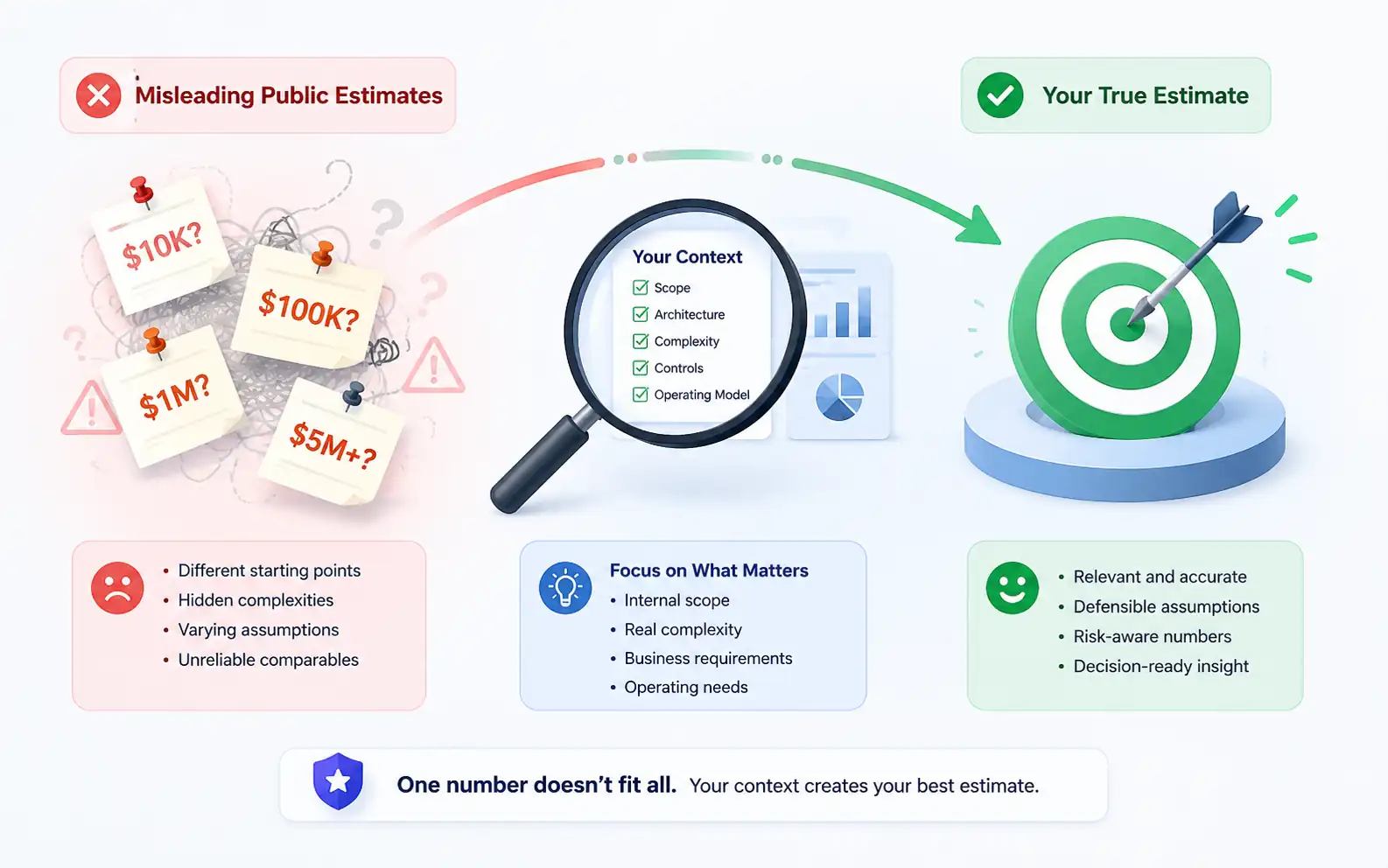
Fixed public estimates are often misleading because enterprises start from different estates. Modernizing ten well documented systems is fundamentally different from modernizing two hundred poorly integrated ones.
Cloud landing zone maturity, data quality debt, regulatory controls, procurement friction, and support coverage can all change the result materially.
Use external figures only as broad sanity checks. The real estimate should come from internal scope, architecture choices, migration complexity, and operating requirements.
- Avoid presenting one range as valid for every industry or estate.
- Treat public benchmarks as context, not as a final budget.
- Explain which assumptions move the number most.
- Re estimate when scope, control depth, or operating model changes materially.
Use Scope Defined Sanity Check Ranges
The following bands are illustrative USD planning ranges for enterprise work. They are not market prices, vendor quotes, or promises of delivery.
Use them only after defining the scope represented by each row. Replace them with a bottom-up estimate as discovery produces better evidence.
| Scenario | Typical included scope | Illustrative cost band | Indicative duration |
|---|---|---|---|
| Constrained pilot | One use case, one or two domains, limited interfaces, and existing environments. | $75,000–$250,000 | 8–16 weeks |
| Foundation and first production wave | Reusable platform controls, several domains, integrations, migration, governance, and operational handover. | $250,000–$1.2 million | 4–9 months |
| Scaled multi-domain program | Multiple releases and use cases, broad remediation, resilience, change enablement, and continuous operations. | $1.2 million–$5 million+ | 9–24+ months |
Five variables govern whether a program belongs near the bottom or top of a band. Record them as caveats beside every estimate:
- Estate complexity: system count, legacy age, documentation quality, hosting diversity, and technical debt.
- Integration burden: interface count, coupling, latency, API maturity, supplier dependencies, and coexistence requirements.
- Data quality: profiling results, missing ownership, reconciliation effort, semantic inconsistency, and remediation backlog.
- Regulatory controls: privacy, residency, security, lineage, audit evidence, approvals, and ongoing validation obligations.
- Use case scope: workflows, users, models, environments, availability, throughput, adoption support, and service coverage.
If one variable changes materially, move the estimate or rebuild it. Do not keep the same range while silently changing the assumptions beneath it.
Assessment And Target State Design Costs
Assessment and target state design cost covers discovery, current state mapping, capability gaps, architecture decisions, control requirements, and the first delivery plan. This is usually the cheapest phase to underfund and one of the most expensive to get wrong.
Keep the estimate bounded. Price the effort needed to define scope, dependencies, decision rights, and a realistic first wave. Do not hide later delivery work inside the design phase.
- Price discovery, workshops, inventories, and architecture decisions separately.
- Include control design effort for security, privacy, and governance.
- Treat the target state design as an input to delivery budgeting, not as delivery itself.
- Avoid inflating design scope with detailed implementation work that belongs later.
Platform, Cloud And Environment Costs
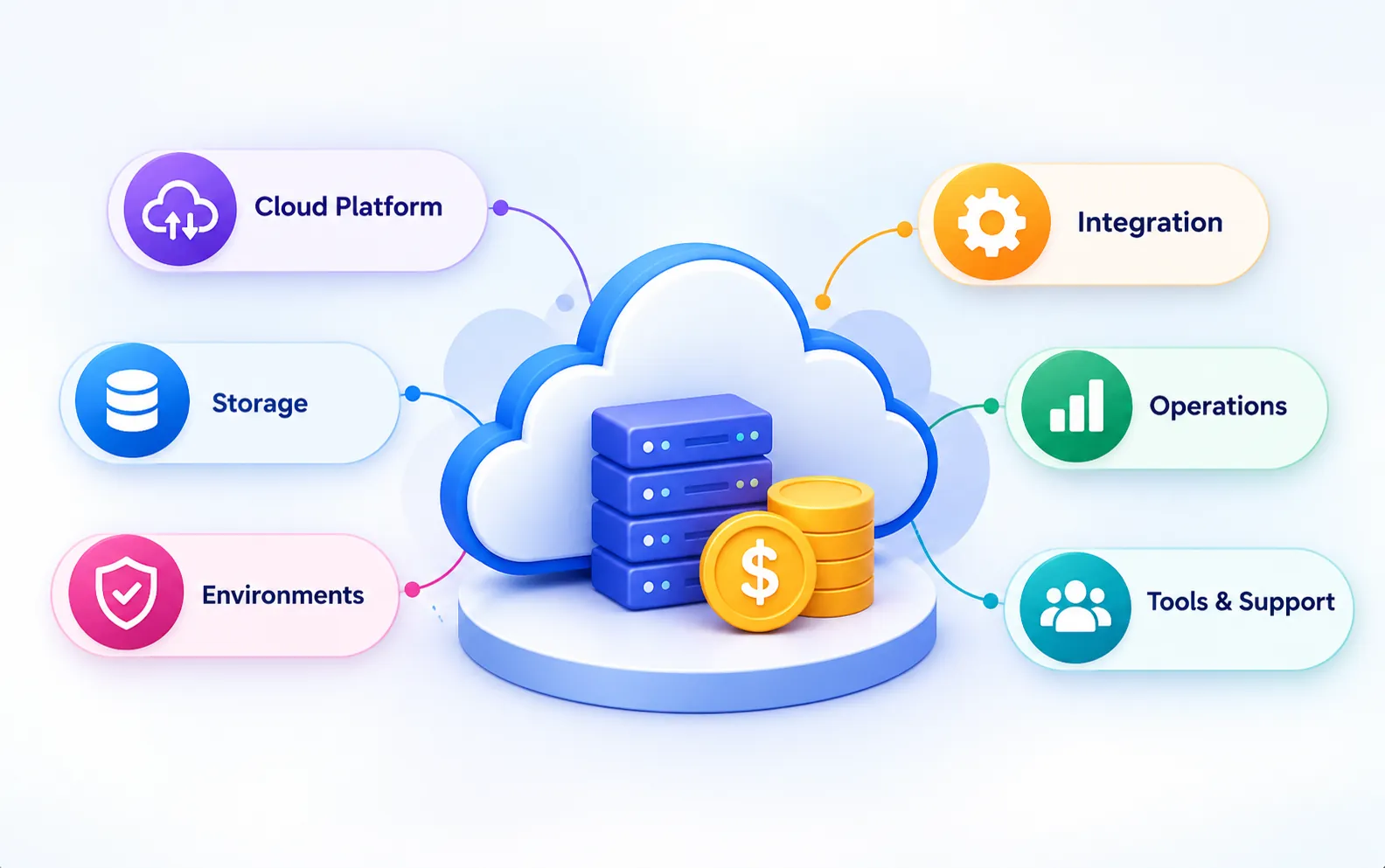
Platform, cloud, and environment cost usually includes landing zones, storage, compute, integration services, orchestration, observability, developer tooling, and non production environments. These costs are partly fixed and partly elastic.
Keep recurring cloud, license, support, and model inference costs separate from implementation. That distinction is essential when a programme looks affordable in build mode but becomes expensive to run.
- Separate environment setup from ongoing platform consumption.
- Model steady state storage, compute, network, and inference spend explicitly.
- Include resilience, recovery, and non production environments in the estimate.
- Track portability, egress, and exit requirements where they affect design cost.
Separate One Time And Recurring Costs
One time costs create or change the capability. They include assessment, architecture, environment setup, migration, integration, remediation, testing, training, cutover, and initial control implementation.
Recurring costs keep the capability useful and safe. They include cloud consumption, subscriptions, support, monitoring, incident response, data operations, model evaluation, retraining, compliance reviews, and ongoing change.
Show both categories for every workstream. A managed service may reduce implementation labor while increasing subscription spend. An open platform may reverse that profile through higher engineering and support needs.
Model The First Three Years
A three-year view usually reveals cost shifts that the implementation budget hides. Show monthly or quarterly spend for the build period, transition, stabilization, and steady-state operations.
Include temporary overlap when legacy and target platforms run together. Dual licensing, replicated data, parallel support, reconciliation, and exit work can create a material short-term peak.
State which costs grow with users, workloads, data volume, model calls, environments, or service levels. Finance teams can then test adoption and consumption scenarios without rebuilding the entire model.
Assign Owners To Assumptions
Every material assumption needs an owner and review date. Technology should own consumption forecasts, delivery should own effort, security should own control depth, and finance should validate rates and benefit treatment.
Track actual spend against the same categories used in the estimate. When actuals differ, update the driver, document the reason, and apply that learning to later releases.
Migration, Integration And Data Quality Costs
Migration, integration, and data quality cost is where many programmes expand unexpectedly. Legacy interfaces, undocumented transformations, reconciliation work, and remediation of poor data often cost more than the destination platform itself.
Estimate this bucket with workload level detail. Count interfaces, data domains, quality fixes, reconciliation effort, cutover design, and the period of dual running when both old and new paths must coexist.
- Budget for interface redesign, schema changes, and contract testing.
- Include business reconciliation, not just row counts and job rewrites.
- Account for temporary dual run or coexistence periods explicitly.
- Treat poor data quality as a delivery cost driver, not as a separate surprise later.
Governance, Security And Compliance Costs
Governance, security, and compliance cost is not optional overhead. It includes policy design, access controls, lineage, quality evidence, auditability, privacy controls, and specialist review effort. Regulated programmes usually underestimate this bucket first.
Estimate it according to risk and evidence depth. A low risk internal analytics workflow does not cost the same to govern as a customer facing AI decision system. The right model is risk based, not flat.
- Budget for control design, review, evidence storage, and ongoing validation.
- Scale governance depth by business impact and data sensitivity.
- Avoid treating legal or compliance review as a zero cost shared service.
- Keep one time control implementation separate from recurring review and monitoring.
AI Use Case Delivery And Production Operations
AI use case delivery and production operations are often mixed into one number even though they behave differently.
Delivery covers product design, data work, model or retrieval workflows, testing, release preparation, and rollout support. Run cost covers monitoring, incidents, retraining, re indexing, inference usage, and support.
Keeping these categories separate makes the cost model more honest. It shows whether the programme is expensive to build once, expensive to operate continuously, or both.
- Budget delivery work per use case, wave, or product line.
- Budget recurring support, observability, and incident handling separately.
- Include model inference or retrieval serving cost where applicable.
- Avoid hiding operational spend inside the initial implementation estimate.
For an external reference on delivery and operating disciplines that create recurring run cost, see Google Cloud's MLOps guidance.
Change Management, Hidden Costs And Dependency Risks
Hidden cost usually comes from dependency delays, procurement cycles, change resistance, thin ownership, and rework created by late control decisions. These costs are real even when they do not appear in the first architecture spreadsheet.
Treat change enablement and delivery risk as explicit budget items. Teams that ignore them often understate total cost and then label the overrun a technical surprise.
- Add contingency for unknown interfaces, quality debt, and approval delays.
- Budget change management effort where workflows, roles, or controls will change.
- Track vendor and procurement timing where it delays delivery capacity.
- Escalate missing ownership as a cost risk, not only a governance issue.
Review The Estimate Before Approval
Ask an independent reviewer to trace major totals back to source evidence. The review should challenge omissions, optimism, duplicated allowances, and unsupported productivity assumptions.
- Confirm that scope boundaries, exclusions, dependencies, and acceptance criteria use consistent language.
- Verify that labor, technology, supplier, change, control, and operating costs use the same time horizon.
- Test optimistic, expected, and adverse values for the variables that have the greatest financial effect.
- Check that contingency maps to documented risks and does not conceal unplanned product features.
- Identify decisions that would move the estimate into another scenario band or delay a release.
- Set a re-estimation trigger for architecture, scope, regulation, consumption, or delivery-model changes.
Record the approved baseline, date, owner, and evidence version. Without version control, later comparisons can confuse a changed scope with poor delivery performance.
How To Control Budget Through Phased Outcomes
The best way to control cost is to deliver phased outcomes with explicit stop, continue, or redirect decisions. Price the first wave, validate the assumptions, then decide how much shared platform and migration scope still makes sense.
That approach works better than assuming the full programme can be estimated once and then left untouched. Use phase gates to compare actual cost drivers against the original model and revise the range honestly.
- Fund discovery, foundation, and first wave delivery as distinct decisions.
- Use each phase to validate assumptions that affect later cost bands.
- Separate cashable savings from strategic or non cashable benefits when justifying spend.
- Revisit the estimate when scope, cloud usage, or control depth changes materially.
Reference Frameworks For Cost And Value Planning
Use current FinOps guidance when turning a modernization estimate into an operating cost model. The guidance supports shared accountability, cost visibility, optimization, and staged practice maturity.
- The FinOps Foundation's What is FinOps? overview explains the operating practice and its focus on maximizing business value.
- The FinOps Framework overview helps teams connect personas, principles, phases, and domains to cost ownership.
- The FinOps capabilities provide a practical checklist for allocation, forecasting, workload optimization, and organizational alignment.
For cost-estimating discipline, GAO-20-195G: Cost Estimating and Assessment Guide provides a useful structure. It covers scope, work breakdown, assumptions, data, methodology, risk analysis, documentation, and updates using actual costs.
Organizations do not need to be U.S. federal agencies to apply those practices. The guide works as a quality checklist for major technology programs that need transparent, reviewable estimates.
For benefit-cost analysis, OMB Circular A-94 emphasizes explicit assumptions, alternatives, time-distributed costs and benefits, uncertainty, and sensitivity analysis.
Apply its principles according to your finance policy and jurisdiction. Use approved discount rates, inflation assumptions, and evaluation periods rather than copying values from an unrelated program.
Turn The Estimate Into A Delivery Plan
A cost range is most useful when it is tied to scope, dependencies, and phased delivery choices. If you need help converting the estimate into a sequenced implementation plan, see enterprise data and AI modernization services.
Frequently Asked Questions
Base contingency on identified risk categories from the assessment and hidden cost checklist. Assign it by exposure: integration risk, data quality remediation, regulatory retrofit, and vendor dependency.
Use contingency funding for mitigation actions identified in the plan rather than as undifferentiated padding.
Choose a managed platform when your priority is speed and reduced in house operational capability. Expect lower delivery engineering effort but higher recurring platform fees and potential vendor dependency.
An open stack suits organizations with strong platform engineering and a desire for greater control over ongoing costs.
Separate one time model development from recurring MLOps work, including monitoring, retraining, serving infrastructure, and feature store maintenance.
Include people costs for model operations, observability and validation tools, plus governance and compliance checks that scale with the model count.
Invest in a thorough assessment that captures undocumented interfaces and data semantics, prioritize reusable pipeline components, and plan parallel run reconciliation during cutover. Early stakeholder alignment on data definitions and test plans reduces late stage rework and associated budget overruns.
Present a scope driven budget that ties objectives to assessment, platform enablement, migration, AI delivery, governance, change management, and run operations.
Use the phased allocation model to show how initial investments produce reusable assets and how recurring costs emerge over time.