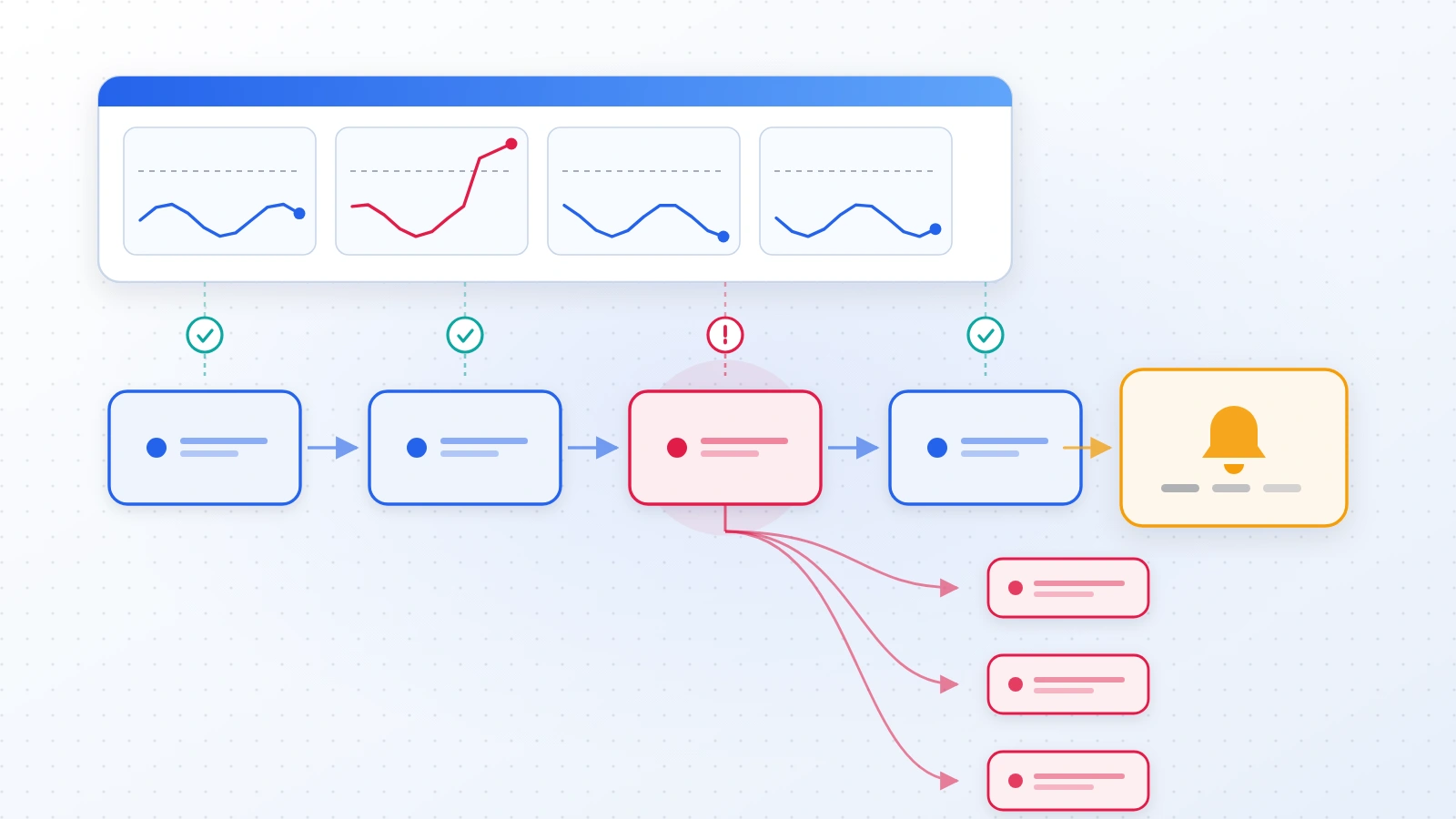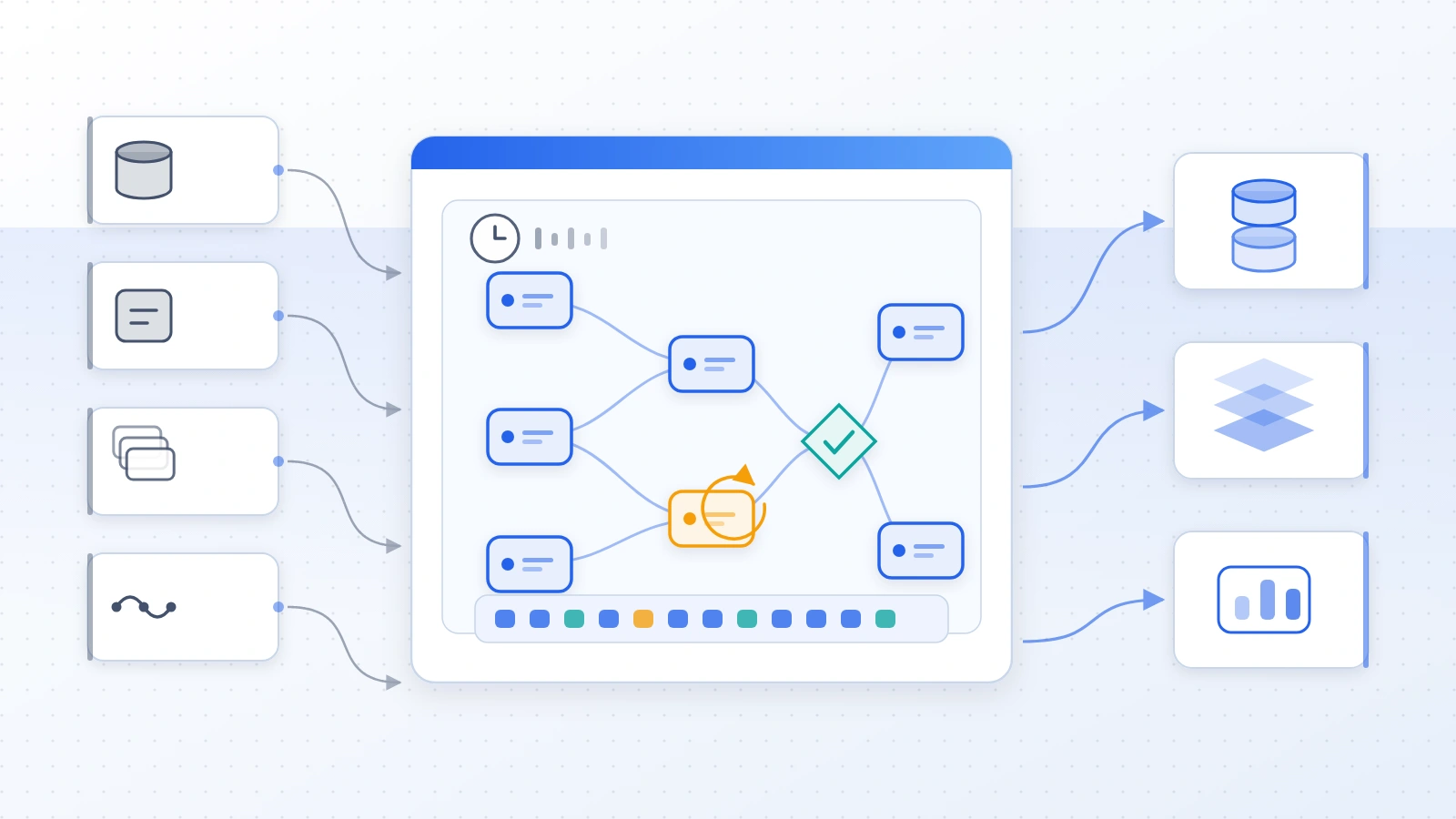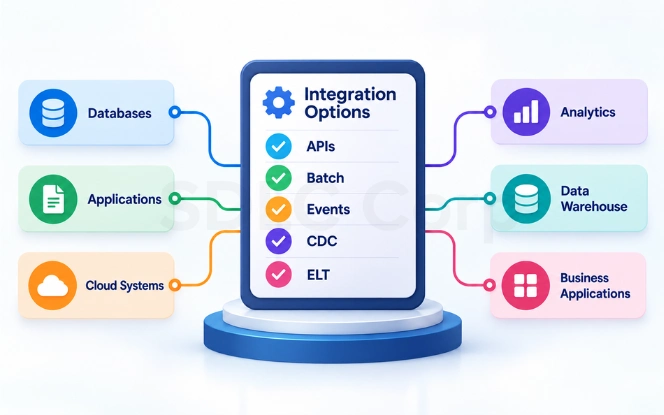
A cloud data modernization strategy separates migration from modernization. Start with business outcomes, data sensitivity, and dependencies. Do not default to wholesale lift and shift. Use one decision framework, one current-to-target view, and one migration-wave plan so technical and business stakeholders can make the same tradeoffs.
- What you will decide: Help enterprise leaders plan which data workloads to modernize, migrate, retain or retire across cloud and hybrid environments.
- Why it matters: A decision-led strategy that separates migration from modernization and avoids treating cloud adoption as a simple hosting change.
Start with outcomes, not platforms. Define the business improvements you expect, such as faster analytics, lower operational risk, tighter controls, or lower total cost.
Then attach a measurable target to each one, such as time to insight, recovery time objective, or a cost driver. That keeps tradeoffs explicit and stops the program from collapsing into a hosting move.
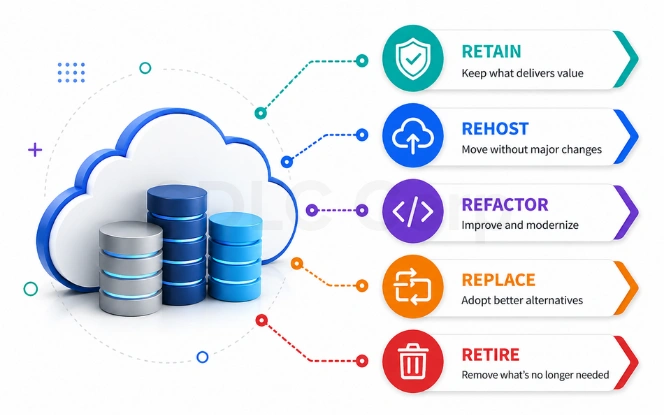
Use a repeatable decision framework before choosing tools. Assess workload criticality, data sensitivity, dependencies, and operational maturity. Then classify each workload into retain, rehost, refactor, replace, or retire.
Show the result in one current-to-target view and one migration-wave table with validation gates and rollback paths. Include hybrid or on-premise patterns where regulation or latency require them.
Cloud Modernization Is More Than Moving Databases
Cloud migration is a technical activity that moves assets from A to B. Data modernization is a business program that changes how the organization collects, stores, governs and uses data to drive outcomes.
Treating modernization as a hosting swap misses opportunities to reduce technical debt, rationalize data models and improve downstream analytics.
Enterprises should separate migration workstreams from modernization workstreams, which is the operating split behind most cloud transformation services engagements. Migration focuses on availability and integrity during transfer.
Modernization focuses on schema simplification, metadata, lineage, and fit for analytics or machine learning. Document both tracks in the program plan and assign clear ownership for cutover and for post-migration optimization.
Use an explicit acceptance criteria set for each workload. Include data fidelity checks, performance baselines, security controls, and business user validation. Where applicable, map the acceptance criteria to service level objectives and regulatory obligations to avoid operational drift after migration.
- Define migration versus modernization deliverables for each workload.
- Keep legacy systems stable while modernization pilots validate new models.
- Document rollback and contingency steps for migration windows.
- Align acceptance criteria to business stakeholders and compliance owners.
Define The Business Outcomes First
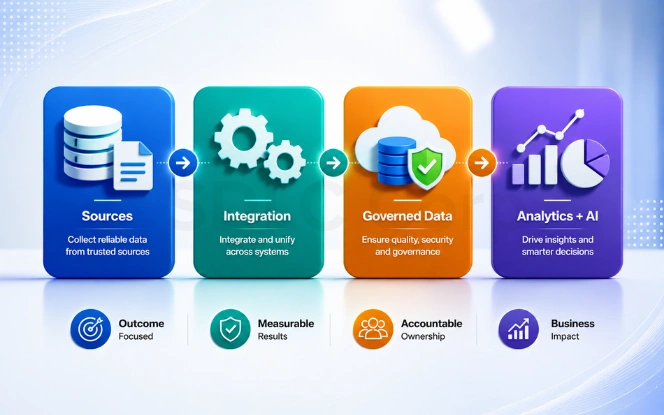
Prioritize outcomes in business terms before any technical evaluation. Examples: reduce time to market for data products, raise data quality for regulatory reporting, or lower storage and operational costs for archival datasets.
For each outcome assign a sponsor, measurable KPIs and a time horizon tied to business planning cycles.
Translate outcomes into concrete technical goals. If the outcome is faster analytics, set query latency targets, concurrency requirements, and expected data freshness, and confirm they are achievable against the business intelligence layer consuming the data.
If outcome is compliance, list controls, retention rules, and audit traceability requirements. That translation prevents platform selection based on marketing rather than fit.
Use outcome mapping to choose workloads for early modernization pilots. Select a mix of high-value, low-risk workloads to validate architecture and change management. Keep pilots short and instrumented to produce learning that scales across later waves.
- Map each business outcome to specific, measurable technical targets.
- Assign executive sponsors and product owners for outcome accountability.
- Prioritize pilot workloads that validate the most critical outcomes.
- Avoid platform decisions until outcomes and targets are confirmed.
Capture outcomes in a one-page decision brief that stakeholders sign off on.
Assess Workloads, Dependencies And Data Sensitivity
Build the Workload Inventory
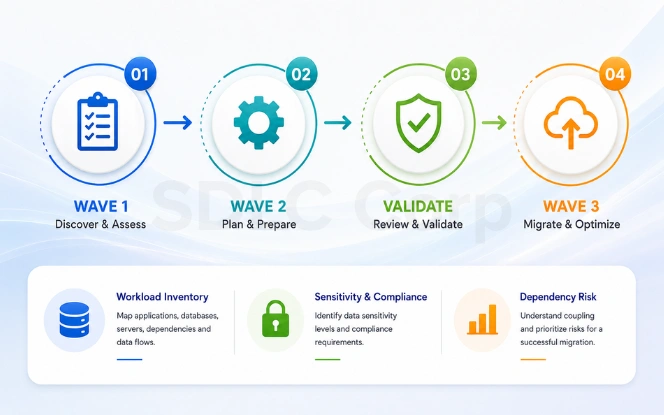
Build a workload inventory that captures schema, owners, SLA, downstream consumers, and integrations. Include physical dependencies such as network topology and data gravity that influence latency and transfer cost.
Use automated discovery tools where possible but validate findings with app and business owners.
Classify Sensitivity and Compliance Constraints
Classify data sensitivity and compliance requirements at workload level. Distinguish public, internal, confidential and regulated datasets and map them to required controls.
For regulated data include jurisdiction, retention mandates, and permitted processing locations to determine if public cloud, private cloud, or on-premise retention is required.
Where personal data crosses borders, check the transfer conditions in Article 44 of the GDPR before assuming a region is available.
Test Dependency and Coupling Risk
In practice, dependency maps are almost never complete on the first pass.
Application owners usually know their upstream systems, but downstream reporting consumers and ad-hoc extracts often surface only during migration testing, which is why discovery should be revisited after the first wave rather than signed off once.
Assess coupling and dependency risk. High coupling to legacy transactional systems or on-premise middleware increases migration complexity and may justify hybrid patterns or delayed modernization, which usually means involving IT infrastructure consulting alongside the data team.
Document dependency owners and plan integration tests to validate end-to-end flows prior to cutover.
- Inventory inputs: schema, owners, consumers, SLAs and retention rules.
- Classify sensitivity and legal constraints per dataset and region.
- Map technical dependencies and network constraints for each workload.
- Estimate migration and validation effort, not just data volume.
Produce a workload risk matrix that ranks migration complexity and business impact.
Choose What To Retain, Rehost, Refactor, Replace Or Retire
This is the part of a cloud data modernization strategy that most programmes skip. Without a repeatable scoring model, workload decisions get made by whoever argues hardest in the room, and the same debate repeats in every wave.
The Cloud Data Modernization Workload Decision Framework
Score each workload 1-5 on five criteria, apply the weights below, and map the weighted result to one of five outcomes: retain, rehost, refactor, replace or retire.
Document trade-offs explicitly. Rehosting reduces short-term risk but preserves technical debt. Refactoring requires more upfront investment and yields greater operability and cost efficiency over time.
Replacing with SaaS may accelerate time to value but creates vendor lock-in and migration of integrations.
Scoring Criteria and Starting Weights
Weighted score = sum(score x weight) / 100, on a 1.0-5.0 range.
| Criterion | Weight | Score 1 means | Score 5 means | Worked row: customer transactions DB |
|---|---|---|---|---|
| Business value | 30% | Few consumers, no revenue link | Revenue or regulatory reporting depends on it | 5 |
| Technical debt | 20% | Clean, documented, actively maintained | Undocumented schema, brittle jobs, no owner | 3 |
| Regulatory constraints | 20% | Public or internal data, no residency rules | Regulated data with residency and audit mandates | 5 |
| Cost of ownership | 15% | Cheap to run and scale today | Expensive licensing, hardware or vertical scaling | 3 |
| Modernization effort | 15% | Self-contained, few dependencies | Deep coupling, complex cutover, hard rollback | 4 |
| Weighted score | 100% | 1.0 | 5.0 | 4.15 |
These weights are starting points for enterprise modernization workshops rather than an industry standard. Teams should adjust them based on regulatory, operational, and business priorities, and record the rationale for every change.
WorkloadCustomer transactions DB
Recommended outcomeRefactor for cloud-native (or hybrid refactor with dedicated connectivity); high regulatory weight may require VPC/dedicated links
- BV
- 5
- TD
- 3
- Reg
- 5
- Cost
- 3
- Effort
- 4
- Weighted
- 4.15
WorkloadMarketing data lake
Recommended outcomeRehost now to reduce risk, plan refactor later for cost/operability
- BV
- 4
- TD
- 4
- Reg
- 2
- Cost
- 4
- Effort
- 3
- Weighted
- 3.45
WorkloadArchival logs
Recommended outcomeRetire or move to low-cost cold archive (no active consumers)
- BV
- 1
- TD
- 1
- Reg
- 1
- Cost
- 2
- Effort
- 1
- Weighted
- 1.15
Score-to-Outcome Mapping
| Weighted score | Outcome | Choose when | Override |
|---|---|---|---|
| 4.0 - 5.0 | Refactor for cloud-native | High business value and high debt justify redesign | Regulatory score of 4 or above: hybrid refactor with dedicated links |
| 4.0 - 5.0 | Replace with SaaS or a modern platform | A commodity capability where SaaS cuts operations and risk | Skip if integration migration cost exceeds the operational saving |
| 3.0 - 3.99 | Rehost now, refactor later | Stable workload needing a short-term risk reduction window | Record the refactor trigger so the debt is not lost |
| 2.0 - 2.99 | Retain on-premise or hybrid | Residency, latency or data gravity make cloud impractical | Set a review date tied to cost or regulatory change |
| 1.0 - 1.99 | Retire or archive cold | No active consumers and no retention obligation | Confirm legal retention before deletion |
Adjusting the weights: the defaults above suit a typical digital business. Increase Regulatory weight for regulated industries (finance, health), increase Technical debt weight when many legacy systems block fast modernization, and increase Business value weight when prioritizing revenue-impacting systems.
Re-run the matrix with adjusted weights and document rationale for each change.
Worked Example: A Legacy Analytics Workload
Current state. An Oracle warehouse feeding nightly ETL into BI reports, with three downstream marts maintained by different teams.
Problems. An eight-hour batch window that overruns month-end, duplicated customer data across marts, expensive vertical scaling, and no usable lineage when finance queries a number.
Framework result. Business value 5, technical debt 4, regulatory 3, cost 4, effort 4 gives a weighted score of roughly 4.05, which maps to refactor rather than a straight rehost.
Target state. Object storage landing zone, cloud data platform for curated models, a managed transformation layer, and analytics and AI consumption on top with a catalog carrying lineage.
Validation. Row-count reconciliation, schema validation, report-accuracy comparison against the legacy output, performance comparison at peak concurrency, then a rehearsed rollback verification before cutover.
The workload that is easiest to migrate is rarely the workload that delivers the most business value. Sequencing purely by ease produces a fast first wave and a stalled second one.
Create clear criteria for when to revisit retained workloads, typically triggered by changes in cost, regulatory posture, or business model. Prefer refactor when long-term operability and cost matter most. Choose rehost for short-term stability windows and predictable workloads.
Use retirement as a viable strategy for legacy data with no consumers. For regulated or latency-sensitive workloads, include hybrid options such as virtual private cloud with dedicated connectivity or edge processing.
- Score workloads by business value, risk, and technical debt to form targeted decisions.
- Prefer refactor when long-term operability and cost matter most.
- Choose rehost for short-term stability windows and predictable workloads.
- Use retirement as a viable strategy for legacy data with no consumers.
Capture decisions in a single migration target column for each workload in the migration table.
Design The Target Cloud And Hybrid Data Architecture
Define the Data Zones
Design the target architecture with zones for landing, staging, curated analytics, and long-term storage. Define data flows, formats, and lifecycle rules for each zone. Include metadata, cataloguing, and lineage as first-class components to support governance and discoverability.
Match Storage and Compute to the Workload
Choose storage and compute patterns that match workload characteristics: object storage for immutable large datasets, columnar stores for analytics, transactional stores for OLTP. For hybrid environments ensure secure, low-latency connectivity and consistent identity and access models across locations.
Pressure-test the design against the reliability, security and cost pillars in the Azure Well-Architected Framework, and align schema and engine choices with data engineering services where the target platform is already chosen.
Standardize Integration and Schema Evolution
Define integration patterns and APIs for downstream consumers. Standardize ingestion frameworks and schema evolution policies to limit brittle pipelines. Document the current-state-to-target-state diagram and share it with platform, security, and business teams as the canonical architecture reference.
- Define landing, staging, curated and archival zones with responsibilities.
- Make metadata, lineage and cataloging mandatory parts of the design.
- Match storage and compute to workload characteristics, not vendor hype.
- Ensure consistent identity, access and encryption across hybrid boundaries.
Add the current-state-to-target-state diagram to align stakeholders on the canonical architecture.
Plan Migration Waves And Validation Gates
Sequencing is where a strategy either becomes executable or stays a slide. The goal of this section is not a full programme plan, but a defensible order of work with clear gates between waves.
Prioritize Workloads by Risk
Rank workloads on five factors only: business criticality, dependency surface, data sensitivity, rollback difficulty, and modernization effort.
Anything that scores high on rollback difficulty belongs later in the sequence regardless of how attractive the business case looks, because the cost of a bad cutover is paid in trust as well as downtime.
The workload patterns in the AWS Well-Architected Analytics Lens are a useful cross-check when ranking analytics estates.
Define Migration Waves
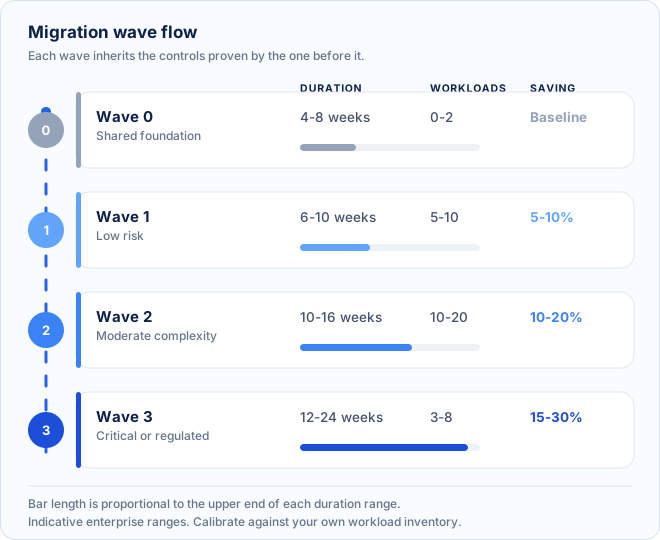
- Wave 0 - shared cloud foundation: identity, networking, logging, secrets, tagging and landing zones, so downstream waves inherit controls instead of reinventing them.
- Wave 1 - low-risk workloads: contained datasets with few consumers, used to prove automation, reconciliation and runbooks.
- Wave 2 - moderate-complexity workloads: integrated systems and refactor candidates where schema change and pipeline rework are in scope.
- Wave 3 - critical or regulated workloads: moved only after platform maturity, security gating and hybrid constraints have been validated in earlier waves.
Wave 1 is usually oversubscribed. Teams want their workload in the first cohort because it looks like the safest slot, when in practice the first wave carries the most tooling risk and the least automation.
Set Validation Gates
- Data correctness: row and control-total reconciliation, schema validation, sampled quality checks against agreed thresholds.
- Security: encryption, key management, access model and audit logging verified against the classification assigned in discovery.
- Performance: query latency, concurrency and batch windows compared with a documented pre-migration baseline.
- Business acceptance: named owners sign off on report accuracy and operational usability, not just technical availability.
Automate each gate once and reuse it across waves. Manual validation is affordable in wave 1 and unmanageable by wave 3.
Where internal capacity for gate automation is thin, this is the point at which teams typically bring in cloud consulting support.
Define Rollback Criteria
Write the stop conditions before the cutover window opens, when nobody is under pressure. Typical triggers are reconciliation variance above an agreed threshold, a failed security control, sustained performance regression against baseline, or a business owner rejecting output accuracy.
For stateful systems, use dual-run or phased cutovers so fallback does not mean data loss, and rehearse the rollback at least once in a lower environment. Postpone rather than proceed when a dependency owner cannot be reached during the window.
Publish the migration-wave table early and update it after each wave to reflect what was actually learned.
Detailed estimating belongs in a separate exercise. Model compute, storage tiers, egress, licensing and transition staffing separately, and keep programme sequencing in the roadmap rather than in this strategy.
This strategy sets the what and why; those two documents carry the when and how much.
Build Governance, Security And FinOps Into The Programme
Make Governance Enforceable
Make governance practical and enforceable. Define data owners, steward responsibilities, classification policies, and approval workflows. Implement guardrails that block noncompliant configurations rather than relying solely on post-factum reviews. Keep governance lightweight for analytics teams to avoid stifling innovation.
Embed Security in the Pipeline
Embed security controls into pipelines: encryption at rest and in transit, tokenized access for sensitive fields, key management and logging.
For regulated data map controls to specific obligations and maintain audit evidence, using an established control catalogue such as NIST SP 800-53 rather than an ad-hoc list.
Keep continuous monitoring and incident response in scope after cutover, not only during migration.
Use centralized policy enforcement where hybrid environments allow consistent control.
Introduce FinOps Early
Tagging retrofitted after wave 2 is expensive and usually incomplete. It is far cheaper to enforce tags at provisioning than to reconstruct ownership from billing exports six months later.
Integrate FinOps from day one. Tag resources by workload, owner and environment to enable cost visibility. Set budgets per wave and include cost validation gates in the migration-wave table.
Optimize storage lifecycle policies and compute reservation strategies after the first wave to avoid premature long-term commitments.
- Assign data owners and stewards with clear approval workflows.
- Enforce security guardrails in ingestion and provisioning pipelines.
- Tag cloud resources for cost allocation and accountability.
- Include compliance evidence and auditability in pipeline outputs.
Governance must be visible in the migration plan and enforced by automated guardrails.
For an external control baseline on AI risk and lifecycle governance, use the NIST AI Risk Management Framework. For production delivery and operating discipline around ML pipelines, see Google Cloud's MLOps guidance.
Modernize The Operating Model, Not Only The Platform
Modernization succeeds when teams, processes and incentives change. Rebalance responsibilities between platform, data engineering, security and business teams. Define runbooks, on-call rotations, and escalation paths for the new environment and invest in tooling that supports observability and collaboration.
Shift-left practices for security and quality to reduce post-deployment rework. Train data owners and engineering teams on cost-aware design, schema hygiene, and monitoring.
Create a platform team responsible for shared services, automation, and developer experience to reduce friction for consuming teams, and give that team ownership of the release and observability toolchain.
Adapt governance and delivery cadences to continuous improvement. Replace big-bang releases with smaller, frequent delivery windows and post-release evaluation. Use retrospectives after each migration wave to capture operational learnings and update runbooks and automation.
- Redefine team responsibilities and create a platform team for shared services.
- Invest in training for cost awareness, monitoring and secure design.
- Adopt smaller, frequent delivery cadences with post-wave retrospectives.
- Standardize runbooks and on-call practices for the modern environment.
Plan organizational changes alongside technical migrations to avoid operational debt.
Reference Frameworks For Migration And Cloud Operating Choices
Three current framework sources support the strategy decisions in this article. Microsoft's Cloud Adoption Framework ties cloud work to business outcomes and staged readiness.
AWS's Migration Lens gives current migration patterns and testing guidance for rehost, replatform, retain, retire, and related choices. For cloud cost and operating discipline, use the FinOps Foundation's Framework overview and Domains.
Cloud Data Modernization Strategy: Final Takeaway
A workable cloud data modernization strategy runs in a fixed sequence: business outcomes, workload assessment, modernization decision, target architecture, migration waves, governance, then operations. Outcomes set the measurable targets. Assessment produces the inventory, sensitivity classification and dependency map.
The decision framework scores each workload and places it into retain, rehost, refactor, replace or retire. The target architecture turns those decisions into zones, storage and compute choices, and integration patterns.
Migration waves sequence the work behind validation gates and written rollback criteria. Governance, security and FinOps run across every wave rather than after them, and the operating model changes alongside the platform.
If a decision cannot be traced back to a business outcome and a workload score, it is a platform preference rather than a strategy.
Once the curated layer is stable, the same foundation is what enterprise AI development work depends on.
Move From Strategy To Execution
When the strategy is agreed and the next step is sequencing workloads, controls, and migration waves, use enterprise data and AI modernization services to turn the target-state decision into an executable roadmap with validation gates and delivery ownership.
Frequently Asked Questions
Cloud migration moves systems and data to a new hosting environment. Data modernization changes data models, pipelines, governance, and operating practices to make data more usable, auditable and cost effective.
Treat migration and modernization as separate but coordinated tracks with distinct acceptance criteria.
Retain workloads on-premise when regulatory restrictions, data residency, low latency or extreme data gravity make cloud impractical. Hybrid patterns apply when part of a workflow benefits from cloud analytics while transactional systems remain local.
Use sensitivity classification, latency tests and legal input to decide.
Essential gates include data integrity checks, functional acceptance by business users, performance baselines, security control verification and cost tracking. Automate checks where possible and require sign-off from owners listed in the migration-wave table before promoting each wave into production.
Introduce governance and FinOps early with policy-as-code, tagging standards and automated guardrails. Assign data owners and stewards, and include cost attribution in wave acceptance criteria. Keep policies practical so they protect assets without blocking productive experimentation.
A focused discovery that produces a canonical inventory, the current-state-to-target-state diagram and an initial migration-wave table is a practical first deliverable. It converts intent into executable scope, clarifies dependencies and produces the acceptance criteria needed for executive approval.