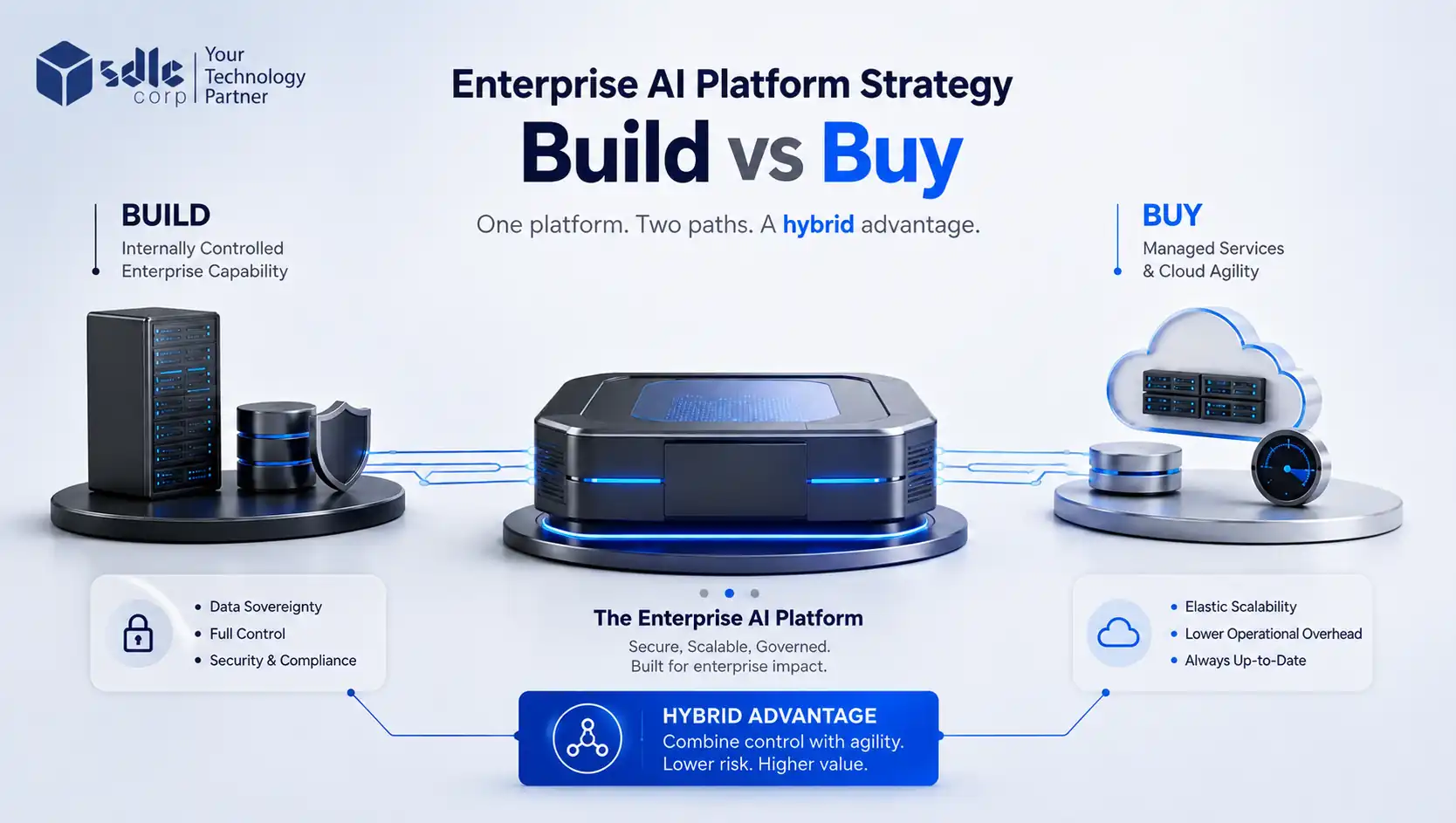
Make the enterprise AI platform build vs buy decision capability by capability. Do not treat it as a platform slogan. This judgment is central to enterprise AI modernization. Some capabilities deserve internal investment because they affect differentiation, control, or risk. Others are faster and safer to buy.
A hybrid model is often the practical answer. Compare speed, control, integration burden, operating cost, portability, and exit options. Do not assume the same answer applies to every layer of the AI stack.
Platform sourcing should follow readiness assessment, not replace it. Before deciding which capabilities to build, buy, or combine, review business priorities, data readiness, governance, security, operating ownership, and delivery constraints. For organizations formalizing AI governance, ISO/IEC 42001:2023 provides requirements for establishing, implementing, maintaining, and continually improving an AI management system.
The enterprise AI readiness assessment stage helps identify the gaps and dependencies that should shape the sourcing decision.
- Choose capabilities based on business value and operating risk.
- Separate commodity services from strategically differentiating ones.
- Treat portability and exit as first class design criteria.
- Use a clear capability matrix rather than one broad platform verdict.
Choosing whether to build, buy, or adopt a hybrid AI platform depends on more than technical capability. It also reflects broader shifts in governance, data strategy, and operating model.
Those shifts often include changes to data ownership, model governance, and cross functional workflows. They can determine which delivery model best balances scale, risk management, and time to value.
For a concise overview of the organizational and technical changes that inform platform choices, see Enterprise Data & AI Modernization Services.
Score Each Platform Capability Before Choosing A Sourcing Model
Use one decision record per capability instead of deciding that the entire platform is built or bought. The score below is a planning method, not a procurement formula. Revisit it when the workload, provider safeguards, or operating model changes. Where EU regulatory obligations apply, consider the requirements of the EU Artificial Intelligence Act (Regulation (EU) 2024/1689). Factor those requirements into control, documentation, oversight, and risk decisions instead of treating regulatory exposure as a generic score.
CapabilityData access and policy enforcement
Example decisionKeep policy decisions and entitlement mapping under accountable internal control.
- Internal control signal
- Sensitive data, complex entitlements, or a control that differentiates the business.
- Buy signal
- Standard access patterns with proven identity integration and audit evidence.
CapabilityModel serving
Example decisionUse managed serving for a bounded low risk workload with documented exit tests.
- Internal control signal
- Special hardware, residency constraints, or a workload that needs custom runtime behavior.
- Buy signal
- Managed serving meets performance, portability, and support requirements.
CapabilityEvaluation and release gates
Example decisionOwn the release decision; use managed test execution where evidence remains exportable.
- Internal control signal
- The evaluation rubric encodes business policy or regulated approval requirements.
- Buy signal
- A provider feature accelerates routine testing without hiding evidence.
CapabilityMonitoring
Example decisionSend approved operational signals to a managed backend while retaining incident ownership.
- Internal control signal
- Signals must join to internal incidents, business controls, or restricted telemetry.
- Buy signal
- A managed service provides sufficient isolation, retention, and export controls.
Capability scoring template
Record one decision record per capability. Score each criterion 1 to 5 (1 = low, 5 = high). Higher Differentiation and Control scores push toward keeping the capability internal.
Higher Speed and low Exit Risk push toward buying. Treat the total as a documented tradeoff, not a binding procurement formula.
CriterionDifferentiation
InterpretationHigh => prefer internal control
- Definition
- Does this capability materially differentiate the product or customer experience?
- Score 1 to 5
CriterionSpeed to market
InterpretationHigh => consider buying
- Definition
- How urgent is delivery? Can a third party accelerate safely?
- Score 1 to 5
CriterionControl requirement
InterpretationHigh => prefer internal control
- Definition
- Regulatory, audit, residency, or sensitive data controls required?
- Score 1 to 5
CriterionIntegration effort
InterpretationHigh => favors internal or hybrid
- Definition
- Effort to integrate with identity, data, and workflows (higher = harder)
- Score 1 to 5
CriterionOperating cost
InterpretationHigh => consider buying
- Definition
- Ongoing staff, infra, and maintenance cost if built in house
- Score 1 to 5
CriterionExit risk
InterpretationHigh => prefer internal or require exit tests
- Definition
- Risk and difficulty of moving away from a provider later
- Score 1 to 5
Worked example: claims triage assistant
A claims team may keep retrieval permissions, policy rules, evaluation evidence, and escalation workflows under internal control because they affect customer decisions and auditability.
It can still buy managed model serving and telemetry after testing data handling, identity propagation, export access, and an exit path. The decision is therefore hybrid by capability, not a permanent label for the whole platform.
Example decision record for the capability "Data access and policy enforcement" (claims triage assistant):
| Criterion | Score (1 to 5) |
|---|---|
| Differentiation | 5 |
| Speed to market | 2 |
| Control requirement | 5 |
| Integration effort | 3 |
| Operating cost | 3 |
| Exit risk | 4 |
| Total (max 30) | 22 |
Interpretation: high Differentiation and Control scores support retaining policy enforcement and entitlement mapping internally. Moderate Integration effort and Exit risk require documented export and portability tests before any managed dependency.
The team therefore chooses a hybrid approach: internal control for access and policy, with managed model serving and telemetry for other bounded workloads after verification.
- Record the workload, data class, owner, and required evidence for every capability decision.
- Test portability before a production dependency becomes difficult to unwind.
- Review the score when a provider changes its controls, pricing model, or supported deployment options.
Define The Capabilities Your AI Platform Must Provide

Start with capabilities, not vendors. List what the platform must actually do. It may ingest data, manage reusable inputs, support development, run evaluations, and automate workflows. It may also serve models or agents, monitor production, enforce policy, and connect to business systems.
Then write simple rules for each capability. Note the users, the expected latency, the control needs, the likely failure modes, and the team that will own it. That keeps the decision grounded in delivery reality rather than product marketing.
- Write the capability list before discussing products.
- Set one clear success rule for each capability.
- Record latency, control, and ownership needs up front.
- Use the same capability list when comparing build, buy, and hybrid options.
When Building Internally Creates Strategic Value
Build internally when the capability creates lasting advantage and depends on business specific logic, proprietary data, or unusual control needs. Typical examples include domain specific decisioning, tightly embedded workflow actions, or specialised evaluation and audit requirements.
Building brings freedom, but it also creates a long obligation. Teams must fund engineers, maintain the service, document the controls, support incidents, and keep improving the platform after the first release.
- Build when the capability changes competitive position or control quality.
- Build when off the shelf tools cannot meet the business workflow safely.
- Do not build just to avoid procurement friction.
- Price the long term support burden before calling build the cheaper option.
When Buying Accelerates Delivery
Buy managed services when capability needs are common across enterprises and fast time to value matters. Examples include hosted experiment tracking, managed feature stores, and model serving platforms with autoscaling.
Buying reduces initial investment and supplies hardened operational practices out of the box. This is helpful for early production use cases and for teams that do not yet have mature platform skills.
Managed services reduce operational burden but increase dependency on provider SLAs, update cycles, and contractual terms.
Use buying for commodity functions such as monitoring primitives, metric stores, or shared orchestration layers. Vendor expertise and scale can sometimes deliver reliability at lower marginal cost than an internal build.
Buy when internal teams need to focus on product differentiation rather than platform plumbing. If the differentiating layer must be built in house or with a partner, treat AI Development Services as a product capability. Do not treat it as a one off integration.
During procurement, document exit options, API contracts, and data egress steps. This preserves portability and limits lock in as usage grows.
- Buy for commodity capabilities with predictable requirements and high vendor maturity.
- Buy to accelerate pilots and early production use cases with limited in house skills.
- Buy when vendor SLAs and support reduce operational risk for core teams.
- Negotiate data egress, integration APIs and portability clauses at procurement.
Purchase managed capabilities where speed and operational maturity deliver measurable business value quickly.
For related production deployment guidance, see AI/ML Implementation.
Why Hybrid Is Often The Practical Enterprise Model

A hybrid model mixes internal builds and managed services to balance control and speed. Keep capabilities with strict regulatory, residency, or differentiation needs under tighter internal control.
Use managed model serving or monitoring where provider safeguards, portability, and operating maturity are acceptable. Invest internal effort where it creates differentiation. Outsource commodity functions that do not need proprietary control.
Design hybrid boundaries around integration contracts and clear ownership. In a hybrid architecture, internal services handle sensitive data, feature computation, and model training orchestration.
Managed services can provide model hosting, observability backends, or prebuilt connectors. This reduces duplication while preserving the ability to iterate on differentiating features.
Operationally, hybrids require robust identity, network segmentation, and clear SLAs for handoffs. Ensure teams agree on data movement patterns, encryption, and where logs are ingested.
Build a small set of hardened integration patterns and enforce them through procurement and architecture reviews. This helps prevent ad hoc service sprawl.
- Keep high control capabilities under internal or customer controlled operation when regulation, residency, or portability requires it. Use managed hosting or telemetry where controls are sufficient.
- Define clear API contracts and ownership for each hybrid boundary.
- Use managed services to reduce ops burden while preserving internal control of IP.
- Enforce consistent identity and network policies across internal and managed components.
Use hybrid designs to balance speed and control: outsource commodity functions and own strategic capabilities.
Compare Differentiation, Speed, Control, Risk And Cost
Use the enterprise AI platform build vs buy framework to compare build, buy, and hybrid options. Apply the same six criteria: differentiation, speed to market, control requirements, integration effort, operating cost, and exit risk. The matrix makes the trade offs visible without forcing one sourcing model across the entire AI platform.
Build vs buy vs hybrid comparison matrix
| Criterion | Build | Buy | Hybrid |
|---|---|---|---|
| Differentiation | Strongest when proprietary logic, data, or workflows create lasting competitive advantage. | Best when the capability is largely commodity and owning the internals adds little strategic value. | Keep differentiating logic internal while using managed services for standard platform functions. |
| Speed to market | Usually slower because the team must design, engineer, test, secure, and operate the capability. | Usually fastest when a mature managed service already meets the workload and control requirements. | Faster than a full internal build while preserving custom control over the strategic layers. |
| Control requirement | Provides the highest direct control over data handling, policies, runtime behavior, and governance. | Control depends on provider safeguards, deployment options, contracts, and available audit evidence. | Retain sensitive policy and data controls internally while outsourcing bounded lower risk capabilities. |
| Integration effort | Requires significant internal engineering but allows deep customization around existing systems and workflows. | Can reduce initial engineering, although vendor APIs, identity patterns, and platform limits may add integration work. | Requires disciplined interfaces and ownership because internal and managed components must operate together. |
| Operating cost | Carries ongoing staffing, infrastructure, maintenance, monitoring, security, and incident response costs. | Shifts much of the operating burden to the provider but introduces recurring service, usage, and possible egress costs. | Balances internal and managed costs, but teams must include integration and vendor management overhead. |
| Exit risk | Reduces provider dependency, although proprietary internal architecture can still create technical debt and migration cost. | Can create the highest lock in risk when APIs, data formats, model artifacts, or workflows are difficult to export. | Keeps exit risk manageable when interfaces, ownership boundaries, export formats, and portability tests are designed up front. |
Indicative AI platform cost by scope
Use cost ranges only after defining the delivery scope. The figures below are illustrative USD planning ranges for implementation plus the first 12 months of operation; they are not vendor quotes.
Actual cost varies with model usage, data readiness, integration count, security and compliance requirements, availability targets, internal staffing, and commercial terms.
| Scope | Build | Buy | Hybrid |
|---|---|---|---|
| Pilot / bounded use case 1 production use case, 1 to 2 integrations, limited user group | $75k to $200k | $25k to $80k | $50k to $130k |
| Department / business function 3 to 5 use cases, 3 to 6 integrations, production monitoring and controls | $250k to $750k | $100k to $350k | $175k to $500k |
| Enterprise platform Multiple teams, 10+ integrations, shared governance, resilience and lifecycle operations | $750k to $2.5M+ | $300k to $1.2M+ | $500k to $1.8M+ |
For procurement, compare three to five year total cost of ownership as well. Include implementation, licences or usage fees, infrastructure, staffing, integrations, security, monitoring, support, upgrades, data egress, and exit or migration work.
No single column wins every row. Build is strongest where differentiation and control justify long term ownership. Buy is strongest where speed and operational maturity matter more.
Hybrid is useful when the platform needs both internal control and managed scale. Apply the matrix capability by capability.
Review both the sourcing decision and cost assumptions when workload, regulation, provider controls, pricing, or portability requirements change.
Plan For Integration, Portability And Exit Options
Design integration and portability requirements before signing contracts. Specify API standards, data formats, authentication methods, and acceptable latency. The NIST Cloud Computing Standards Roadmap (SP 500-291r2) treats interoperability and portability as core standards concerns. It also addresses moving data and applications between cloud environments at acceptable cost.
Require vendors to document data extraction procedures and provide testable egress paths for both data and models. These requirements reduce surprise integration effort and simplify future migrations.
Model portability matters. Require model export formats, dependency manifests, and reproducible pipelines to minimize cost if you need to move from a managed service to an internal runtime.
For models trained by a vendor, ask for training artifacts and synthetic datasets where real data portability is restricted for compliance reasons.
Include contractual exit criteria and handover plans. Verify identity and access management flows, data retention rules, and operational runbooks.
Use an integration checklist during architecture reviews that covers API stability guarantees, rate limits, and contingency plans for vendor outages. This reduces brittle production dependencies.
- Require documented APIs, data schemas and authentication methods before procurement.
- Contractually secure model export formats and training artifacts for portability.
- Specify testable data egress and handover procedures in contracts.
- Validate identity flows and rate limits as part of preproduction integration testing.
Protect portability and exit options through clear technical and contractual requirements.
Sequence The Platform From Foundation To Scale
Adopt a phased roadmap that aligns platform capability growth with validated use cases. Phase 1 establishes secure data access, a basic model development workflow, and simple deployment patterns.
Phase 2 adds evaluation pipelines, monitoring, and governance automation. Phase 3 scales multi team orchestration, cost optimization, and advanced model lifecycle features.
A phased roadmap should communicate milestones, owners, and success criteria. Tie each phase to measured outcomes such as production model count, mean time to deploy, and incident resolution SLA.
Prioritize capabilities that unblock multiple use cases to maximize return on platform investment during early phases.
Maintain a lightweight gating process to move capabilities from experimental to production. Require production readiness checklists that include reproducibility, test coverage, monitoring, and rollback procedures.
Scaling without these gates increases operational risk and technical debt as usage grows across business units.
- Phase 1: secure data access, basic dev workflows and a minimal serving path.
- Phase 2: evaluation pipelines, observability and governance controls.
- Phase 3: multi team orchestration, cost management and advanced lifecycle features.
- Gate production readiness with reproducibility, monitoring and rollback checks.
Sequence platform build and procurement in phases tied to validated use cases and production readiness.
Govern Procurement And Platform Standards
Establish a procurement and architecture review board that enforces platform standards. The board should approve sourcing decisions using the capability sourcing matrix, validate security and compliance checklists, and ensure lifecycle ownership is assigned.
Require architecture review early in the procurement process to reduce rework and inconsistent tool selection.
Specify operational ownership and SLAs for each capability. Assign teams responsible for runbooks, incident response, cost monitoring, and feature updates.
For hybrid setups, clarify who owns integration maintenance and who pays for scale beyond initial quotas. Avoid ambiguous ownership that results in orphaned services and uncontrolled costs.
Include procurement rules that require portability, documented APIs, and data egress terms. Maintain a controlled vendor catalog and discourage ad hoc platform purchases.
Use the governance checklist to evaluate exceptions and track technical debt introduced by expedited procurements or temporary tool choices.
- Use an architecture review board to enforce sourcing decisions and standards.
- Assign clear lifecycle owners and runbook responsibilities for each capability.
- Require portability and data egress clauses in procurement contracts.
- Maintain a vendor catalog and formal exception handling process.
Govern sourcing with a board that enforces standards, ownership and lifecycle accountability.
Use procurement and platform standards that support control, measurement, and lifecycle operations. The NIST AI Risk Management Framework (AI RMF 1.0) provides a voluntary framework for governing, mapping, measuring, and managing AI risk. Google Cloud's MLOps guidance remains a practical reference for CI/CD/CT and production operations.
Frequently Asked Questions
Internal ownership is strongest when a capability contains proprietary business logic, sensitive policy decisions, unusual integration requirements, or controls that materially differentiate the organization. Managed services can still be appropriate when provider safeguards, portability, residency, performance, and support meet the workload requirements. Decide capability by capability rather than applying one build or buy rule to the entire platform.
Insist on documented APIs, exportable data formats, model artifact exports and contractual egress provisions. Maintain a minimal compatible runtime internally for critical functions and require vendors to provide handover runbooks and testable extraction procedures to reduce migration risk.
Hybrid is wrong when it increases operational complexity without clear benefit, for example when multiple vendors produce duplicated capabilities and no one owns integration. Avoid hybrid if you cannot staff integration ownership or enforce consistent identity and network policies across components.
Hire core MLOps and data platform engineers early to establish reproducible pipelines and governance. Add domain modelers and validation specialists as use cases move toward production. Prioritize staff that can automate operations to reduce headcount pressure as the platform scales.
Buying is usually a stronger option for mature, commodity capabilities where providers already offer reliable operations and the business gains little from owning the internals. Examples can include managed model serving, experiment tracking, monitoring primitives, metric stores, feature store services, and shared orchestration. The final choice should still be checked against control, integration, portability, performance, and support requirements.
Compare more than the initial license or infrastructure price. Include engineering time, cloud or hardware costs, integration work, security and compliance effort, support, monitoring, upgrades, incident response, data egress, and future migration costs. A managed service can reduce operational work. An internal build may still be justified when enough differentiation or control value offsets its long term ownership cost.
Test data handling, identity propagation, access controls, latency, availability expectations, monitoring, export access, rate limits, failure handling, and rollback procedures before production use. Teams should verify that data and model artifacts can be extracted in a usable format. They should also test whether the provider's documented exit path works in practice, rather than existing only as a contractual promise.
Review sourcing decisions whenever the workload, business priority, regulation, provider safeguards, pricing model, deployment options, integration burden, or portability requirements materially change. A capability that was sensible to buy during an early pilot may deserve more internal control at scale. An internally built commodity service may later be cheaper and easier to replace with a mature managed option.