Moving an AI pilot to production is a decision about the whole system, not the model. An AI pilot demonstrates that a model or workflow can create value under controlled conditions.
Production means the same capability operates reliably against live data, real users, enterprise permissions and operational consequences.
The key decision is whether the full system, not just the model, meets measurable readiness gates for data, architecture, evaluation, security, monitoring and adoption.
- Key Decision Determine whether the entire solution meets objective, owned readiness gates rather than relying on model performance alone.
- Operational gates Use measurable gates for data, architecture, evaluation, security, operations and adoption; each gate needs evidence and an accountable approver.
- Controlled rollout Adopt shadow mode, limited release and staged scaling with defined rollback and support processes to reduce business risk.
Moving from pilot to production requires evidence that the complete service can operate safely with live data and real users. That evidence covers enterprise permissions, support ownership, and measurable rollback conditions.
Production operating patterns differ for predictive models and LLM applications, but those differences should be evaluated after the system has satisfied the common readiness gates.
AI Pilot vs Production: What Actually Changes
Define an AI pilot as a time boxed implementation that validates feasibility and initial value using curated data, restricted users and direct developer support.
Production is a continuously operated service. It accepts live inputs, enforces access controls, and logs decisions for audit. It also recovers from failures without manual intervention and connects to enterprise systems.
State this distinction clearly so stakeholders judge readiness against operational requirements rather than demo impressions.
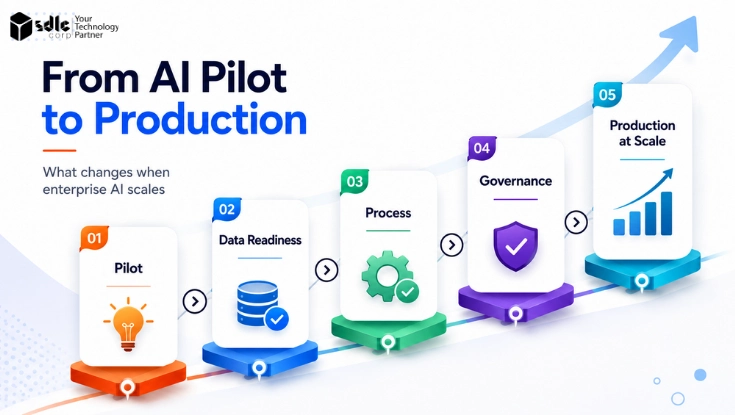
Treat the path from pilot to production as a sequence of gates that must each supply objective evidence and an owner decision.
The gates cover business value, data readiness, architecture stability, evaluation under representative conditions, security and compliance, operational monitoring, and adoption processes. A pilot-to-production gate sequence makes the required evidence, owners, rollback options, and shadow-mode decisions explicit before scale.
Why AI Pilots Behave Differently in Production
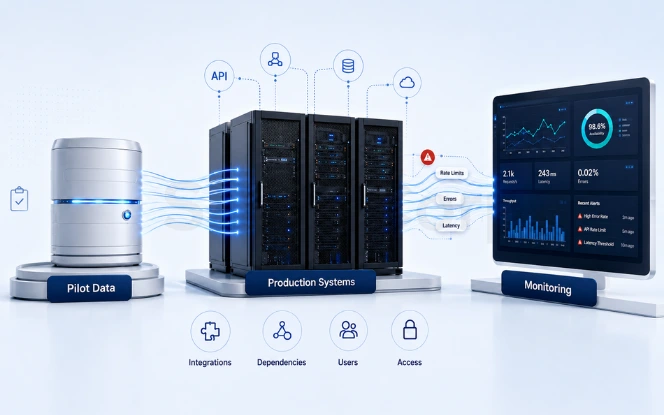
Pilots typically run on prepared datasets, controlled prompts and a small set of users who know the project context. Engineers often compensate for missing integrations by running manual checks and interventions.
Those conditions reduce variability and conceal operational gaps such as incomplete data ingestion, permission failures or unexpected user requests that appear only at scale.
Production systems encounter live, unpredictable inputs, intermittent data quality, concurrent users and downstream dependencies that a pilot avoids. Examples include document formats not present in the pilot, rate-limited APIs, regional routing with different latency, and users who expect deterministic behavior.
Each difference can change the observed value proposition or introduce failure modes that require different design choices.
Document the exact conditions that made the pilot succeed. Create a gap matrix that lists pilot assumptions, required production changes, owners and estimated effort. Use that matrix to scope work and to set gate acceptance criteria.
This record prevents surprise decisions based on enthusiasm and ensures the team can cost and schedule the work needed to close each gap.
- List pilot constraints: curated data, fixed prompts, limited user set, developer interventions and manual corrections.
- Identify production risks: variable input schema, API rate limits, multi-tenant access controls and downstream system failures.
- Create a gap matrix mapping pilot assumptions to production requirements with owners and estimated remediation steps.
- Require documented runbooks for any manual actions used in the pilot before allowing those actions in production.
Translate pilot assumptions into a gap register with owners before any production decision.
Step 1: Define AI Production Readiness Gates
Production-transition boundary: This discussion focuses on the evidence and accountable decisions required to move a pilot into a supported service.
MLOps and LLMOps define the ongoing operating controls; this process verifies that those controls, support ownership, rollout safeguards, and handover evidence are ready before scale.
What Each Readiness Gate Must Prove
Readiness gates make the move to production a decision sequence instead of a single push. Typical gates are business value, data readiness, architecture, evaluation, security and compliance, operations and adoption.
Each gate must state objective evidence, an owner who can accept or reject, and a minimal set of artifacts that prove the claim.
Make gates measurable but pragmatic. For data readiness, require connected sources, documented schemas, ownership and baseline quality checks. For evaluation, require a representative test set and defined acceptance thresholds tied to business outcomes.
For security, require threat modeling results, permission reviews and an incident response owner. Record these in an eight-row gate register that stakeholders can review.
Scope note: the gates below define what must be true before release.
The full register is set out in the AI production readiness checklist later in this guide. It lists the evidence, owner and go or no-go question for each gate.
Keep the Gate Register Lean
Keep the gates lean to avoid excessive bureaucracy. Require only the minimal evidence needed to reduce operational risk.
The gate table becomes the single source of truth during handover from the pilot team to production teams. Record the acceptance decision and signoff for auditability.
- Business gate: documented use case, expected value, KPIs and sponsor approval.
- Data gate: live sources connected, ownership assigned, schema contract and quality checks automated.
- Architecture gate: modular components, versioning policies, identity and fallback patterns verified.
- Evaluation gate: representative test set, task-specific metrics, and decision thresholds tied to business KPIs.
- Security gate: access controls, provider terms reviewed, audit logging and incident response assigned.
Require an owner signoff and an evidence artifact for every readiness gate.
For approval gates, risk tiers and oversight evidence, align the gate register with an enterprise operating model.
Teams without an internal template often shape it with an AI consulting partner before the first release. Map the gate language to the NIST AI Risk Management Framework.
Organizations formalizing this as a management system usually align it with ISO/IEC 42001, the AI management system standard.
Step 2: Close Data and Architecture Readiness Gaps
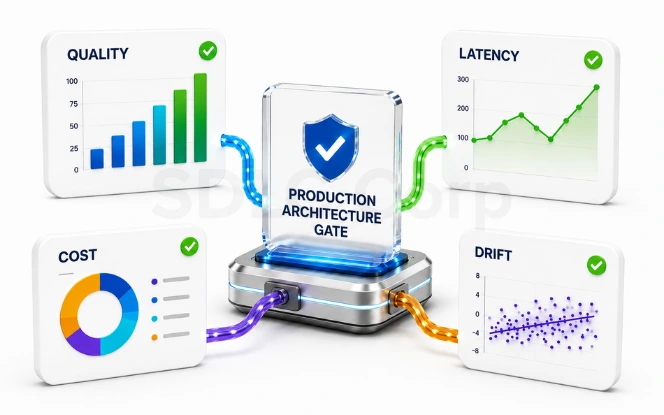
The architecture gate covers deployment environments, controlled configuration, and identity and permission enforcement. It also covers capacity assumptions, dependency timeouts, retry and rollback behavior, audit logging, and named operational ownership.
The gate is passed when these requirements are tested under representative load and failure conditions; detailed platform design belongs in the relevant architecture and operations guides.
Implement identity and access using managed identities, role-based access, and least privilege for data pipelines and model access. Version artifacts separately: model versions, prompt templates, retrieval indexes, configuration and evaluation datasets.
Treat prompts as versioned code and review them against prompt engineering best practices before each release. Include feature flags and runtime routing so you can shift traffic between models or switch to a safe fallback when metrics degrade.
Design deterministic rollback and graceful degradation paths. For high-risk requests, route through human review or enforce stricter validation. For noncritical tasks, return a safe default or a confidence score to downstream systems.
Capture these patterns in architecture diagrams and operational runbooks so support teams can act without developer assistance.
- Separate concerns: UI, orchestration, model layer, retrieval/data layer and monitoring/logging.
- Use versioned artifacts: model, prompt, retrieval index and evaluation set versioning with clear deployment tags.
- Enforce managed identities and RBAC for all service-to-service calls and storage access.
- Implement feature flags and traffic routing to control rollout and provider switching.
- Define fallback strategies and human-in-the-loop escalation for high-impact decisions.
Architect for component interchangeability and deterministic rollback before the first production deployment.
Before scaling, confirm that the data layer feeding the system is trustworthy. It is usually the same foundation used for business intelligence and data services. Documented ownership and quality checks are the minimum.
Related resources: if the program needs delivery capacity to close these gaps, see AI development services.
Step 3: Evaluate AI Under Production-Like Conditions
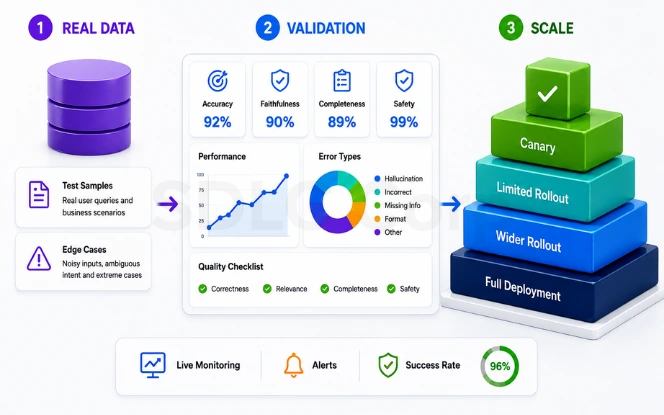
Evaluation must use representative data, realistic user interactions and business exception cases. Replace pilot test sets with production-like samples that include edge cases, noisy inputs and adversarial examples where relevant.
A workable starting point is 300 to 500 labelled cases per task, of which at least 50 are known edge cases.
For retrieval augmented generation workflows, test with the live document mix and common failure modes such as stale content or partial matches.
Measure task-specific quality using metrics tied to business outcomes: correct decision rate for predictive tasks, answer usefulness for generative assistants, or end-to-end completion for workflow automation.
Avoid overreliance on a single model score; instead track error types such as false positives, false negatives, hallucinations, and unsupported assertions. Use these error taxonomies to prioritize remediation.
Set an explicit regression threshold as well. If the primary task metric falls more than 2 percentage points below the accepted baseline, the release is blocked and the change is rolled back.
Continue evaluation after deployment. Set up periodic revalidation of the evaluation set and add production-sampled cases to detect drift. Integrate evaluation results into the monitoring layer so alerts can trigger specific actions: rollback, prompt adjustments, retraining or content updates.
Make evaluation datasets and thresholds auditable.
- Use production-like test samples including edge cases and adversarial inputs.
- Define task-specific metrics tied to business KPIs rather than a single aggregate model score.
- Track error taxonomies: false positives, false negatives, unsupported answers and retrieval misses.
- Add sampled production cases to evaluation sets to detect data drift and changing behavior.
- Automate periodic revalidation and link outcomes to corrective actions such as retraining or rollback.
Prioritize task-specific evaluation and continuous revalidation over a single performance metric.
Step 4: Establish Security, Governance and Ownership
Who Owns a Production AI System
Four named roles, recorded in the gate register so every approval is traceable.
Business owner
- Accountable for
- Outcomes, KPIs and the value case for the use case.
- Decision rights
- Go / no-go on the business gate and the cost envelope.
Data owner
- Accountable for
- Source systems, schemas, quality checks and retention.
- Decision rights
- Whether live data can be used, and under which permissions.
Technical owner
- Accountable for
- The running service: deployments, versions, uptime and rollback.
- Decision rights
- Release, rollback and architecture changes in production.
Risk owner
- Accountable for
- Compliance, provider terms, audit logging and incident response.
- Decision rights
- Acceptance of residual risk and mandatory human-review rules.
One accountable use-case owner should coordinate these four roles. Ownership removes ambiguity during incidents and makes it clear who can accept residual risk.
Permissions, Provider Terms and Impact Tiers
Assess data permissions, model-provider terms, and exposure pathways. Confirm permitted data flows, retention policies, encryption at rest and in transit, and logging that supports audit and forensics.
For third-party models ensure contractual terms allow your intended use and that data sharing aligns with policy. Include human review rules and thresholds when automated outputs may cause harm.
Classify use cases by impact and apply proportionate controls. Low-impact productivity tools can have lighter review and faster iteration. High-impact decisions require stronger evidence, formal review boards and staged signoffs.
Capture classification rationale, required controls and periodic reassessment cadence in governance documentation.
- Declare owners: business, data, technical and risk with documented responsibilities.
- Validate provider contracts, permitted data uses and model export restrictions before production.
- Require encryption, audit logging and retention policies tailored to data sensitivity.
- Define human review thresholds and mandatory escalation paths for high-risk decisions.
- Use impact classification to scale governance controls proportionally.
Assign accountable owners and apply risk-based controls aligned to the use-case impact.
Test the design against the OWASP Top 10 for LLM Applications. It covers generative-AI threats such as prompt injection and insecure output handling. Keep the wider control set aligned with responsible AI development principles.
Use cases serving EU users should also be classified against the risk tiers set out in the EU AI Act.
Step 5: Build Monitoring, Reliability and Cost Controls
Prove that the operating model is ready for handover
Monitoring must track availability, latency, error rates, model or retrieval quality, user feedback and cost. Design observability so technical signals map to business impact indicators.
For example, a rising rate of user corrections should feed a business KPI alert if those corrections increase operational cost or reduce throughput. An observability view should make signal categories and escalation paths clear to delivery and support teams.
Alert routing, on-call rotation and incident evidence usually sit with the same managed IT and operations services practice that runs the estate.
Define alert thresholds, ownership and playbooks for different classes of issues. Alerts can range from immediate outages to slow quality degradation. Decide which alerts automatically trigger mitigation actions such as routing to a fallback model and which require human investigation.
Include signals for data pipeline health and for model provider availability to avoid blind spots.
Tie monitoring to decision workflows: use alerts to trigger retraining, prompt updates, content refreshes, or rollback. Track cost metrics that combine model usage, retrieval queries, storage and human review effort to compute cost per completed task or per business outcome.
Use those metrics to tune routing rules, batch sizes and retention to optimize operating cost versus value.
- Monitor categories: availability, latency, errors, quality metrics, drift, user feedback and cost.
- Map technical signals to business impact and define owner and playbook per alert type.
- Include provider health and data pipeline signals to detect external faults early.
- Automate mitigations for known failure modes and require human review for uncertain degradations.
- Measure cost per completed task or business outcome, not just cost per model call.
Design observability so alerts map directly to corrective actions and business impact.
For an external reference on production ML delivery, testing, release automation, and monitoring, see Google Cloud's MLOps guidance.
Step 6: Use Shadow Mode and Controlled Rollout
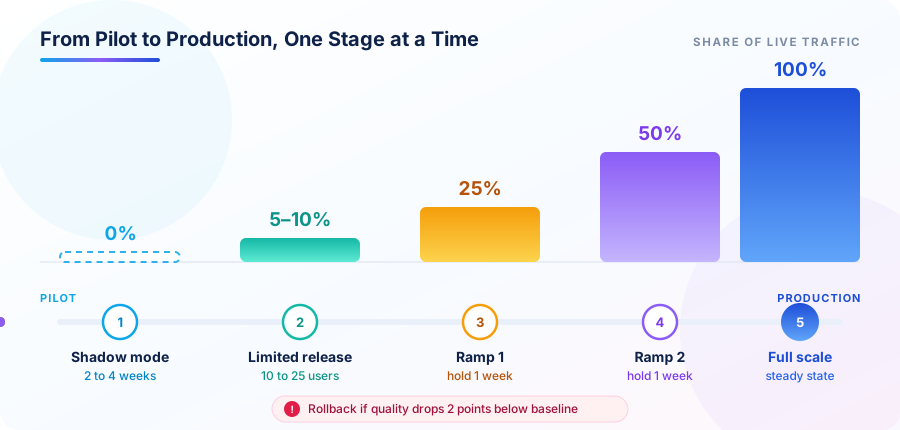
Use a staged rollout sequence: shadow mode, limited release and scale. Shadow mode runs the AI in parallel without affecting live outcomes so you can compare AI recommendations with actual decisions and measure correction burden.
Run shadow mode for two to four weeks, or until at least 1,000 comparable decisions have been logged, whichever comes later. Sample and label a minimum of 200 of those cases to collect realistic failure examples before any live impact.
Limited release should start at 5 to 10 percent of traffic, or a single team of 10 to 25 users. Keep task types restricted and support active. During this stage track incident rates, support tickets and user correction time.
Establish clear escalation paths and increase monitoring frequency. Only expand scope after acceptance criteria for reliability, accuracy and user support are met.
Prepare Users, Support Teams and Operational Owners
Adoption fails more often than models do. Before scale, name who reviews output, who handles exceptions, and who receives alerts. Name who owns incidents outside working hours, and how user feedback returns to the AI team.
Take a customer-support assistant as an example. The pilot ran on twenty curated tickets with an engineer watching.
Production means live CRM data, role-based access, PII redaction, and an escalation path to a human agent. It also means audit logs and a support team that knows what the assistant may answer.
The same handover pattern applies to any AI chatbot and virtual assistant deployment that touches live customers.
When scaling, ramp in stages of roughly 25, 50 and 100 percent, holding each stage for at least one week. Apply automated guardrails such as traffic caps, rollback triggers and cost thresholds at every stage.
Communicate capabilities and known limitations to users, provide concise training on review and escalation, and maintain a visible feedback channel. Retain the ability to revert quickly and to run targeted experiments that isolate changes to a single component.
- Shadow mode: run in parallel, collect decision comparisons and correction effort without live impact.
- Limited release: narrow user cohort, restricted tasks, active support and frequent checkpoints.
- Scale with progressive ramping, traffic caps and automated rollback triggers.
- Document user-facing capabilities and limits, train reviewers and provide feedback channels.
- Use staged expansion to validate integrations and operational support at each step.
Sequence rollout through shadow, limited release and progressive scale with clear rollback gates.
Step 7: Manage the Economics of Production AI
Production AI cost includes model usage, infrastructure, retrieval, monitoring, support and human review. Break costs into recurring usage and support activities and map them to business outcomes to calculate cost per completed task or per incremental business value.
This view clarifies tradeoffs between a lower-cost model that increases correction work and a higher-cost model that reduces manual effort.
Design routing and throttling to match model capability with task value. Route complex or high-value tasks to stronger model variants or human review while sending routine queries to lighter, cheaper options.
Use caching and batched retrieval where feasible to reduce calls and storage costs. Push deterministic, rules-based steps into workflow automation instead of paying for model calls. Include guardrails that prevent runaway usage from exploratory user behavior or API loops.
Make economics transparent to stakeholders with a periodic cost review that includes usage trends, unexpected index growth, support tickets and human review hours. Use those reviews to tune retention, update routing rules, renegotiate provider contracts or introduce stricter rate limits.
Treat economics as an operational metric with owners and cadence for review.
- Calculate cost per completed task or per business outcome combining model, infra, retrieval and support costs.
- Route tasks by value and complexity to appropriate model tiers and human review channels.
- Employ caching, batching and retention policies to limit unnecessary calls and storage growth.
- Create cost review cadence with owners and trigger rules for renegotiation or throttling.
- Monitor unexpected cost drivers such as index growth, exploratory user behavior and error loops.
Measure economics as cost per outcome and adjust routing and retention to align cost with value.
AI Production Readiness Checklist
Use this register as the single source of truth during handover. Every gate needs an evidence artifact, a named owner, and a recorded go or no-go decision before the AI pilot moves to production.
| Gate | Evidence required | Owner | Go / no-go question |
|---|---|---|---|
| Business value | Baseline KPI, target KPI, acceptable cost per outcome, documented use case | Business sponsor | Is the expected value larger than the fully loaded running cost? |
| Data | Live sources connected, schema contract, ownership assigned, automated quality checks | Data owner | Can the system run on live data without manual preparation? |
| Architecture | Versioned model, prompt and index artifacts, RBAC, timeouts, retries, rollback tested | Technical owner | Can we roll back or reroute traffic within minutes? |
| Evaluation | Production-like test set, task metrics tied to KPIs, error taxonomy, acceptance thresholds | AI/ML lead | Does quality hold on representative and edge-case inputs? |
| Security & governance | Threat model, permission review, provider terms, encryption, audit logging, retention policy | Risk owner | Are permitted data flows and residual risks formally accepted? |
| Operations & monitoring | Alert thresholds, owners, playbooks, drift and provider-health signals, incident process | Operations owner | Will someone be alerted, and know what to do, when quality drops? |
| Adoption & handover | User training, review and escalation rules, feedback channel, runbooks handed to support | Product/support owner | Can support run this service without the pilot team? |
| Economics | Cost per completed task, routing and caching rules, usage caps, review cadence | Business sponsor | Does cost per outcome stay inside the approved envelope at scale? |
A gate with evidence but no named owner is not passed. Record the approver and the date beside each row so the decision remains auditable after handover.
When Is an AI Pilot Ready for Production?
An AI pilot is ready for production when every gate has evidence and an accountable approver, not when the demo impresses stakeholders.
Business value, data, architecture, evaluation, security, operations, adoption, and economics each need to clear on their own terms. A single unresolved gate usually becomes the first production incident.
The practical rule is simple: if the team cannot show the artifact, name the owner, and describe the rollback, the capability is not ready to scale.
Close the gap, re-run the gate, and move forward with a controlled rollout rather than a full launch. Where internal capacity is the constraint, an experienced enterprise AI development partner can run the readiness work alongside the delivery team.
Frequently Asked Questions
A pilot validates feasibility and initial value using curated data, restricted users and supported operation. Production AI operates continuously with live inputs, enforced permissions, audit logging, monitoring, incident response and defined owners.
The production decision should be based on evidence that the whole system, not just the model, meets operational requirements.
Check business value, data readiness, architecture stability, representative evaluation, security and compliance, operational monitoring and user adoption readiness.
Each area should provide objective evidence, an owner who can accept residual risk, and minimal artifacts such as connected data sources, test sets and incident playbooks.
Yes when feasible. Shadow mode runs the AI in parallel without affecting outcomes. Teams can compare AI suggestions against live decisions, measure correction work, and collect realistic failure cases.
It reduces risk by exposing issues before any production impact and informs acceptance criteria for subsequent rollout stages.
Evaluate with production-like samples and task-specific metrics tied to business outcomes. Track error types and correction cost rather than a single model score.
Continue evaluation after deployment by sampling live cases to detect drift and feed corrective actions such as retraining, prompt updates or content refreshes.
Ownership should include a business owner accountable for outcomes and a data owner for sources and schemas. It should also include a technical owner for the running service and a risk owner for compliance.
One accountable use-case owner should coordinate approvals and gate signoffs to avoid fragmentation.
Monitoring should include availability, latency, error rates, model or retrieval quality metrics, data pipeline health, user feedback, drift signals, incident counts and cost metrics. Map these signals to business impact, define owners and playbooks, and automate mitigations where appropriate.