What Is AI Model Monitoring in Production?
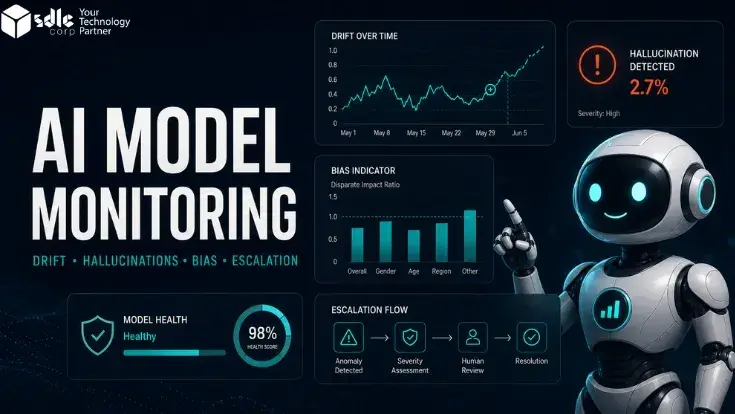
AI model monitoring is the ongoing process of checking whether a deployed model or AI application still produces acceptable results. It combines model-quality signals with operational, safety, cost, and business metrics.
Traditional monitoring answers questions such as: Is the API available? Is latency increasing? Are requests failing? Those checks are still important. However, they cannot always tell whether the AI output itself remains useful.
For example, a customer-support assistant may respond within one second while giving customers outdated information. Likewise, a fraud model may process every transaction successfully while missing a new fraud pattern.
Production AI monitoring adds this missing quality layer.
Teams that want this layer built in from the start can explore our AI development services, which cover the full path from model development through deployment, monitoring, and ongoing optimization.
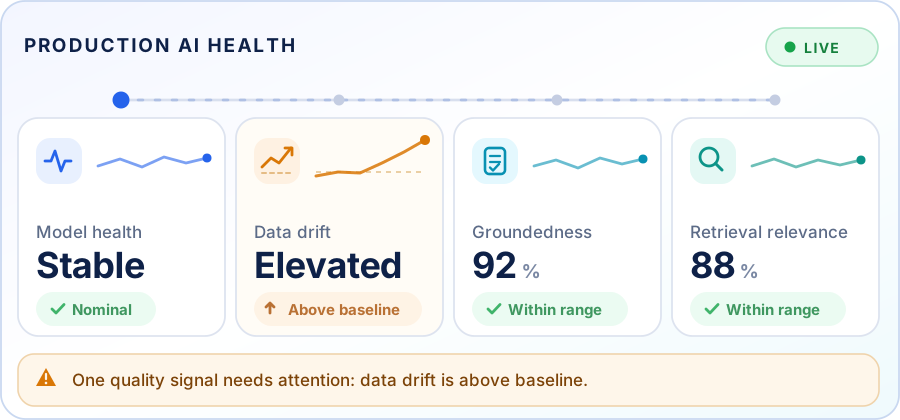
Teams generally need to monitor several areas. For data, this includes missing values, schema changes, feature distributions, and data drift. Predictive models may also require accuracy, confidence, calibration, and prediction monitoring.
LLM applications need other signals, including groundedness, answer relevance, safety, refusals, latency, and token cost. RAG applications add retrieval relevance, context quality, source freshness, and citation support.
Fairness, user feedback, task completion, cost, and business outcomes should also be included when they matter to the application.
Teams should also record the model version, prompt version, retriever configuration, vector index, and knowledge-base version running in production. That history makes it much easier to connect a sudden quality drop with a recent deployment.
An illustrative scenario (not a specific client engagement) makes the difference concrete. Picture a customer-support assistant whose uptime and P95 latency both look healthy. After a knowledge-base migration, retrieval relevance on a sampled evaluation set starts to drift downward over several days. If the team records index versions alongside quality scores, the decline lines up with the migration and the index can be rolled back quickly — an operational dashboard on its own would show nothing wrong.
Planning an AI system that has to stay reliable in production?
Talk to our AI team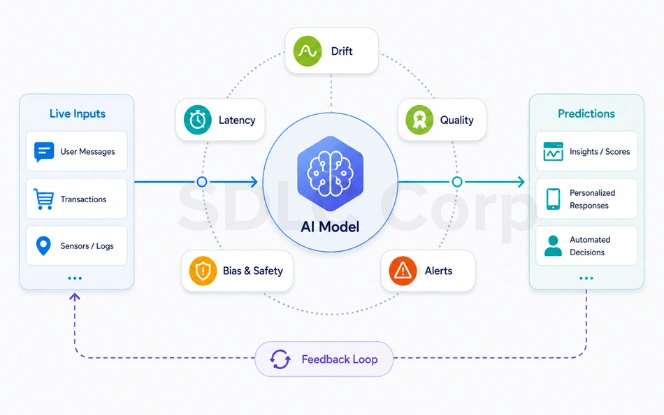
How to Detect Model Drift in Production
Model drift describes meaningful changes between expected and current production behavior. However, teams should identify what exactly has changed before deciding how to respond.
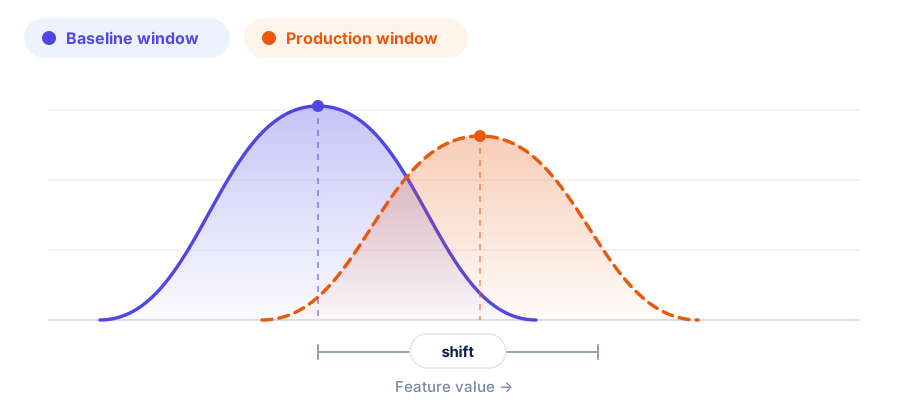
Data drift occurs when incoming data no longer looks like the reference data. Customer behavior, transaction size, locations, devices, product usage, or other features may shift over time.
Prediction drift occurs when the pattern of model outputs changes. For example, a classifier may suddenly produce far more positive predictions than usual.
Concept drift is different. It occurs when the relationship between inputs and the correct outcome changes. The data itself may look similar, but the pattern the model learned is no longer valid.
Teams can compare current and reference distributions using methods such as PSI, KS tests, or Jensen-Shannon divergence. These methods can help detect change, but no single drift test should decide whether a model has failed.
The important question is whether the change is large, sustained, and relevant to model or business performance.
For a wider view of how these checks fit into automated delivery pipelines, see Google Cloud’s MLOps architecture guide.
What if ground truth arrives late?
Many real-world systems do not receive correct labels immediately. Fraud, credit, churn, and forecasting models may wait days or weeks before teams know the true result.
Until then, teams can watch data distributions, prediction patterns, confidence changes, anomaly rates, and useful business proxies. These signals act as an early warning.
Once ground truth arrives, teams should measure real performance using metrics such as accuracy, precision, recall, F1, calibration, or other measures suited to the problem.
How to Monitor LLM Hallucinations and RAG Quality
An LLM can produce a confident answer that is incomplete, unsupported, or incorrect. That makes hallucination detection an important part of production LLM monitoring.
However, a single “hallucination score” is rarely enough. Teams usually need several signals because different failures look different.
Groundedness checks whether an answer is supported by the information provided to the model. Answer relevance checks whether the response actually addresses the user's question. Faithfulness checks whether the answer remains consistent with the supplied context.
Teams may also use factual checks, citation validation, evaluation models, sampled human review, and user feedback. These signals work better together than when one evaluator is treated as perfect ground truth.
Industry work on measuring these signals is moving quickly. The survey of hallucination in large language models covers detection approaches, and OpenAI’s SimpleQA benchmark shows how factual accuracy is being measured in practice.
RAG systems need another layer of monitoring because retrieval happens before generation.
If you are building on this stack, our generative AI development services cover production LLM applications end to end, and you can read more background on retrieval-augmented generation (RAG) if the pattern is new to your team.
A simple RAG flow is:
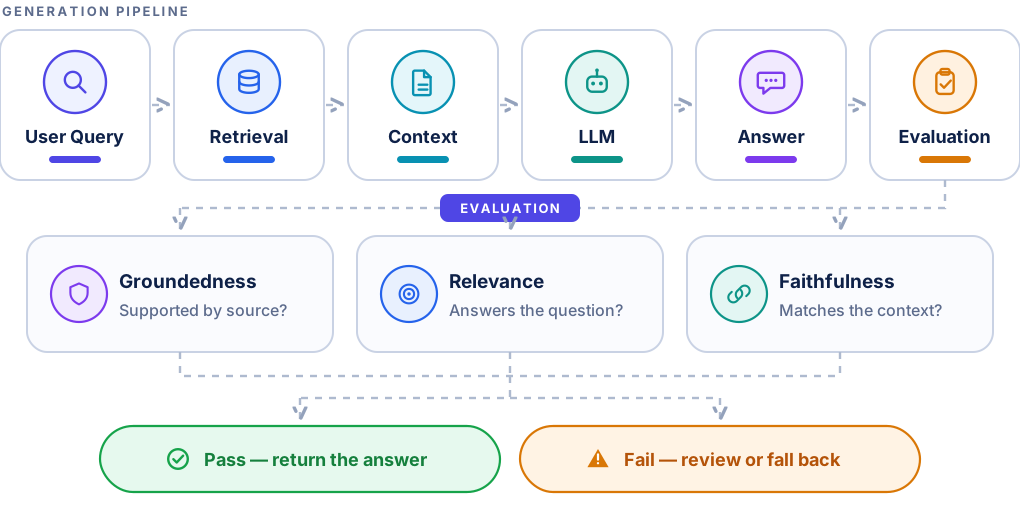
At the retrieval stage, teams should ask whether the system found useful and current information. At the context stage, they should check whether that information is relevant to the question.
After generation, they should check whether the answer stays grounded in that context and whether any citations genuinely support the claims.
This distinction matters because a poor RAG answer does not always mean the LLM failed. The retriever may have returned irrelevant, incomplete, or outdated documents.
Need a RAG system with retrieval and generation monitored separately?
Discuss your RAG projectHow to Monitor AI Bias and Fairness in Production
Fairness testing should not end when a model is deployed. Production data changes, and the mix of users interacting with a system can also change.
Overall model performance may therefore remain stable while one important group receives worse results.
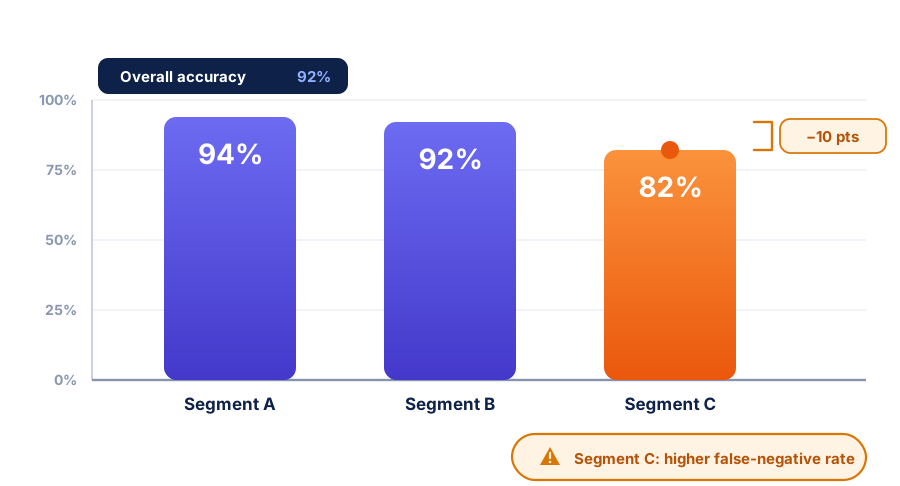
For example, imagine that a model has 92% overall accuracy. At first glance, that looks healthy. However, one customer segment may have only 82% accuracy and a much higher false-negative rate.
That difference is what AI bias monitoring should surface.
Teams can compare accuracy, false positives, false negatives, calibration, approval rates, or other relevant outcomes across meaningful groups. Depending on the use case, they may also evaluate measures such as demographic parity or equal opportunity.
The correct fairness metric depends on what the system does and who it affects. A metric that works for one business decision may be unsuitable for another.
Fairness monitoring of this kind belongs inside a wider responsible AI development practice. For a formal reference on governing these risks, the NIST AI Risk Management Framework is a useful starting point.
Teams should also watch for bias drift. This occurs when performance differences between cohorts grow over time, even though overall model quality still appears stable.
How to Set Baselines, Thresholds, and Alerts
Monitoring produces useful signals, but teams still need to know when a change requires action.
A baseline represents expected behavior. Teams can then define warning and critical conditions around important metrics.
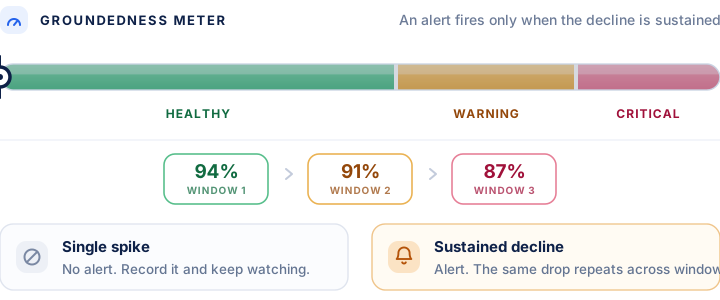
Thresholds should reflect historical behavior, validation results, normal model variability, business impact, and risk tolerance. They should not be copied from an unrelated system.
As a worked example, a support assistant with a groundedness baseline of 94% over the last 30 days and a normal day-to-day spread of roughly two points might set warning at 91% and critical at 87%, evaluated on rolling one-hour windows with a minimum of 500 responses. Retrieval relevance on the same system might sit at 88% baseline, with warning at 84% and critical at 78%. A bias gap between cohorts might be accepted up to 3 points, flagged at 5, and escalated above 8. These are starting numbers, not defaults — each one should be re-derived from your own validation runs and business impact.
Teams should also avoid creating alerts for every temporary fluctuation. Rolling windows, minimum sample sizes, sustained breaches, and combined signals can reduce unnecessary noise.
For example, a low groundedness result across five requests may only need observation. If the same decline appears across thousands of responses and continues for several monitoring windows, it deserves much more attention.
Business impact also matters. A quality decline in an internal writing assistant carries different consequences from a similar decline in a system influencing high-impact decisions.
Threshold reference for other signals
| Signal | Normal | Warning | Critical |
|---|---|---|---|
| Data drift | Within expected range | Elevated change | Sustained breach |
| Groundedness | Near baseline | Persistent decline | Major quality failure |
| Retrieval relevance | Stable | Noticeable decline | Large sustained decline |
| Bias gap | Within accepted range | Widening gap | Risk limit exceeded |
What Happens After an AI Monitoring Alert?
An alert is useful only when the team knows what to do next.
The first step is to confirm that the issue is real. Then, the team should investigate whether the problem came from data, the model, a prompt, retrieval, a knowledge-base update, infrastructure, or another dependency.
Version tracking becomes especially valuable here. If quality dropped immediately after a new prompt or index deployment, the team has a clear place to start.
The next step is containment. The goal is to reduce user impact while engineers investigate. Depending on the application, this may involve human review, traffic restriction, a fallback system, or temporarily disabling one capability.
A practical response cycle is:
| Severity | Typical Response |
|---|---|
| Low | Record and continue monitoring |
| Medium | Engineering investigation |
| High | Human review, traffic restriction, or fallback |
| Critical | Rollback or disable the affected capability |
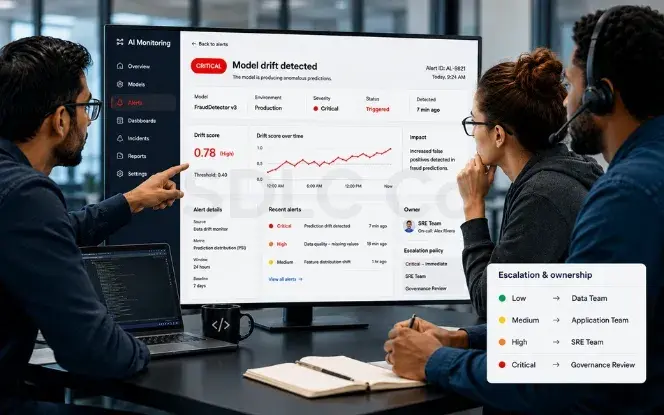
Ownership should already be defined. Data and ML teams may handle drift, while application teams investigate LLM or RAG failures. Platform or SRE teams usually handle infrastructure issues.
Serious safety, fairness, or policy problems may also require domain experts, governance teams, compliance teams, or risk reviewers.
Every important alert should therefore answer three questions: How serious is it? Who owns it? What happens next?
Teams formalising this process often borrow from established incident practice, such as Google’s SRE guidance on managing incidents.
How Monitoring Should Improve After an Incident
An incident should not end when the dashboard turns green again.
Production failures reveal cases that testing and evaluation may have missed. Teams should use those cases to improve future monitoring and release checks.
Suppose a new RAG index causes retrieval quality to drop. After fixing the problem, the failed user queries should be added to the evaluation dataset. The next index version can then be tested against those queries before release.
Teams should also review whether their alert rules worked correctly. If an important incident was detected too late, thresholds may need adjustment. If alerts fired too often without meaningful impact, the monitoring window or minimum sample size may need to change.
The improvement loop is straightforward:
This process turns real failures into better tests instead of allowing the same problem to return later.
Production AI Monitoring Architecture and Best Practices
A practical monitoring architecture connects the AI system with telemetry, evaluation, alerting, ownership, and recovery.
Consider a customer-support RAG assistant after a knowledge-base update. Uptime and latency remain healthy, but retrieval relevance begins to fall. Because the LLM now receives weaker context, groundedness also declines.
The monitoring system detects that both signals remain outside their accepted ranges. Version history shows that the decline started after a new index deployment, so the system raises a high-severity alert.
While the AI team investigates, uncertain responses move to human support. Engineers confirm that the new index caused the problem and roll it back. Retrieval relevance and groundedness return to normal.
The team then adds the failed queries to its future evaluation suite. That means the same retrieval problem is more likely to be caught before another index reaches production.
Production AI Monitoring Checklist
Tick what you already have in place. Each area tells you the risk you are carrying until it is complete.
Signal foundations
Not startedPartialCoveredDetection rules
Not startedPartialCoveredOwnership & escalation
Not startedPartialCoveredRecovery & learning
Not startedPartialCoveredConclusion
Effective AI model monitoring does more than show whether an application is online. It helps teams understand whether a deployed AI system is still producing reliable results and what to do when that behavior changes.
A strong monitoring process connects quality signals with baselines, thresholds, severity, ownership, and recovery actions. It also learns from production incidents, so real failures improve future evaluation and release decisions.
For predictive ML, LLM, and RAG systems, the goal is simple: detect important problems early, limit their impact, recover safely, and keep the AI reliable as production conditions change.