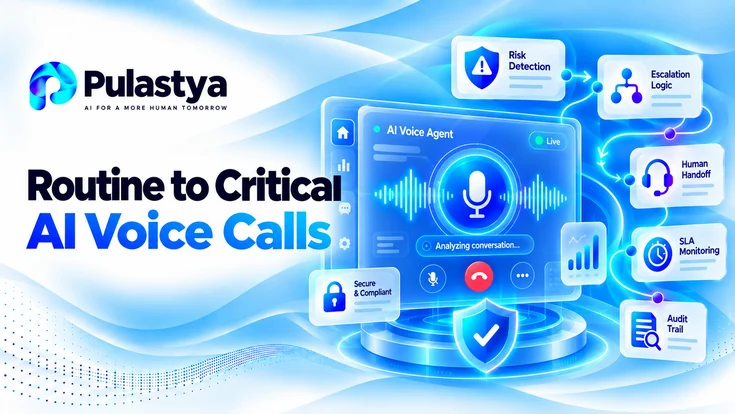
Routine AI voice calls regularly handle low-risk tasks like appointment reminders, balance queries, and status updates. When those same calls cross thresholds that affect safety, revenue, or regulatory obligations, they become critical.
Design and operations must anticipate state changes, detect escalation accurately, and enforce predictable handoffs to meet reliability, compliance, and customer-experience goals.
- Detect escalation early Use combined signals (ASR confidence, NLU intent risk, keywords, silence, sentiment) to trigger state changes before outcomes worsen.
- Design deterministic transitions Define explicit state machine transitions with circuit breakers, human-override paths, and time-based fallbacks to prevent oscillation and race conditions.
- Log and govern every change Maintain immutable event streams and audit trails mapped to business rules and SLAs for forensics and compliance.
Moving a call from routine to critical requires explicit state management: a call is not simply active or ended. State includes intent confidence, account risk, user distress signals, and elapsed time since trigger conditions. Enterprises need deterministic rules and telemetry that convert probabilistic model outputs into actionable states so downstream systems, agents, and legal controls react consistently.
Practical design patterns and operational controls let teams change call state without introducing service disruption or compliance exposure. The core engineering, product, and operations considerations are vendor neutral: detection logic, signal routing, latency and reliability tradeoffs, auditability, escalation SLAs, and testing strategies for production voice AI.
Detecting When a Routine Call Becomes Critical
Detection must combine voice-layer signals and business-context signals. At the voice layer, monitor ASR confidence drops, repeated user interruptions, elevated speech rate, silence durations, keyword hits like emergency words, and sentiment indicators. Public service lines carry that risk most sharply, since an emergency arriving on a non-emergency line has to be recognized without being assessed.
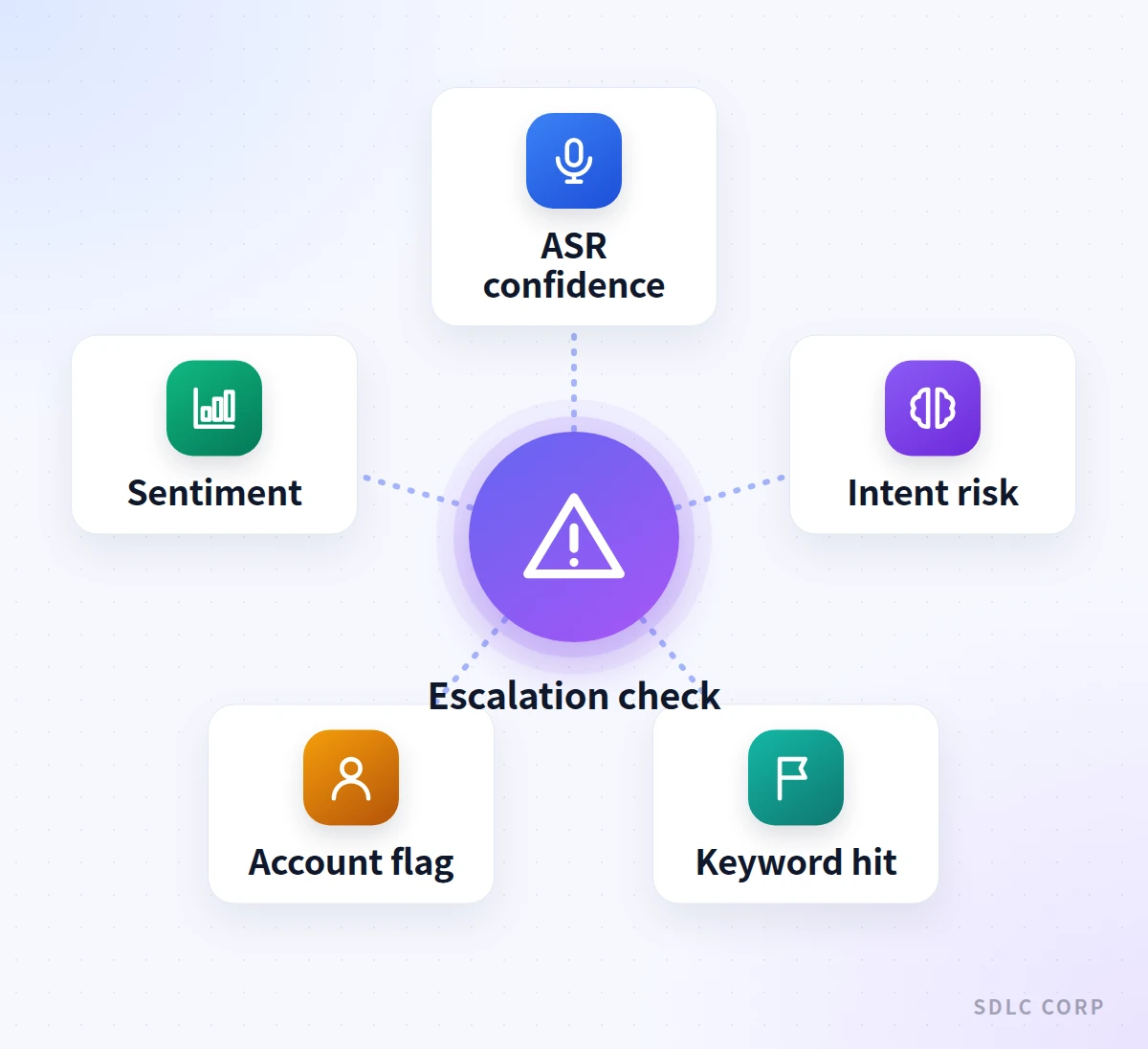
At the business layer, use account flags, transaction size thresholds, recent churn signals, and third-party fraud alerts. Merge these signals with a weighted rule or model so the system raises a critical flag only when multiple independent indicators align.
Avoid overreliance on a single classifier. ASR can degrade under network jitter or unfamiliar accents; sentiment models can be brittle with domain language. Design a small ensemble of detectors with confidence thresholds tuned against labeled incident data.
For high-value outcomes, require at least two orthogonal triggers before escalating automatically. This reduces false positives that lead to unnecessary human intervention or compliance escalations. Safety-critical cues are the exception: an emergency statement, a threat of harm, or an explicit request for a person should escalate on its own. Utilities meet the same tension at volume, which an outage that turns a steady line into a spike sets out.
Design detection events as explicit, typed messages in your call-state bus. Each event should include source, timestamp, confidence, and the rule that fired. This makes it possible to trace why a call changed state, replay decisions in a sandbox, and tune thresholds with business stakeholders. Keep detectors independent so operators can mute or adjust them without code deployment.
- Combine ASR, NLU, and sentiment signals
- Use business flags like high-value account
- Require multiple triggers, except safety cues
- Emit typed detection events with confidence
- Enable runtime tuning without deploys
Early, multi-signal detection reduces both missed escalations and false alarms.
Defining Call States and Explicit Transitions
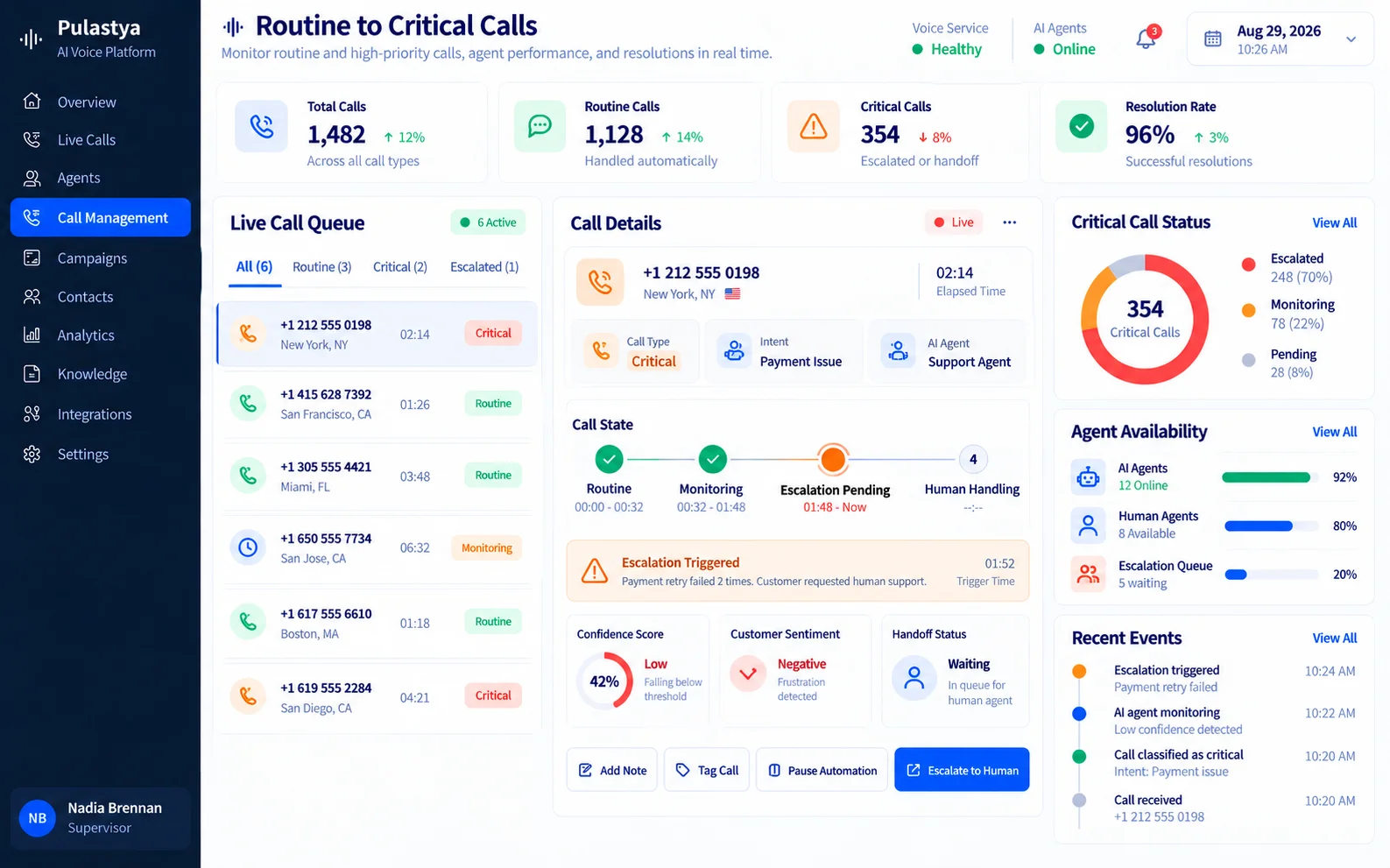
Define a small, unambiguous set of call states: e.g., Idle, Active-Routine, Monitoring, Escalation-Pending, Critical, Human-Handled, Resolved. For each state enumerate allowed inbound events and permitted outbound transitions.
Capture timeouts for transient states to avoid indefinite Monitoring states. Keep the state machine observable and versioned so product and compliance teams can review behavioral changes between releases.
Avoid implicit or emergent states inside model components. Embed state as a shared, single-source-of-truth in a lightweight call metadata record that follows the call across services. Use optimistic concurrency control or version stamps when multiple services update the state to prevent race conditions. If a downstream system rejects a transition, record the rejection event and provide a predefined fallback path.
Design transition guards for safety: e.g., a move to Critical requires a minimum confidence, a business rule override, or explicit human confirmation depending on impact. Attach SLA windows to each transition: how long an Escalation-Pending can stay unresolved and what automated actions happen when timers expire. State definitions should be part of runbooks and release notes.
Monitoring screens should show the same states people act on. The live call view in Pulastya AI, for example, shows each call's handling status (AI handling, escalating, transferring, human handling, completed) alongside its risk level and AI confidence.
- Use a compact, auditable state model
- Version and document every transition
- Store state in shared metadata record
- Apply concurrency guards on updates
- Attach timeouts and SLA windows
Explicit states and guards prevent ambiguous routing and operational drift.
Call state transitions
What Moves a Call Between States, and What Happens Next
| Trigger | State change | Action |
|---|---|---|
| Independent signals align, such as 'unauthorized' on a flagged account | Active-Routine to Escalation-Pending | Start the escalation timer; route to a specialist queue with evidence |
| Emergency statement or threat of harm | Any state to Critical on a single cue | Stop automation and connect a person right away |
| Specialist accepts the escalated call | Escalation-Pending to Human-Handled | Lock the state so automation cannot reassert control |
| Escalation timer expires with no pickup | Escalation-Pending to manager escalation | Route to a manager queue or offer a callback |
| Media or NLU component fails mid-call | Routine flow to degraded fallback | Offer transfer or callback; high-safety flows fail closed |
Every transition has a named trigger and a guarded action, so the same event always moves a call the same way.
Architecting Reliable State Change for Voice AI Systems
Architect for eventual consistency but provide strongly consistent checkpoints for critical transitions. Use an append-only event stream to record detector outputs and state transition proposals, and a compact materialized view for real-time routing decisions. This separation preserves a tamper-evident audit trail while enabling low-latency reads for call handling components.
Design message flows with idempotency and deduplication. A common failure mode is duplicate detector events leading to repeated escalations or email floods. Include idempotency keys tied to detection windows and make downstream actions idempotent so retries do not amplify customer impact. Use backpressure mechanisms and circuit breakers when downstream human queues are saturated.
Plan for network and model latency. Critical transitions should not wait for bulk analytics to complete. Implement a prioritized path: lightweight detectors run synchronously in the media path, while heavier scoring runs asynchronously and can trigger secondary actions. Maintain a health channel that tracks model lag and network degradation so operators can adjust thresholds dynamically.
- Record events in an append-only stream
- Serve a materialized view for decisioning
- Make transition actions idempotent
- Use circuit breakers for overloaded queues
- Prioritize lightweight detectors in path
Architect state change with events, idempotency, and prioritized detectors.
Operational Playbook: Handoffs, Human-In-The-Loop, and Fallbacks
Handoffs must be predictable. Define explicit queues and routing logic for escalations: route by geography, language, skill, or regulatory domain. Provide agents with a summary card showing the detection evidence, timestamped transcript snippets, and relevant account context. That context reduces handle time and prevents repeated information requests that frustrate customers.
Human-in-the-loop controls should include a clear override mechanism and a 'reason-for-override' that gets logged. When a human agent accepts an escalation, lock the call state to Human-Handled to prevent automated systems from reasserting control. If the agent cannot resolve the issue within a predefined window, automatically escalate to a manager queue or trigger an alternative remediation path.
Build safe fallbacks for degraded conditions. If media or NLU components fail, present the caller with a clear transfer or callback option rather than attempting risky automated remediation. Implement a fail-open vs fail-closed policy aligned with business risk: high-safety flows should fail-closed to human review, low-risk informational flows can fail-open with best-effort responses.
- Route escalations by skill and compliance domain
- Surface decision evidence to agents
- Log overrides with required rationale
- Lock state on human takeover
- Provide clear fail-open/fail-closed rules
Operational clarity at handoff reduces resolve time and legal exposure.
Monitoring, Metrics, and Audit Trails for Changed Call State
Track metrics tied to state transitions: detection rate, false escalation rate, time-to-human, time-in-critical, abandonment during escalation, and resolution rate post-handoff. Map these metrics to business KPIs such as revenue at risk, regulatory incidents, or customer satisfaction. Dashboards should allow filtering by detector version, region, and time window for root-cause analysis.
Capture full forensic context on every critical transition: raw audio pointer, ASR transcripts with confidence, NLU intents with scores, detector inputs, and the exact rule set or model version that triggered escalation. Store these artifacts in a retention policy that satisfies legal and privacy requirements. Make search and playback available to compliance and investigations teams with role-based access controls.
Instrument synthetic tests that trigger defined escalation paths and verify end-to-end behavior. Run those tests on a schedule and after model or rule updates. Correlate real incident timelines with synthetic test results to spot regressions. Use replay capability against canary environments before releasing detectors or transition logic to production.
- Monitor detection and false-positive rates
- Measure time-to-human and resolution rate
- Store transcripts, model versions, and events
- Enforce retention and RBAC for artifacts
- Run synthetic escalation tests regularly
Comprehensive telemetry and forensics make escalations auditable and tunable.
Example: A Billing Call That Escalates to Critical
A bank voice bot handles routine balance queries. A customer calls, agitated about an unexpected large debit. ASR confidence is acceptable, but repeated interruptions, the keyword 'unauthorized', a flagged high-value account, and a recent fraud alert combine to set a Critical flag. The detector emits a Critical proposal into the call-state stream with attached evidence and timestamps.
The state machine transitions the call from Active-Routine to Escalation-Pending, starts a 90-second timer, and routes to a fraud-specialist queue. The human agent receives a context card with recent transactions, the suspect debit ID, and the detector evidence.
The agent locks the call state to Human-Handled and places a temporary block on the card to stop further unauthorized debits while verifying identity.
After identity confirmation, the agent opens a dispute case and starts the bank's provisional credit process for the debit. All events-detector triggers, state transitions, agent actions, and the final resolution-are stored in the audit stream. Post-incident, product and fraud teams review the case to refine thresholds that minimized customer friction while protecting the bank from revenue loss.
- Multiple signals triggered Critical flag
- 90-second SLA for escalation routing
- Agent receives evidence-packed context card
- Agent locks state, blocks the card, and opens a dispute
- Incident recorded for postmortem tuning
Concrete incident evidence helps balance customer experience and fraud prevention.
Governance, Compliance, and Contractual SLAs for Escalations
Governance must align detection and escalation behavior with legal and contractual requirements. For regulated interactions, define minimum retention, consent capture, and disclosure language. Map which transitions trigger mandatory notifications to regulators or customers. Include model explainability requirements and a documented evidence chain that proves why a call changed state and what actions followed.
SLA language should go beyond agent pick-up times. Specify detection-to-routing latency, maximum allowed false escalation rates, and remediation SLAs tied to business impact tiers. Contract clauses should also define acceptable maintenance windows, telemetry access for audits, and incident notification commitments. Make SLAs testable with synthetic verifications and sample audits.
Set up governance reviews for detector updates, threshold changes, and state-machine modifications. Require cross-functional signoff from product, legal, security, and operations. Maintain a changelog and risk assessment for each release and include rollback plans. For high-impact flows, require canary deployment and a monitoring hold period before global rollout.
- Define retention and consent for escalations
- Include detection latency in SLAs
- Require cross-functional signoff for changes
- Make SLAs testable with synthetic audits
- Keep a versioned changelog and rollback plan
Governance and testable SLAs reduce operational and legal risk.
Testing, Release Controls, and Continuous Improvement
Testing should cover unit detection logic, end-to-end call flows, and human-handoff behavior. Build deterministic tests that simulate degraded audio, accented speech, and conflicting detector signals. Incorporate fuzz tests that randomly inject transient errors and validate that fallback behaviors preserve safety. Automate regression suites that gate deployments to production for both models and rule changes.
Use staged rollouts and canary detectors with real traffic sampled at low rates. Monitor key indicators and rollback on regression signals like spike in false escalations or increased abandonment during handoffs. Keep a feedback loop where agent annotations and post-incident findings feed labeled datasets that improve detectors and reduce future misclassifications.
Treat operational handover as part of every release: document the state model, detector thresholds, runbooks, and on-call ownership before a change goes live, whether the detectors and event pipelines were built in-house or by an implementation partner.
- Run deterministic and fuzz tests for detectors
- Canary detectors on sampled real traffic
- Gate releases with regression thresholds
- Feed agent annotations into retraining sets
- Document operational handover and runbooks
Continuous testing and staged rollout prevent regressions and maintain trust.
For the transfer triggers themselves, see when AI voice agents should transfer calls; for matching each call to the right team, see routing calls to the right team.
Conclusion
Reliable escalation from routine to critical AI voice calls depends on more than recognizing a risky phrase. Voice signals and business context must feed a clearly defined state machine with guarded transitions, timeouts, and an auditable event trail. Safety-critical cues require an immediate response, while other triggers should draw on multiple independent signals to reduce false alarms. When escalation is necessary, the receiving agent needs the evidence and call context to take over without making the caller start again.
Making this work consistently requires ongoing operational discipline. Define measurable escalation SLAs, test failed transfers and degraded audio, and monitor false escalations, time-to-human, and post-handoff resolution. Review incidents and detector updates with product, security, compliance, and operations teams, then refine thresholds and fallback paths as conditions change. With clear ownership and regular testing, AI voice systems can handle routine requests efficiently while directing critical calls to human support reliably.
Frequently Asked Questions
Use a combination of voice-layer signals (ASR confidence drops, repeated interruptions, keywords, sentiment) and business signals (high-value account flags, recent fraud alerts, regulatory markers). Require multiple orthogonal signals to reduce false positives, but let a single safety cue, such as an emergency statement or a request for a person, escalate on its own. Log every transition so it stays auditable.
Implement explicit transition guards, idempotent actions, versioned state records, and timeout windows. Use optimistic concurrency control on state updates and lock the state when a human agent takes over to prevent automated systems from reasserting control.
Include timestamps, detector evidence, transcript snippets with confidence, relevant account details, recent transactions or flags, and the model or rule version that fired. This reduces verification time and prevents repeated questions for the caller.
Escalation SLAs should include detection-to-routing latency, maximum acceptable false escalation rates, time-to-human pick-up, and remediation windows tied to impact tiers. Routine call SLAs can remain focused on throughput and average handle time.
Store immutable event streams, transcripts, audio pointers, model versions, and override reasons. Apply retention schedules aligned with legal requirements and provide role-based access controls for investigations. Ensure artifacts are searchable for postmortems and compliance audits.