AI voice agents can reduce handle time and scale routine interactions, but transfer decisions determine whether automation helps or harms customer outcomes.
Good transfer logic balances task completion, compliance, sentiment, and cost. Clear, operational rules for when an AI voice agent should transfer a call to a human, backed by explicit tradeoffs and metrics, turn that balance into real implementation choices.
- Core rule Transfer when the expected marginal benefit of a human exceeds the expected benefit of automated continuation, given cost and service constraints.
- Signal-driven gates Use intent confidence, identity verification, sentiment, and policy flags as primary transfer triggers; combine them with business-specific conditions.
- Measure and iterate Track handoff success, repeat transfer rate, time-to-resolution after transfer, and customer effort to refine thresholds and context payloads.
Start with a single operational objective: minimize total resolution cost while meeting service-level, compliance, and customer-satisfaction constraints. That objective forces explicit transfer gates: points at which the incremental value of a human exceeds continued automated handling.
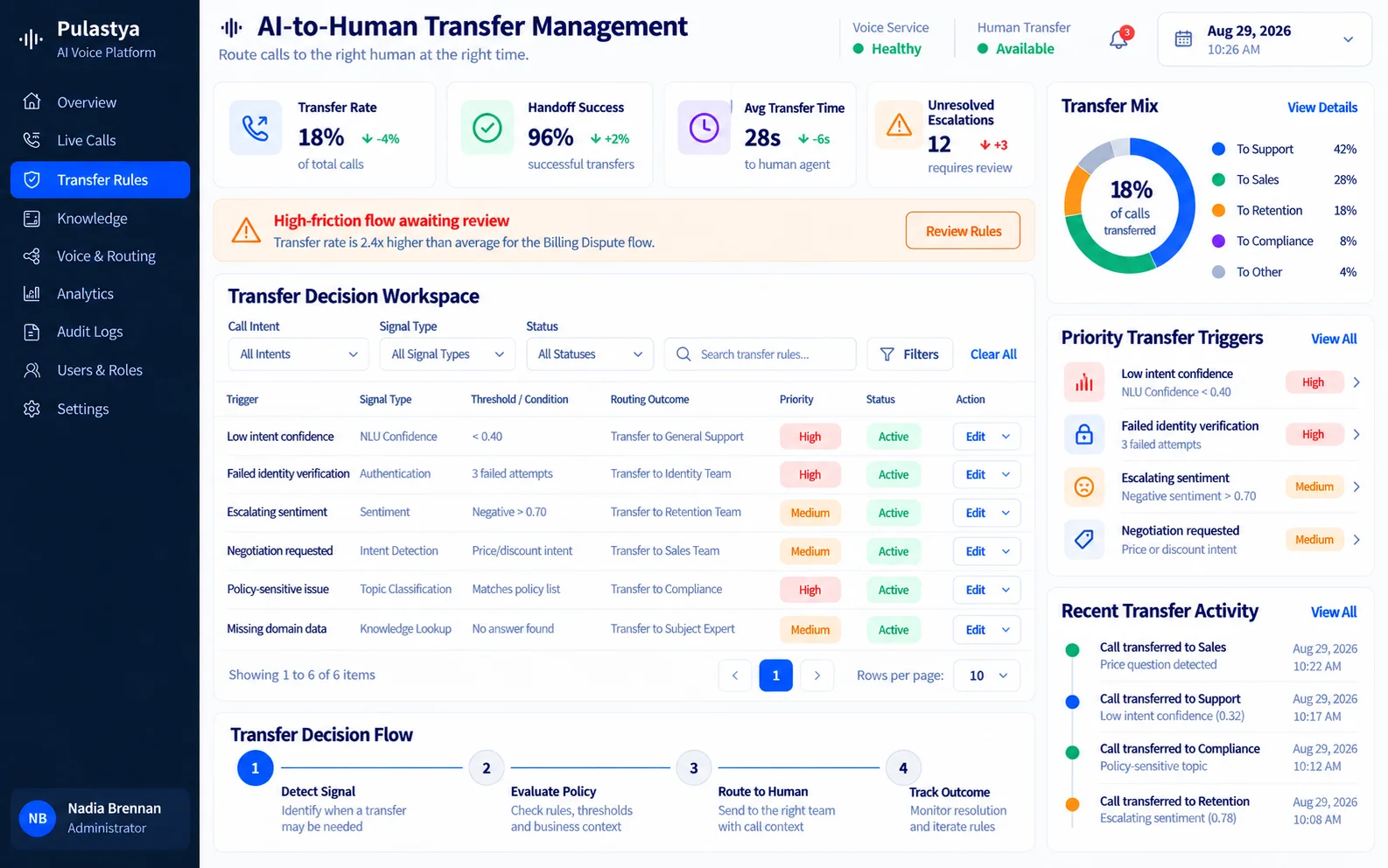
For enterprise contact centers that carry high-value customers or regulatory risk, treat transfer rules as a portfolio of risk controls, not a single threshold.
Design transfer behavior around use cases and measurable signals. Signals include failed intent identification, identity verification failure, constrained domain knowledge, negative sentiment trends, or explicit escalation requests.
Each signal should map to a transfer action, a confidence threshold, required context to send with the call, and a post-handoff metric to evaluate team and AI performance. Maintain a short list of mandatory transfer triggers and a configurable list of conditional triggers.
Transfer When Intent Confidence Is Low or Ambiguous
The clearest technical gate for transfer is low intent or multiple competing intents. If the NLU stack reports confidence below a prequalified threshold or returns several intents with similar scores, and a short clarifying question does not resolve it, the agent should transfer. Low confidence leads to long loops that frustrate callers and consume minutes.
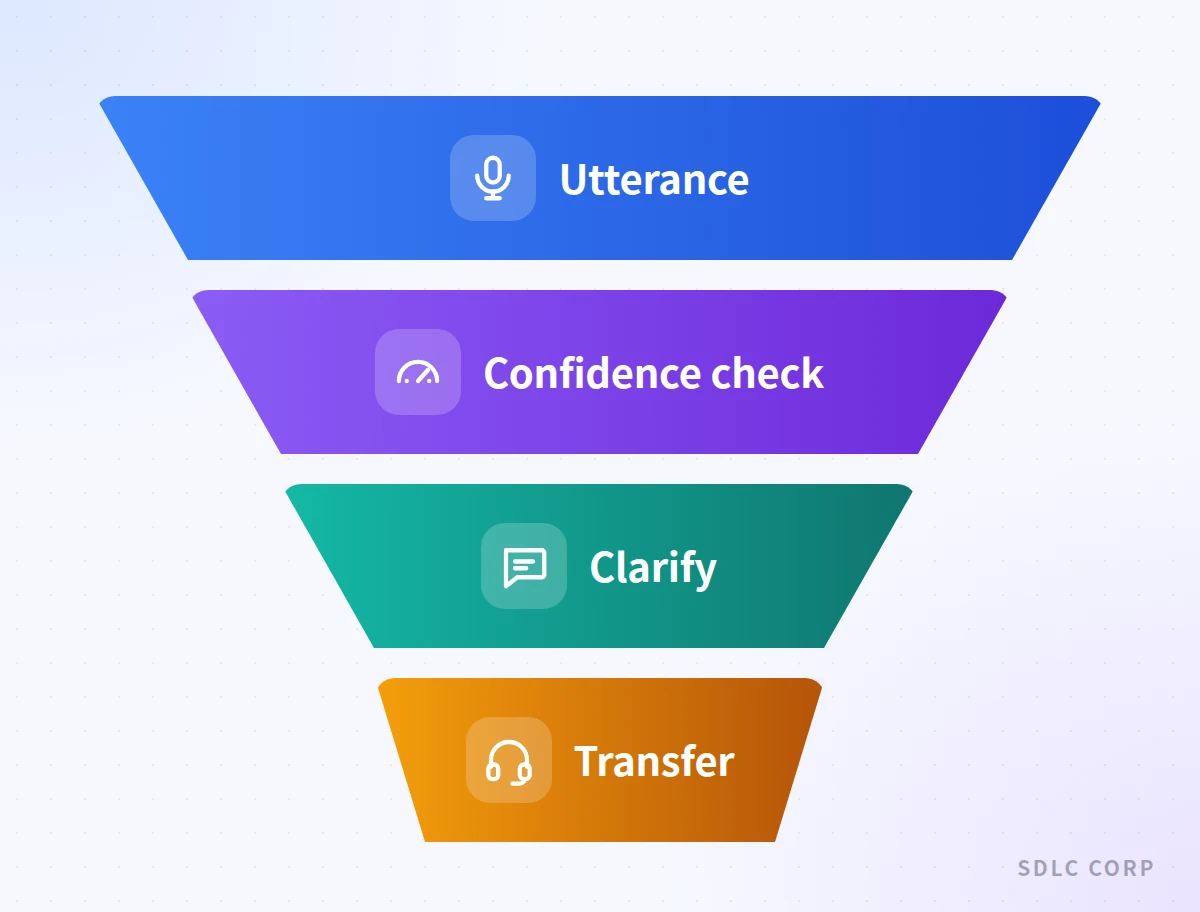
For enterprise deployments, set conservative thresholds for high-risk intents and allow more aggressive automation on transactional intents like balance inquiries.
Implementing this gate requires calibrated confidence metrics. Use holdout sets and production telemetry to align model confidence with real-world accuracy. For intents that map to regulated outcomes, lower the tolerance for false positives.
Use ensemble methods and a simple fallback rule: if the top two intents are within a small margin and neither produces a safe path, escalate immediately to a human.
Operationalize the transfer with context. Send the last few utterances, detected intents and confidence scores, any fulfilled slots, and whether identity verification completed. This reduces the warmup time for the agent receiving the call and improves first-contact resolution rates. Ensure the receiving queue has routing priorities based on intent category and customer tier.
- Calibrate intent confidence using production feedback loops, not only test sets.
- Lower the confidence threshold for high-risk or compliance-bound intents.
- Escalate when multiple intents are close in score and none yields a safe path.
- Attach NLU metadata and recent utterances to the handoff payload.
Low or ambiguous intent that one clarifying question cannot resolve should trigger a prompt transfer to avoid wasted voice minutes and frustration.
Transfer When Identity or Authorization Fails
Authentication and authorization are binary from a policy perspective: if required verification cannot be completed to the enterprise standard, transfer. The cost of a data breach or regulatory violation typically exceeds any savings from continued automated attempts. Build verification modules that report both success and confidence, and enforce hard stops when confidence is below the compliance threshold.
Design verification escalation paths. For agents that use passive voice biometrics, allow a limited number of retries before transfer. When multi-factor verification is required, the agent should be able to initiate a secure callback or directly transfer to a verification specialist. Make sure voice transcripts and verification artifacts are stored according to retention and audit policies.
On the receiving side, route transfers to agents who are cleared for the requested transaction level. Include a short summary: verification attempts made, artifacts collected, and which steps failed. This reduces redundant verification attempts and improves agent efficiency. Log every transfer for audit and to train models on verification failure modes.
- Implement hard stops when verification confidence is below policy thresholds.
- Allow controlled retries but cap attempts to avoid fraud vectors.
- Provide verification context and failed steps to the human agent at transfer.
- Log verification failures for audit and model improvement.
When verification cannot meet policy standards, transfer without negotiation to preserve security and compliance.
Transfer When Customer Sentiment or Frustration Escalates
Signal-based sentiment models can detect rising frustration, repeated interruptions, or angry language. When those signals cross a calibrated threshold, transfer to a human trained in de-escalation. A timely human handoff can recover a relationship and prevent churn. Define sentiment thresholds per customer segment; premium customers may have lower tolerance for automated handling than lower-value segments.
Sentiment models are imperfect; combine them with behavioral signals such as repeated identical queries, long pauses when prompted, or high speech rate. Use short windows of analysis rather than single-utterance flags to avoid false positives. When a transfer is triggered by sentiment, the handoff payload should include a concise sentiment timeline and the last agent actions taken.
Train receiving agents on empathetic scripting and quick fact-finding to reduce handling time after transfer. Track post-transfer customer satisfaction and resolution time as primary KPIs. If sentiment-triggered transfers consistently result in faster, higher-satisfaction outcomes, widen the trigger; if not, recalibrate to avoid unnecessary human cost.
- Combine sentiment scores with behavioral patterns to reduce false positives.
- Set lower tolerance for premium customer segments to preserve loyalty.
- Include recent agent actions and a sentiment timeline in the handoff.
- Measure post-transfer satisfaction to validate sentiment-trigger thresholds.
Escalate on sustained negative sentiment to recover customer trust before the situation worsens.
Transfer When Requests Require Human Judgment or Negotiation
Creative problem solving, exceptions, and negotiations need human judgment beyond deterministic scripts. Examples include complex refunds, contract changes, or discretionary credits. If business rules do not cover a clear path to resolution, transfer. Automating negotiation can be risky and erode customer trust if the agent makes incorrect concessions or cannot accurately explain policy.
Detect these scenarios by flagging out-of-policy inputs, multi-faceted requests, or mentions of legal or contractual terms. Use a small set of 'requires-human' intent tags in the NLU and maintain a business-rule engine that marks transactions needing manual adjudication. When transferring for negotiation, provide recommended resolutions and any constraints the agent attempted.
Balance load by routing negotiation transfers to specialist teams with authority levels. Track decision times, override rates, and downstream impacts like refunds or churn to refine which cases truly need human handling. Consider limited autonomy for agents in low-risk negotiation windows, backed by monitoring and rollback controls.
- Flag out-of-policy or multi-faceted requests as requires-human immediately.
- Provide attempted resolution recommendations with the transfer context.
- Route negotiation transfers to agents with clear authority levels.
- Track overrides, decision times, and financial impacts to refine rules.
When outcomes depend on judgment or negotiation, human agents should lead to preserve discretion and accountability.
Transfer When Domain Knowledge or Data Access Is Missing
AI voice agents will fail when an interaction requires proprietary data or deep subject-matter expertise the model cannot access in real time. Examples include troubleshooting a bespoke enterprise product, accessing siloed account notes, or handling policy exceptions requiring historical context. Design the agent to detect missing data calls and route to humans with access to the necessary systems.
Bridge gaps by integrating real-time APIs and knowledge connectors where feasible. If integration latency or security limits block access, prefer transfer. Use microservices that expose sanitized context to the voice agent to expand its effective scope without broadening its privileges. For high-volume but narrow-scope requests, build read-only data fetches the agent can safely use.
On transfer, include the data access failures and relevant keys so the receiving agent can authenticate and fetch records quickly. Maintain an escalation path to subject-matter experts for rare but deeply technical calls. Regularly review which data gaps cause transfers; prioritize integrations with highest transfer volume and business impact.
- Detect missing data or blocked APIs and transfer before looping.
- Integrate read-only knowledge connectors where security allows.
- Send data access failure logs and keys to the human agent at handoff.
- Prioritize integrations that reduce the highest transfer volumes.
When required knowledge or data is unavailable to the agent, transfer to an appropriate human expert.
A Practical Example Scenario: Retail Escalation Workflow
Example scenario: a retail customer calls about a disputed charge, mentions an incorrect shipping address, and expresses frustration after three failed attempts to update the order.
The AI agent verifies identity successfully but returns low intent confidence because the conversation touches payments, shipping, and fraud. The correct action is to transfer to a senior agent who can reconcile payments, update shipping, and file a dispute.
Implement this workflow with these triggers: multi-intent detection spanning payments and shipping, low top-intent confidence, and rising sentiment score. The agent should aggregate relevant records, lock the order to prevent concurrent changes, and place the caller in a priority queue for a senior specialist.
Provide the specialist with a concise summary: verification status, actions attempted, timestamps, and a suggested next step. Because the transfer goes to a queue rather than a named person, the summary should appear on the specialist's desktop at pickup so the caller is not asked to repeat the story.
Measure the workflow by tracking time-to-resolution after transfer, repeat contact rates, and dispute overturn rates. If specialists resolve these transfers quickly with high customer satisfaction, expand the automation to pre-collect additional authorizations.
If specialists regularly need more context, prioritize deeper integration into order and payment systems. This scenario illustrates how combined signals produce reliable transfer decisions.
- Trigger transfer on combined multi-intent, low confidence, and negative sentiment.
- Aggregate and lock relevant records before transfer to prevent race conditions.
- Route to senior specialists with a clear action summary and suggested next step.
- Monitor post-transfer resolution time, repeat contacts, and dispute outcomes.
Combine signals to detect cross-domain disputes and route callers to the right specialist without redundant steps.
Designing Transfer Rules, Metrics, and Handoff Data
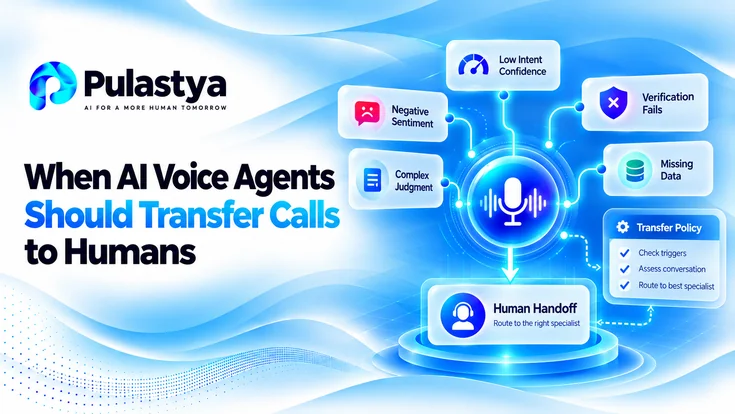
Start with a transfer policy matrix that lists signals, thresholds, actions, and required handoff fields. Signals include intent confidence, verification status, sentiment trends, out-of-policy flags, and missing-data indicators.
For each signal, define whether transfer is mandatory, recommended, or conditional, and whether it should be a warm or cold transfer. A warm transfer briefs the receiver or confirms availability before the caller is connected; a cold transfer sends the live call straight to the destination, with context attached as a screen pop or record note where systems support it.
This matrix becomes your living governance artifact for tuning thresholds and auditing transfer behavior.
Define a compact handoff payload standard: caller ID and tier, verified identity artifacts, last N utterances, detected intents with confidence scores, actions attempted by the agent, relevant account or ticket IDs, and a short recommended next action.
Establish SLAs for how long a human must pick up a transfer and monitor the queue load to prevent cascading delays that defeat the purpose of escalation.
Measure transfer effectiveness with a small set of KPIs: transfer rate by trigger, first-contact resolution after transfer, time-to-resolution post-transfer, customer effort score, and transfer-to-repeat-call ratio. Use these KPIs to close the loop into model retraining and rule changes.
- Create a transfer policy matrix mapping signals to actions and payload requirements.
- Standardize a concise handoff payload to minimize warmup time for humans.
- Track transfer KPIs and feed outcomes back into model and rule tuning.
- Set SLAs for human pickup and monitor queue behavior to avoid transfer delays.
A governance-first transfer matrix and concise handoff payload are essential to efficient, auditable escalations.
Transfer rules are easier to set once the full inbound scope is clear. The overview of inbound AI voice agents shows which calls are usually resolved, captured or transferred.
For calls whose risk changes mid-conversation, see when routine calls become critical; for matching each call to the right team, see routing calls to the right team.
Transfer policy matrix
Transfer Triggers: The Action to Take and the Context to Send
| Trigger | Action | Context to pass |
|---|---|---|
| Low or competing intent confidence | Clarify once, then transfer to the queue for that intent | Last utterances, top intents with scores, filled slots |
| Required identity verification fails | Hard stop: transfer to a cleared verification specialist | Verification attempts, artifacts collected, failed steps |
| Sustained negative sentiment | Transfer to a human agent trained for tense calls | Sentiment timeline and the last actions the AI took |
| Request needs judgment or negotiation | Route to a specialist team with the right authority level | Request details, recommended resolutions, constraints tried |
| Needed data or system access is missing | Transfer to a human with access before the AI loops | Data access failures and record keys for fast lookup |
Each trigger pairs a specific destination with the context that destination needs, so the receiver can act without asking the caller to start over.
Conclusion
AI voice agents should transfer calls to humans when automation can no longer provide a secure, accurate, or satisfactory resolution. Low intent confidence, failed identity verification, rising customer frustration, complex decisions, and unavailable information are key signals that human intervention may be necessary. Clear escalation rules help businesses maintain customer trust while using automation effectively.
A reliable human handoff requires more than identifying the right transfer moment. Businesses should establish risk-based thresholds, route callers to qualified teams, and provide relevant conversation context without exposing unnecessary sensitive information. By continuously measuring transfer success, resolution times, and customer satisfaction, organizations can improve the balance between AI efficiency and human expertise.
Frequently Asked Questions
Identity verification failure should force immediate transfer when that verification is required to complete the transaction. Security and compliance obligations typically outweigh cost savings from automation, so treat verification failure as a hard stop and route callers to a specialist or verification queue.
Calibrate thresholds using production telemetry, combine multiple signals to avoid acting on single noisy indicators, and use confidence windows rather than single-utterance flags. Monitor post-transfer outcomes and iteratively tighten rules where transfers do not materially improve resolution or satisfaction.
Always include caller identity status, last few utterances, detected intents with confidence, actions and retries attempted by the agent, relevant account or ticket IDs, and any policy constraints. A concise recommended next-step reduces warmup time and improves first-contact resolution.
Yes. Design two-way handoffs where humans can route structured tasks back to the AI for execution if appropriate. Ensure the AI receives the full context and a clear task payload to avoid repeating verification and to maintain auditability of the workflow.
Review transfer rules at least monthly for high-volume flows and quarterly for lower-volume ones. Use continual monitoring of transfer KPIs to trigger interim reviews when handoff success or satisfaction metrics degrade.