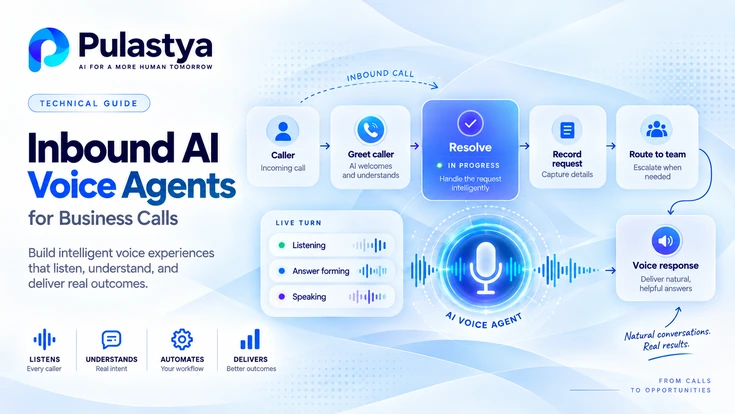
An inbound AI voice agent is software that answers calls coming into a business, understands what each caller needs, and then answers, captures details, routes or transfers the call based on approved rules.
It is for organizations that receive more calls than their teams can answer promptly, or that want consistent intake across locations and hours.
- Natural first response Callers describe their need in their own words and get an answer, a captured request or a transfer.
- Rules you control Call types, routing destinations, capture fields and escalation triggers are defined by the business and reviewable.
- Visible outcomes Transcripts, summaries and call outcomes show what the agent resolved and what reached people.
The business outcome is a prompt, consistent first response for inbound demand, with staff time reserved for calls that need a person. Callers stop queuing for simple answers, and requests reach the team with details already structured.
Inbound voice AI combines several capabilities, from intent classification to analytics. Teams should understand how those capabilities fit together before designing any single part, then use the detailed guide for each one.
What an Inbound AI Voice Agent Does
An inbound AI voice agent handles the first response on calls a business receives: it greets the caller, identifies the request, and resolves, records or routes it. What distinguishes it from the automation a business already has is that it acts inside the call rather than deferring the work to a queue or a message.
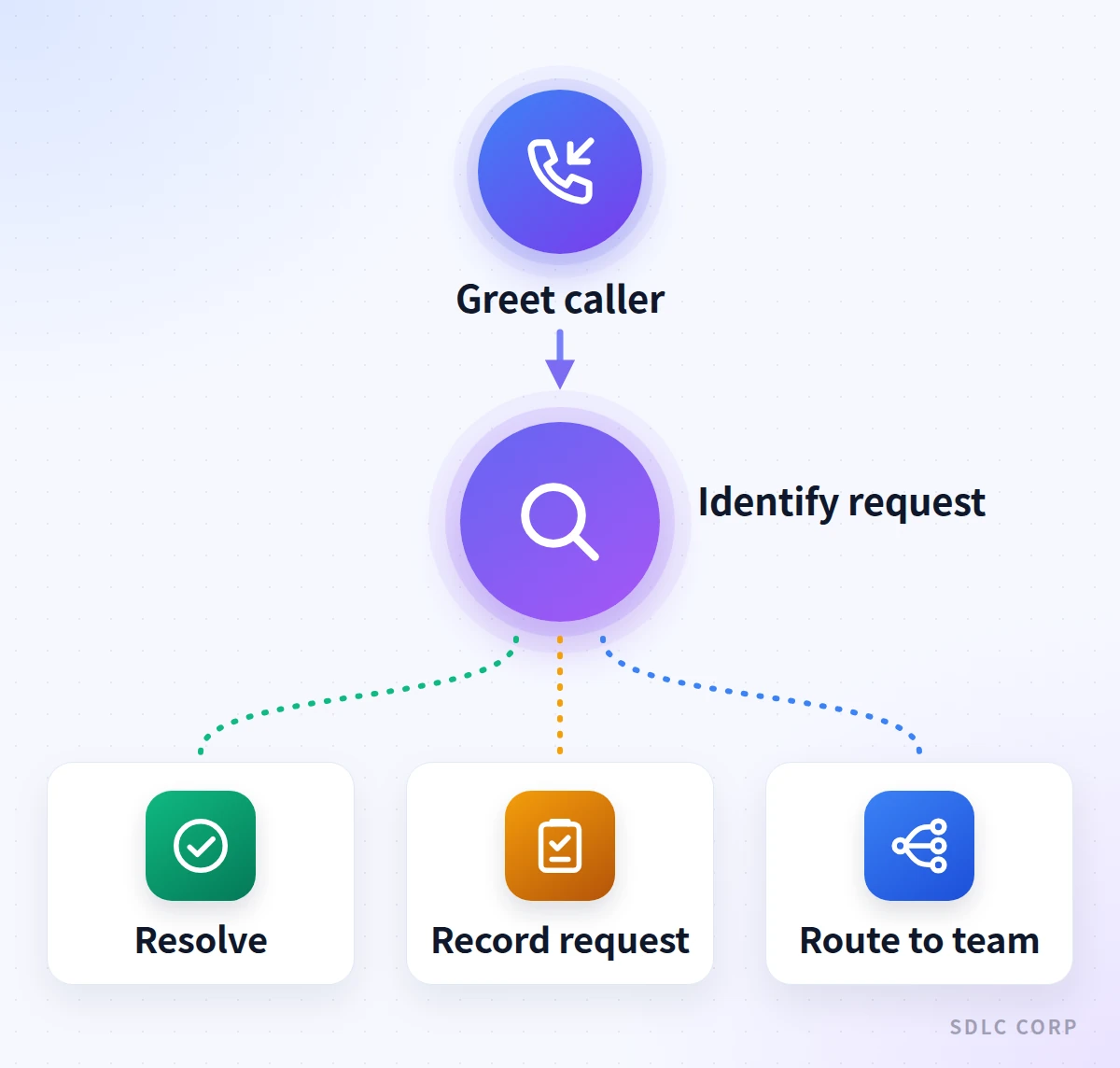
Inbound voice AI sits in front of existing teams rather than replacing them. The unit of deployment is a single phone line. Each line carries its own opening, its own list of recognized request types and its own set of destinations, so two lines in one organization can behave very differently without conflicting.
That is why the first design question is which line you are automating and who owns it. That choice fixes the vocabulary the agent must handle, the material it may quote and the people it may reach. Four kinds of line come up again and again.
A general-purpose line where the agent is the first voice a caller hears. See the AI receptionist for business calls.
A line whose callers hold an account with the business. See the AI voice agent for customer support.
A line whose typical outcome is a change to a calendar. See AI appointment scheduling for business calls.
A line owned by a dispatch or operations team, which acts on the record the call leaves behind.
How Inbound AI Calls Work From Ring to Outcome
An inbound AI call moves through telephony, speech recognition, language understanding, business rules and speech output in a loop until it ends in an answer, a captured request or a transfer. The business number connects the call to the voice agent, which then manages the conversation turn by turn.
- Call connectsThe business number forwards the call to the voice agent, which plays an approved greeting.
- Listen and transcribeThe caller's speech is transcribed as they talk, including interruptions and corrections.
- Understand and decideThe agent classifies the request and selects the rule, content or action for that call type.
- ActIt answers, captures details, routes the call or transfers it to a person.
- Close and recordIt confirms the next step and saves a transcript, summary and outcome.
The intake stage is explained in depth in how AI voice agents automate call intake and routing. Three practical decisions govern how quickly this loop can go live.
The first is the telephony path. Most businesses do not want a new number, so the common approach is to keep the existing one and forward its calls, or point its webhook, at the voice agent. That also makes the change reversible: point the number back and the line behaves exactly as it did before.
The second is which accounts the loop runs on. Telephony and the model layer are separate providers, and on some platforms the organization connects its own accounts for both, which means usage is billed to it directly rather than resold. Settle that before a pilot, because it decides who holds the provider relationship afterwards.
The third is where the loop ends. Every pass through it must finish in a recorded outcome rather than trailing off, because the outcome field is what later reporting counts. A line with no defined outcome for an unrecognized request will record those calls as nothing at all.
Identifying Caller Intent and Answering From Business Knowledge
An inbound AI voice agent first classifies why the person is calling, then answers from approved knowledge or applies the rule for that call type. Both steps depend on definition work from the business: a clear list of call types and the content the agent may use.
Intent classification maps what the caller says to a defined call type, such as a pricing question, a new service request or a complaint. The guide to intent classification in AI voice agents explains how that mapping works and how to design the call types behind it.
Where the classified type calls for an answer rather than an action, the agent draws it from the documents the line has been given. Retrieval-augmented generation for voice agents explains how it finds the right passage and turns it into a spoken answer during a live call.
At this level the decision is inventory rather than wording. List the documents each line may draw on, name an owner for every one of them, and agree the refresh path before launch. A line with no named owner for its material drifts out of date within a quarter, however good the retrieval is.
Then require one behavior explicitly: where the documents do not cover a request, the agent says so and offers a person rather than improvising. That single rule is what keeps every spoken answer traceable to a file a manager can open and edit.
Routing Inbound Calls to the Right Destination
Routing sends each call to the person, team or line that owns the request, based on the classified intent plus business rules such as availability, priority and time of day. Routing rules should be explicit enough that a supervisor can explain why any call went where it did.
Techniques for reducing unnecessary transfers are covered in intelligent call routing. At launch the job is narrower: write down the destination inventory for this line, because a rule can only send a call somewhere that already exists.
- A named individual, reached on one number with nothing queuing behind it.
- A team line, where whoever is free picks the call up.
- An external line owned by a partner, a contractor or an on-call provider.
- A fallback for each of the above, used when the first choice does not answer.
- A failover line that takes the caller directly if the agent itself cannot continue.
The last two are the ones teams leave until after launch and then regret. A destination that goes unanswered and a platform that has stopped serving requests are different failures, and each needs its own written answer.
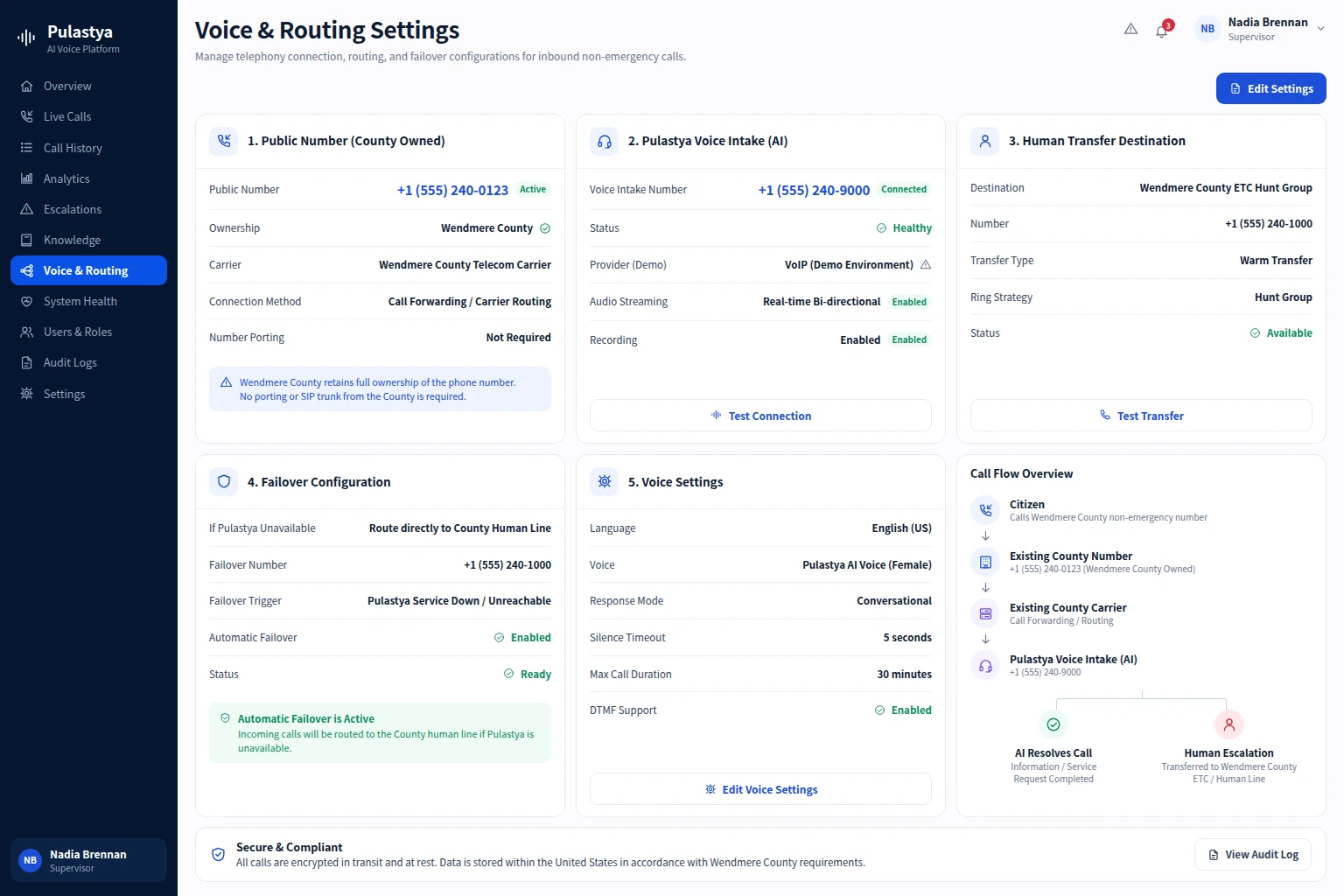
A routing settings screen is where those decisions stop being a diagram and become a configuration.
In Pulastya, SDLC Corp's voice agent platform, the settings shown above hold the voice intake number, a human transfer destination with warm transfer, and a failover line that takes calls directly if the agent cannot continue, which is close to the minimum set any inbound deployment needs before it answers a real call.
How deterministic routing rules are applied to classified intents is described in the AI call intake and routing case study.
Capturing Caller Data, Service Requests and Appointment Requests
Data capture turns a spoken request into structured fields the business can act on, such as contact details, account references, issue descriptions and preferred times. The agent should read critical fields back, because a misheard phone number or address leads to a failed follow-up.
Capture design starts with the minimum fields each request type needs, not a long form read aloud. Methods for extracting and validating spoken details are covered in turning spoken requests into structured data.
Service Requests
A service request is capture that another team has to act on later, which raises the bar on the record itself. Automating service requests and tickets with voice AI explains how captured requests become tickets.
Run capture alongside classification rather than after it, so the field list is chosen by the identified request type. Otherwise every caller is walked through the union of all the fields any request could need.
Appointment Requests
Scheduling calls split on one question: does this line hold write access to the booking system, or only permission to record what the caller wants? Both are workable, and the sibling guide linked above sets out each. At this level you need only to know which of the two you are buying.
Underneath all three, judge captured output by its structure. Values that arrive as named fields can be posted into another system unchanged. The same values embedded in a block of prose must be rekeyed by a person first, which in practice means they often are not. Confirm which form a platform produces before designing the field list.
After-Hours Calls, Escalation and Human Handoff
A line has to behave sensibly at two moments the designer is not watching: when the destinations behind it are unattended, and when the call turns out to need someone the agent cannot substitute for. Both are configuration rather than something the model should decide in the moment.
After-Hours and Overflow Calls
The parent-level question is simply whether the line's hours are a property of the line at all. A line with a clock attached behaves one way during business hours and another outside them, which is a second rule set to write and maintain. The scheduling detail behind that is set out in after-hours call handling.
Escalation and Handoff
Two questions decide this: what causes a handoff, and what travels with it. The conditions themselves are design work covered in When AI voice agents should transfer calls. The payload is a platform property, and it should be confirmed directly rather than assumed.
The difference shows up on the receiving end. A handoff carrying the conversation lets the receiver open where the caller left off. A bare connected call makes the caller start over, which spends most of what the automated opening saved.
Some requests are out of scope for any line, however capable the platform is. Put those exclusions in the line's rules rather than trusting the model to recognize them, keep identity checks on a channel built for that purpose, and remember that call consent and local recording requirements remain the business's own responsibility.
Monitoring Live Calls and Measuring Inbound Performance
Analytics for inbound AI calling show what callers ask for, how calls end and where the agent needs better content or rules. Without that visibility, a team cannot tell whether the agent is resolving calls correctly or transferring and misrouting them.
- Call outcomes: resolved, request captured, transferred or abandoned.
- Top intents, and calls the agent could not classify.
- Transfer reasons, which expose content gaps and rules that fire too often.
- Questions approved content did not answer.
- Sampled transcripts reviewed against approved answers.
Which measures to track and how to read them is covered in AI voice agent metrics that matter. Organizations may set implementation targets, but actual performance depends on call mix, content quality and integration depth.
At a minimum, expect a transcript and a summary for every call, plus a dashboard showing call status, duration and outcome.
A live view of calls in progress is more valuable than it first appears: seeing each call's classification, confidence, language and handling status while it is still running is how a supervisor catches a badly defined call type in the first week rather than the first quarter.
A status distribution read next to the top intents answers the question that matters most in month one, which is whether the agent is resolving the calls it was given or quietly transferring most of them.
What to Check Before Choosing an Inbound AI Voice Agent
Choose an inbound AI voice agent by testing it against your own call mix: your top call reasons, documents, routing destinations and escalation rules. Scripted demos can hide how a system handles interruptions, unclear requests or a failed transfer.
- Telephony: can you keep your existing number, and where do calls go if the AI service is down?
- Grounding: does it answer only from approved content and admit when content is missing?
- Conversation: does it cope with interruptions, pauses and callers who change topic?
- Handoff: does the receiving person get a summary, transcript and transfer reason?
- Visibility: can supervisors review live calls, outcomes and transcripts?
- Cost model: how are telephony, speech and model usage billed?
For a complete scoring framework, use the AI voice agent software evaluation checklist. The matrix below summarizes what the business must provide for each capability before automated inbound calls go live.
Decision guide
Inbound Capabilities and What Each Needs
| Capability | What the business provides | What to verify |
|---|---|---|
| Knowledge answers | Approved, current documents with owners | Agent admits when content is missing |
| Intent and routing | Defined call types and destinations | Misroutes found in transcript reviews |
| Data capture | Minimum required fields per request type | Critical fields read back to callers |
| Escalation and handoff | Transfer triggers and a failover line | Context reaches the receiving person |
| Analytics | Clear definitions of each call outcome | Resolved and transferred trends over time |
Each inbound capability depends on inputs only the business can provide, so readiness should be checked capability by capability.
On conversation quality, ask specifically about barge-in, turn-taking and end-of-speech detection, because those three decide whether a caller who interrupts is heard or overridden, and audition the available voices on your own script rather than on a vendor sample.
On cost, the number that matters is the total per connected minute once telephony, speech synthesis and model usage are added together, so establish which of those you are billed for directly and which are bundled into a single rate.
How to Get Started With an Inbound AI Voice Agent
Start AI inbound call automation with one line and a short list of call types, launch with conservative escalation rules, and expand scope as transcripts show what callers need. A narrow scope is easier to test and makes early problems easier to trace.
- Map inbound call reasonsRank call types by volume and mark which ones need a person, live data or a calendar.
- Define the rulesSet the default action, required fields, destination and escalation triggers for each call type.
- Load approved contentPrepare the documents the agent answers from and assign owners for updates.
- Test before live trafficCover interruptions, unclear requests, after-hours scenarios and failed transfers.
- Launch, monitor and adjustReview outcomes and transcripts, then refine content, call types and routing.
Most platforms follow broadly the same launch sequence: create an account, connect the telephony and model providers the agent will use, load the approved documents, then place a test call from a browser before any real caller reaches the line.
Pulastya is built around that four-step sequence and is aimed at business teams rather than developers. Once your call map is ready, you can review the inbound AI voice agent platform or place a test call in the browser before connecting a live number.
Conclusion
An inbound AI voice agent works best when it follows clearly defined call-handling rules rather than trying to resolve every request. It can greet callers, identify their needs, answer from approved business knowledge, capture structured details, and route calls to the right team. Human handoff, after-hours handling, and failover rules ensure that calls outside its scope still have a reliable next step.
Start with one phone line, a small set of common call types, current knowledge sources, and clear outcomes for every call. Test unclear requests, interruptions, and failed transfers before going live. Then review transcripts, call outcomes, and transfer reasons regularly to refine the setup and expand automation where it adds measurable value.
Frequently Asked Questions
The published number hands the call over, either by forwarding it or by pointing its webhook at the platform. From there the call runs as a loop: speech in, transcription, a decision taken against the rules written for that line, speech out. The loop repeats until it reaches a recorded outcome, and a transcript and summary stay attached to it.
Yes, to whichever destinations the line names: an individual, a team line or an external number. Two further destinations are worth defining at the same time, because they cover different failures. A fallback catches a destination that goes unanswered. A failover line takes the caller directly if the agent itself cannot continue.
Often, depending on the platform and telephony provider. Many platforms forward calls from an existing number, or point that number's webhook to the voice agent, instead of requiring a new number. Keeping the published number is usually preferable, because printed material and directory listings stay valid, and the change can be reversed at any point by pointing that number back to its previous destination.
That is a scope decision taken per line and written down before launch, not left to the model. Mark every recognized request type as resolve, capture or hand over, and set the line's default for anything unrecognized to hand over. A line with an explicit default behaves predictably on the calls no one anticipated.
Track the outcome distribution first: resolved, captured, transferred, abandoned. Read it beside the top intents and the transfer reasons, and sample transcripts against it. Any target set on those measures has to allow for call mix, material quality and integration depth, which is what actually drives the numbers.