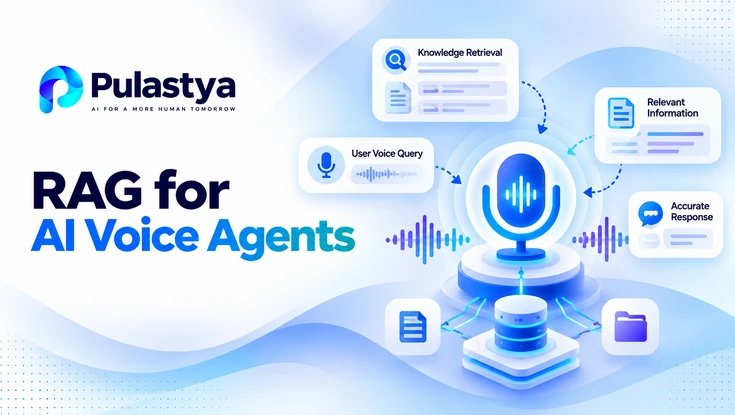
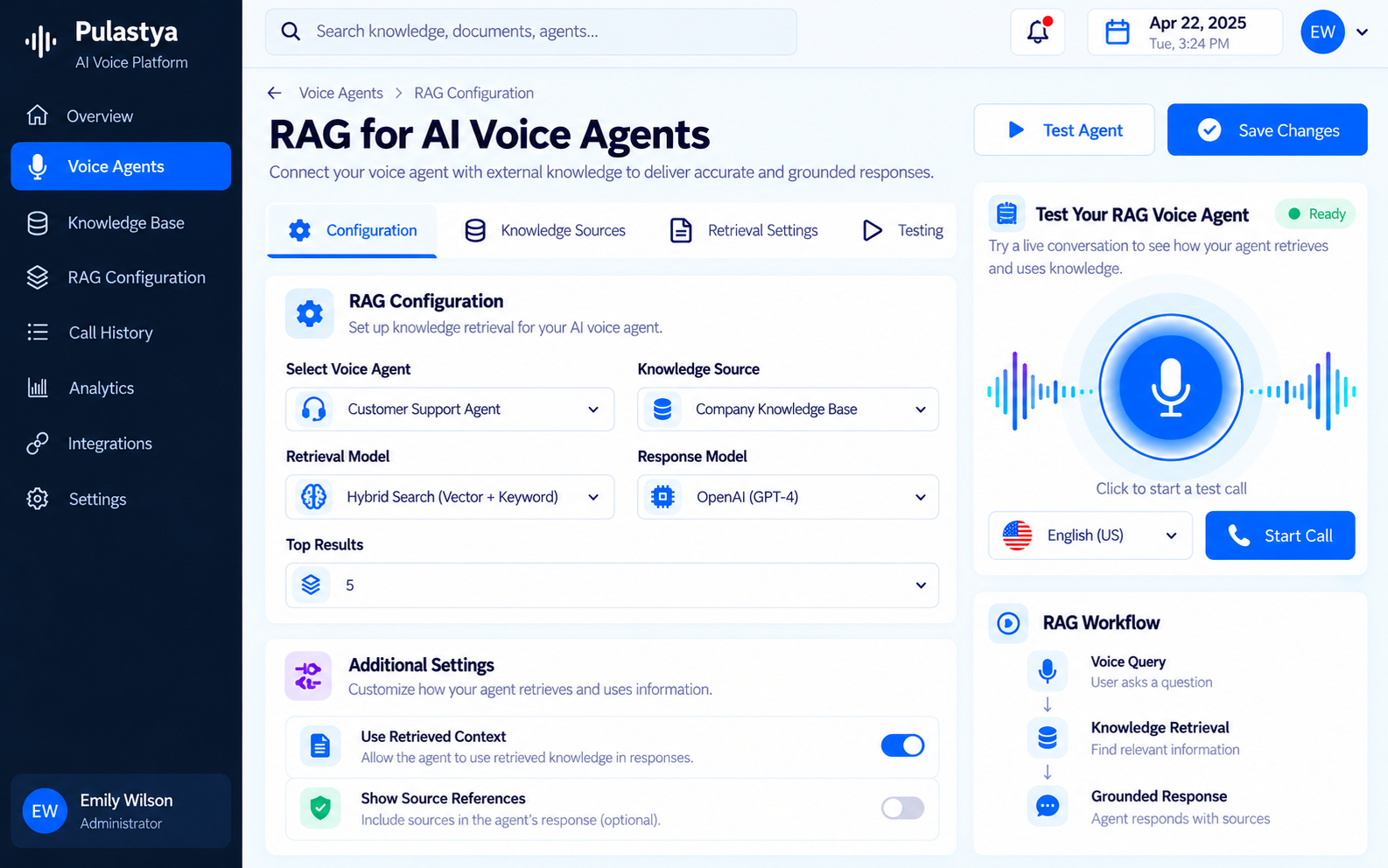
RAG for AI voice agents combines retrieval from curated sources with real-time speech-driven interaction to produce grounded, auditable voice responses.
For enterprise voice systems, RAG brings relevant documents and structured data into the agent response pipeline, reducing hallucination risk and enabling traceable citations across live calls and asynchronous follow ups.
- Ground answers with traceable sources Combine ASR confidence and document citations so every spoken claim references a retrievable source or fallback path.
- Design retrieval for short queries Optimize chunk size, embeddings, and reranking for brief, mis-transcribed voice queries rather than long textual search.
- Control latency under call constraints Use caching, incremental retrieval, and prioritized rerankers to keep response time within conversational thresholds.
Deploying RAG in a voice channel shifts responsibility from the model alone to a managed retrieval and grounding pipeline. That pipeline needs speech-to-text quality controls, targeted search indexes, chunking and embedding strategies built for short utterances, and ranking models tuned to conversational intent.
These engineering choices determine call latency, accuracy, and regulatory compliance for customer interactions.
Architects and product owners who integrate RAG into contact centers and voice assistants face concrete tradeoffs on latency, index design, query engineering, security, and hybrid dialog design. Settling them early yields operational patterns you can use to pilot a retrieval-grounded voice agent that meets enterprise SLAs and auditability requirements.
How RAG Grounds Answers for Live AI Voice Agents
Grounding starts by linking each candidate response to a documented source that an operator or compliance auditor can retrieve. In voice systems you must record that link in the call transcript record, logs, or follow-up messages because spoken citations are cumbersome.
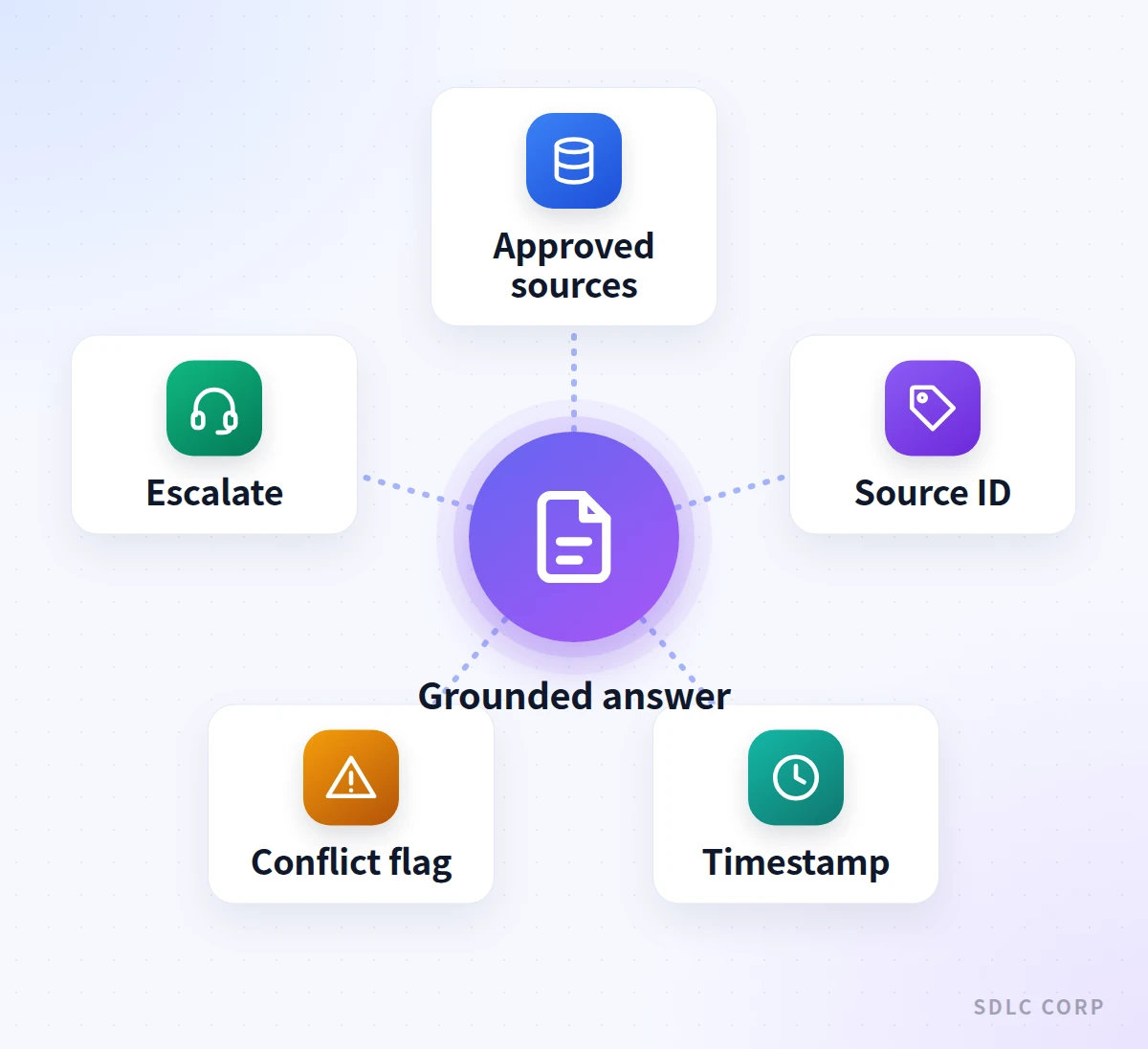
Design the pipeline so the generation step attaches stable source IDs and optional short citations that the call recording platform stores with timestamps.
Choose candidate source sets deliberately: product manuals, contracts, pricing sheets, regulatory guidance, and verified FAQs. Avoid broad web crawls for live voice unless you implement strong freshness and trust signals.
For enterprise agents, an approved source list with metadata tags for document type, effective date, and jurisdiction yields predictable retrieval results and reduces legal risk during agent assertions.
Make grounding visible in the agent behavior: when confidence is low or sources conflict, the voice agent should offer to put the user on hold, transfer to a human, or schedule a follow-up that includes the cited documents in email. That escalation path enforces quality control and preserves the audit trail for post-call review.
- Tag sources with jurisdiction, author, and effective date for fast filtering
- Attach source IDs to every generated answer in transcripts and logs
- Provide both short spoken citations and full document links in follow-up messages
- Implement a conflict flag when top sources disagree on the answer
Treat grounding as an operational requirement, not an optional feature.
How to Design Retrieval Layers for Telephony Contexts
Voice queries are shorter and noisier than text search, so retrieval must compensate with query rewriting and expansion. Rewrite the query using recent utterances and the detected intent, and apply caller profile fields and session state as metadata filters rather than embedding personal data into the search vector.
Keep authoritative documents and conversational knowledge in separate indexes with their own freshness and permission rules. Fetch transactional data such as balances or order status from live APIs at call time instead of indexing it.
Chunking strategy differs for voice: create smaller, coherent chunks that preserve answerable spans rather than long paragraphs.
Embeddings tuned on transcribed speech can improve recall for conversational phrasing; test any embedding model against your own call transcripts. For search speed, maintain a hybrid index that combines a vector store for semantic match and an inverted index for exact-value retrieval like invoice numbers or policy IDs.
Query preprocessing should normalize numbers, dates, and abbreviations from ASR output. Use ASR confidence to trigger reformulation or disambiguation prompts when key entities are uncertain. Design the retrieval API to accept partial queries, enabling incremental lookups while the user continues speaking, and discard results if the final transcript changes the question.
- Keep chunks small and answer-focused to reduce irrelevant matches
- Separate authoritative and conversational indexes; fetch transactional data live
- Tune embeddings on transcribed voice samples for better recall
- Use hybrid vector plus exact-match search for IDs and numeric fields
Optimize indexes and chunking for short, noisy voice queries, not long-form text.
RAG on a live call
From Caller Speech to a Grounded, Logged Voice Answer
- Transcribe with confidenceASR turns speech into text and scores confidence for key entities
- Rewrite the queryNormalize numbers and dates, add recent turns and intent, apply metadata filters
- Retrieve with hybrid searchVector search for meaning plus exact match for IDs across approved sources
- Rerank within the budgetA fast reranker picks the top chunks and flags sources that disagree
- Generate from sources onlyCompose a short spoken reply and log source IDs and document versions
Possible outcomes
- Speak the answerSources agree and confidence is high
- Ask to clarifyA key entity was misheard or uncertain
- Transfer to a humanSources conflict or the intent is high-risk
Notice that confidence and source agreement are checked before anything is spoken, and every answer leaves an audit trail.
How to Manage Latency and Throughput on Calls
Latency is the primary operational constraint for live voice. Design the pipeline with strict budgets: ASR plus retrieval plus generation must fit within the acceptable pause window for your service. Use parallelization: start retrieval while the caller finishes the utterance, and maintain an ASR hypothesis stream so downstream components can act on partial transcripts.
Implement tiered response strategies. For high-confidence retrieval returns under a short latency threshold, generate a final spoken answer. For longer or low-confidence cases, generate a brief interim reply and continue background retrieval, or prompt a clarifying question.
Use small, fast rerankers in the hot path, and reserve expensive cross-encoder rerankers for intents where the latency budget allows or for offline evaluation.
Scale throughput with horizontal replicas of your vector store and lightweight caching for frequent queries and popular documents. Monitor tail latency closely and set thresholds to circuit-break expensive retrievals into fallback deterministic flows, preserving call continuity and SLA adherence.
- Start retrieval on partial ASR transcripts to shave latency
- Use two-stage ranking: a fast reranker live, a heavier one only where budget allows
- Cache common query-document pairs at the edge
- Circuit-break long retrievals into deterministic fallback prompts
Design within conversational latency budgets, and fall back safely rather than trade away grounding for speed.
How to Secure PII During Retrieval and Response
PII protection must be enforced across the retrieval pipeline: data tokenization, storage, index access, retrieval results, and generation. Apply strict redaction rules before indexing and separate raw transcripts from production search indexes. Use field-level encryption for sensitive attributes and role-based access for indexes containing personal data.
During live calls, implement real-time redaction where ASR detects sensitive entity types, and substitute safe placeholders before the text is sent to retrieval or written to logs. Log redacted and full transcripts in separate, access-controlled storage for compliance review rather than mixing them in the same index. Ensure that any citations exposed to customers do not include raw PII.
Audit trails are critical: store retrieval IDs, the exact query, ASR confidence, document version, and the model response used on the call. Build tooling to extract audit packets for regulators or legal discovery quickly, and automate retention policies to meet data governance rules without manual overhead.
- Redact or mask PII before indexing; keep raw transcripts encrypted separately
- Use role-based access and field encryption for sensitive indexes
- Log retrieval IDs, ASR confidences, and document versions for audits
- Automate retention and data deletion per governance policies
Treat redaction and auditability as built-in features, not afterthoughts.
How to Build Contextual Memory and Session State
Maintain a compact session state that combines recent conversational turns, user profile signals, and last-retrieved source IDs. This state should be available to the retriever and the generator as structured metadata so retrieval prioritizes recently referenced documents and the generator can cite the appropriate source. Keep session state size bounded to prevent drift and inexplicable grounding.
Use ephemeral embeddings for session context and persist only verified facts into a longer-term profile store. For transaction continuity, write critical elements like case IDs back to the system of record after the caller confirms them. Provide mechanisms to explicitly flush or correct memory in real time to address user privacy requests and to limit error propagation across sessions.
For enterprise pilots, integrate session state with downstream CRM or ticketing systems so retrieval can surface case histories and approved responses. When returning follow-up material after a call, include the session-derived citations and an excerpt of the source material.
- Store recent turns and last-retrieved source IDs in a bounded session object
- Persist only verified facts to long-term profile stores after confirmation
- Provide real-time memory correction and flush controls to users
- Integrate session state with CRM for consistent cross-channel continuity
Keep session memory small, verifiable, and tied to system-of-record confirmations.
When to Combine RAG With Deterministic Dialog Flows
Merge RAG into deterministic flows for tasks requiring high accuracy or regulated language such as contract terms or billing promises. Use deterministic templates for obligation statements and RAG to supply supporting context or citations. Deterministic flows ensure reproducible outcomes while RAG augments the agent with evidence and clarifications when needed.
Decide routing rules up front: for high-risk intents, prefer deterministic responses or human handoff. For informational intents with low risk, allow RAG to generate grounded answers with attached citations. Implement a policy rule engine that maps intent confidence, ASR quality, and retrieval agreement into a response mode: deterministic, grounded RAG, or human transfer.
Example scenario: a lender's voice agent reads back a quoted mortgage rate and cites the related disclosure document. The rate itself comes from the lending system through an API, deterministic scripting supplies the confirmation language, and RAG pulls the disclosure excerpt.
An escalation rule routes the call to a human when ASR confidence is low or retrieved documents conflict. This hybrid approach preserves legal phrasing while delivering context-rich answers.
- Use deterministic templates for legally sensitive statements and promises
- Route responses by intent risk, ASR confidence, and retrieval agreement
- Allow RAG to populate supporting citations while templates deliver core wording
- Define clear handoff rules to human agents on conflict or low confidence
Use RAG for context and citations, deterministic flows for guarantees and obligations.
Retrieval is only one part of the answer path. The guides to building an AI voice knowledge base and choosing between a knowledge base and a real-time API clarify where evidence should come from.
Grounded retrieval is what lets a support line answer repeat questions safely. See how an voice agent handling support calls combines approved knowledge with service requests and escalation.
For choosing between retrieval, rules and model reasoning, see RAG vs rules vs LLMs in voice AI.
Conclusion
RAG for AI voice agents is most reliable when every spoken answer draws on approved, versioned sources and the retrieval pipeline is designed for the pace of live conversations. ASR-aware query rewriting, hybrid search, fast reranking, and bounded session memory help agents handle short or imperfect transcripts while keeping responses grounded. Recording source IDs and document versions also makes answers easier to trace and review after each call.
For an enterprise rollout, build privacy, latency controls, and escalation into the system from the start. Redact sensitive data, enforce retrieval permissions, and switch to deterministic responses or a human agent when the intent is high-risk, ASR confidence is low, or sources disagree. Pilot with a focused set of approved knowledge, then measure answer accuracy, response latency, fallback rates, and audit completeness before expanding to more use cases.
Frequently Asked Questions
ASR confidence should gate retrieval paths: low confidence triggers disambiguation prompts or constrained retrieval on high-precision fields, while high confidence enables broader semantic search. Track confidence per entity and apply reformulation before heavy retrieval when key identifiers are uncertain.
Look for stores with low tail latency, fast nearest-neighbor search, versioning for documents, and fine-grained access controls. Ability to shard by dataset and hot-key caching for frequent documents is essential for call center throughput.
Persist the full audit packet: original audio, ASR transcript with confidence scores, retrieval query and top candidate IDs, document versions, and the final generated text. That packet demonstrates the grounding trail and supports dispute resolution.
Transfer when retrieval disagreement crosses a policy threshold, ASR confidence on critical entities is low, the intent is high-risk, or when the caller requests escalation. Automate these triggers to maintain SLAs and reduce manual monitoring.